

 Tulisan ini bagian dari sistem kesadaran reflektif
There are times when we want to be close, yet precisely need to give space. Not to leave, disappear, or close the door, but to guard meaning so it does not dissolve into a hurried attachment.
The Center of Meaning
- Distance is not rejection; it is a space for guarding wholeness
- Healthy closeness requires clear boundaries
- Distance trains the ability to be present without possessing
- Mature love gives space; it does not swallow
Distance is the place where the inner life draws breath, orders itself, and chooses again with awareness. In the pause, a person hears more clearly. In silence, one finds again the healthy boundary between being present and losing oneself.
Human beings live between two needs: wanting to be connected and remaining whole. Too close, and one may lose form. Too far, and one may lose direction. Consciousness grows when we learn to weigh both without wounding ourselves or others.
In The System of Silence, distance is not a wall. It is a space of echo. A space so feeling does not rule, and presence does not demand more than what can be guarded.
Distance as a Space of Reflection
We often misunderstand distance. We think it is cold, or a sign of moving away. Yet distance is a way of guarding love so it can still breathe, and of keeping thought from being closed off by the intensity of feeling.
Distance does not extinguish closeness; it makes it clearer. For closeness that is too tight can turn into a grip, and every grip is a form of fear of loss, not mature love.
Consciousness in relationship is born not from always being together, but from the ability to be present without swallowing, give without demanding, and love without binding.
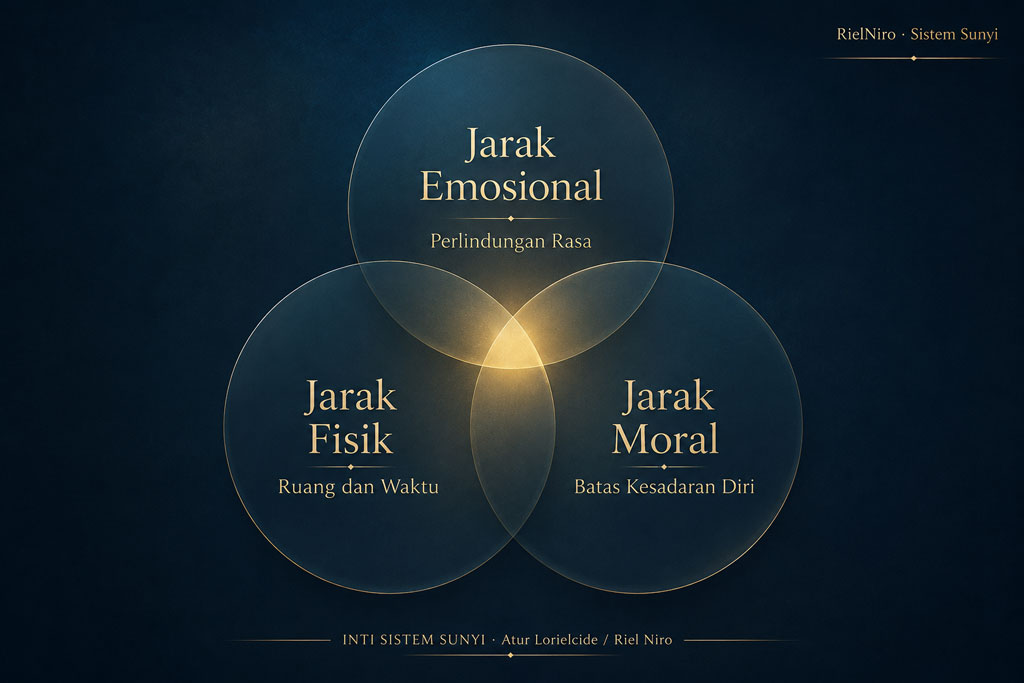
Three Dimensions of Distance
- Physical Distance: Ordering the View
Sometimes the body needs to move so the heart can see more clearly. Longing is not weakness; it is the way meaning tests its firmness. And not everyone who keeps distance is leaving. Sometimes they are preserving space so that presence remains meaningful.
- Emotional Distance: Guarding the Clarity of Feeling
There are times when we hold back reaction not because we are closing ourselves off, but so feeling does not drown reason and dignity. Emotional distance is not a wall; it is a subtle fence that protects the dignity of the inner life and the relationship. Empathy remains alive, but is not carried away by the current until it loses its footing.
- Moral Distance: A Space for Honesty
This is the deepest distance: a boundary guarded by conscience. It ensures that love does not turn into pressure, and attention does not turn into possession.
Keeping moral distance means remaining honest to value, even when feeling pushes us to draw closer than wisdom allows.
Distance and Consciousness
All distance is a practice of consciousness. When we are too close, we easily become reactive. When there is space, we begin to understand.
Distance creates a pause between event and response, and there maturity grows. Not from running away, but from the courage to give space.
In distance, we learn to distinguish:
- longing and gripping
- guarding and controlling
- being silent because of wisdom and being silent because of fear
Distance is not severance. Distance is a way of keeping the form of the self and the form of the relationship healthy.
Closing: A Distance That Brings Near
Those who are truly close do not always cling. They are able to give one another space, so that presence may continue to carry light.
Sometimes stepping away for a while is not loss, but a way of guarding oneself so one can be present more wholly.
And in that space, love grows without forcing, hope remains gentle, and consciousness knows when to draw near or give space, so closeness does not erase the self, but strengthens it.
Tulisan ini merupakan bagian dari Sistem Sunyi, sebuah sistem kesadaran reflektif yang dikembangkan secara mandiri oleh Atur Lorielcide melalui persona batinnya, RielNiro.
Setiap bagian dalam seri ini saling terhubung, membentuk jembatan antara rasa, makna, iman, dan kesadaran yang terus berputar menuju pusat.
Sistem Sunyi lahir dari perjalanan batin manusia, bukan dari mesin atau algoritma. Ia tumbuh dari luka, jeda, doa, dan keberanian untuk diam. Orbit, spiral, dan gema bukan formula buatan, melainkan kosmologi yang muncul dari pengalaman hidup yang jujur.
Untuk memahami asal-usulnya lebih jauh, lihat juga Origin Story Sistem Sunyi: Ruang Orientasi · · · .
Pengutipan sebagian atau keseluruhan isi diperkenankan dengan mencantumkan sumber: RielNiro – TokohIndonesia.com (Sistem Sunyi)
Tulisan Inti: Pengantar
Sistem Sunyi berangkat dari pengalaman manusia dan berusaha memahami bagaimana pengalaman itu berhubungan dengan Rasa, Makna, dan Iman. Pusat, Spiral Kesadaran, dan Empat Orbit membentuk kerangka untuk membaca hubungan tersebut, sekaligus menempatkan pengalaman batin dalam konteks kehidupan yang lebih luas.
Tulisan-tulisan dalam kategori ini memperkenalkan asal-usul, fondasi, dan cara kerja Sistem Sunyi. Pembaca dapat menelusuri kerangkanya tanpa menyamakan peta dengan pengalaman manusia yang hendak dipahami.
Jelajahi berdasarkan kelompok fungsional, atau buka daftar kanonik lengkap untuk melihat seluruh 32 tulisan sesuai urutan sumber.
Jalur berdasarkan fungsi
Kelompok ini merupakan cara lain menjelajahi tulisan, bukan pengganti urutan kanonik.
Fondasi dan orientasi (2 tulisan)
Menjadi gerbang umum yang merangkum arsitektur dan cabang ekosistem; bukan pengganti tulisan khusus tiap konsep.
Origin Story (5 tulisan)
Bagian awal perjalanan naratif yang melahirkan cara membaca Sistem Sunyi.
Mengembangkan pengalaman asal menjadi pembacaan konseptual atas Rasa, Makna, dan Iman.
Menggambarkan pengalaman setelah guncangan sebagai bagian dari perjalanan asal yang ikut membentuk cara Sistem Sunyi membaca pengalaman manusia.
Menandai sikap batin yang tumbuh dari pengalaman asal dan membantu menjelaskan bagaimana seseorang dapat tetap berada dalam perjalanan tanpa harus menjauh dari dirinya sendiri.
Berfungsi sebagai peta naratif bagi fragmen-fragmen Origin Story, bukan sekadar kisah tunggal.
Simbol dan jangkar konseptual (1 tulisan)
Memadatkan pengalaman asal Sistem Sunyi ke dalam lambang konseptual: Shield menjaga pusat tanpa menyerang, Kompas memberi orientasi ketika arah lama runtuh, dan Orbit Pusat menata fragmen agar tidak tercerai. Alur Rasa–Makna–Iman menjadikan tanda ini pengingat asal-usul dan arah pulang, bukan kelanjutan kisah Origin Story.
Fondasi pembacaan manusia (1 tulisan)
Menjadi penjelasan tentang titik mula epistemik dan sikap pembacaan Sistem Sunyi terhadap pengalaman manusia.
Panduan membaca (3 tulisan)
Menetapkan sikap dan batas dasar pembaca ketika memasuki tulisan-tulisan Sistem Sunyi.
Memetakan jalur baca dan memberi orientasi tentang tahap yang dapat ditempuh pembaca. Fungsinya membantu menentukan arah membaca, sementara Atlas memperlihatkan hubungan dan arsitektur Sistem Sunyi.
Berfungsi sebagai gerbang reflektif untuk menentukan apakah dan bagaimana pembaca ingin masuk.
Akses dan orientasi ekosistem (2 tulisan)
Menjadi perangkat pencarian untuk menemukan materi berdasarkan kebutuhan, bukan penjelasan konseptual tentang sistem.
Memperkenalkan simpul navigasi utama yang membantu pembaca menemukan titik masuk sesuai kebutuhan dan menentukan ke mana pembacaan dapat dilanjutkan.
Arsitektur dan keterhubungan Sistem Sunyi (1 tulisan)
Atlas bukan sekadar indeks atau daftar bacaan; fungsi utamanya memperlihatkan hubungan dan arsitektur kesadaran, dengan navigasi sebagai fungsi pendamping.
Posisi dan batas pembacaan (3 tulisan)
Menempatkan Sistem Sunyi dalam perjumpaannya dengan berbagai disiplin dan tradisi pemikiran, sekaligus menjelaskan batas perbandingan agar persinggungan tidak dianggap sebagai kesamaan.
Menyatakan posisi Sistem Sunyi secara langsung, sehingga pembaca dapat memahami pijakan dan batas kerangka ini tanpa harus terlebih dahulu menelusuri perjumpaannya dengan disiplin lain.
Menetapkan batas teologis dan posisi iman dalam Sistem Sunyi agar sunyi tidak diperlakukan sebagai pengganti iman.
Prinsip dan jangkar konseptual (1 tulisan)
Menguraikan hubungan ego, Pusat, dan keutuhan sebagai prinsip konseptual dalam Sistem Sunyi. Pembahasannya berada pada tingkat pemahaman tentang Pusat, bukan sekadar petunjuk untuk kembali ke sana.
Fondasi konseptual (2 tulisan)
Menjelaskan poros utama sistem, bukan peta keseluruhan atau mekanika Spiral secara rinci.
Memperjelas kedudukan Iman, Pengharapan, dan Kasih dalam pembacaan Rasa Sistem Sunyi. Tulisan ini berhubungan dengan Tritunggal Rasa–Makna–Iman, tetapi membahas lapisan nilai dan daya batin yang tidak dapat begitu saja disamakan dengannya.
Mekanika dan model kesadaran (4 tulisan)
Menjelaskan bagaimana struktur batin menjadi gerak: rasa yang dilihat atau ditahan, Resonansi Makna, Gravitasi Iman, Orbit Kebiasaan, Momentum Kesadaran, dan Gradien Sunyi memengaruhi gerak Spiral. Istilah fisika di sini adalah metafora mekanis, bukan klaim ilmiah literal; Spiral membantu membaca perpindahan dari reaktif menuju reflektif tanpa menjadi tangga moral.
Memusatkan perhatian pada dinamika internal Spiral Kesadaran dan prinsip yang menjelaskan geraknya. Fokusnya adalah cara kerja, bukan hanya susunan tahap yang dapat dilihat pada peta Spiral.
Membahas mekanisme spesifik yang dapat menggeser gerak kesadaran kembali ke pola lama.
Memberi model dasar untuk memahami cara kerja Spiral Kesadaran dalam Sistem Sunyi. Tulisan ini menjadi landasan pembacaan mekanisme, sedangkan tulisan-tulisan peta memperlihatkan susunan, lapisan, dan hubungan di dalam arsitekturnya.
Arsitektur dan peta kesadaran (6 tulisan)
Menyatukan arsitektur kesadaran dalam satu peta: Empat Orbit memberi struktur ruang belajar batin, Spiral menunjukkan ritme geraknya, dan gravitasi Iman menjaga arah pulang. Peta ini memperlihatkan hubungan struktur, gerak, dan pusat tanpa mengubahnya menjadi jenjang rohani.
Memperlihatkan susunan besar Empat Orbit dan Spiral dalam satu kerangka, sehingga pembaca dapat melihat hubungan keduanya pada tingkat arsitektur sebelum memasuki uraian mekanisme yang lebih rinci.
Menyajikan gambaran keseluruhan empat lapisan Spiral Kesadaran dalam satu peta, agar susunan lapisan dapat dibaca sebagai bagian dari satu arsitektur.
Memperlihatkan hubungan dua arah gerak batin dalam arsitektur Spiral Kesadaran, dengan perhatian khusus pada relasi yang ditunjukkan oleh model Spiral Ganda.
Memusatkan pembacaan pada lapisan ketiga Spiral Kesadaran sebagai bagian khusus dari keseluruhan arsitektur Spiral.
Memusatkan pembacaan pada lapisan keempat Spiral Kesadaran sebagai bagian khusus dari keseluruhan arsitektur Spiral.
Klarifikasi dan pertanyaan pembaca (1 tulisan)
Berfungsi sebagai rujukan tanya-jawab, bukan urutan utama atau penjelasan tunggal seluruh sistem.
Daftar kanonik lengkap — Pengantar (32 tulisan)
- Tentang Sistem Sunyi
- Dari Sesuatu yang Tidak Selesai
- Rasa, Makna, dan Iman: Membaca yang Tidak Selesai
- Setelah Guncangan
- Tidak Pergi ke Mana-Mana
- Peta Besar Fragmen: Dari Sesuatu yang Tidak Selesai
- Tanda Pusat Sistem Sunyi
- Dari Mana Sistem Sunyi Memulai Membaca Manusia?
- Jalan Menuju Sunyi
- Cara Membaca Sistem Sunyi
- Peta Alur Membaca Sistem Sunyi
- Apakah Sistem Sunyi Cocok untuk Saya?
- Mesin Pencarian Sistem Sunyi
- Tentang Pusat Orientasi Sistem Sunyi
- Membaca Sistem Sunyi Lewat Atlas
- Sistem Sunyi di Persimpangan Disiplin
- Posisi Sistem Sunyi
- Nol yang Menggenapkan
- Sunyi, Iman, dan Jalan Pulang
- Tritunggal Sistem Sunyi: Rasa ↔ Makna ↔ Iman
- Dinamika Batin & Spiral Kesadaran: Zona Mekanisme Sistem Sunyi
- Fisika Spiral Kesadaran
- Orbit Kebiasaan: Lintasan Default dan Tarikan Balik Sistem Sunyi
- Peta Kesadaran Sistem Sunyi
- Rasa Sistem Sunyi: Iman, Pengharapan, Kasih
- Peta Sistem Sunyi: Rangka Kesadaran Empat Orbit
- Spiral Kesadaran: Cara Sistem Sunyi Bekerja
- Peta Spiral Sistem Sunyi – Empat Lapisan Kesadaran
- Peta Spiral Ganda Sistem Sunyi
- Peta Spiral Ketiga Sistem Sunyi
- Peta Spiral Keempat Sistem Sunyi
- F.A.Q. Sistem Sunyi
Tulisan Inti: Penutup
Kategori Penutup memuat tulisan yang memperluas pembacaan Sistem Sunyi ke dalam kehidupan, praktik, dan berbagai bentuk karya. Di sini, kerangka yang telah dikenali bertemu dengan pengalaman yang terus berjalan dan berkembang.
Tulisan-tulisan di dalamnya mencakup perjalanan dan kepulangan, pengembangan cabang ekosistem, medium ekspresi, ruang praktik, hingga cara membaca fenomena. Perbedaan fungsi di antara perangkat, pengalaman, dan bentuk perwujudan tetap menjadi bagian dari peta Sistem Sunyi.
Jelajahi berdasarkan kelompok fungsional, atau buka daftar kanonik lengkap untuk melihat seluruh 19 tulisan sesuai urutan sumber.
Jalur berdasarkan fungsi
Kelompok ini merupakan cara lain menjelajahi tulisan, bukan pengganti urutan kanonik.
Integrasi dan kepulangan (4 tulisan)
Menutup perjalanan inti dengan sintesis arah Sistem Sunyi dan makna pulang.
Mengendapkan perjalanan naratif dan mengembalikan perhatian pada kehidupan yang terus berlangsung setelah cerita selesai. Dalam arsitektur Origin Story, tulisan ini juga menjadi bagian dari perjalanan yang melahirkan cara membaca Sistem Sunyi.
Menekankan keberlanjutan laku setelah sintesis epilog; pulang menjadi cara berjalan, bukan titik akhir.
Menjadi catatan reflektif singkat setelah Epilog dan Coda, dengan fungsi sebagai tambahan penutup, bukan pengulangan sintesis Epilog atau uraian laku setelah pulang dalam Coda.
Asal-usul cabang dan bentuk karya (2 tulisan)
Menjelaskan asal-usul dan fungsi Esai Resonansi sebagai bentuk ekspresi yang tumbuh dari kesadaran dan gema pengalaman dalam ekosistem Sistem Sunyi.
Menempatkan Fraktal sebagai kelanjutan alami dari gema, bukan sistem yang berdiri sendiri.
Dialektika dan penjernihan makna (1 tulisan)
Memperkenalkan dua format Dialektika Sunyi: penjernihan istilah populer melalui cara baca Sistem Sunyi, dan dialog dua arah dengan 24 rumah pemikiran yang tetap membawa sejarah serta rumah konseptual masing-masing. Keduanya menjernihkan perbedaan dan membuka ruang koreksi tanpa penyerapan.
KBDS dan ekosistem istilah (1 tulisan)
Memperkenalkan fungsi, cakupan, dan perkembangan KBDS sebagai perangkat untuk menelusuri istilah serta hubungan makna dalam ekosistem Dialektika Sunyi.
Extreme Distortion: posisi dan batas (1 tulisan)
Menjelaskan hubungan dan perbedaan kedua kerangka agar ED tidak disamakan dengan Sistem Sunyi atau dipahami sebagai sistem terpisah.
Extreme Distortion: mekanika (1 tulisan)
Berfokus pada mekanisme internal ED; berbeda dari tulisan sebelumnya yang terutama membedakan posisi dua kerangka.
Pengamatan dan pembacaan fenomena (2 tulisan)
Memperkenalkan ruang observasi untuk mencatat dan membaca jejak yang ditemukan di luar ekosistem formal Sistem Sunyi, tanpa langsung menempatkannya sebagai bagian dari perangkat internal ekosistem.
Memperkenalkan praktik membaca fenomena secara langsung melalui pendekatan Sistem Sunyi. Fokusnya adalah proses pembacaan itu sendiri, bukan pencatatan jejak yang ditemukan di luar ekosistem formal.
Medium ekspresi dan resonansi (1 tulisan)
Memperkenalkan musik sebagai ruang ekspresi dan resonansi dalam ekosistem Sistem Sunyi, serta menjelaskan kedudukan Jejak Sunyi dalam Musik di antara bentuk-bentuk karya dan pembacaan lainnya.
Praktik dan penghayatan (2 tulisan)
Menjelaskan Ruang Praktik sebagai ruang penghayatan dan penerapan Sistem Sunyi, sehingga pembaca dapat membedakan pengalaman praktik dari penjelasan konseptual tentang sistem.
Memperkenalkan Litani Sunyi sebagai bentuk khusus praktik sunyi yang berpusat pada satu napas untuk kembali ke Pusat, sekaligus menjelaskan batas maknanya dalam ekosistem Sistem Sunyi.
Medium visual dan naratif (3 tulisan)
Memperkenalkan infografik sebagai bentuk visualisasi konsep Sistem Sunyi yang membantu pembaca melihat susunan atau hubungan gagasan melalui representasi visual.
Memperkenalkan komik sebagai bentuk naratif visual yang membawa pengalaman manusia ke dalam cerita, sehingga gagasan Sistem Sunyi dapat dijumpai melalui pengalaman yang dituturkan.
Memperkenalkan wallpaper dan koleksi visual sebagai bentuk pengingat serta resonansi visual dalam keseharian, dengan fungsi yang berbeda dari infografik yang memvisualisasikan konsep dan komik yang menyampaikan pengalaman melalui narasi.
Manusia, karya, dan perwujudan (1 tulisan)
Memperlihatkan hubungan antara kerangka Sistem Sunyi, sosok RielNiro, dan karya yang tumbuh di dalam orbitnya, tanpa menjadikan sosok atau karyanya sebagai pusat dari keseluruhan sistem.
Daftar kanonik lengkap — Penutup (19 tulisan)
- Epilog Sistem Sunyi: Pulang ke Pusat
- Sesudah Semua Cerita
- Asal Muasal Esai Resonansi: Dari Kesadaran ke Gema
- Awal Mula Seri Fraktal: Dari Gema ke Pola
- Mengenal Dialektika Sunyi
- Tentang Kamus Besar Dialektika Sunyi (KBDS)
- Tentang Extreme Distortion vs Sistem Sunyi
- Mekanika Extreme Distortion
- Tentang Jejak Sunyi di Luar
- Apa Itu Pembacaan Sunyi
- Apa Itu Jejak Sunyi dalam Musik
- Tentang Ruang Praktik Sistem Sunyi
- Litani Sunyi: Satu Napas untuk Kembali ke Pusat
- Tentang Infografik Sistem Sunyi
- Tentang Komik Sistem Sunyi
- Tentang Wallpaper & Koleksi Visual Sistem Sunyi
- Coda Sistem Sunyi: Menjaga Keheningan Setelah Pulang
- RielNiro dan Orbit Sunyi
- Postscript Sistem Sunyi
Tulisan Inti: Studi Kasus
Studi Kasus membawa pembacaan Sistem Sunyi ke dalam pengalaman konkret. Fokusnya bukan menyederhanakan pengalaman menjadi rumus, melainkan mengikuti bagaimana rasa muncul, bagaimana makna mulai terbaca, dan bagaimana seseorang dapat menemukan kembali arah ketika berhadapan dengan kehilangan, kehampaan, atau kegagalan.
Ketiga tulisan dalam kategori ini bergerak melalui pengalaman yang berbeda: belajar mendengar setelah kehilangan, menghadapi hidup yang tampak penuh tetapi tidak terasa hidup, dan menemukan kemungkinan jalan pulang setelah jatuh. Pengalaman-pengalaman tersebut menjadi bahan pembacaan, bukan diagnosis atau resep yang berlaku sama bagi setiap orang. Sistem Sunyi hadir sebagai cara untuk memperhatikan apa yang sedang dialami dan membuka ruang bagi pemahaman yang tumbuh dari dalam pengalaman itu sendiri.
Daftar berikut memuat tiga tulisan inti kategori Studi Kasus.
Tulisan ini membawa pembacaan Rasa, Makna, dan Iman ke dalam pengalaman kehilangan. Duka tidak segera ditutup oleh penjelasan; rasa diberi ruang untuk didengar, makna tumbuh melalui perubahan bentuk kehadiran, dan iman menjaga arah ketika jawaban belum ditemukan.
Tulisan ini mempertemukan cara membaca Sistem Sunyi dengan kehampaan yang dapat muncul ketika kehidupan terus berjalan, tetapi tidak lagi terasa hidup. Fokusnya adalah jarak antara kepenuhan aktivitas dan kehadiran batin, serta kemungkinan mendengarkan kembali pengalaman yang selama ini tertutup oleh kesibukan.
Tulisan ini membawa pembacaan Sistem Sunyi ke dalam pengalaman kegagalan dan kemungkinan kembali ke Pusat. Jatuh membuka ruang untuk meninjau ulang cara seseorang memahami dirinya dan arah hidupnya, tanpa menjadikan kegagalan sebagai jaminan pertumbuhan atau keharusan untuk segera menemukan hikmah.
Atur Lorielcide berjalan di antara kata dan keheningan.
Ia menulis untuk menjaga gerak batin tetap terhubung dengan pusatnya.
Melalui Sistem Sunyi, ia mencoba memetakan cara pulang tanpa tergesa.
Lorong Kata adalah tempat ia belajar mendengar yang tak terlihat.
Baca juga: Dua Ruang, Satu Sunyi: Jejak Atur Lorielcide alias Rielniro