
 Tulisan ini bagian dari sistem kesadaran reflektif
Human beings are not always masters in the house of their own inner lives. Parts of the self speak through dreams, reactions, shadows, attractions, refusals, and symbols before thought can explain them.
Human beings often assume that they know the reasons for their actions. They call a decision principle when fear is working beneath it. They regard rejection as objective judgment when something within them feels threatened. They become unusually drawn to a person, symbol, idea, or community, and only afterward find language to justify the attraction. There are also times when dreams, fantasy, anger, shame, or recurring patterns reveal that inner life is not wholly under the control of the ego.
Jungian Thought enters this territory with a fundamental suspicion: human consciousness is not the whole psyche.
What the ego knows is only part of inner life. Beyond what is easily recognized lie memories, drives, patterns, images, complexes, and symbolic tendencies that can influence how human beings see the world. Jung described part of this territory as the personal unconscious and developed the broader ideas of the collective unconscious and archetypes.
An affinity with this territory can also be found in The System of Silence. It reads echoes, distortions, patterns, resonance, inner voices, gravity, and movements that cannot always be explained immediately. Yet similarity of language does not mean identity of theory. The Theory of Inner Echo concerns reverberations of experience in awareness, not the collective unconscious. The System of Silence Model (MSS) orders emotion, morality, and spirituality, but does not claim that the psyche is objectively arranged according to Jungian archetypes.
This difference matters so that the language of The System of Silence does not become another secret dictionary. Echo, center, orbit, and gravity are interpretive tools that must remain open to correction from body, relationship, fact, and other traditions.
Their encounter matters precisely because both are vulnerable to misuse. The language of depth can make human beings more honest, but it can also make them feel exceptional. Symbols can open layers of meaning, but may also be used to evade facts. Shadow can be recognized, but also turned into a justification for destructive impulses. Numinous experience can enlarge life, but can become metaphysical certainty immune to correction.
This essay preserves Jungian Thought as an independent psychological and hermeneutic tradition. The System of Silence appears as a dialogical partner learning from its precision concerning projection, persona, complex, symbol, and the numinous, while testing every reading through ethics, power, body, relationship, work, faith, and embodied life.
Jungian Thought Is Not a Secret Dictionary of the Psyche
Popular culture often presents Jungian thought as a set of codes capable of explaining human beings quickly. Dreams are assumed to have fixed meanings. Archetypes are used like personality types. Shadow work becomes an exercise in finding one’s dark side. Synchronicity becomes evidence that the universe is sending personal messages.
The simplification is attractive because it creates the feeling that inner life can be read immediately. Yet it contradicts the complexity of Jung’s own thought.
A symbol is not a sign with one translation. It appears precisely where meaning cannot be exhausted by direct explanation. Dreams do not have a universal dictionary that always applies. Shadow is not a box of negative traits that merely need to be “accepted.” Individuation is not an individualistic project of becoming the best version of oneself.
Jungian Thought is closer to a dialogue with parts of the psyche not governed by the ego. It demands a willingness not to know immediately, to distinguish image from fact, and to acknowledge that interpretation always carries risk.
The System of Silence needs the same discipline. Because it is rich in symbolic language, it may be tempted to make terms such as center, echo, gravity, orbit, or Returning Home into final explanations. Yet these terms may also function as symbols that assist interpretation, rather than evidence that the psyche is objectively structured in exactly that way.
An Original Home: Analytical Psychology and a Complicated History
C. G. Jung developed analytical psychology after separating from Sigmund Freud. Their differences concerned not only a personal relationship, but also the meaning of libido, the unconscious, religion, myth, symbol, and the aim of psychotherapy.
Jung accepted the importance of the personal unconscious and past experience, but extended attention toward symbolic patterns that he believed did not arise only from individual history. He developed the ideas of complexes, persona, shadow, anima and animus, Self, archetypes, the collective unconscious, and individuation.
This legacy has had wide influence in psychotherapy, religious studies, literature, art, culture, and thinking about symbols. Yet some Jungian claims are difficult to test empirically, some of Jung’s language is highly speculative, and several formulations concerning gender, race, culture, and sexuality reflect limitations of his era and assumptions that require criticism.
Acknowledging these limits does not mean that all of Jung must be discarded. It means that Jungian Thought should be treated as a rich, influential, and contested tradition, not as a final scientific map of the human psyche.
A similar responsibility applies to the language of The System of Silence itself. A reflective system does not become strong by eliminating criticism. It matures by distinguishing working metaphors, psychological hypotheses, convictions of faith, and claims that require evidence.
The Ego Is Not the Whole Self
In Jungian thought, the ego is the center of consciousness, but not the whole psyche. It organizes continuity of identity: the “I” that remembers, chooses, evaluates, and acts. Yet the ego may mistakenly assume that it is the whole house.
When the ego becomes too dominant, what does not fit the conscious image may be repressed, projected, or return through symptoms. Conversely, when the ego is too weak in relation to unconscious contents, human beings may be swept away by fantasy, complexes, or symbolic experience without sufficient distance to evaluate them.
Health is not the elimination of the ego. Nor is it the surrender of the ego to depth. The work is to build a more conscious relationship between the ego and the wider psyche.
The System of Silence reads this tension through the relationship between awareness, the center of orientation, and wider movement. Yet it must preserve one distinction: the center in The System of Silence is not an automatic equivalent of the Jungian Self. The two possess different histories, structures, and conceptual responsibilities.
What can be learned is humility: the loudest voice within is not necessarily the truest, and what remains unconscious can still direct a life.
Persona and the Price of Being Accepted
Persona is the social face that enables human beings to function in the world. It is not merely a lie. Teachers, leaders, parents, writers, physicians, and workers need forms of conduct appropriate to their roles.
The problem appears when the ego identifies completely with persona. A person begins to believe that worth depends on preserving an image. They become the strong person who must never need. The wise person who must never be confused. The spiritual person who must never be angry. The helper who is not allowed to become tired.
Parts of life that do not fit the persona are then moved into darkness. Exhaustion becomes resentment. Need becomes shame. Ambition is disguised as calling. The desire for recognition is wrapped in the language of service.
The same risk of persona does not stop outside The System of Silence. The language of silence can become an image of calm. Humility can become a subtle way of appearing deeper. The authorial position can become the persona of someone who always knows how to read the inner life.
Reading persona is therefore not an attempt to discard roles. It is a question about the price paid to keep a role intact and which parts of the self must disappear so that the image does not crack.
Shadow Is Not Only the Evil Side
Shadow is often understood as the dark side: anger, envy, aggression, greed, desire, and motives one does not wish to acknowledge. This is partly true, but too narrow.
Shadow may also contain life rejected because it does not fit the environment or persona. Tenderness may become shadow for someone raised to remain hard. Courage may become shadow for someone permitted only to obey. Creativity may be discarded as useless. The capacity to enjoy life may be suppressed by an identity built around sacrifice.
Encountering shadow therefore does not merely mean admitting negative traits. It may also mean recovering life energy once exiled.
Integrating shadow, however, does not mean obeying every impulse. Recognizing aggression does not justify violence. Becoming aware of envy does not grant the right to destroy. Accepting desire does not abolish consent and boundaries.
Jung regarded the recognition of shadow as a moral problem. This matters. Shadow work without ethics merely expands the language of self without expanding responsibility.
Shadow, in the reading of The System of Silence, lives in body and relationship. It is revealed not only through symbols, but through the treatment of those with less power, responses to criticism, the use of authority, and the stories told about disliked people.
Projection: When a Part of the Self Appears as Another Person
Projection occurs when inner content that has not been recognized is experienced as though it comes entirely from outside. Human beings see a quality, intention, or force in another person while part of the energy of judgment arises within themselves.
Projection does not mean that the other person has no real qualities. Someone may indeed be manipulative, attractive, dangerous, or admirable. The question is why a particular response becomes so large, absolute, or disproportionate.
A person may hate another’s arrogance because arrogance also lives within. They may worship someone because of courage they have not dared to possess. They may regard a figure as savior because the need for protection has no conscious place.
Projection turns relationship into a screen. The other person is no longer seen as a person, but as a place where the psyche stages its story.
Through resonance and distortion, The System of Silence stands close to this reading. Yet it must ensure that projection is not used to invalidate criticism. Saying “that is only your projection” can become a way of avoiding real responsibility.
Mature reading holds two possibilities at once: something outside may truly be happening, and our inner response may carry additional weight.
Complex: The Inner Part That Takes Over
A complex is not merely a problem or wound. In analytical psychology, it refers to a cluster of emotion, memory, image, and belief organized around a theme. When a complex is activated, a person may feel as though a particular part has taken over.
Someone usually calm becomes suddenly small under criticism. A rational person loses proportion when feeling ignored. A confident leader overreacts to correction because an older experience of humiliation becomes alive again.
Complexes possess a degree of relative autonomy. They are not separate beings, but the subjective experience can feel that way. Human beings say, “I do not know why I reacted like that.”
Jungian Thought helps reveal that reactions do not always arise from the present situation alone. Yet the language of complex must not become an excuse. Knowing that a part has been activated should widen choice, not erase consequences.
The System of Silence reads a complex as a high-gravity pattern. Once activated, it pulls feeling, thought, body, and interpretation into its orbit. Moving out requires distance, pattern recognition, bodily regulation, and relationships safe enough for the person not to become completely fused with that part.
Dreams and Symbols without a Universal Dictionary
Dreams hold an important place in the Jungian tradition because they are understood as one way the psyche presents something consciousness has not yet reached.
A dream, however, is not an objective report, automatic prophecy, or message translated through a list of fixed meanings. A snake does not always mean the same thing. Houses, water, death, children, forests, and journeys gain meaning through the person’s life, personal associations, culture, and the pattern of the dream itself.
A symbol differs from a code. A code has an assigned translation. A symbol retains an excess of meaning. It points toward something that cannot yet be fully summarized.
Working with dreams therefore requires patience. What is felt? How does the image relate to present life? Which aspects are personal, cultural, religious, or archetypal? Which interpretation offers certainty too quickly?
The System of Silence receives dreams as material for reading, not as authority. Dreams may reveal conflict, feeling, or symbols that deserve attention. Yet public decisions, accusations, and actions affecting others still require facts, consent, and ethical judgment.
Archetypes: Patterns That Open Meaning or Claims That Overreach?
Archetype is among Jung’s most influential and disputed ideas. Jung did not understand archetypes as ready-made images, but as basic patterns that take form through myths, dreams, religions, stories, and human experience.
The idea helps explain why certain themes recur across cultures: mother, hero, journey, death, rebirth, trickster, sacrifice, shadow, and wholeness.
Similarity, however, does not always prove a universal psychic source. Motifs may spread through history, biological needs, social structure, or shared human conditions. Archetypal readings therefore need to be distinguished from stronger empirical claims.
Archetypes are useful as hermeneutic lenses when they open questions. They become dangerous when they close context. Calling someone “the mother archetype,” “warrior,” or “trickster” may erase concrete history, culture, gender, and agency.
The language of large patterns also appears within The System of Silence. The same risk must be read: poetic and powerful terms easily acquire more authority than the evidence they can bear.
Anima and Animus: A Legacy That Requires Re-reading
Jung used anima and animus to discuss inner dimensions associated with the feminine in men and the masculine in women. The ideas were influential in the history of analytical psychology, but their original formulation remains deeply tied to binary gender divisions and particular cultural assumptions.
A contemporary reading cannot repeat them without criticism. Sensitivity, rationality, receptivity, assertiveness, imagination, and agency do not belong biologically to one gender.
What may remain is a broader question: which qualities has a person discarded because social identity did not permit them? Which parts then return through projection onto a partner or ideal figure?
The System of Silence chooses to read this territory through inner polarities not fixed to gender. Human beings may develop the capacities to receive and act, listen and assert, care and set boundaries, without forcing them into a rigid masculine-feminine scheme.
A humble dialogue need not preserve every inherited term. It can honor history while acknowledging what needs revision.
Individuation Is Not a Project of Perfection
Individuation is often misunderstood as becoming the most unique, conscious, or complete version of oneself. In popular form, it can become an endless project of self-development.
Within Jungian Thought, individuation is closer to a process of differentiation and integration: the ego learns to relate to parts of the psyche that have remained unrecognized, without imagining itself to be the whole and without being swallowed by the unconscious.
Wholeness does not mean the resolution of every conflict. It is not harmony without fracture. It is the capacity to bear tension among different parts without exiling one of them or surrendering control completely.
Individuation is also not individualism. Human beings do not become themselves outside relationship, culture, community, and responsibility. An inner journey indifferent to its effects on others merely produces a more elaborate ego.
This understanding of wholeness resonates with The System of Silence. Yet embodied life remains the test. Does inner reading make human beings more honest, more able to establish boundaries, more responsible in work, more present in love, and more willing to receive correction?
Wholeness experienced only in imagination has not yet become a way of life.
Numinous Experience, Faith, and the Risk of Inflation
Jung gave considerable attention to numinous experience: experiences carrying a sense of power, mystery, awe, or presence beyond the ego.
Such experiences can transform life. They may arise in prayer, dreams, art, nature, crisis, or religious symbols. Yet intensity does not automatically determine source.
In Jungian language, inflation occurs when the ego identifies with archetypal content or overwhelming experience. A person begins to feel entrusted with a special mission, hidden knowledge, or unique access to transcendent reality.
Within the language of faith and inner voices, The System of Silence recognizes a similar risk. A profound experience may be grace, yet it still needs to be distinguished from the need to feel special, compensation for wounds, or the desire for authority.
Faith need not reduce numinous experience to psychology. Yet faith must not use the intensity of experience as final proof. Discernment must attend to facts, ethics, humility, time, community, and consequences for the freedom of others.
When Symbols Become an Escape from Reality
Symbolic language can give form to suffering. It can also move human beings away from realities that need to be faced directly.
Domestic violence is described as an encounter with shadow. Illness becomes a message from the soul. Poverty is read as a phase of transformation. Workplace conflict becomes an archetypal drama between hero and tyrant.
Such readings may offer one layer of meaning, but become dangerous when they replace facts. Violence requires safety. Illness requires examination. Injustice requires change. Trauma requires appropriate support.
The System of Silence places symbol beside reality, not above it. Meaning may grow, but must not make mechanism, body, power, and responsibility disappear.
What Jungian Thought Demands of The System of Silence
Jungian Thought tests The System of Silence precisely through the language it uses. A system that speaks of the Center, Echo, the Orbits, and faith can still carry the projections of its creator, the needs of its community, or the desire of its readers to find an order that is too neat. Terms born from deep experience may feel universal because they are deeply convincing to the person who encounters them, but inward conviction does not automatically become an objective structure for all human beings.
For this reason, The System of Silence must continue to distinguish among originating experience, interpretive metaphor, and claims about reality. Epistemic humility is not a weakness of the system. It serves as a safeguard against allowing personal experience to gradually become universal law.
The language of Silence can also generate a persona of its own. Calmness, clarity, and centeredness can easily become valued social identities. A person may learn to appear quiet while concealing anger, need, ambition, or fear that does not fit the image. The Aesthetics of Inner Discipline therefore needs to remain open to testing so that calmness does not become performance. Mature Silence is recognized not by style, but by the capacity to receive correction, acknowledge conflict, and act responsibly.
A similar issue arises with symbols. Echo, gravity, the Center, home, and Returning Home can open experience without having to be treated as literal descriptions of the structure of the psyche. Here, Jungian Thought helps keep symbols alive: a symbol expands the possibilities of interpretation precisely because it is not forced into becoming an anatomy of inner life.
Conflict, too, does not always need to be treated immediately as a disturbance that must be resolved. In a Jungian frame, parts of the self that unsettle the conscious image may sometimes serve a compensatory function. Anger can correct excessive compliance, envy can reveal a denied desire, and doubt can keep faith from hardening into false certainty. The System of Silence Model (MSS) therefore does not need to settle every tension too quickly, as though emotion, morality, and spirituality must immediately fall into alignment.
Compensation, of course, does not mean that every conflict carries a hidden message that should be obeyed. It simply opens the possibility that something outside awareness may be counterbalancing an overly one-sided conscious stance. Anger can reveal a boundary that has been ignored for too long, doubt can restrain faith from false certainty, and envy can reveal a form of life that has not yet been given room. All of these still need to be read, tested, and situated within the wider life of the person.
The final challenge concerns the meaning of wholeness. Returning Home to the Center can be misunderstood as a return to the most comfortable part of the self, whereas individuation requires a relationship with what has been rejected, projected, or excluded from one’s self-image. In the language of The System of Silence, wholeness is not a condition without conflict. It is the capacity to hold difference without allowing one part to take over the whole of life.
What The System of Silence Adds to the Reading of Psychic Depth
Recognizing that the ego is not the whole self opens the way to a deeper reading, but The System of Silence does not stop at psychic depth itself. Interpretations of the unconscious still need to be tested through the body, relationships, ethics, power, work, and faith. Depth does not gain privileged status simply because it feels mysterious.
For this reason, the shadow cannot be read merely as an inward conflict standing on its own. Not every tension is a symmetrical projection between two sides. There are perpetrators and victims, superiors and subordinates, majorities and minorities. The language of shadow must not be used to blur inequality or relocate the responsibility of the perpetrator into the inner life of the victim. The relational Orbit, The Psychology of Distance, and The Ethics of Feeling keep the reading attentive to position, boundaries, and concrete consequences.
A complex also needs to be returned to the body. It is not only a cluster of meanings, but may appear as tension, freezing, sudden impulses, shifts in tone of voice, or a narrowing of the capacity to choose. The psychospiritual Orbit reminds us that symbolic dialogue may at times need to proceed alongside regulation, safety, care, and new relational experiences.
The relative autonomy of a complex does not mean that a separate being exists within the self. The term points instead to the force of an inner configuration that, when activated, can narrow attention and the capacity to choose. Symbolic reading therefore needs to remain in contact with the language of the body, safety, and regulation, so that depth does not turn into mythology about what is actually taking place.
Symbols, too, need to return to life. Dreams, images, and interpretations can open understanding, but their value does not end with their power to fascinate. They still need to be tested through the way a person works, speaks, sets boundaries, sustains relationships, and treats others. Orbit III resists a depth that merely adds more stories about the self. Interpretation needs to produce change that can actually be inhabited.
The same distinction applies to numinous experience. Psychological intensity can carry powerful spiritual force, but it does not automatically prove divine origin. The System of Silence maintains a distinction among experience, interpretation, and belief so that none of them substitutes for the others. Faith as Gravity is therefore tested through humility, love, freedom, and responsibility, not merely through the force of symbols or synchronicity.
Wholeness, finally, does not always mean bringing everything together. Some parts need to be accepted, some need to be bounded, and some relationships need to end. Not every contradiction must be dissolved into harmony. The Inner Fence Phenomenon makes room for a form of wholeness that preserves differentiation. The psyche may become more whole precisely when it is able to say no to impulses, figures, or communities that cause harm.
When depth becomes a mythology of the self
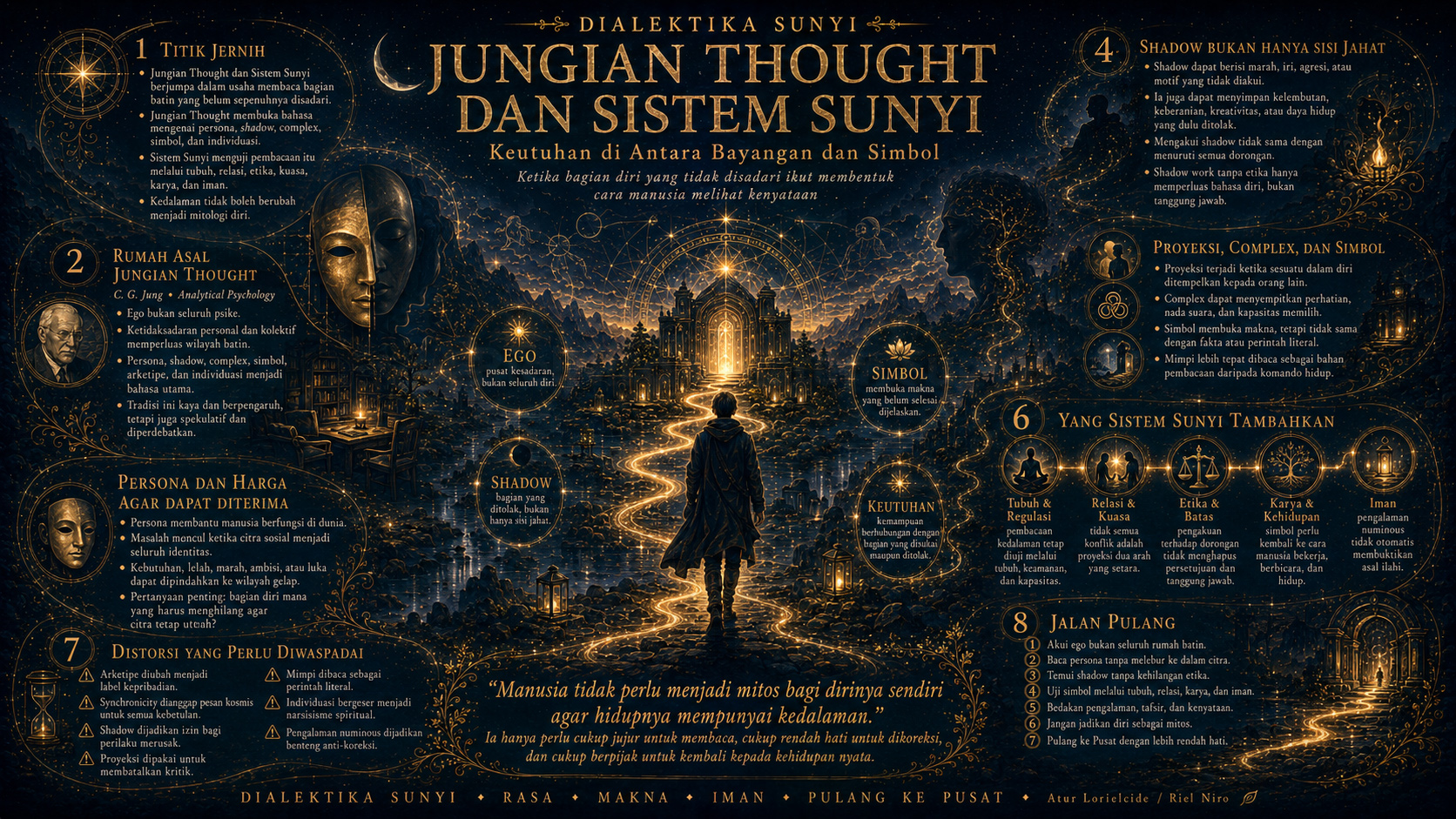
Jungian language and The System of Silence can both bring greater depth to the reading of human life. Yet depth can easily turn into a mythology of the self when terms meant to open space are instead used to close questions, legitimize impulses, or turn interpretation into identity. The following distortions show several ways this shift can occur.
Archetypes lose their interpretive power when they harden into personality types. Calling someone “the hero” or “the archetypal mother” can make history, context, and the complexity of a life disappear behind a single image. A symbol that should open interpretation becomes a stereotype instead. Archetypes are more useful as lenses for inquiry than as stamps of identity.
A similar problem appears when every attraction or coincidence is immediately read as synchronicity. Not every event carries a cosmic message. Some events are simply coincidental, some arise from psychological patterns, and others are experienced as meaningful coincidences. When every encounter is given mystical weight, the capacity to discern gradually erodes. Synchronicity needs critical space if it is not to become superstition.
The shadow can also be misused as permission. Acknowledging disowned impulses does not mean legitimizing violence, manipulation, or destructive behavior. On the contrary, recognizing the shadow demands greater moral responsibility: the energy that emerges needs to be read, situated, and directed rather than released without limits.
The language of projection brings another danger. It can help a person recognize that judgments of others often carry an inward charge, but that insight can be twisted into a way of dismissing criticism: “that is only your projection.” At that point, a psychological concept becomes a shield. Honest relationship requires both directions to remain visible at once: there may be resonance within, but there is still an external reality that needs to be examined.
Dreams also lose their function when they are treated as literal commands. Images from sleep can open something that has not yet found language, but they should not replace facts, ethical judgment, or common sense in major decisions. Dreams are better treated as material for reading than as commands demanding obedience.
Individuation can slide into spiritual narcissism when the inward journey is treated as a project of self-perfection that moves ever farther from shared life. Social commitment, responsibility, and the freedom of others then become secondary to personal depth. What emerges is not integration, but an ego that grows more elaborate and more fascinated with itself. Mature individuation must still answer to relationships and concrete consequences.
Numinous experience carries a different risk. Spiritual intensity can bring great force, but it does not automatically confer final authority. When such experience is used to claim a position beyond correction, faith becomes a fortress. The question is not only how powerful the experience feels, but whether it gives rise to love, humility, freedom, and responsibility in life.
These distortions converge in the same tendency: the language of depth shifts from a tool for reading into a tool for closure. Archetype becomes label, synchronicity becomes certainty, shadow becomes permission, projection becomes shield, dream becomes command, individuation becomes self-glorification, and numinous experience becomes authority. Depth remains useful only so long as it makes a person more capable of reading reality, rather than more protected from it.
Wholeness without Turning the Self into Myth
Jungian Thought gives The System of Silence the courage to distrust a consciousness too certain that it knows itself. It shows how persona, projection, complex, and symbol work beneath conscious explanation.
The System of Silence brings the next test: how does a reading of depth face body, power, relationship, work, and faith? Not everything that feels numinous deserves obedience, and not every conflict should be returned to projection.
Between the two, symbol becomes a window rather than a verdict. It opens questions about the self without releasing human beings from fact, responsibility, and the need for boundaries.
Human beings need language for parts of themselves not yet explainable. Jungian Thought offers symbols, patterns, and ways of dialoguing with the unconscious. The System of Silence keeps that language from replacing the life being lived.
The four orbits offer different fields of testing. The psychospiritual orbit reads echo, complex, and body. The relational orbit examines projection, power, and boundaries. The existential-creative orbit requires interpretation to produce work and changed habit. The metaphysical-narrative orbit preserves distance between numinous experience, faith, and claims about God.
The Theory of Inner Echo does not make every repetition a mysterious message. The System of Silence Model (MSS) does not require all parts to become immediately harmonious. Emotion may disturb the moral image; morality may correct impulse; spirituality may keep ego from turning inner experience into authority.
Wholeness is therefore not a project of making the self into the most compelling story. It is the capacity to relate to liked and disliked parts, receive symbols without submitting to them, and limit what harms without denying that it once belonged to experience.
Human beings do not need to become myths to themselves for life to possess depth. They need only enough honesty to read, enough humility to be corrected, and enough grounding to return to relationship, work, and actual responsibility.
Dialektika Sunyi (Format 2) adalah ruang dialog antara Sistem Sunyi dan dua puluh empat rumah pemikiran dari berbagai tradisi filsafat, psikologi, etika, teologi, dan pemikiran sosial. Dua puluh empat tulisan ini tidak disusun untuk menjadikan tradisi-tradisi tersebut sebagai bagian dari Sistem Sunyi, melainkan untuk mempertemukan cara pandang yang berbeda agar manusia dapat dibaca dari lebih dari satu pintu.
Sistem Sunyi tidak datang ke dalam dialog dengan rumah yang kosong. Ia sudah membawa cara membaca sendiri: Rasa perlu didengar tanpa segera dijadikan kebenaran, Makna tidak dipaksakan kepada luka, Iman memberi arah tanpa menjadi jawaban instan, dan manusia tidak dapat dihabiskan oleh satu istilah atau satu peta.
Karena itu, setiap rumah pemikiran hadir sebagai ruang dialog yang tetap memiliki bahasa, sejarah, pertanyaan, dan batasnya sendiri. Dialektika Sunyi bukan upaya membuktikan bahwa dua puluh empat tradisi tersebut pada akhirnya mengatakan hal yang sama dengan Sistem Sunyi.
Mengapa dua puluh empat rumah pemikiran?
Karena manusia terlalu luas untuk dibaca melalui satu lensa. Penderitaan dapat hadir sebagai pengalaman batin, pola tubuh, relasi, cerita diri, bahasa, kondisi sosial, struktur kuasa, sejarah, iman, maupun perubahan kehidupan. Satu lensa dapat membuka sesuatu yang penting, tetapi selalu ada wilayah yang berada di luar jangkauannya.
Dua puluh empat rumah pemikiran karena itu membuka percakapan dari berbagai arah. Membuka pintu tidak berarti meninggalkan rumah. Setiap tradisi tetap dibaca sebagai rumahnya sendiri, sementara Sistem Sunyi membiarkan perjumpaan itu memperluas cara melihat tanpa kehilangan batasnya.
Di dalam panel ini, dua puluh empat tulisan dibagi menjadi tiga bagian: Peta I, Peta II, dan Peta III. Ketiganya adalah pembagian navigasi untuk membantu menemukan delapan rumah pemikiran pada masing-masing bagian.
Sebelum masuk ke daftar, dua ruang berikut dapat digunakan untuk melihat keseluruhan Dialektika Sunyi dalam skala yang lebih luas:
Atlas Dialektika Sunyi
24 Percakapan, 24 Peta Pembacaan
Ruang orientasi publik untuk menjelajahi dua puluh empat tradisi yang berdialog dengan Sistem Sunyi tanpa kehilangan rumah pemikirannya masing-masing.
Peta Pengetahuan Dialektika Sunyi
Dua Puluh Empat Rumah. Tidak Ada yang Dilebur Menjadi Satu.
24 Rumah Pemikiran · 20 Kejernihan · 25 Pintu Kehidupan
Ruang untuk melihat bagaimana dua puluh empat tradisi dipertemukan dengan Sistem Sunyi tanpa penyerapan, kemenangan, atau sintesis yang lebih tinggi.
Peta ini hanya membantu menemukan jalan. Pembacaan sebenarnya terjadi di dalam masing-masing tulisan, ketika satu rumah pemikiran dibuka dan dialognya dengan Sistem Sunyi mulai berlangsung.
Paket I bergerak paling dekat dengan pengalaman personal, tetapi tidak membiarkan batin menjadi dunia yang tertutup. Kendali bertemu keadaan, perhatian bertemu makna, kedekatan membawa sejarah relasi, kebebasan berhadapan dengan keterbatasan, dan keheningan diuji oleh doa serta kehidupan yang kembali dijalani.
- Ketika keteguhan tidak berarti mematikan rasa
- Ketika hadir belum berarti memahami
- Ketika hidup tidak hanya meminta penjelasan, tetapi jawaban
- Ketika kebutuhan akan tempat aman ikut membentuk cara manusia mencintai
- Ketika hidup tidak menyediakan kepastian yang dapat memilih atas nama manusia
- Ketika bagian diri yang tidak disadari ikut membentuk cara manusia melihat kenyataan
- Ketika bahasa iman belajar mengakui Tuhan tanpa menjadikan misteri sebagai tempat bersembunyi
- Ketika keheningan di hadapan Tuhan kembali menjadi kasih, kerja, batas, dan tanggung jawab
Paket II memperdalam pertanyaan tentang bagaimana pengalaman sebenarnya terbentuk. Apa yang terasa tidak hadir tanpa tubuh. Apa yang dipahami tidak lahir tanpa bahasa. Agency mempunyai lingkungan. Care mempunyai distribusi beban. Makna dan keyakinan memperoleh ujian ketika mereka meninggalkan jejak dalam kebiasaan, tindakan, dan dunia bersama.
- Ketika kenyataan perlu diberi ruang sebelum kesimpulan mengambil alih
- Ketika tubuh, kebiasaan, alat, relasi, dan dunia ikut membentuk cara manusia memahami dan memilih
- Ketika rasa sakit tidak harus hilang sebelum manusia bergerak menuju yang bernilai
- Ketika motivasi dibaca melalui autonomy, competence, relatedness, dan mutu alasan untuk bergerak
- Ketika kisah hidup memberi arah, tetapi tidak berhak menjadi seluruh kenyataan
- Ketika bahasa, sejarah, tradisi, dan kuasa ikut menentukan apa yang dianggap sebagai kebenaran
- Ketika kebutuhan, dependency, kerja perawatan, kompetensi, dan pembagian beban menjadi persoalan moral
- Ketika gagasan diuji melalui kebiasaan, penyelidikan, konsekuensi, komunitas, dan revisi
Paket III membawa pembacaan ke kondisi yang membuat sebagian pengalaman dipercaya, sebagian dinormalkan, dan sebagian bahkan sulit memperoleh bahasa. Struktur dan sejarah masuk lebih jelas, tetapi manusia tidak dibiarkan menghilang di dalamnya. Karena itu Systems Thinking bertemu Virtue Ethics, Liberation Theology bertemu batas praxis, dan Process Philosophy menutup paket dengan kehidupan yang terus menjadi tanpa kehilangan tanggung jawab.
- Membaca penderitaan di antara batin, ideologi, institusi, ekonomi, dan distribusi kuasa
- Ketika pengetahuan dibentuk oleh posisi, tubuh, bahasa, kredibilitas, dan relasi kuasa
- Bahasa, institusi, dan relasi yang membuat kategori terasa alamiah
- Sejarah, bahasa, representasi, dan kuasa di balik hak untuk menjelaskan manusia lain
- Membaca pola, feedback, penundaan, batas sistem, dan perubahan yang tidak pernah berdiri sendiri
- Karakter, kebiasaan, emosi, teladan, dan kebijaksanaan praktis dalam kehidupan sehari-hari
- Ketika doa, kasih, keselamatan, dan kitab diuji oleh kemiskinan, penindasan, serta tindakan pembebasan
- Identitas, relasi, waktu, dan Pusat yang bertahan tanpa membeku menjadi bentuk final
Atur Lorielcide berjalan di antara kata dan keheningan.
Ia menulis untuk menjaga gerak batin tetap terhubung dengan pusatnya.
Melalui Sistem Sunyi, ia mencoba memetakan cara pulang tanpa tergesa.
Lorong Kata adalah tempat ia belajar mendengar yang tak terlihat.
Baca juga: Dua Ruang, Satu Sunyi: Jejak Atur Lorielcide alias Rielniro