
 Tulisan ini bagian dari sistem kesadaran reflektif
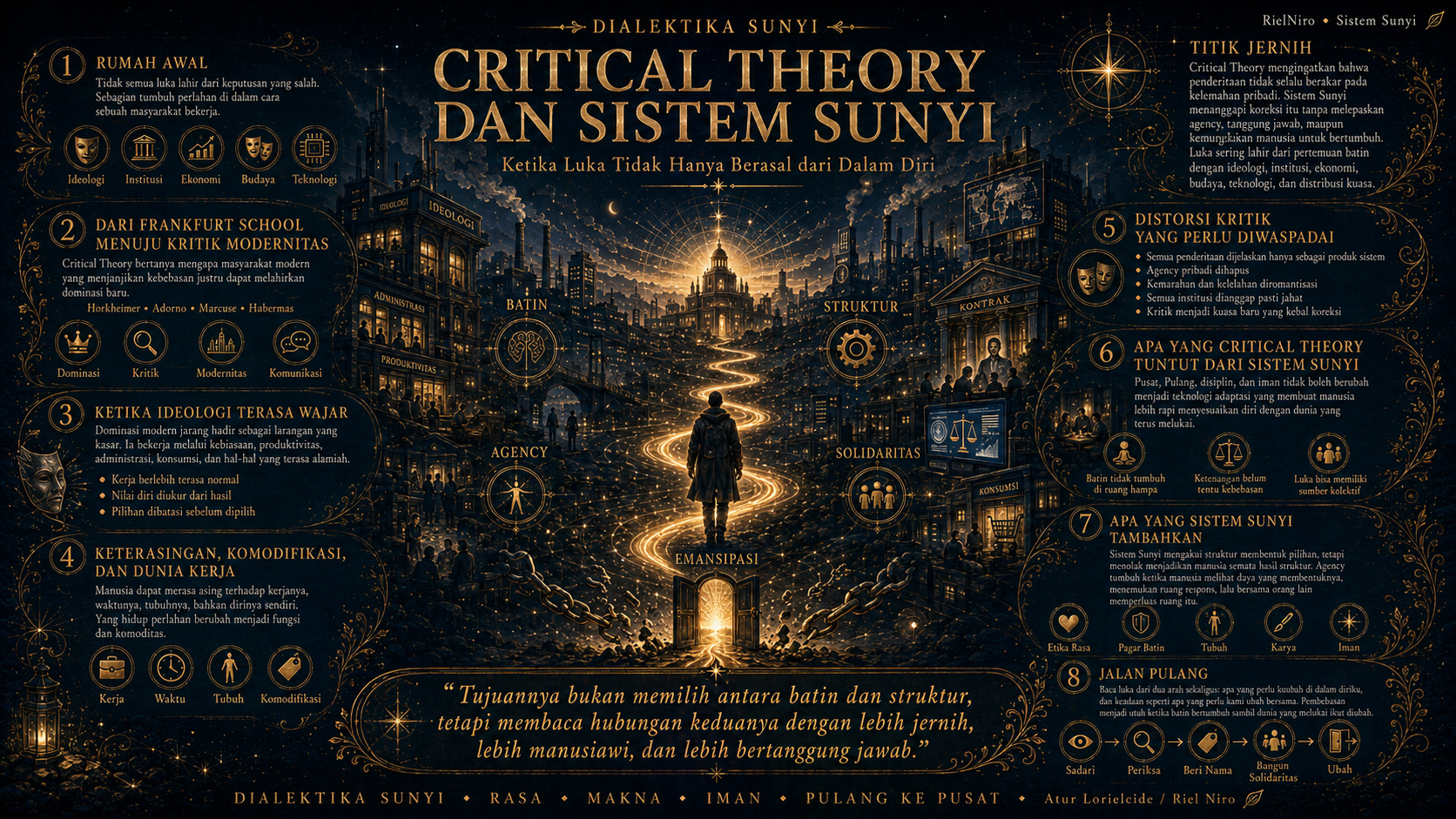
Not every wound arises from a wrong decision. Some grow slowly within the way a society works, through rules treated as natural, language that appears neutral, demands that keep rising, and systems that teach human beings to blame themselves.
Human beings easily assume that whatever is felt within must have originated within. Exhaustion is read as insufficient discipline. Failure becomes proof of inadequacy. Anxiety at work is treated as a problem of emotional regulation, while targets, contracts, hierarchy, and economic insecurity remain largely unexamined.
Critical Theory enters this territory with suspicion toward conditions that appear natural. It asks how history, institutions, economy, culture, and technology shape what is considered normal, reasonable, or impossible to change.
This tradition does not look only for those who openly command. It reads domination working through standards of success, the division of time, the design of work, patterns of consumption, administrative language, and needs formed before a person experiences themselves as choosing.
The System of Silence has reason to listen to this critique. Its language of the Center, habit, discipline, boundaries, work, and faith can help people read their lives. Yet the same language can become unjust when the entire burden of repair is returned to individuals living within conditions that continually reproduce wounds.
Their encounter is not a choice between inner life and structure. A human being is never only the contents of inner life, yet is never exhausted by the system either. People are shaped by the world, respond to it, and together with others may help change the world that shaped them.
Within that boundary, this essay treats Critical Theory as a plural tradition of social critique rather than a single doctrine. The System of Silence enters the conversation as a dialogical partner learning to read ideology, domination, alienation, commodification, and emancipation while keeping critique connected to bodies, relationships, agency, faith, and life as it is actually lived.
When failure feels entirely personal
Imagine someone working harder with every passing year. They arrive earlier, leave later, attend training, read books on productivity, and try to improve themselves little by little. Yet the targets keep moving farther away. Free time grows thinner. The body becomes more exhausted. Family relationships begin to fracture. Eventually they reach a conclusion that feels entirely reasonable: perhaps I am simply not good enough.
The conclusion sounds deeply personal. That is precisely where the problem begins.
Critical Theory asks whether the failure truly arose from within, or whether a person is living inside a system whose demands keep increasing while room to breathe grows smaller. What appears to be weakness of character may actually be the result of institutions, economy, technology, culture, or a distribution of power that is never itself questioned.
This change in perspective is not intended to release people from responsibility for their lives. It attempts instead to return responsibility to its proper place. Some of it belongs to personal choice, but some belongs to social conditions that keep shaping choice before a person is even aware of them.
At this point, The System of Silence brings the Center, feeling, habit, boundaries, work, and faith into the dialogue. All of these remain necessary. Critical Theory nevertheless reminds us that inner life never grows in a vacuum. The way a person feels, thinks, works, and even judges themselves always unfolds within a world larger than the self.
The center of the question then shifts. It is no longer only, why am I wounded?, but also, what kind of condition keeps producing wounds like this? The second question does not replace the first. It enlarges it.
From the Frankfurt School toward a critique of modernity
The widening of the question became one of the greatest contributions of the Frankfurt School. Through thinkers such as Max Horkheimer, Theodor W. Adorno, Herbert Marcuse, and later Jürgen Habermas, Critical Theory developed not as a theory seeking to explain society from a distance, but as an attempt to understand why modern societies promising freedom can produce increasingly subtle forms of domination.
They questioned not only state power or economic force. They also attended to things much closer to everyday life: how people work, enjoy entertainment, use technology, build identity, understand success, and even imagine what counts as a normal life.
Horkheimer distinguished traditional theory from critical theory. Knowledge never truly stands outside society. The ways people explain the world arise from particular histories, institutions, languages, and interests. Theory therefore cannot stop at explanation. It must also ask who benefits, who is harmed, and what form of life a particular mode of thought is preserving.
Questions like these did not arise from nowhere. Behind them lies a Marxian inheritance that reads how labor, commodities, class, alienation, and social relations can stand before human beings like the power of things no longer felt as their own creation. From this, Critical Theory receives one of its most important roots: society must not only be explained, but examined through the ways it shapes human life.
The Frankfurt School did not stop at labor and economic ownership. Its thinkers carried the question into culture, psychology, family, technology, and everyday life. They asked how domination can move through ordinary things, even through the ways people enjoy entertainment, understand success, or imagine who they are.
Adorno carries the critique further. Modern domination, in his reading, often no longer appears as crude coercion. It works through habit, administration, culture, efficiency, and modes of thought that slowly come to feel so ordinary that they are hardly recognized as forms of power.
Marcuse saw a similar condition from another direction. Modern society, in his view, can absorb critique by offering comfort, consumption, and satisfaction that make people stop questioning the structure shaping their lives.
Habermas later opened another possibility. He not only examined domination, but also asked how freer communication might allow people to correct one another without having to conquer one another. The Frankfurt School was therefore never one uniform voice, but a long conversation about how freedom might still be thought within modern society.
This diversity matters. If Critical Theory is reduced to the belief that every institution oppresses, every tradition is merely an instrument of power, or all modernity is failure, its own critical spirit disappears. Critique exists not to replace one dogma with another, but to preserve society’s capacity to examine itself.
When ideology feels like ordinary reality
One reason modern domination is difficult to recognize is that it rarely appears as an explicit prohibition. More often it appears as something natural. People overwork not because they are always directly forced, but because they gradually come to believe that their worth is measured by productivity. A person feels like a failure not because a judge condemns them, but because they have already accepted inherited measures of success without ever truly examining them.
Critical Theory uses the term ideology to read this condition. Ideology is not only propaganda or political slogans. It works more subtly. It makes historical conditions appear natural, social choices resemble laws of nature, and human-made structures feel as though they could never be otherwise.
A work culture that praises exhaustion as dedication can become ideological when it erases questions about unreasonable targets, unequal distributions of profit, or a system that continually turns human time into an economic resource. What is being corrected is not the work ethic, but the belief that every problem must be solved through individual improvement while the structure producing the problem remains intact.
The room for choice within such a condition is not equally distributed. Owners of resources, permanent employees, contract workers, informal workers, people without savings, and those supporting families do not possess the same freedom to refuse, pause, or leave work that is harming them.
Power must be read concretely. Who sets the targets? Who writes the contracts and determines wages? Who can change a rule after it causes harm? Who receives the benefit, and who bears the risk of saying no? Questions like these keep the word structure from becoming too large and vague to touch.
The System of Silence responds to ideological critique by reexamining the sources of inward impulse. Not every impulse felt as inward truly arises from the Center. Some needs are shaped by culture, some fears are learned through history, and some ambitions grow because the world keeps teaching that human beings are valuable only insofar as they produce.
Yet dialogue ceases to be healthy when ideological critique becomes total suspicion. Not every choice is the result of manipulation, just as not every inner experience is the voice of the Center. Human beings still possess the capacity to judge, accept, refuse, change direction, and build meaning that is not completely determined by the surrounding world.
Mature critique does not replace one prison with another. It helps people distinguish which needs genuinely sustain life, which are continually produced to keep a system running, and where a space of freedom may still be found between them.
When life slowly ceases to feel like one’s own
When ideology works by making a condition feel ordinary, one result is a quieter experience: a person begins to feel increasingly estranged from their own life.
They still wake every morning, finish their work, meet targets, answer messages, attend meetings, and return home exhausted. Everything proceeds as it should. Yet over time, an impression arises that is difficult to explain. They seem to be living a life that keeps moving, but is no longer truly inhabited.
Critical Theory recognizes this experience as alienation. In its Marxian roots, alienation does not refer only to feeling distant from oneself. It also concerns separation from the process of labor, from what one creates, from other people encountered mainly through competition and function, and from the capacity to experience life as a power that can be shaped together.
Alienation does not always appear as dramatic suffering. It often emerges as routine that feels normal. People continue to function, remain productive, and may even succeed by social standards. Yet that success becomes harder to experience as something truly their own. Life continues, but its direction seems governed by a logic arriving from outside.
When reading alienation, The System of Silence corrects one of its own tendencies. Alienation can easily be understood as losing the Center. Critical Theory reminds us that the Center is not always lost because a person has failed to listen inwardly. Sometimes the room required for listening is continually narrowed by working rhythms, economic pressure, unequal relationships, or social structures that keep a person reacting without ever having time to be present.
Yet alienation does not erase every possibility of action. Within narrow conditions, people may still build friendships, preserve small forms of integrity, name their own experience, or discover forms of solidarity that are not wholly determined by the system. Alienation is therefore not a final identity, but a condition that can still be read and gradually changed.
Such change does not always begin with solitary courage. It can grow through unions, communities, organizations, shared protection, or the creation of alternative institutions. Agency sometimes acquires form only when people stop carrying the same condition separately and begin to recognize it as something that can be faced together.
When rationality asks only how, not why
The experience of alienation does not appear from nowhere. It grows alongside a mode of thought that Horkheimer and Adorno called instrumental reason. This form of rationality does not primarily ask whether a goal is worth pursuing, but how it can be achieved as efficiently as possible.
Questions of meaning are gradually replaced by questions of function. What matters is no longer whether work enriches human life, but whether it increases productivity. The primary question is no longer whether technology makes relationships healthier, but whether it makes processes faster. Efficiency gradually acquires a moral status that is rarely questioned.
At a certain point, human beings themselves are treated through the same logic. The body becomes a resource. Attention becomes an asset. Time becomes a commodity. Even relationships can become networks of utility judged by the results they provide.
This is why instrumental reason can be so dangerous. It does not always produce malicious intent. Many institutions are built by people who genuinely want to work well. The problem appears when the entire way of seeing the world is narrowed to function and outcome. Something is considered good merely because it works, not because it truly humanizes.
The System of Silence affirms a boundary closely aligned with this critique. Work matters. Discipline matters too. Yet work that loses dignity, care, boundaries, and relationship can become a machine that keeps moving without knowing for whom it moves. Efficiency becomes the goal, although it was originally only a tool.
Critical Theory does not ask people to abandon rationality. It restores a question older than efficiency: for what kind of life is this entire system being built?
The question needs to be brought closer. Efficient for whom? What costs disappear from the report? Who receives the benefit when time is accelerated, labor is depleted, and measures keep rising? A system can appear successful because part of its cost has been transferred to the bodies, families, or futures of people who did not help determine its goals.
Culture that slowly shapes desire
Modern domination does not work only through offices, schools, or states. It also grows through everyday culture, the films people watch, the music they hear, the news they share, repeated advertising, and algorithms deciding what continually appears on a screen.
Adorno and Horkheimer described this condition as the culture industry. Culture is no longer merely a space of human expression. It also becomes an industry producing attention, taste, and even the ways people imagine the kind of life worth desiring.
Critical Theory is not saying here that all popular culture is manipulation. Human beings are not passive recipients who simply swallow every message. People can still enjoy, reinterpret, refuse, or create new meaning from what they consume.
Culture nevertheless has the power to shape. The more often a person sees success equated with wealth, productivity, or a particular image, the more natural those measures begin to feel. Over time people do not merely buy objects. They begin to buy an image of themselves.
This power does not always work by forcing people to accept a single message. Sometimes it only arranges what remains visible and what slowly disappears from view. Choice still seems available, while the material needed to imagine another form of life becomes narrower.
The digital world intensifies this process. Algorithms do not simply present information. They learn to recognize attention, anticipate emotion, and repeat patterns that keep a person inside the system longer. Noise is no longer merely a side effect. It can be designed because attention has become a source of economic profit.
The critique of the attention economy requires The System of Silence to widen its reading. Reducing notifications, practicing silence, and protecting focus all matter. Yet personal care of attention is not enough when the digital environment is designed to fragment it. The Ecology of Silence therefore concerns not only individual discipline, but also the ecosystem continually shaping how people give attention.
When human beings become numbers
At the end of this movement another, subtler condition appears. After people are trained to see the world as function, shaped by a particular culture, and placed inside systems that continually measure, they gradually begin to see themselves in the same way.
Critical Theory describes this condition as reification, when human beings are treated like objects. Reification does not always appear as violence. It often arrives in highly administrative forms. A worker becomes a performance score. A student becomes an examination grade. A patient becomes a queue number. A social media user becomes a predictable collection of behavioral data.
Simplification is sometimes necessary for institutions to work. Hospitals need data. Schools need assessment. Organizations require certain measures. The problem begins when the measure replaces the person being measured. What was created to help read reality slowly comes to be treated as reality itself.
Reification works more deeply when human-made relations begin to appear as independent forces. Targets seem to possess a will. Markets are said to speak. Procedures are treated like laws of nature. Those who design or preserve the rules can then claim that they too have no choice, as though the system had never been built and could not be changed by human beings.
The System of Silence faces a similar danger. Maps, orbits, terms, and categories remain useful only insofar as they help people understand themselves. When a map becomes identity, a term replaces experience, or a category is trusted more than the person living within it, the reading has lost its direction.
Critical Theory and The System of Silence ultimately arrive at the same warning: do not allow tools to take the place of human beings. Theory, data, systems, and even the clearest language must always return to the lives they seek to understand. Otherwise, human beings will gradually come to live as numbers within a world of their own creation.
When comfort begins to replace freedom
Domination does not always preserve itself through fear. In modern society it often survives by making life feel comfortable enough. People do not need to be forced to love the system. It is enough to keep them busy, connected, entertained, and convinced that the available choices represent every possible form of life.
Herbert Marcuse saw this as one of the major changes of modern industrial society. Power no longer works primarily through prohibition, but through the ability to create needs, offer satisfaction, and make people feel free within limits already determined in advance.
Marcuse uses the term false needs to describe this condition. He does not mean that every human desire is false, but that some needs are formed in ways that keep people supporting the very system limiting their freedom. People feel that they are choosing, although the field of choice was designed long before.
This critique needs protection from the arrogance of the critic. No one automatically gains the right to define another person’s needs merely by feeling more conscious. Comfort does not always mean unconsciousness. Safety, rest, and stability may be things a person has never possessed for long.
The question is not whether a particular pleasure should be viewed with suspicion, but whether the need can still be examined. Does it enlarge life, or does it demand repetition that benefits the system while narrowing other possibilities?
This critique becomes increasingly relevant in the digital age. Devices, applications, services, and even online identities keep offering new forms of comfort. Not all of them are harmful. Many genuinely help life. Marcuse’s question nevertheless remains: do these conveniences enlarge freedom, or make it harder to imagine another way of living?
The System of Silence uses Marcuse’s question to examine its own inner life. Silence can become consumption. Practice can become identity. Terms created to help orientation can become a collection of symbols that decorate the self-image without truly changing how a person treats others.
Comfort is not the enemy. What must be watched is the moment comfort slowly replaces the freedom to question.
Is liberating conversation still possible?
While much of Critical Theory shows how domination works, Jürgen Habermas opens a different question. After all the critique has been made, what still allows human beings to live together?
He does not seek the answer in the victory of one group over another. Habermas returns to something that appears simple: the human capacity to speak, hear reasons, respond, and test claims together without having to conquer one another.
The idea of communicative rationality arises from the conviction that communication can become a space of emancipation when conversation is not governed by manipulation, threat, or inequalities of power that make some people afraid even to speak.
Such a condition never appears perfectly. Language always carries history. Institutions always have hierarchies. Education, social class, and access to knowledge influence who sounds more convincing. Yet this is precisely why fairer communication must remain a direction to be pursued, not a condition presumed to be already possessed.
Equal permission to speak does not necessarily create an equal conversation. Institutional position, gender, language, safety, and the consequences of speaking all influence who is believed. Some people can voice an objection without losing anything. Others must risk work, access, safety, or dignity.
Those with greater power cannot stop at saying that the door is open. They also bear a greater responsibility to ensure that correction can be expressed without punishing the person who offers it.
Liberating conversation opens an important territory for The System of Silence. It reads dialogue as more than an exchange of opinions. A genuinely constructive conversation requires a sense of safety, the ability to listen, the courage to correct oneself, and the willingness to acknowledge that another person’s experience may reveal something we could never see from the center of our own experience.
Communication is not merely a technique of speaking. It is a practice of humility.
Emancipation without becoming a new prison
The aim of Critical Theory is often summarized as emancipation, the liberation of people from forms of domination that prevent them from determining their own lives. History nevertheless shows that liberation has its own paradoxes.
A movement may succeed in dismantling an old structure and then build a new one that is no less restrictive. A group once victimized may repeat the same logic after gaining power. Critique originally meant to liberate can become an identity that continually needs an enemy in order to feel alive.
The wounds of that group do not become unreal simply because its newly acquired power later goes astray. Yet suffering does not in itself produce wisdom. It can open the way to empathy, but it can also cultivate vigilance, a sense of being right, or the need to retaliate for what was once endured.
Emancipation cannot be understood merely as a transfer of power. It must change the conditions that allow domination to be born again.
The System of Silence extends this reading into inner space. Human beings may become free from one structure while remaining enslaved by hatred, resentment, or the need to keep proving themselves right. Conversely, an experience of inner peace is still not enough when the structures surrounding them continue to produce the same wounds in others.
This is where the two traditions meet. Critical Theory keeps inner change from ending with the self. The System of Silence keeps social struggle from losing its humanity.
The culture of productivity and inherited exhaustion
One of the most difficult forms of domination to recognize today is the culture of productivity. It does not require police, censorship, or open punishment. It works through the belief that human beings can always do more than they are already doing.
Rest begins to feel like regression. Silence is treated as a lost opportunity. The body is forced to follow an ever-accelerating rhythm, while every failure is understood as insufficient discipline or commitment.
Critical Theory shows that this kind of guilt is often privatized. A problem arising from the structure of work is translated into a defect of character. People are told to improve themselves continually while the system producing exhaustion is hardly questioned.
Exhaustion is not equally distributed. Some people can take leave, refuse extra work, or pay for help. Others have none of those possibilities. Advice about balance sounds different when a person does not have enough power even to determine their working hours.
Such costs often remain in the body before they appear in any report: sleep that keeps shrinking, tension that does not release, illness left unattended, vigilance carried home, and time with family that slowly disappears.
While accepting the critique of structure, The System of Silence continues to read personal habit. Not every exhaustion comes from the system. Some of it does arise from decisions, avoidance, or patterns we build ourselves. Yet not all exhaustion can be resolved through meditation, discipline, or time management. Clarity appears when both layers are read together.
Mature discipline is not the ability to force the body without end. It protects what matters from destroying the life it is meant to serve. Sometimes the most honest form of discipline is to stop, seek protection, negotiate the rules, or admit that a burden cannot be carried alone.
Technology and the struggle for attention
One of the greatest changes of recent decades may not be technological progress itself, but the transformation of attention into an economic resource.
Digital platforms do not merely provide spaces for communication. They study habits, predict responses, and design experiences that keep people inside the system for as long as possible. Time, emotion, and even surprise become part of the business model.
This helps explain why noise feels increasingly difficult to avoid. It is no longer an accidental disturbance, but the result of an architecture designed to capture attention.
In the technological sphere, The System of Silence insists on an important boundary. Protecting attention remains a personal responsibility. Yet protecting attention is not enough when the entire environment is designed to drain it. Inner practice therefore needs to move together with critique of technological design, regulation, digital literacy, and institutional responsibility.
This critique also reaches business models, transparency, and the protection of children. A more humane digital space does not arise only from more disciplined users. It requires design that does not profit from anxiety, choices that can genuinely be used, and institutions willing to bear responsibility for the effects of their products.
Attention finally returns as a moral question. Human beings must choose what they see, but society must also ask who profits from attention that is continually fragmented.
Structural critique without losing personal responsibility
After reading how ideology works, how culture shapes attention, how institutions organize life, and how technology helps determine habit, one question becomes unavoidable: if so much is shaped by structure, are human beings still genuinely free?
This is the most delicate point in Critical Theory. If every experience is explained as the result of a system, the individual gradually loses room to act. Every decision appears merely as an effect of history, economy, culture, or the distribution of power. Critique meant to liberate can become an explanation that closes the possibility of change.
A mature Critical Theory does not stop at dismantling structure. Critique is not the final goal. It opens room for people to act again with greater awareness of the conditions shaping their lives.
The System of Silence complements this critique through its reading of agency. Agency does not arise because people are completely free from the influence of the world. It arises when someone begins to see that influence without surrendering their entire life to it. The world shapes human beings, but human beings are never only what the world has made of them.
The room for action is not equally wide for everyone. Some people can change direction immediately. Others can move only after receiving safety, support, protection, or the presence of others willing to stand with them. Agency does not always grow as solitary courage. Sometimes it begins when a condition once carried alone is finally recognized as a shared problem.
Critical Theory then corrects The System of Silence at an equally important boundary. Not every wound can be resolved through personal courage, inner practice, or a change in thought. Some suffering is continually produced by the way institutions work, by unequal economic relations, by a culture that glorifies productivity, or by technology that profits from fragmented attention. In such conditions, asking individuals to keep improving themselves can become a very subtle form of injustice.
Personal responsibility must therefore not be used to blame victims or ignore how narrow their choices are. It becomes just only when it is read together with limiting conditions, available resources, and the support that makes genuine action possible.
A fuller reading always moves in two directions at once. A person is invited to ask, “what do I need to change within myself?”, but also, “what kind of condition do we need to change together?” These questions do not replace one another. They guard each other, so that personal responsibility does not become unjust guilt, and social critique does not become a reason to postpone personal change.
What Critical Theory Requires of The System of Silence
Critical Theory requires The System of Silence to acknowledge that inner life does not grow in a vacuum. The Center, echoes, habit, discipline, and faith are always situated within history, class, institutions, technology, and relations of power that are unevenly distributed.
The language of Returning Home can become unjust when it implies that people need only return inward to resolve wounds continually produced outside themselves. There are conditions in which restoring inner space is not enough; rules, wages, access, design, protection, and the distribution of power must also change.
Inner discipline must be continually tested so that it does not become a technology of adaptation. People can learn to breathe, focus, and regulate emotion, becoming better able to endure exploitation that is never questioned. Calm that makes injustice easier to bear is not necessarily freedom.
The Theory of Inner Echo must also recognize that some echoes have collective sources. A sense of worthlessness can grow from repeated discrimination. Vigilance may be formed by institutional violence. Shame can be inherited from histories that cast particular groups as less civilized, less capable, or less worthy of belief.
The System of Silence Model (MSS) must ensure that emotion, morality, and spirituality not only order one another within an individual, but also remain capable of reading conditions that continually produce particular feelings. Anger is not always distortion. Sometimes it reads a violation that cannot be resolved through acceptance.
Faith must also receive examination. The language of trial, patience, forgiveness, and God’s will can sustain endurance, yet it can also be used to make people accept conditions that should be changed. Faith as gravity preserves direction; it does not turn injustice into a fate beyond the reach of action.
Its deepest correction is simple but demanding: inner work must not become a way of making people more orderly in their adaptation to a world that continues to injure them. Clarity must also be able to name conditions, build solidarity, and help change what keeps reproducing the wound.
What The System of Silence Adds to the Reading of Structure and Emancipation
The System of Silence acknowledges that structures shape choices while refusing to reduce human beings to products of structure. Agency does not arise from absolute freedom. It grows when people see the forces shaping them, find a space of response, however small, and enlarge that space together with others.
Structural reading must descend into the body. Domination is not only an idea; it appears as sleep deprivation, tension, freezing, neglected illness, vigilance, lost time with family, and a body continually forced beyond its limits. The body reveals costs often absent from institutional reports.
Critique also needs to read feeling without assuming feeling is always clear. Anger may read violation, yet it may also seek a weaker target. Moral certainty may accompany solidarity or form the persona of someone who feels immune to correction. The Ethics of Feeling tests direction and consequence, not only intensity.
Emancipation requires the Inner Fence. Movements, communities, and struggles can demand openness, loyalty, or sacrifice without limit. The Phenomenon of the Inner Fence keeps solidarity from becoming self-surrender and difference from being automatically read as betrayal.
Social change also requires rhythm and work. Critique that never descends into organization, protection, policy, education, care, or alternative forms of life easily becomes a discursive identity. Orbit III asks what is actually being built and who can inhabit the result.
Faith adds a horizon without becoming a shortcut. It can preserve love of justice when results do not arrive quickly, keep power from imagining itself absolute, and remind people that political opponents remain human. Yet faith does not replace analysis, organization, or action.
The System of Silence does not weaken structural critique. It asks how liberation is lived: whether the people for whom the struggle is waged remain visible, whether bodies are protected, whether relationships can receive correction, whether new power possesses boundaries, and whether change can endure as a way of life.
When critique loses the human being
Critique loses direction when all suffering is explained as a product of the system. Structures shape people, yet people also carry histories, choices, habits, needs, and responsibilities that cannot all be transferred to institutions.
It also distorts when every choice is treated as manipulation. If people can never judge or refuse, critique itself loses the subject who could be liberated. Domination narrows agency; it does not always erase it.
The language of ideology can become a means of belittling others: those on the other side are regarded as not yet aware, lulled into passivity, or incapable of understanding their own interests. Such criticism reproduces the domination it criticizes because one side once again claims the right to explain the entirety of another’s experience.
Comfort can also be morally condemned, as though suffering were proof of consciousness and anyone enjoying life had surrendered. Yet safety, rest, pleasure, and stability are also parts of life worth struggling for.
Critique can romanticize anger and exhaustion as signs of political depth. A body continually consumed by struggle is not automatically more faithful to justice. A movement that leaves no room for grief, rest, differing capacities, and care easily repeats the productivity logic it seeks to resist.
Emancipation becomes distorted when liberation is used to justify humiliation, manipulation, limitless violence, or a new structure immune to correction. A history of wounds explains the birth of anger but does not confer unlimited moral authority.
Conversely, people can use social critique to avoid personal change. Structure becomes the explanation for every failure, personal impact is denied, and the need to receive correction is dismissed as individualizing the problem.
Humane critique holds the tension: it names structure without erasing faces, preserves agency without blaming victims, demands change without glorifying suffering, and uses power without imagining itself free from the possibility of going astray.
When wounds do not come only from within
Critical Theory reminds us that much suffering felt as deeply personal arises from histories that extend beyond a single person’s experience. The world of work, public language, digital culture, education systems, political institutions, and economy help shape how people see themselves. What feels like personal failure may sometimes be a symptom of a much wider condition.
From this reality, The System of Silence keeps the Center of its reading without closing its eyes to the world. The world shapes inner life, yet inner life retains the capacity to respond to the world. Clarity does not arise by choosing one over the other. It arises when people can read the relationship between them.
The dialogue between Critical Theory and The System of Silence is not a debate about whether the root of the problem lies inside or outside the self. Such a question is too narrow for human life. What matters more is understanding how inner experience and social structure shape, reinforce, and sometimes wound one another.
Critical Theory keeps The System of Silence from transferring the entire burden of healing onto the individual. The System of Silence keeps Critical Theory from losing the concrete person who must still choose, take responsibility, forgive, repair relationships, and build their life little by little. Structural critique becomes more humane when it does not lose sight of the human face; inner work becomes more just when it does not forget the world in which inner life is lived.
In the end, wounds do not always come from within. Yet the path of Returning Home is never only a change in external conditions. It grows when people dare to change the way they live while helping change the world that has continually shaped that way of living. At that point liberation ceases to be a political slogan or merely a spiritual experience. It becomes a long process in which inner life and the world learn to move toward a more humane form of life.
Dialektika Sunyi (Format 2) adalah ruang dialog antara Sistem Sunyi dan dua puluh empat rumah pemikiran dari berbagai tradisi filsafat, psikologi, etika, teologi, dan pemikiran sosial. Dua puluh empat tulisan ini tidak disusun untuk menjadikan tradisi-tradisi tersebut sebagai bagian dari Sistem Sunyi, melainkan untuk mempertemukan cara pandang yang berbeda agar manusia dapat dibaca dari lebih dari satu pintu.
Sistem Sunyi tidak datang ke dalam dialog dengan rumah yang kosong. Ia sudah membawa cara membaca sendiri: Rasa perlu didengar tanpa segera dijadikan kebenaran, Makna tidak dipaksakan kepada luka, Iman memberi arah tanpa menjadi jawaban instan, dan manusia tidak dapat dihabiskan oleh satu istilah atau satu peta.
Karena itu, setiap rumah pemikiran hadir sebagai ruang dialog yang tetap memiliki bahasa, sejarah, pertanyaan, dan batasnya sendiri. Dialektika Sunyi bukan upaya membuktikan bahwa dua puluh empat tradisi tersebut pada akhirnya mengatakan hal yang sama dengan Sistem Sunyi.
Mengapa dua puluh empat rumah pemikiran?
Karena manusia terlalu luas untuk dibaca melalui satu lensa. Penderitaan dapat hadir sebagai pengalaman batin, pola tubuh, relasi, cerita diri, bahasa, kondisi sosial, struktur kuasa, sejarah, iman, maupun perubahan kehidupan. Satu lensa dapat membuka sesuatu yang penting, tetapi selalu ada wilayah yang berada di luar jangkauannya.
Dua puluh empat rumah pemikiran karena itu membuka percakapan dari berbagai arah. Membuka pintu tidak berarti meninggalkan rumah. Setiap tradisi tetap dibaca sebagai rumahnya sendiri, sementara Sistem Sunyi membiarkan perjumpaan itu memperluas cara melihat tanpa kehilangan batasnya.
Di dalam panel ini, dua puluh empat tulisan dibagi menjadi tiga bagian: Peta I, Peta II, dan Peta III. Ketiganya adalah pembagian navigasi untuk membantu menemukan delapan rumah pemikiran pada masing-masing bagian.
Sebelum masuk ke daftar, dua ruang berikut dapat digunakan untuk melihat keseluruhan Dialektika Sunyi dalam skala yang lebih luas:
Atlas Dialektika Sunyi
24 Percakapan, 24 Peta Pembacaan
Ruang orientasi publik untuk menjelajahi dua puluh empat tradisi yang berdialog dengan Sistem Sunyi tanpa kehilangan rumah pemikirannya masing-masing.
Peta Pengetahuan Dialektika Sunyi
Dua Puluh Empat Rumah. Tidak Ada yang Dilebur Menjadi Satu.
24 Rumah Pemikiran · 20 Kejernihan · 25 Pintu Kehidupan
Ruang untuk melihat bagaimana dua puluh empat tradisi dipertemukan dengan Sistem Sunyi tanpa penyerapan, kemenangan, atau sintesis yang lebih tinggi.
Peta ini hanya membantu menemukan jalan. Pembacaan sebenarnya terjadi di dalam masing-masing tulisan, ketika satu rumah pemikiran dibuka dan dialognya dengan Sistem Sunyi mulai berlangsung.
Paket I bergerak paling dekat dengan pengalaman personal, tetapi tidak membiarkan batin menjadi dunia yang tertutup. Kendali bertemu keadaan, perhatian bertemu makna, kedekatan membawa sejarah relasi, kebebasan berhadapan dengan keterbatasan, dan keheningan diuji oleh doa serta kehidupan yang kembali dijalani.
- Ketika keteguhan tidak berarti mematikan rasa
- Ketika hadir belum berarti memahami
- Ketika hidup tidak hanya meminta penjelasan, tetapi jawaban
- Ketika kebutuhan akan tempat aman ikut membentuk cara manusia mencintai
- Ketika hidup tidak menyediakan kepastian yang dapat memilih atas nama manusia
- Ketika bagian diri yang tidak disadari ikut membentuk cara manusia melihat kenyataan
- Ketika bahasa iman belajar mengakui Tuhan tanpa menjadikan misteri sebagai tempat bersembunyi
- Ketika keheningan di hadapan Tuhan kembali menjadi kasih, kerja, batas, dan tanggung jawab
Paket II memperdalam pertanyaan tentang bagaimana pengalaman sebenarnya terbentuk. Apa yang terasa tidak hadir tanpa tubuh. Apa yang dipahami tidak lahir tanpa bahasa. Agency mempunyai lingkungan. Care mempunyai distribusi beban. Makna dan keyakinan memperoleh ujian ketika mereka meninggalkan jejak dalam kebiasaan, tindakan, dan dunia bersama.
- Ketika kenyataan perlu diberi ruang sebelum kesimpulan mengambil alih
- Ketika tubuh, kebiasaan, alat, relasi, dan dunia ikut membentuk cara manusia memahami dan memilih
- Ketika rasa sakit tidak harus hilang sebelum manusia bergerak menuju yang bernilai
- Ketika motivasi dibaca melalui autonomy, competence, relatedness, dan mutu alasan untuk bergerak
- Ketika kisah hidup memberi arah, tetapi tidak berhak menjadi seluruh kenyataan
- Ketika bahasa, sejarah, tradisi, dan kuasa ikut menentukan apa yang dianggap sebagai kebenaran
- Ketika kebutuhan, dependency, kerja perawatan, kompetensi, dan pembagian beban menjadi persoalan moral
- Ketika gagasan diuji melalui kebiasaan, penyelidikan, konsekuensi, komunitas, dan revisi
Paket III membawa pembacaan ke kondisi yang membuat sebagian pengalaman dipercaya, sebagian dinormalkan, dan sebagian bahkan sulit memperoleh bahasa. Struktur dan sejarah masuk lebih jelas, tetapi manusia tidak dibiarkan menghilang di dalamnya. Karena itu Systems Thinking bertemu Virtue Ethics, Liberation Theology bertemu batas praxis, dan Process Philosophy menutup paket dengan kehidupan yang terus menjadi tanpa kehilangan tanggung jawab.
- Membaca penderitaan di antara batin, ideologi, institusi, ekonomi, dan distribusi kuasa
- Ketika pengetahuan dibentuk oleh posisi, tubuh, bahasa, kredibilitas, dan relasi kuasa
- Bahasa, institusi, dan relasi yang membuat kategori terasa alamiah
- Sejarah, bahasa, representasi, dan kuasa di balik hak untuk menjelaskan manusia lain
- Membaca pola, feedback, penundaan, batas sistem, dan perubahan yang tidak pernah berdiri sendiri
- Karakter, kebiasaan, emosi, teladan, dan kebijaksanaan praktis dalam kehidupan sehari-hari
- Ketika doa, kasih, keselamatan, dan kitab diuji oleh kemiskinan, penindasan, serta tindakan pembebasan
- Identitas, relasi, waktu, dan Pusat yang bertahan tanpa membeku menjadi bentuk final
Lorong Kata adalah ruang refleksi di TokohIndonesia.com tempat gagasan dan kesadaran saling menyeberang. Dari isu publik hingga perjalanan batin, dari hiruk opini hingga keheningan Sistem Sunyi - di sini kata mencari keseimbangannya sendiri.
Berpijak pada semangat merdeka roh, merdeka pikir, dan merdeka ilmu, setiap tulisan di Lorong Kata mengajak pembaca menatap lebih dalam, berjalan lebih pelan, dan mendengar yang tak lagi terdengar.
Atur Lorielcide berjalan di antara kata dan keheningan.
Ia menulis untuk menjaga gerak batin tetap terhubung dengan pusatnya.
Melalui Sistem Sunyi, ia mencoba memetakan cara pulang tanpa tergesa.
Lorong Kata adalah tempat ia belajar mendengar yang tak terlihat.
Baca juga: Dua Ruang, Satu Sunyi: Jejak Atur Lorielcide alias Rielniro