
 Tulisan ini bagian dari sistem kesadaran reflektif
Some ideas sound entirely true for as long as they have not touched life. Once lived, they begin to reveal whether they truly open a way forward, merely repeat an old pattern, or quietly create wounds that were previously unseen.
There are moments when a thought feels so clear that it seems to require almost no further explanation. Someone discovers a new way of seeing life, reads a book that changes perspective, or formulates a principle that appears capable of answering many problems at once. At that moment, the idea seems to have reached its goal. It has persuaded the mind.
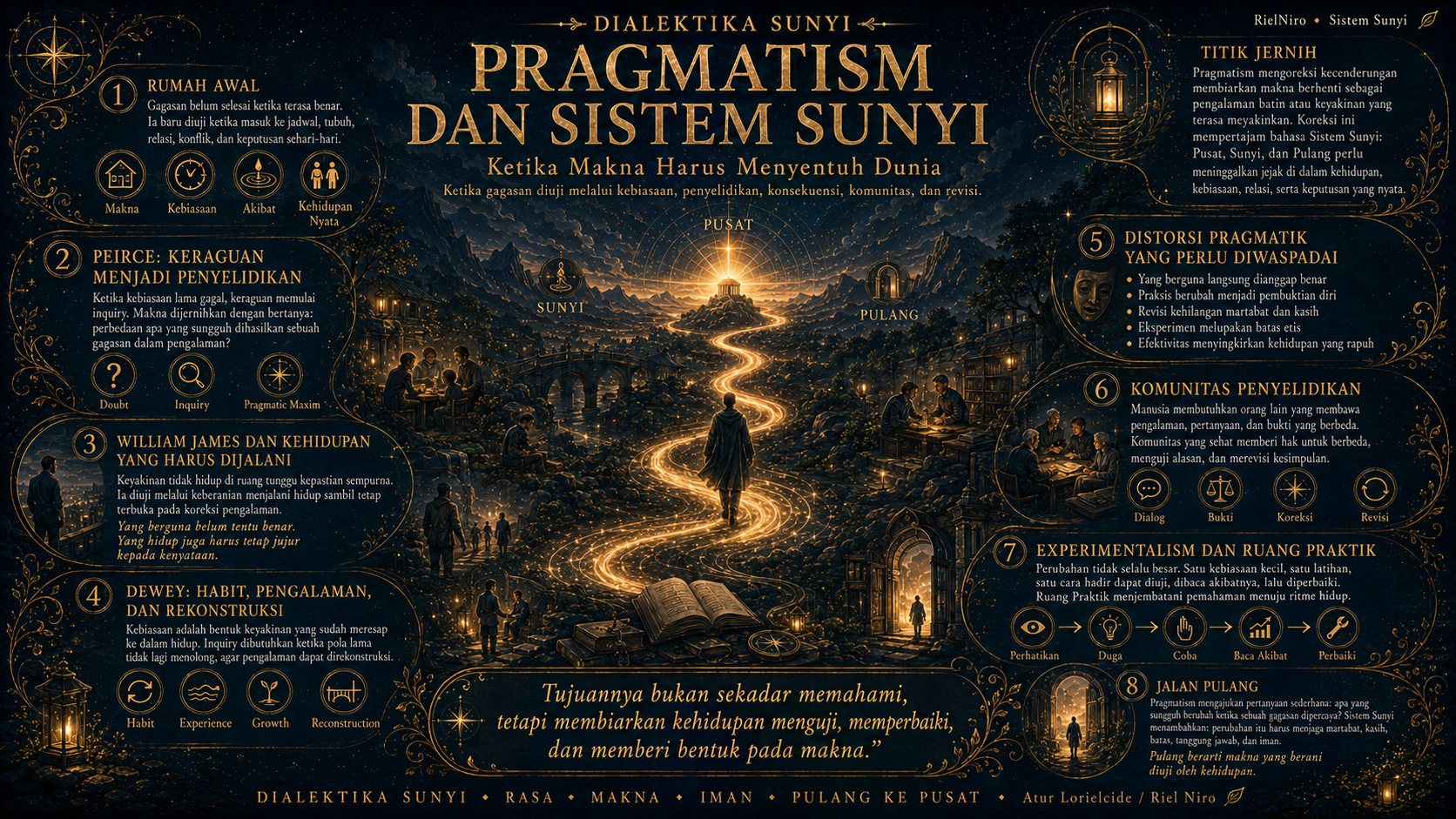
For Pragmatism, however, that is precisely where the real journey begins. An idea is not finished because it has been understood. It begins to reveal its quality when it enters the actual world, when it must live within crowded schedules, difficult relationships, tired bodies, complex conflict, and decisions that cannot be postponed. Life slowly asks every belief: what truly changes after you are trusted?
This question shifts attention from the content of an idea toward its consequences. Not because content no longer matters, but because meaning always seeks form in action. Ideas shape habits, habits shape ways of seeing, and ways of seeing eventually determine how human beings treat themselves and others. A beautiful theory may lose its force when it continues producing a life that never changes.
The work of Pragmatism begins when belief starts to take the form of habit. It asks how inquiry repairs error, how consequences test the honesty of an idea, and how community keeps human beings from becoming trapped inside certainties of their own making. The technical terms for these movements will appear gradually in the sections that follow, once the experiences that give rise to them have become visible. Truth is not sought as a motionless object, but as something continually tested by experience.
The encounter with Pragmatism becomes especially fruitful when the inward orientation of The System of Silence is tested by its consequences in life. The System of Silence speaks of Center, clarity, faith, and Silence as inward orientations that help human beings find the way of Returning Home. Pragmatism asks a different but complementary question: does that orientation actually change how someone lives? Does it make relationships more honest, decisions more responsible, and love more real? When it does not, perhaps the problem lies not in life, but in the way the idea has been understood.
Peirce: when doubt becomes the beginning of inquiry
Charles Sanders Peirce began with something very simple that is often overlooked. Human beings do not think merely because they want to think. They begin to think seriously when an old habit is disturbed. As long as the world proceeds as expected, belief provides stability. But when reality begins to resist the old way of reading a situation, doubt appears. For Peirce, doubt is not intellectual weakness. It is a sign that inquiry is needed.
Peirce therefore calls this process investigation or inquiry: the movement of seeking a new orientation when old beliefs and habits can no longer guide action adequately. Inquiry does not arise from abstract curiosity, but from the need to recover the ability to move within the world. Belief always has a practical function: it enables human beings to act. Doubt interrupts that ability and forces them to seek a more adequate way of reading.
Yet inquiry needs a way to clarify what is actually at issue. When the meaning of an idea remains vague, human beings can debate at length without ever knowing what difference is genuinely at stake in action.
From here came one of the most influential ideas in Pragmatism, later known as the pragmatic maxim. The meaning of a concept becomes clearer when we ask what difference it actually makes in experience. If two terms never produce different consequences for action, perhaps their difference has not yet become meaningful. This question does not reduce philosophy to usefulness. It disciplines language by removing distinctions that remain alive only in abstraction.
Peirce was not saying that whatever succeeds immediately becomes true. Once meaning has been clarified, an idea must still enter a longer process of inquiry. Inquiry requires time, correction, evidence, and continuing conversation. One personal experience is not enough to end the search. Precisely because human beings are easily mistaken, belief must be willing to live within a community that tests it.
This kind of discipline matters for the language of The System of Silence. Terms such as Center, Echo, inward gravity, or the Inner Fence gain sharpness not because they sound beautiful, but when they can show real changes in the way human beings read themselves, live within relationships, and make decisions. Language that never touches life slowly becomes spiritual decoration.
But doubt need not be celebrated as an end in itself. Inquiry arises so that human beings can form a more adequate orientation and return to action. Doubt that is never willing to be tested can become a new way of avoiding decisions. Pragmatism does not invite human beings to remain within endless uncertainty. It teaches the courage to move while remaining open to correction.
William James and the life that must be lived
If Peirce spoke mainly about how inquiry works, William James brought Pragmatism closer to everyday experience. He attended to the fact that human beings almost never make decisions after receiving all the information they desire. Most of life is lived amid uncertainty. People still have to choose work, marry, forgive, trust someone, or embrace a faith even when the available evidence is never complete.
James asked not only how an idea is proven, but how it enables human beings to live. A belief has meaning when it truly helps shape experience, opens new possibilities, or gives someone courage to face a condition that had previously been paralyzing. Life is not a waiting room for perfect certainty.
This is why James is so often misunderstood. He is frequently reduced to the philosopher who said that what is useful is true. What he meant was far more complex. Usefulness is not momentary comfort or quick practical success. A belief must continue to face the fullness of experience, the resistance of reality, and the life lived over time. What appears to work today may collapse as experience develops.
Openness to experience as it continues to develop leads James toward pluralism. By pluralism he does not mean that every view is equally true, but that life may open more than one legitimate way of finding meaning. The world can still resist beliefs that fail to read reality, while experience continues forcing human beings to improve the way they think. James’s pluralism is therefore not relativism.
The tension between the life-giving force of belief and the limits of what it can prove brings James into conversation with the language of faith in The System of Silence. Faith can indeed become a source of courage, orientation, and inward endurance. Yet good psychological fruit does not automatically prove the entire content of a belief. Nor does an experience of peace release anyone from the responsibility to examine whether that peace arose from clarity or merely from successfully avoiding reality. Pragmatism reminds us that life always has a way of testing what is truly believed.
Yet such testing does not reduce faith to a mere hypothesis to be discarded whenever life becomes difficult. Suffering does not automatically prove faith wrong, just as comfort does not automatically prove an interpretation true. What can continually be tested is how human beings understand, practice, and use their faith in life. Faith as gravity provides direction, but human interpretations of that direction still require humility.
John Dewey: habit, experience, and the world that helps shape human beings
If Peirce showed how doubt begins inquiry, and James showed that belief must sustain a life actually lived, John Dewey carried the question further. For him, the issue was not merely whether an idea made sense, but how human beings continually improve their way of living as the world changes. Knowledge does not stand outside experience. It grows with experience as experience is reconstructed.
The idea of reconstructing experience leads Dewey directly to habit. Most of life does not move through great decisions that are continually reconsidered, but through patterns that allow human beings to act without calculating every step. Pragmatism calls these patterns habits: not merely routines, but dispositions that shape how bodies, minds, and relationships respond to the world. It is precisely when a habit fails, when an old pattern can no longer answer a new situation, that inquiry becomes necessary. Inquiry arises not because human beings love theory, but because life forces them to find a new way to move.
One of Pragmatism’s greatest contributions is showing the depth of habit. Habit is not merely mechanical action performed without thought. It is the most visible form of a belief that has entered life. What a person truly believes appears not first in what is said, but in what is continually done.
Habit is therefore often more honest than declarations. A person may speak at length about respect for human dignity while their daily habits remain filled with small acts of humiliation they never recognize. Someone may claim to make family a priority while nearly the entire rhythm of life shows that work always comes first. Over time, habit reveals the true direction of a belief.
Habit also has another side. Precisely because it keeps life moving smoothly, human beings often stop questioning it. A pattern built to answer one situation may continue long after the situation has changed. What was once a solution slowly becomes a prison. Inquiry matters not because habit is bad, but because habit always risks outliving the reason that first created it.
Habit also cannot be read only as an individual possession. To understand why a pattern is so readily repeated, Dewey directs attention to experience as an encounter between human beings and the world around them. The body, environment, work, technology, family, institutions, and society all help shape what a person ultimately learns. Habits do not live only within the self. They are also shaped by schedules, spaces, divisions of labor, systems of reward, organizational cultures, and material conditions that make some patterns feel easy while making others nearly impossible to live out.
The Orbit of Habit in The System of Silence moves through a neighboring field. It reads the default inward trajectory formed through repeated reactions, hardened meanings, and ways of life carved by experience and environment. It is not a fifth orbit, but the trajectory returned to when the spiral weakens. The encounter with Dewey expands this reading: old patterns are not only matters of will or inward discipline, but also traces of a world that has repeatedly trained bodies and relationships to move in particular ways.
Silence was never intended as an escape from life, but as a space in which life can be read again with greater clarity. If, after entering Silence, someone continues repeating the same relational patterns, making the same decisions, and falling into the same wounds, perhaps only the inward atmosphere has changed, not the way of living. Clarity that never changes a way of being eventually loses its own corrective force.
What works is not necessarily just
Outside philosophy, the word pragmatic is often used for someone realistic, flexible, or not overly attached to ideals. This everyday usage makes Pragmatism sound as if it taught only one thing: choose whatever is most effective. Yet the philosophical tradition built by Peirce, James, and Dewey is far richer than the pursuit of results.
Pragmatism is not a theory of efficiency. It is a way of understanding how meaning, habit, inquiry, experience, and community shape one another. The question is not only whether an action reaches a particular goal, but how that action changes the person undertaking it and the world in which it occurs.
This distinction matters because something can be highly practical and deeply shallow. A method may accelerate work while damaging relationships. A communication technique may make an organization appear harmonious while silencing criticism. A spiritual exercise may calm the mind while quietly strengthening avoidance. Effectiveness and moral maturity do not always move together.
The success of an action cannot be judged only at the moment its initial objective is achieved. The reading must extend to the traces the action leaves in habits, relationships, institutions, and the longer course of life.
Sometimes those traces appear immediately; sometimes they become visible only after years. Pragmatism therefore continually returns to one simple but unavoidable question: what actually happens after a belief is lived?
Pragmatism uses the term consequence for the entire trace left by an idea or action, not merely for an easily measured final result. Consequence includes changes in habit, the quality of relationships, courage to take responsibility, the way institutions operate, and even the kind of person slowly being formed by a belief. An idea may solve one problem while quietly creating another that is deeper.
Consequences must therefore be read from several directions at once. Who benefits? Who bears invisible costs? Who has the authority to define success? Whose voice is absent when consequences are assessed? What appears to work today but leaves damage that emerges years later? Life rarely gives black-and-white answers. More often, it reveals a network of connected effects.
Once meaning has been read through habit and consequence, another equally dangerous temptation appears. If an idea produces consequences that seem good, does that mean the idea is true? Pragmatism is often reduced in precisely this way, as if the entire tradition merely claimed that success is the final measure of truth.
This is exactly where the reading must slow down. Life shows that many things can work while continuing to wound human beings.
An organization may become highly efficient through a culture that erodes the dignity of workers. A family may appear harmonious because everyone has learned to hide conflict. A spiritual community may look peaceful because every question is treated as a threat. Something has succeeded in producing a certain condition, but that condition may not be worthy of preservation.
These examples show why success cannot be read without asking what form of life it produces. Pragmatism therefore does not stop at asking does it work. It also asks: for whom does it work, through what means, at what cost, and what kind of world is this success creating? Consequence is never a single number. It always has a history, a distribution, and people who bear its effects differently.
In conversation with The System of Silence, this reading of consequence encounters an important limit. Inward life must touch the actual world, but the actual world cannot by itself serve as the final judge. What works is not necessarily just. What brings calm does not necessarily bring human beings closer to truth. What resolves conflict quickly does not necessarily heal relationships. What creates compliance does not necessarily create love. Every consequence must therefore still be read together with intention, dignity, boundaries, relationships, faith, and the direction of the life being formed.
Fallibilism and a community willing to be corrected
Behind the entire Pragmatist tradition lives a decisive attitude: fallibilism, the willingness to maintain belief and commitment while acknowledging that human understanding can still be mistaken and revised. Human beings may be sincerely convinced, work honestly, and even possess much evidence supporting a belief while still remaining capable of error. This awareness is not an invitation to live without commitment. It keeps every commitment open to realities not yet seen.
Fallibilism grows from respect for a world always larger than human knowledge of it. Life continues to move, experience continues to expand, and consequences once invisible slowly emerge. A mature belief is therefore not one immune to correction, but one strong enough to be repaired without losing direction.
If human beings can be wrong, who helps them see the error? This question moves Pragmatism from fallibilism toward a community of inquiry. Inquiry never belongs to one isolated consciousness. Human beings need others who read from different experiences, carry different questions, and dare to show what personal habit can no longer see.
A community of inquiry is not merely a place for exchanging opinions. It is a space where reasons are tested, evidence considered, and conclusions revised without treating change as personal failure. Such a space requires the right to differ, safety for admitting error, access to evidence, willingness to hear minority experience, and mechanisms through which power itself can be examined.
Community does not automatically produce truth. History is full of groups that achieved broad agreement while preserving injustice. Minority voices can be silenced, certain experiences declared invalid, and dominant methods treated as the only way of knowing the world. Community must therefore continue examining its own distribution of power.
The need to test both community and its power makes the connection with Silent Dialectics clearer. Silent Dialectics is not a space for finding as many similarities as possible between The System of Silence and other traditions, but a space in which both sides are genuinely granted the right to correct one another. Attention to feeling, faith, and relationship can widen the questions another discipline brings. In return, other disciplines must also be allowed to reveal what The System of Silence has not yet seen. Dialogue loses its dignity when one side is used only to reinforce beliefs already held.
The same openness belongs to the journey of The System of Silence itself. The Atlas, KBDS, Silent Dialectics, and the wider architecture of reading were never intended as structures finished once and for all. They are instruments of orientation that continue learning to read human beings. When life reveals something not yet seen, the map must be revised. Revision is not a threat to the Center. It is how the Center is kept from becoming a conceptual idol.
After Peirce, James, and Dewey, Pragmatism developed toward language, education, democracy, feminism, race, politics, and ecology. This development shows that a tradition lives not by freezing old formulations, but by changing as human problems change. What must be preserved is not every old sentence, but the direction of inquiry through which the tradition can continue recognizing itself.
Experimentalism and the Practice Space of The System of Silence
All these readings eventually return to everyday life through experimentalism, a way of learning by carrying out limited actions, reading their consequences, and revising them when necessary. Pragmatism does not ask human beings to wait for a perfect theory before acting. It invites them to act consciously while allowing experience to correct the way they act. Life becomes a space of experiment, but not an experiment that treats human beings as objects without dignity.
Mature inquiry is not random action. It generally begins with a genuinely problematic situation, attends to what is happening, proposes a provisional possibility, tries a sufficiently limited change, reads the consequences, and then improves the way of acting. Courage to try must remain joined to the ability to stop when risk becomes too great or when others bear burdens they never agreed to carry.
Someone learning to listen may try one small change: not answering immediately when feeling attacked. Another person rebuilding the rhythm of life may change one habit for several weeks and then read what actually changed. The question is not merely whether the technique succeeded, but whether the change truly formed someone more capable of living with clarity.
These examples of small changes show that experimentalism does not always require a large project. Changes of this scale deepen the reading of the Practice Space of The System of Silence. This space is a bridge from understanding toward lived practice, a small space in which ideas slowly descend into rhythm, attention, breath, and everyday decisions. It was not built as a system of inward productivity, nor as a way of creating human beings who appear calmer, more spiritual, or more disciplined than others.
Practice is not a performance of inward discipline. It is humble inquiry. Every rhythm, every practice, and even every form of quietness carries one question continually asked of life: am I truly growing, or only becoming more skilled at repeating myself?
Practices of Silence, Rhythms of Silence, Litanies of Silence, and Echoes of Silence need not be read as a ladder that everyone must climb in the same order. Not everyone returns to presence through the same doorway. Some begin with a body that is too tense, a feeling that is too full, a day that is too noisy, a one-breath prayer, or one small sentence that keeps them from drifting too far from themselves.
Pragmatism helps the Practice Space preserve two things at once. First, every practice should leave consequences that can be read in the body, reactions, relationships, decisions, and the use of power. Second, a practice that no longer helps must be willing to change. Habit is needed so that understanding can take form, but habit must not become a rule immune to life.
But experiments in life have limits that must not be forgotten. Not everything may be tried merely to discover the result. Human life is not a laboratory free of moral responsibility. The consent of those who share the risk, the seriousness of possible harm, the possibility of reversing or stopping a change, who bears the cost, and the ability to leave a practice must all be considered. Every experiment therefore remains under a larger question: does this way protect human dignity, enlarge love, and make the world slightly more inhabitable than before?
Work, discipline, and the danger of turning praxis into self-proof
If every idea must eventually touch the world, the next question is no longer whether someone acts, but what kind of person is being formed by that action. Praxis is never neutral. It slowly shapes the way someone sees others, uses power, faces failure, and understands the self.
Karya-Only Philosophy reminds us that meaning is not completed as feeling or discourse. It must take a form that life can touch. Yet work itself can become narrowed. Productivity easily becomes a new measure of human worth. Those who produce more are treated as more successful, while work that preserves ordinary life becomes increasingly invisible.
Life does not move through achievement alone. The world is also sustained by maintenance, patience, attention, repetition, and willingness to care for what never becomes major news. Some work creates a building, while other work keeps human beings able to live within it. Pragmatism helps us see that the consequence of action does not always appear as a spectacular result. Often, it appears as a quality of life slowly changing.
Read alongside The System of Silence, this movement toward praxis encounters an important boundary. Praxis must not become self-proof. Silence is not practiced so that someone can appear more mature. Discipline is not maintained so that spiritual identity feels superior. Even life change can become a new ego when all attention is eventually directed toward personal success.
In an age when nearly every development can be recorded, measured, shared, and displayed, a person may become busier documenting change than actually changing. Journals, goals, habit sequences, and evaluations can help, but they can also become a new stage for the need to prove that the self is growing.
Praxis must therefore return to forms of life that are not always visible. Does someone become more able to apologize, pause before causing harm, receive correction, share burden, care for the body, and refuse to make other people instruments of personal development? Questions like these rarely produce an impressive image. Yet this is where change often takes its most honest form.
When meaning truly touches the world
In the end, Pragmatism asks one simple question that is never finally answered: what actually changes when an idea is believed? This question brings philosophy down from the realm of definition into the realm of life. Meaning is measured not only by conceptual precision, but also by the kinds of habits, relationships, communities, and futures slowly being formed through it.
The same question also tests Center, Silence, faith, clarity, and Returning Home. Each of these orientations must leave traces in the way human beings live, but those traces cannot be measured only through effectiveness. What is useful is not necessarily true. What succeeds is not necessarily just. What produces calm does not necessarily enlarge love. Praxis must therefore still be read together with human dignity, the freedom of others, moral responsibility, and openness to correction.
This difference gives their relationship its most honest form. Pragmatism and The System of Silence correct one another without becoming one. Pragmatism keeps inward experience from remaining a beautiful private world that changes nothing. From the other direction, attention to dignity, love, boundaries, faith, and responsibility keeps action from shrinking into a worship of results that forgets the human being. The difference need not be dissolved. One side continues to test whether meaning truly works; the other asks what kind of person is being formed by the way it works.
From Pragmatism comes an important courage: allowing life to refuse formulations that have begun to feel settled. Conversely, the language of The System of Silence concerning dignity, love, boundaries, responsibility, and faith keeps revision from shrinking into the search for a more effective technique, allowing it to remain a way of keeping action faithful to life.
Perhaps this is where clarity takes its fullest form. Not when an idea succeeds in defending itself from every question, but when it remains willing to be tested by life, brave enough to be corrected by reality, and still able to direct human beings toward a world that is a little more honest, more responsible, and more inhabitable than before.
Dialektika Sunyi (Format 2) adalah ruang dialog antara Sistem Sunyi dan dua puluh empat rumah pemikiran dari berbagai tradisi filsafat, psikologi, etika, teologi, dan pemikiran sosial. Dua puluh empat tulisan ini tidak disusun untuk menjadikan tradisi-tradisi tersebut sebagai bagian dari Sistem Sunyi, melainkan untuk mempertemukan cara pandang yang berbeda agar manusia dapat dibaca dari lebih dari satu pintu.
Sistem Sunyi tidak datang ke dalam dialog dengan rumah yang kosong. Ia sudah membawa cara membaca sendiri: Rasa perlu didengar tanpa segera dijadikan kebenaran, Makna tidak dipaksakan kepada luka, Iman memberi arah tanpa menjadi jawaban instan, dan manusia tidak dapat dihabiskan oleh satu istilah atau satu peta.
Karena itu, setiap rumah pemikiran hadir sebagai ruang dialog yang tetap memiliki bahasa, sejarah, pertanyaan, dan batasnya sendiri. Dialektika Sunyi bukan upaya membuktikan bahwa dua puluh empat tradisi tersebut pada akhirnya mengatakan hal yang sama dengan Sistem Sunyi.
Mengapa dua puluh empat rumah pemikiran?
Karena manusia terlalu luas untuk dibaca melalui satu lensa. Penderitaan dapat hadir sebagai pengalaman batin, pola tubuh, relasi, cerita diri, bahasa, kondisi sosial, struktur kuasa, sejarah, iman, maupun perubahan kehidupan. Satu lensa dapat membuka sesuatu yang penting, tetapi selalu ada wilayah yang berada di luar jangkauannya.
Dua puluh empat rumah pemikiran karena itu membuka percakapan dari berbagai arah. Membuka pintu tidak berarti meninggalkan rumah. Setiap tradisi tetap dibaca sebagai rumahnya sendiri, sementara Sistem Sunyi membiarkan perjumpaan itu memperluas cara melihat tanpa kehilangan batasnya.
Di dalam panel ini, dua puluh empat tulisan dibagi menjadi tiga bagian: Peta I, Peta II, dan Peta III. Ketiganya adalah pembagian navigasi untuk membantu menemukan delapan rumah pemikiran pada masing-masing bagian.
Sebelum masuk ke daftar, dua ruang berikut dapat digunakan untuk melihat keseluruhan Dialektika Sunyi dalam skala yang lebih luas:
Atlas Dialektika Sunyi
24 Percakapan, 24 Peta Pembacaan
Ruang orientasi publik untuk menjelajahi dua puluh empat tradisi yang berdialog dengan Sistem Sunyi tanpa kehilangan rumah pemikirannya masing-masing.
Peta Pengetahuan Dialektika Sunyi
Dua Puluh Empat Rumah. Tidak Ada yang Dilebur Menjadi Satu.
24 Rumah Pemikiran · 20 Kejernihan · 25 Pintu Kehidupan
Ruang untuk melihat bagaimana dua puluh empat tradisi dipertemukan dengan Sistem Sunyi tanpa penyerapan, kemenangan, atau sintesis yang lebih tinggi.
Peta ini hanya membantu menemukan jalan. Pembacaan sebenarnya terjadi di dalam masing-masing tulisan, ketika satu rumah pemikiran dibuka dan dialognya dengan Sistem Sunyi mulai berlangsung.
Paket I bergerak paling dekat dengan pengalaman personal, tetapi tidak membiarkan batin menjadi dunia yang tertutup. Kendali bertemu keadaan, perhatian bertemu makna, kedekatan membawa sejarah relasi, kebebasan berhadapan dengan keterbatasan, dan keheningan diuji oleh doa serta kehidupan yang kembali dijalani.
- Ketika keteguhan tidak berarti mematikan rasa
- Ketika hadir belum berarti memahami
- Ketika hidup tidak hanya meminta penjelasan, tetapi jawaban
- Ketika kebutuhan akan tempat aman ikut membentuk cara manusia mencintai
- Ketika hidup tidak menyediakan kepastian yang dapat memilih atas nama manusia
- Ketika bagian diri yang tidak disadari ikut membentuk cara manusia melihat kenyataan
- Ketika bahasa iman belajar mengakui Tuhan tanpa menjadikan misteri sebagai tempat bersembunyi
- Ketika keheningan di hadapan Tuhan kembali menjadi kasih, kerja, batas, dan tanggung jawab
Paket II memperdalam pertanyaan tentang bagaimana pengalaman sebenarnya terbentuk. Apa yang terasa tidak hadir tanpa tubuh. Apa yang dipahami tidak lahir tanpa bahasa. Agency mempunyai lingkungan. Care mempunyai distribusi beban. Makna dan keyakinan memperoleh ujian ketika mereka meninggalkan jejak dalam kebiasaan, tindakan, dan dunia bersama.
- Ketika kenyataan perlu diberi ruang sebelum kesimpulan mengambil alih
- Ketika tubuh, kebiasaan, alat, relasi, dan dunia ikut membentuk cara manusia memahami dan memilih
- Ketika rasa sakit tidak harus hilang sebelum manusia bergerak menuju yang bernilai
- Ketika motivasi dibaca melalui autonomy, competence, relatedness, dan mutu alasan untuk bergerak
- Ketika kisah hidup memberi arah, tetapi tidak berhak menjadi seluruh kenyataan
- Ketika bahasa, sejarah, tradisi, dan kuasa ikut menentukan apa yang dianggap sebagai kebenaran
- Ketika kebutuhan, dependency, kerja perawatan, kompetensi, dan pembagian beban menjadi persoalan moral
- Ketika gagasan diuji melalui kebiasaan, penyelidikan, konsekuensi, komunitas, dan revisi
Paket III membawa pembacaan ke kondisi yang membuat sebagian pengalaman dipercaya, sebagian dinormalkan, dan sebagian bahkan sulit memperoleh bahasa. Struktur dan sejarah masuk lebih jelas, tetapi manusia tidak dibiarkan menghilang di dalamnya. Karena itu Systems Thinking bertemu Virtue Ethics, Liberation Theology bertemu batas praxis, dan Process Philosophy menutup paket dengan kehidupan yang terus menjadi tanpa kehilangan tanggung jawab.
- Membaca penderitaan di antara batin, ideologi, institusi, ekonomi, dan distribusi kuasa
- Ketika pengetahuan dibentuk oleh posisi, tubuh, bahasa, kredibilitas, dan relasi kuasa
- Bahasa, institusi, dan relasi yang membuat kategori terasa alamiah
- Sejarah, bahasa, representasi, dan kuasa di balik hak untuk menjelaskan manusia lain
- Membaca pola, feedback, penundaan, batas sistem, dan perubahan yang tidak pernah berdiri sendiri
- Karakter, kebiasaan, emosi, teladan, dan kebijaksanaan praktis dalam kehidupan sehari-hari
- Ketika doa, kasih, keselamatan, dan kitab diuji oleh kemiskinan, penindasan, serta tindakan pembebasan
- Identitas, relasi, waktu, dan Pusat yang bertahan tanpa membeku menjadi bentuk final
Lorong Kata adalah ruang refleksi di TokohIndonesia.com tempat gagasan dan kesadaran saling menyeberang. Dari isu publik hingga perjalanan batin, dari hiruk opini hingga keheningan Sistem Sunyi - di sini kata mencari keseimbangannya sendiri.
Berpijak pada semangat merdeka roh, merdeka pikir, dan merdeka ilmu, setiap tulisan di Lorong Kata mengajak pembaca menatap lebih dalam, berjalan lebih pelan, dan mendengar yang tak lagi terdengar.
Atur Lorielcide berjalan di antara kata dan keheningan.
Ia menulis untuk menjaga gerak batin tetap terhubung dengan pusatnya.
Melalui Sistem Sunyi, ia mencoba memetakan cara pulang tanpa tergesa.
Lorong Kata adalah tempat ia belajar mendengar yang tak terlihat.
Baca juga: Dua Ruang, Satu Sunyi: Jejak Atur Lorielcide alias Rielniro