
 Tulisan ini bagian dari sistem kesadaran reflektif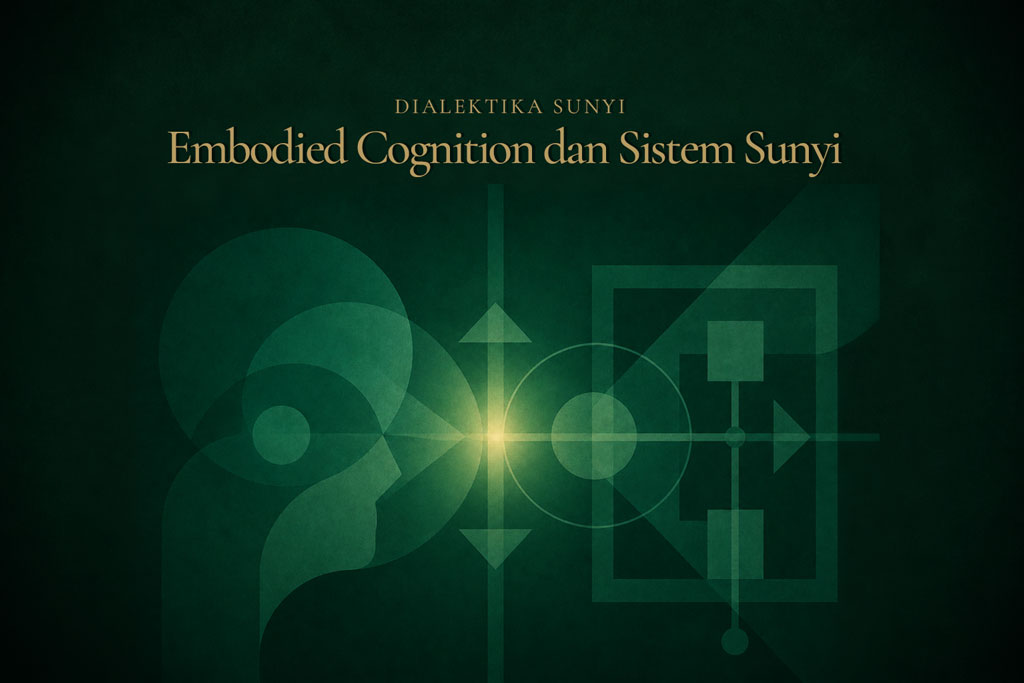
The mind never arrives alone. It always comes with a breathing body, an inhabited space, recurring habits, tools in use, other people who help shape attention, and a world that opens or closes possibilities.
Someone sits before a laptop intending to finish a piece of work. Before the first paragraph has been read, their hand is already reaching for the phone. Their shoulders begin to fold inward, their breathing shortens, and attention moves before any clear reason can be named. The explanation—“I lost focus”—comes later. The body has already entered the story.
This simple experience reveals something long overlooked in many discussions of mind. Human beings have often been imagined as thinking mainly through processes inside the head, while the body merely carries out decisions already made. Embodied Cognition grew from an objection to this picture. It does not deny the importance of the brain, but asks whether the brain alone is enough to explain how human beings recognize the world, make decisions, and learn to live.
If mind always works with body, then attention, emotion, memory, and self-understanding cannot be cleanly separated from posture, movement, space, tools, and environment. Mind is not an invisible content directing the body from a distance. It takes shape through the ways a body inhabits, acts, waits, withdraws, and meets the world.
This change in perspective does not make inner life disappear. It gives inner life firmer ground. What The System of Silence calls Feeling, direction, or clarity is always lived by a body that breathes, moves, tires, falls ill, learns, ages, and interacts. Inner life does not lose depth when the body is included. It loses only the illusion that depth can exist without ground.
When the Mind Is No Longer Seen as an Isolated Computer
For several decades, influential currents within cognitive science often described mind as a computational system: information enters, internal representations process it, and decisions or actions follow. This picture has explained a great deal. The difficulty begins when one working model is treated as a complete account before body and environment have entered the explanation.
In everyday life, human beings rarely solve problems only by manipulating abstract representations inside the head. They look, move, touch, adjust posture, use surrounding objects, and continually receive feedback from the environment. Thinking often resembles a conversation between organism and world more than calculation in a sealed room.
The critique of computationalism is therefore not a wholesale rejection of computation or representation. Some embodied approaches retain both, while others move much farther away from them. What they share is a refusal to consider cognition fully explained before bodily form, possibilities for action, social situations, tools, and environment have been allowed to matter.
The boundary needs to hold in both directions. Scientific knowledge of the body need not erase the language of meaning, value, or faith. Language about soul or inner life, in turn, cannot float as though brain, body, and environment played no part in experience. Both become clearer when neither is asked to take over the work of the other.
One Family of Ideas, but Not One Voice
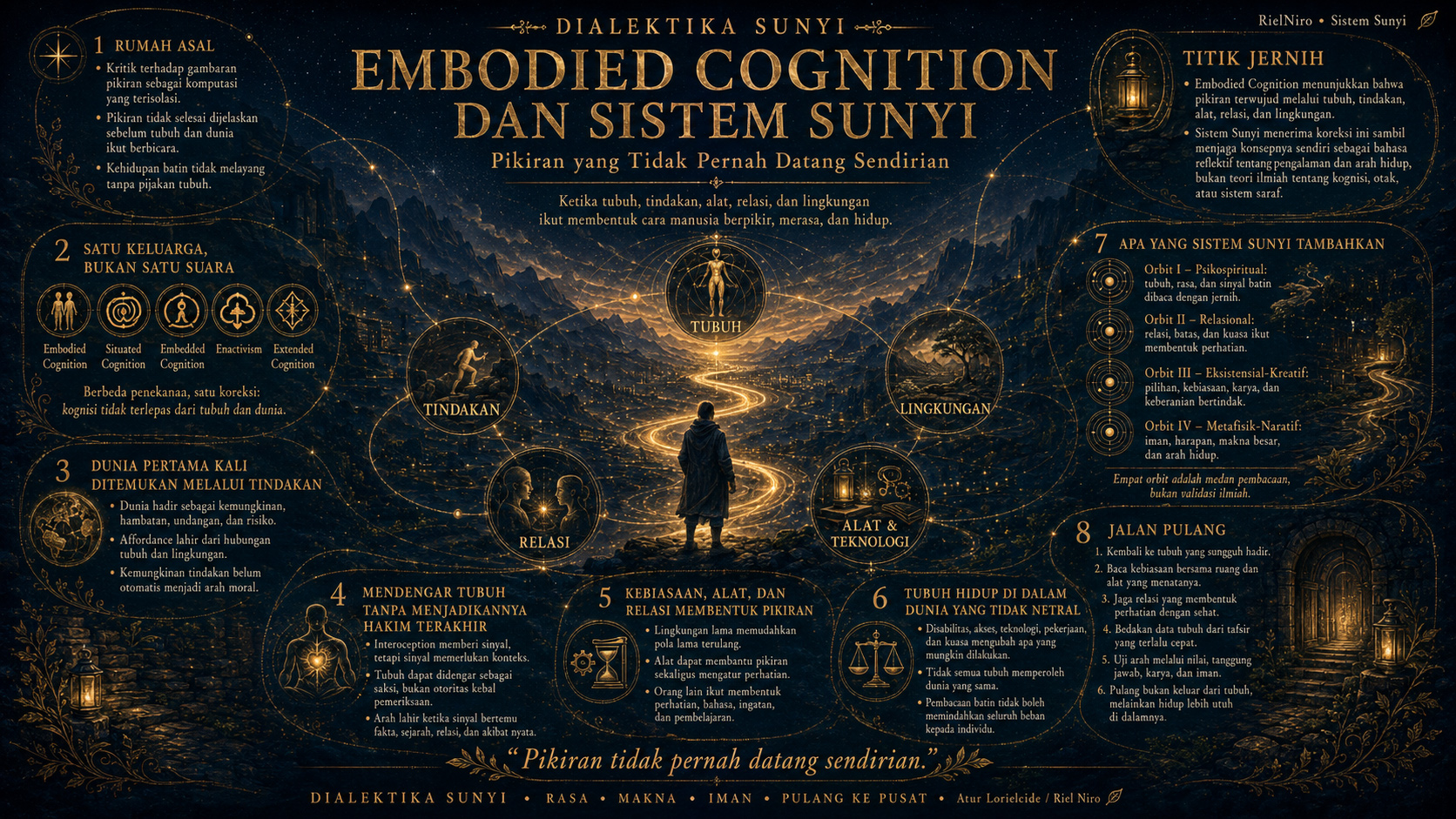
Embodied Cognition is not a single theory. It is a family of neighboring approaches that do not always share assumptions or reach the same conclusions. Treating them as identical would erase the debates that have enabled the field to develop.
Embodied approaches emphasize how bodily form and sensorimotor capacities help shape the way a world is understood. Situated cognition attends to the concrete situation in which thinking occurs. Embedded cognition shows how an environment can reduce or carry part of a cognitive load. Enactivism places greater weight on the organism’s active involvement in bringing forth a meaningful world.
Extended cognition goes further by proposing that, under certain conditions, tools outside the body may become part of a cognitive system. This claim remains debated. Not every object in use automatically becomes part of the mind, and not every theory draws the boundary of mind in the same place.
This diversity means that dialogue need not begin by choosing a camp. The System of Silence can first receive the discipline these approaches share: when speaking of inner life, do not let body and world disappear; when explaining body and world, do not mistake one level of explanation for the whole human being. Their disagreements should remain visible, because those differences clarify the boundaries of the conversation.
The World Is First Discovered Through Action
When someone climbs stairs, each step is rarely measured before moving. When a musician plays an instrument, every movement is not translated into a conscious instruction. The world first appears as something that can be done, not as a collection of information that must be analyzed.
In sensorimotor accounts, perception does not stand apart from possibilities for action. A body knows space through movements it can or cannot make: reaching, stepping, bending, avoiding, approaching. The world does not first arrive as a neutral image. It appears at once as opportunity, obstacle, invitation, and risk.
James J. Gibson gave this relation an influential name: affordance. A chair affords sitting, stairs afford climbing, and a door handle affords a particular way of opening. The possibility belongs neither to the object alone nor to a body inventing it at will. It arises between features of an environment and the capacities of the organism encountering them.
For this reason, the same world does not appear in the same way to every body. Stairs that are easy for an athlete may become a barrier for an older person or a wheelchair user. A room that feels safe to one person may feel threatening to another. Affordances are not universal because bodies, histories, capacities, and environments are not uniform.
Affordance helps describe what becomes available, possible, or easy within a body–environment relation. It does not tell anyone what ought to be done. A possibility for action is not yet a moral decision. Cognitive description reaches a boundary here, and questions of value, responsibility, and life direction begin to require another home.
When the Body Is No Longer Felt as an Object One Owns
On most days, a hand reaches for a glass, feet adjust their steps, and the body avoids collision without constant conscious supervision. This fluency is often discussed through body schema: sensorimotor organization that allows movement without first turning every gesture into an object of thought. The term and its boundaries remain debated, but the experience it names is close to everyday life.
The body is not a passive object controlled by the mind from a distance. Years of walking, writing, driving, cooking, or playing music form an intelligence that does not always appear as a thought that can be put into words.
Body image is often distinguished from this territory because it concerns how someone perceives, evaluates, accepts, or rejects the body. The boundary between the two is not always clean. An athlete recovering from injury may still know how to move while doubt fills every step. Someone shaped by years of humiliation may have a functioning body and still feel estranged from it.
For The System of Silence, this distinction helps prevent the body from being reduced to a mere symbol of inner condition. The body has its own history, capacities, wounds, and changes. It can be injured without losing dignity, change without losing value, and grow old without losing direction in life.
Listening to the Body Without Making It the Final Judge
The body continually gives signals through heartbeat, breath, hunger, tension, temperature, pain, and fatigue. Interoception is the capacity to sense internal bodily states. Many emotions take shape through the conversation between attention and signals of this kind.
Yet bodily signals do not arrive with a finished meaning. A rapid heartbeat may accompany fear, excitement, anger, exercise, lack of sleep, certain medication, or too much caffeine. The body gives information, but that information requires context.
For this reason, the slogan that the body always knows the truth must be treated carefully. The body often detects change before a rational explanation is formed, but speed does not guarantee accuracy. Signals need to be read together with health conditions, life history, relationships, environment, facts, and real consequences.
The body can therefore be received as living data without being made an authority beyond examination. What is felt deserves attention because it may carry something for which language has not yet formed. But listening is not the same as immediate belief. Direction emerges only as bodily signals meet context, fact, history, relationship, and consequence.
Habit Changes the World Before the World Feels Changed
Many actions that first arise from decisions gradually become patterns that are barely noticed. The environment then calls forth particular actions before conscious deliberation occurs. A phone beside a laptop, room lighting, chair position, home layout, and travel rhythm all help shape the movement of attention.
Change often fails not because intention is weak, but because the body continues to inhabit the same arrangement of possibilities. The old environment still invites the old action. A new decision must struggle against a world that has not changed, and the exhaustion of that struggle is easily mistaken for a lack of will.
Habit Orbit provides reflective language for the default pathway that pulls inner life back toward old patterns. It is not a fifth orbit and does not stand alongside Orbits I through IV. In this dialogue, Embodied Cognition helps show how repeated reactions, hardened meanings, and an unchanged environment can reinforce one another.
This is not scientific proof of Habit Orbit. It is a point of conversation that also corrects it. Inner change cannot be read only as an increase of determination. It may require changes in rhythm, space, tools, relationships, and the possibilities an environment offers each day. A habit is not only something repeated; it is also something continually made easy to repeat.
The Mind Is Also Shaped With Other People
The human mind does not develop only through relations with objects. From the beginning of life, attention is shaped through gaze, gesture, voice, caregiving, imitation, and coordination with others. A child learns what matters because someone points, names, responds, and repeats.
Language is not merely content stored inside the head. Words direct attention, divide the world into categories, carry shared memory, and provide ways to request, refuse, promise, explain, and take responsibility. Human cognition operates within social practices that already have histories.
Other people can also become part of a cognitive environment. Conversation helps a person remember, notice errors, test reasons, and discover possibilities that do not arise alone. Yet relationships can also narrow attention through humiliation, manipulation, fear, or demands for constant conformity.
This correction keeps Echo from becoming a voice born in a private chamber. What returns within is read together with bodily history, language, relationships, and world. The System of Silence receives that wider field without handing judgment over to the social voice. Closeness still needs fact, boundaries, responsibility, and the freedom to differ.
The World Is Not Only Received but Shaped Through Involvement
Enactivism emphasizes that a meaningful world does not always appear as a collection of neutral objects later given meaning from outside. Across its different forms, meaning grows through the involvement of an organism that moves, needs, learns, and responds. The emphases vary, but each unsettles the image of mind as a spectator merely receiving the world.
A climber sees a mountain differently from a tourist. A mother who has just lost a child moves through the same house with a meaning different from that of a guest. The physical environment may be the same, but the way the world appears changes because the history of relation has changed.
Feeling and Echo therefore can no longer be easily imagined as arising from a sealed interior. What resonates is shaped by bodily history, need, relationship, value, language, and the inhabited world. Embodied Cognition does not replace the canonical meaning of Echo. It widens the discipline of reading so that what feels inward is not detached from the life that made it possible.
Involvement does not mean that human beings create reality at will. The world resists. Bodies have limits. Other people have freedom. Not every hope becomes real, and not every choice produces the desired result. Human beings shape the world while continuing to be shaped by it.
When Tools Help the Mind While Also Governing Attention
Extended cognition raises a question that unsettles old boundaries: if a person consistently relies on a digital calendar to remember appointments, does remembering still occur entirely within the brain? Under certain conditions, notebooks, maps, phones, hearing aids, screen readers, or shared work systems can perform part of a cognitive function.
Not every tool automatically becomes part of mind. Accounts of extended cognition usually require the relation to be sufficiently stable, accessible, trusted, and integrated into the way someone acts. Even those criteria remain contested. The question of where mind ends is still open.
Technology is also not neutral. Interfaces, notifications, endless feeds, and algorithms are designed to direct attention. A tool that helps memory can also shape what is considered important. When cognitive architecture depends on platforms owned by others, questions of data, economic interest, control, and dependence cannot be ignored.
Signal-to-Noise Ratio (SNR) enters this dialogue as a reading of clarity, not a neural measure or productivity formula. The Ecology of Silence can read the digital environment as part of the habitat of inner life. Extended cognition scientifically proves neither concept. Instead, it presses both to stop discussing attention as though distraction always began in a failure of personal will.
The Trace of Experience Never Exists Only Inside the Body
The phrase “the body stores wounds” can remind us that experience does not end as memory that can be told. A disturbing event may leave traces in the anticipation of threat, breathing, attention, sleep, posture, and patterns of movement long after the event. Yet the phrase remains a metaphor requiring care, not a complete account of how experience endures.
Yet the body is not a warehouse that stores complete recordings of the past. Shoulder tension does not prove a particular trauma. A rapid heartbeat does not always mean an old danger has returned. Bodily responses may relate to physical condition, sleep, illness, medication, relationships, environment, previous experience, and present circumstances.
Respecting the body requires care in interpreting it. Medical, neurological, psychological, and relational examination each have their own home. This article does not diagnose and does not make the nervous system a universal language for every experience.
The body can be heard as a witness without being raised into a judge. It may open a door toward something that needs attention, but it carries no complete verdict about cause or meaning. Experience still has to meet the body itself, appropriate examination, relationships, history, and a wider reality before clarity can take form.
Not Every Body Receives the Same World
An environment that feels easy to one body can become a barrier to another. Stairs, announcement sounds, font size, lighting, distance, service speed, and digital design determine who can move, read, hear, work, or participate in decision making.
Wheelchairs, canes, prostheses, hearing aids, screen readers, and communication technologies are not always mere additions to a body considered deficient. In many lives, these tools become part of the way the world can be inhabited and action can be performed. They show that human independence is often built through networks of support.
Disability cannot serve merely as a dramatic illustration of affordance theory. It corrects assumptions about a normal body and a neutral world. Some limitations relate to bodily conditions; many barriers arise or intensify because environments are designed for only some people. The experience of disability also remains diverse and cannot be exhausted by either a social or a biological model.
Dignity does not depend on seamless function, rapid adaptation, or independence without assistance. For The System of Silence, reading a body also means asking what support is present, what access is closed, and who is continually expected to adapt alone. Dependence does not diminish wholeness. Often it only reveals the network hidden beneath the myth of independence.
The Body Always Lives in a World That Is Not Neutral
Not everyone has the same space, time, safety, and freedom to regulate breathing, change habits, or redesign an environment. Some bodies are forced to work beyond their limits, live under threat, or adapt to systems never designed for their existence.
Economics, gender, age, race, disability, work, law, and the distribution of power help shape the affordances of everyday life. Some noise does not arise from a failure of self-regulation, but from a world that continually disrupts the possibility of living as a whole person.
Inner reading must not transfer the whole burden to the individual. Finding the Center remains important, but the Center does not live outside material conditions. The Inner Fence is not enough when institutions continually produce threat. New habits struggle to survive when an environment punishes every change. Here inner life meets the distribution of space, time, safety, and power.
Here dialogue with Systems Thinking, Critical Theory, Care Ethics, and Liberation Theology becomes relevant. Yet this article does not collapse those homes into one another. It only affirms that embodied cognition always has social and political dimensions.
Freedom Also Has a Body and an Environment
If habit, body, tools, relationships, and environment help shape choice, freedom cannot be imagined as a pure will standing outside them all. Human beings choose from within conditions that have already opened some possibilities and closed others.
Yet influence is not total determination. Human beings can learn to pause, change a space, ask for help, build new habits, refuse demands, and work with others to change structures. Freedom is a limited capacity that is practiced, supported, and capable of being expanded or narrowed.
Responsibility therefore needs to be read together with conditions. Recognizing the influence of body and environment is not a reason to erase accountability. Conversely, demanding responsibility without reading conditions can become a moralism that blames people for a world they did not choose.
The System of Silence can speak of Pause, the Inner Fence, direction, and Returning Home, but this language must still meet concrete support. Sometimes the path of Returning Home requires sleep, medication, access, a decent income, safe space, assistive technology, community, or institutional change. Inner orientation does not become less profound because it needs conditions through which a body can live it.
Faith Is Also Lived by the Body
Prayer is carried by a breathing body. Worship is lived by a body that can tire. Silence is experienced through a nervous system continually regulating readiness for the world. To acknowledge this does not diminish faith. It returns faith to life as it is actually lived, rather than to an image of someone who could believe without a body.
Physiological regulation can help explain why someone feels calmer after prayer, but that explanation does not automatically cancel the meaning of prayer. Conversely, an experience of peace does not prove that every biological process is irrelevant.
The Law of Silent Vibration is not a scientific theory of interoception, sensorimotor processing, or the nervous system. It is reflective language within Orbit I concerning movement, resonance, reflection, and inner balance. Embodied Cognition does not prove it. The encounter instead requires the concept to preserve its boundary, distinguish metaphor from mechanism, and refuse borrowed scientific authority for a claim living in another epistemic home.
Faith is not a layer added only after the body has been explained. Faith is lived through habit, posture, rhythm, prayer, action, relationships, and the way human beings use power. The body does not become the enemy of faith, and faith does not become an escape from the body.
Description Does Not Automatically Give Moral Direction
Embodied Cognition explains how perception, attention, memory, and action operate through body and world. This explanation matters, but it does not by itself determine the good life. Knowing why an action is easy does not answer whether the action is just or worthy.
The System of Silence brings a language of value, dignity, responsibility, meaning, and faith. That language receives no automatic scientific justification merely because it can enter a dialogue with embodied cognition. Conceptual resonance may deepen a reading without becoming evidence. Dialogue is not validation.
Conversely, cognitive science need not be burdened with answering every moral and spiritual question. Each home has its own methods, limits, and forms of accountability. A healthy meeting occurs when both correct one another without taking one another over.
This position protects the article from two errors: using science to give false authority to metaphor, or using the language of meaning to ignore findings about body and environment.
The Body Explains Much, but Does Not Exhaust the Human Being
Embodied Cognition teaches that the mind grows with the body, is shaped by habit, influenced by space, assisted by tools, directed by environment, and continually changed through relation with the world. The mind does not live alone and is never truly separated from lived life.
Yet mechanism is not an enemy to be defeated. Biological, sensorimotor, social, and technological mechanisms are real parts of human beings. The problem arises when one level of explanation is treated as the entire language of personhood.
Human beings think through the body, but are not exhausted by descriptions of the body. They are shaped by the world, but not completely determined by it. They accept biological limitation without losing dignity, and bear responsibility without pretending to be free from history, relationships, and structures.
The conversation between Embodied Cognition and The System of Silence does not end by deciding which can explain a human being best. It leaves two losses that must remain in view: body separated from meaning, and meaning separated from body. Between them, a person still lives as a body that interprets, chooses, needs others, meets the limits of a world, and remains responsible for the direction slowly being formed.
Dialektika Sunyi (Format 2) adalah ruang dialog antara Sistem Sunyi dan dua puluh empat rumah pemikiran dari berbagai tradisi filsafat, psikologi, etika, teologi, dan pemikiran sosial. Dua puluh empat tulisan ini tidak disusun untuk menjadikan tradisi-tradisi tersebut sebagai bagian dari Sistem Sunyi, melainkan untuk mempertemukan cara pandang yang berbeda agar manusia dapat dibaca dari lebih dari satu pintu.
Sistem Sunyi tidak datang ke dalam dialog dengan rumah yang kosong. Ia sudah membawa cara membaca sendiri: Rasa perlu didengar tanpa segera dijadikan kebenaran, Makna tidak dipaksakan kepada luka, Iman memberi arah tanpa menjadi jawaban instan, dan manusia tidak dapat dihabiskan oleh satu istilah atau satu peta.
Karena itu, setiap rumah pemikiran hadir sebagai ruang dialog yang tetap memiliki bahasa, sejarah, pertanyaan, dan batasnya sendiri. Dialektika Sunyi bukan upaya membuktikan bahwa dua puluh empat tradisi tersebut pada akhirnya mengatakan hal yang sama dengan Sistem Sunyi.
Mengapa dua puluh empat rumah pemikiran?
Karena manusia terlalu luas untuk dibaca melalui satu lensa. Penderitaan dapat hadir sebagai pengalaman batin, pola tubuh, relasi, cerita diri, bahasa, kondisi sosial, struktur kuasa, sejarah, iman, maupun perubahan kehidupan. Satu lensa dapat membuka sesuatu yang penting, tetapi selalu ada wilayah yang berada di luar jangkauannya.
Dua puluh empat rumah pemikiran karena itu membuka percakapan dari berbagai arah. Membuka pintu tidak berarti meninggalkan rumah. Setiap tradisi tetap dibaca sebagai rumahnya sendiri, sementara Sistem Sunyi membiarkan perjumpaan itu memperluas cara melihat tanpa kehilangan batasnya.
Di dalam panel ini, dua puluh empat tulisan dibagi menjadi tiga bagian: Peta I, Peta II, dan Peta III. Ketiganya adalah pembagian navigasi untuk membantu menemukan delapan rumah pemikiran pada masing-masing bagian.
Sebelum masuk ke daftar, dua ruang berikut dapat digunakan untuk melihat keseluruhan Dialektika Sunyi dalam skala yang lebih luas:
Atlas Dialektika Sunyi
24 Percakapan, 24 Peta Pembacaan
Ruang orientasi publik untuk menjelajahi dua puluh empat tradisi yang berdialog dengan Sistem Sunyi tanpa kehilangan rumah pemikirannya masing-masing.
Peta Pengetahuan Dialektika Sunyi
Dua Puluh Empat Rumah. Tidak Ada yang Dilebur Menjadi Satu.
24 Rumah Pemikiran · 20 Kejernihan · 25 Pintu Kehidupan
Ruang untuk melihat bagaimana dua puluh empat tradisi dipertemukan dengan Sistem Sunyi tanpa penyerapan, kemenangan, atau sintesis yang lebih tinggi.
Peta ini hanya membantu menemukan jalan. Pembacaan sebenarnya terjadi di dalam masing-masing tulisan, ketika satu rumah pemikiran dibuka dan dialognya dengan Sistem Sunyi mulai berlangsung.
Paket I bergerak paling dekat dengan pengalaman personal, tetapi tidak membiarkan batin menjadi dunia yang tertutup. Kendali bertemu keadaan, perhatian bertemu makna, kedekatan membawa sejarah relasi, kebebasan berhadapan dengan keterbatasan, dan keheningan diuji oleh doa serta kehidupan yang kembali dijalani.
- Ketika keteguhan tidak berarti mematikan rasa
- Ketika hadir belum berarti memahami
- Ketika hidup tidak hanya meminta penjelasan, tetapi jawaban
- Ketika kebutuhan akan tempat aman ikut membentuk cara manusia mencintai
- Ketika hidup tidak menyediakan kepastian yang dapat memilih atas nama manusia
- Ketika bagian diri yang tidak disadari ikut membentuk cara manusia melihat kenyataan
- Ketika bahasa iman belajar mengakui Tuhan tanpa menjadikan misteri sebagai tempat bersembunyi
- Ketika keheningan di hadapan Tuhan kembali menjadi kasih, kerja, batas, dan tanggung jawab
Paket II memperdalam pertanyaan tentang bagaimana pengalaman sebenarnya terbentuk. Apa yang terasa tidak hadir tanpa tubuh. Apa yang dipahami tidak lahir tanpa bahasa. Agency mempunyai lingkungan. Care mempunyai distribusi beban. Makna dan keyakinan memperoleh ujian ketika mereka meninggalkan jejak dalam kebiasaan, tindakan, dan dunia bersama.
- Ketika kenyataan perlu diberi ruang sebelum kesimpulan mengambil alih
- Ketika tubuh, kebiasaan, alat, relasi, dan dunia ikut membentuk cara manusia memahami dan memilih
- Ketika rasa sakit tidak harus hilang sebelum manusia bergerak menuju yang bernilai
- Ketika motivasi dibaca melalui autonomy, competence, relatedness, dan mutu alasan untuk bergerak
- Ketika kisah hidup memberi arah, tetapi tidak berhak menjadi seluruh kenyataan
- Ketika bahasa, sejarah, tradisi, dan kuasa ikut menentukan apa yang dianggap sebagai kebenaran
- Ketika kebutuhan, dependency, kerja perawatan, kompetensi, dan pembagian beban menjadi persoalan moral
- Ketika gagasan diuji melalui kebiasaan, penyelidikan, konsekuensi, komunitas, dan revisi
Paket III membawa pembacaan ke kondisi yang membuat sebagian pengalaman dipercaya, sebagian dinormalkan, dan sebagian bahkan sulit memperoleh bahasa. Struktur dan sejarah masuk lebih jelas, tetapi manusia tidak dibiarkan menghilang di dalamnya. Karena itu Systems Thinking bertemu Virtue Ethics, Liberation Theology bertemu batas praxis, dan Process Philosophy menutup paket dengan kehidupan yang terus menjadi tanpa kehilangan tanggung jawab.
- Membaca penderitaan di antara batin, ideologi, institusi, ekonomi, dan distribusi kuasa
- Ketika pengetahuan dibentuk oleh posisi, tubuh, bahasa, kredibilitas, dan relasi kuasa
- Bahasa, institusi, dan relasi yang membuat kategori terasa alamiah
- Sejarah, bahasa, representasi, dan kuasa di balik hak untuk menjelaskan manusia lain
- Membaca pola, feedback, penundaan, batas sistem, dan perubahan yang tidak pernah berdiri sendiri
- Karakter, kebiasaan, emosi, teladan, dan kebijaksanaan praktis dalam kehidupan sehari-hari
- Ketika doa, kasih, keselamatan, dan kitab diuji oleh kemiskinan, penindasan, serta tindakan pembebasan
- Identitas, relasi, waktu, dan Pusat yang bertahan tanpa membeku menjadi bentuk final
Lorong Kata adalah ruang refleksi di TokohIndonesia.com tempat gagasan dan kesadaran saling menyeberang. Dari isu publik hingga perjalanan batin, dari hiruk opini hingga keheningan Sistem Sunyi - di sini kata mencari keseimbangannya sendiri.
Berpijak pada semangat merdeka roh, merdeka pikir, dan merdeka ilmu, setiap tulisan di Lorong Kata mengajak pembaca menatap lebih dalam, berjalan lebih pelan, dan mendengar yang tak lagi terdengar.
Atur Lorielcide berjalan di antara kata dan keheningan.
Ia menulis untuk menjaga gerak batin tetap terhubung dengan pusatnya.
Melalui Sistem Sunyi, ia mencoba memetakan cara pulang tanpa tergesa.
Lorong Kata adalah tempat ia belajar mendengar yang tak terlihat.
Baca juga: Dua Ruang, Satu Sunyi: Jejak Atur Lorielcide alias Rielniro