
 Tulisan ini bagian dari sistem kesadaran reflektif
Human beings live through events, but understand themselves through stories. Identity is shaped not only by what happens, but also by how life continues to be told and retold.
Two siblings may carry home the same memory and yet live within entirely different stories. Both experienced their family’s move to another city. For the first, it became the beginning of freedom after years of feeling confined in the old environment. For the second, it became the beginning of loss, because the whole world they knew disappeared through a decision they had never chosen.
Several decades later, the story may change again. One of them may begin to see that their parents were themselves trying to survive under economic pressure. What once looked like betrayal is slowly read as limitation. The event has not changed, but the relationship to the event is no longer the same.
This is where Narrative Identity begins to speak. Human beings do not merely experience life and store it like an archive that can one day be reopened. They keep selecting fragments, arranging relationships among events, deciding where a beginning or turning point lies, and placing themselves as agent, victim, survivor, witness, or someone searching for a new direction. Life becomes intelligible not because every event has an obvious meaning, but because people keep trying to weave events into a story.
This effort brings a great benefit. Story keeps life from feeling like a collection of scattered events. Through story, a person can recognise the thread connecting childhood with today’s choices, or understand why a particular wound still shapes the way they love, work, and hope. Without the capacity to build narrative, experience can easily become fragments that never truly speak to one another.
Yet precisely because story gives form, it also carries power. It decides which fragments count as important, which are forgotten, who is regarded as the cause, and what kind of future feels possible. Story does not merely explain life. Slowly, it begins to direct life.
The question of Narrative Identity is therefore not whether human beings have stories. Everyone does. The more important question is how someone begins to live inside a story they have built themselves. Is the story wide enough to keep receiving new reality, or has it become a house too narrow for a life that is still moving?
Identity as something continually woven
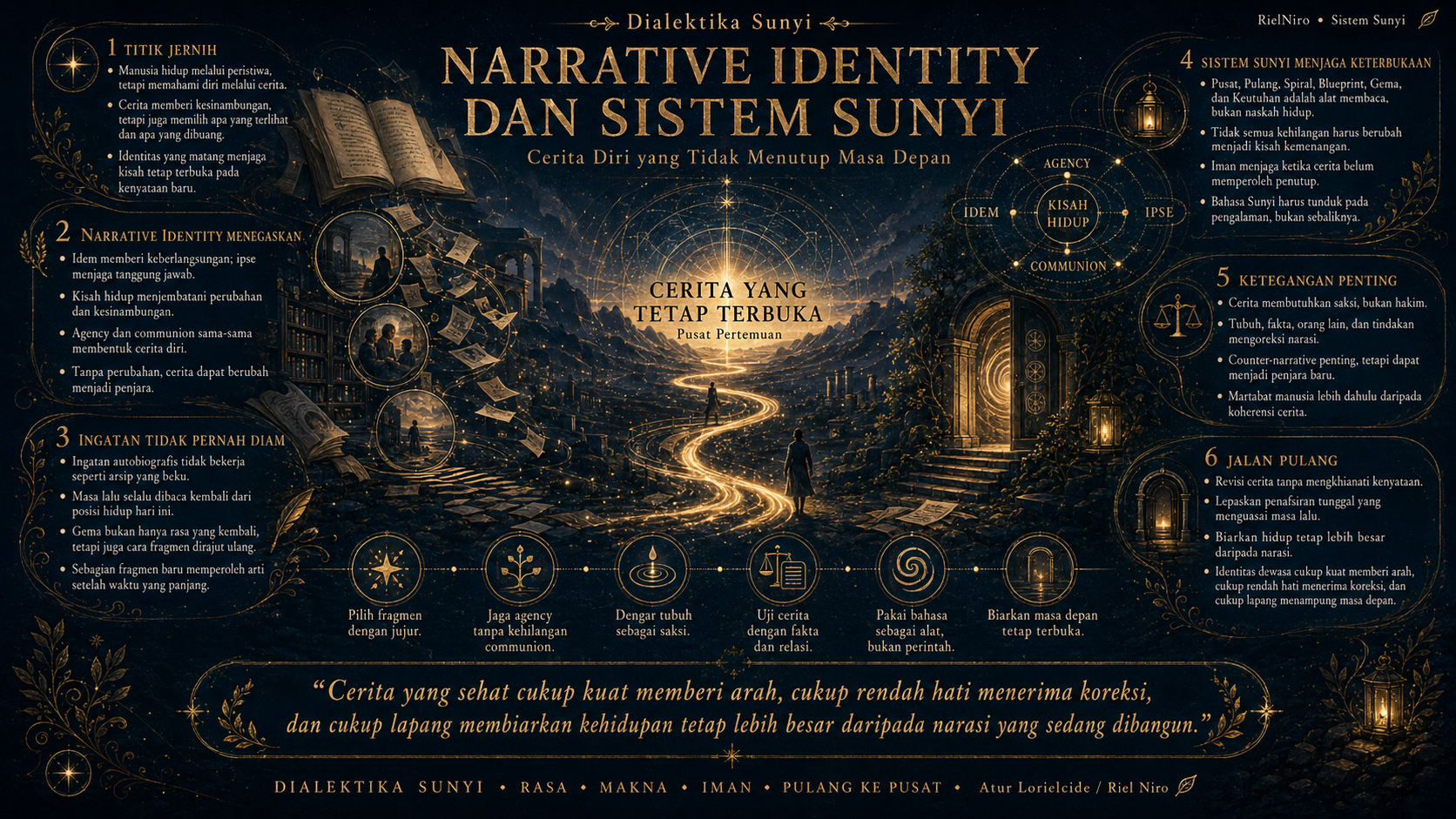
Paul Ricoeur offers one of the most important foundations through his distinction between idem and ipse. Idem refers to the elements by which someone is recognised as the same person over time. Ipse, by contrast, points to the capacity to remain answerable for oneself even as life changes. A person may change work, beliefs, relationships, and even the way they view the past, yet still be called to answer for promises, choices, and consequences they have made.
Between the two, Ricoeur places narrative identity. The self is neither a fixed object nor a formless stream of experience. Human beings preserve continuity precisely through stories that are continually rewoven. Story becomes a bridge between change and persistence. Without story, change feels like rupture. Without change, story becomes a prison.
Through this understanding, the language of Center takes on a more supple form. It need not be imagined as a hidden core that never changes, but as an orientation preserved while the form of life shifts. Returning Home does not mean becoming the same person one once was. It means continuing to recognise direction when life demands a new form.
From personality psychology, Dan McAdams develops a different yet complementary account. He understands Narrative Identity as an internalised and evolving life story. Its foundations begin to grow through conversation and memory in childhood, while a more integrated life story takes shape in adolescence and emerging adulthood. Human beings connect a reconstructed past, a lived present, and an imagined future within a story that offers some degree of continuity, purpose, and meaning. The story is never finished. It keeps growing, being corrected, shortened, expanded, and sometimes rewritten after an experience changes the way a person understands themselves.
Within that story, McAdams reads two motivational themes that recur across life narratives. The first is agency, expressed through power, choice, achievement, and the capacity to influence the direction of life. The second is communion, expressed through love, intimacy, dialogue, care, and a place within meaningful relationships. Many life stories move between these two longings: to be someone who can act and to be someone who still has a home among others.
Ricoeur and McAdams speak in different languages, but both remind us of the same thing. Identity is not a list of traits stored inside the self. It is ongoing work. Human beings continue becoming themselves through the way they understand what has happened, what is being lived, and what may still be pursued.
The affinity between Narrative Identity and the vocabulary of The System of Silence lies in a shared effort: reading continuity within change. Yet that affinity also carries a warning. Returning Home, Spiral, Blueprint, and Wholeness can help people read life only while they remain tools. When this language becomes a story that must be followed, its original function reverses. What once helped life to be understood begins to command how life ought to unfold.
Memory that never truly falls silent
If identity is built through story, memory becomes material that is continually rewoven. Yet autobiographical memory does not work like a filing cabinet preserving the past exactly as it was. Each time a person remembers, they are rebuilding the relationship between the past and the self who remembers now.
No memory therefore stands entirely alone. The question being faced today, the person listening, the sense of safety or threat, and even newly acquired language help determine which fragments appear first. The past does not change, but the path toward the past is always changing.
A woman who spent her youth saying that her family was fine may only decades later acquire language for control, manipulation, or emotional neglect. Her story changes not because she is inventing a new past, but because her present self can see relationships she once could not name.
Story can also change in the opposite direction. In order to defend a decision already made, people may unconsciously select fragments that support their present belief and let other parts slowly disappear. Memory can heal, but it can also protect an identity that is trying to preserve itself.
Here Narrative Identity avoids two extremes at once. It does not treat memory as an objective recording that never changes, but neither does it assume that every reconstruction carries the same weight of truth. Story always moves between what was genuinely experienced and the way that experience continues to be understood again.
Echo names something that keeps returning and calling for attention. Narrative Identity widens the reading: what returns is not only Feeling, but also the way a person links the fragments of life. A wound may carry the same Echo while its meaning slowly shifts because life has moved elsewhere.
This is why the Larger Map of Fragments has a natural affinity with this territory. Life does appear as pieces that do not always speak to one another. Yet Narrative Identity reminds us that fragments are not puzzle pieces that already belong to one final picture. Some gain meaning only after years. Some shift when relationships change. Some never find a place of complete unity.
A story needs a witness, not a judge
Not every story can emerge merely because a person is ready to speak. Some stories take shape only when another person is safe enough to listen. Experiences denied for too long often do not lack memory. They lack a space where memory can be spoken without being immediately contradicted, corrected, justified, or forced into a conclusion.
A survivor may carry the same fragments for years, yet begin to understand the experience only when someone does not rush to ask why they did not leave sooner. A child may realise how heavy an old role was only after entering a relationship that does not require them to keep mediating. The listener does not create a new past. Yet the way a person is heard can determine whether the past remains a burden without language or begins to find a place where it can be thought about.
Witnessing therefore carries both power and danger. A listener can help someone find words, but can also insert a plot that never truly belonged to the speaker. Therapists, religious leaders, families, media, and communities may name an experience too quickly: trauma, calling, forgiveness, recovery, or victory. A name can open a door. It can also hurry an experience into the wrong room.
Narrative Identity is therefore not only about who tells the story, but also before whom the story is formed. Life stories always arise within relationships. Questions, looks, trust, distrust, and the listener’s expectations help determine which parts dare to appear and which parts return to hiding.
Here Silence is tested by the way a person listens. It is not a space in which the interpreter takes over another person’s story, but one that protects the time an experience needs to find its own language. Accompanying does not mean accelerating a conclusion. Listening is not waiting for a turn to place someone inside a map already prepared.
The human desire for continuity
From memory, human beings begin building something larger: the sense that they remain the same person amid the changes of life. In Narrative Identity, this function is often read as temporal continuity, a thread linking the remembered self, the self now living, and the self still imagined. Without such a thread, life can feel like a series of episodes with no relation to one another.
That thread may be built through enduring values, relationships continually cared for, a place still called home, or choices that gradually form a direction. Through such a thread, a person can say, “I have changed, but I still recognise myself.”
Continuity, however, has another side. A thread pulled too tightly can become a rope that binds. Statements such as “I have always been this way,” “I can never change,” or “I was born to be like this” often offer safety because they offer certainty. Yet that certainty may be purchased by the loss of new possibilities.
Coherence works alongside continuity. Human beings want life to make sense. They want to know why a loss led them toward a particular work, why a failure changed the way they love, or why one decision eventually opened the way to decisions that followed.
The desire for coherence is not wrong. Through it, experiences that were once fragmented can slowly become intelligible. Yet coherence becomes a trap when people begin cleansing their stories of everything that does not fit the plot they have chosen.
Some people want so badly to see themselves as survivors that every wound must end in victory. Others are so certain they always fail that every success is dismissed as an irrelevant accident. In both cases coherence has been achieved, but not because life has truly been understood. It has been achieved because disturbing parts were quietly removed from the story.
The critique of coherence touches the language of Wholeness directly. Wholeness must not become a demand that every fragment eventually find a beautiful place. Some lives continue to hold contradiction. Some decisions are never fully explained. Some losses do not become lessons. Wholeness may not be the ability to answer everything, but the ability to keep walking while carrying what has not yet been understood.
Becoming an agent without becoming a hero
From continuity and coherence, story moves toward the next question: who am I within this story? Here the theme of agency appears. Almost everyone wants to experience themselves not merely as something continually pushed by circumstance, but as someone who can still choose a direction for life.
Agency can restore enormous energy. Stories such as “I once rose again,” “I repaired a wrong,” or “I can still begin” keep the future open. They make room for hope even when circumstances have not yet changed.
Yet agency can easily become a myth of heroism. Modern stories often glorify individuals who seem to have overcome everything alone. Family support, social opportunity, economic conditions, luck, and even the body that enabled someone to endure slowly disappear from the story. What remains is a central character who appears able to transform an entire life through personal will.
Narrative Identity shows that mature agency never stands alone. A person does choose, but every choice takes place within a particular history, body, set of relationships, and world that both provides and restricts possibility.
The critique of heroic agency also reaches the language of work, calling, and journey. Not every success can be turned into evidence that everyone could have done the same. Human dignity is not determined by how heroically someone can rewrite a life. Agency sometimes appears in far simpler steps: remaining present, continuing to speak honestly, or preserving direction when circumstances still offer no way out.
Mature agency therefore does not only say, “I chose.” It can also say, “I was helped,” “I was constrained,” or “this part was never within my control.” Such acknowledgement does not diminish freedom. It frees a person from the demand to become the sole hero of an entire life.
When identity is built with other people
No story contains only one character. Sooner or later, every life story returns to relationship. Here McAdams speaks of communion, the human longing to have a place among others.
Some people recognise themselves mainly through what they have accomplished. Others recognise themselves through whom they love, whom they care for, or which community gives them a sense of home. In reality, the two almost always move together. Human beings want a meaningful life, but they also want that life to be shared with someone.
The problem appears when communion hardens into a role. The child who always mediates the family begins to believe that their existence is useful only when they keep the peace. A mother recognises herself only while caring for everyone. A leader loses identity when no longer needed. A relationship that once gave a home slowly becomes a room deciding who a person must continue to be.
The Paradox of Kinship meets Narrative Identity naturally when home is understood not only as a place that shapes identity, but also as a space that can lock a story in place. Closeness can nurture life, but it can also leave a person never knowing themselves beyond the role they continue to perform.
Mature communion is therefore not a relationship that refuses change. It is strong enough to let each person grow without treating growth as a threat to belonging. A healthy home does not force a story to stop at one chapter. It gives each person room to keep writing the next part of life.
Who has the right to tell whose story
Every life story carries other people within it. Parents, partners, children, friends, perpetrators, victims, helpers, and those present only briefly can become important characters in the way someone understands themselves. Yet the need to tell a story does not automatically give a person ownership over the whole of another person’s story.
Someone can say that they were hurt without claiming to know the full intention of the person who hurt them. They can name a wrongful act without turning the perpetrator into a flat character who exists only to explain their own growth. Conversely, respect for another person’s complexity must not be used to blur violence, erase responsibility, or force a victim to offer unsafe space.
This boundary becomes even more important when a story is published. One person’s recovery narrative may expose another person’s wound when that person never agreed to become part of public testimony. A child may be used as proof of a parent’s sacrifice. A partner may be turned into an antagonist without any chance to protect privacy. Even a true story still requires an ethics of what may be said, who will bear the consequences, and which parts are not ours to disclose.
Narrative Identity reminds us that identity is always formed with others, but is never fully owned together. Other people retain rights over their memories, interpretations, boundaries, and silence. A narrative becomes more mature when it can admit the limits of its perspective: this is what I experienced, but it is not necessarily the whole of reality.
A similar boundary applies when Echo is read within a relationship. Recognising what continues to speak does not grant the right to take over the voices of everyone who once inhabited it. Love requires not only the courage to speak honestly. It also requires the discipline not to turn other people’s lives into material for our own depth.
When life is forced into a victory story
Every culture favours certain kinds of story. In McAdams’s work, one recurring pattern is the redemption sequence: a bad or painful state is followed by an outcome understood as good, so that wounds become wisdom, loss becomes calling, or failure becomes a stepping stone toward a better life. Such stories can indeed offer hope. They help people rediscover possibility when life feels shattered.
Yet precisely because redemption is attractive, it can become an unnoticed demand. Suffering is treated as unfinished until it produces a lesson. Grief feels illegitimate until it becomes growth. Someone who has not found meaning then feels they have failed twice: first because they were wounded, and second because they have not succeeded in making the wound useful.
Popular culture, religious communities, and even some forms of psychological support can unintentionally reinforce this pattern. Every experience must carry a message. Every loss must become a new beginning. Every tear must end in victory. Narrative Identity reminds us that life does not always work this way.
Some wounds remain wounds. Some deaths produce no wisdom. Some betrayals open no door toward a higher version of the self. Respecting experience sometimes means refusing to use it as material for a heroic story about oneself.
A contrasting pattern is the contamination sequence. Here an experience that began well ends badly, and the good itself comes to feel spoiled by what followed. Trust becomes betrayal. Hope becomes evidence that the world is unsafe. Closeness becomes a reason to withdraw.
This pattern often grows from experiences that were genuinely real. It should not therefore be dismissed at once as negative thinking. Yet when all of life is eventually read through contamination, every new possibility begins to look like a threat waiting for its moment. The future stops being a space of possibility and becomes a repetition of the past.
In the vocabulary of The System of Silence, Echo names the force through which past experience continues to speak in present life. But Echo is not destiny. The past shapes how someone sees new possibilities, but it has no right to decide that every possibility must end in the same pattern. Here the language of faith must also be careful. Not every suffering must be forced into redemption in order to deserve a place, but neither should every wound be allowed to determine the whole direction of life.
Narrative foreclosure and a life declared finished too soon
There is another, quieter form of a story becoming frozen. It is not that life has become too heroic, but that life is considered finished before it has truly been lived. Narrative foreclosure names the conviction that no new interpretation of the past, and no new commitment or experience in the future, can substantially change the life story.
A person begins to believe that they always fail, are unworthy of love, are useful only when helping others, or are destined to repeat the life of their family. The story offers certainty. As long as the future is assumed to be known, a person no longer has to risk hope.
Foreclosure does not always arise from a personal decision. It is often built slowly through voices repeated for years. Families can decide which child is strong, which is troubled, and which will never change. Schools, institutions, workplaces, and even psychological diagnoses can gradually shift from descriptions into identities. What began as an explanation is finally accepted as the whole self.
Foreclosure also tests the terms of The System of Silence. Blueprint, Center, or calling may help people recognise patterns in life. Yet if they are understood as fixed scripts waiting only to be discovered, these terms can close off the possibility of new interpretation. Blueprint is more wisely understood as a tendency continually tested, not a hidden identity that has already determined the entire future.
Narrative revision therefore often demands more than finding a new way to tell oneself. Sometimes a person must leave an environment that keeps repeating the old story, build new relationships, or enter a community that no longer forces the same role upon them. Not every prison of identity is located inside the mind. Some stand outside the self and continue shaping the story that is eventually believed to be reality.
For the same reason, advice to “change your story” can become cruel when given to someone still living in conditions that keep proving the old story. Not every narrow narrative comes from insufficient reflection. Some are sustained by poverty, discrimination, violence, dependence, or institutions that genuinely restrict choice. The story may need revision, but reality may also need change.
Stories inherited before they could be chosen
No human being begins writing a life story from a blank page. Long before a person can name themselves, they have received stories about how life is supposed to be lived. Family, culture, religion, education, media, and society provide plots that feel so natural they are rarely recognised as stories.
Master narratives and cultural scripts give people a shared language. They offer images of what counts as successful, mature, dutiful, faithful, healed, or meaningful. Through these stories, someone learns when they are considered on time, when they are judged to be late, and what forms of life are deemed worthy of desire.
This inheritance is not always oppressive. Without shared stories, people would struggle to find orientation within social life. Yet every shared story also has a price. It always finds some forms of life easier to see than others.
Culture often believes stories of individual achievement more readily than stories of dependence. It celebrates those who rose alone more quickly than those who endured because others held them up. Even suffering is often considered worthy only if it finally produces a victory that can be told.
For this reason, counter-narratives serve an important function by opening space for experiences that have long been denied a language. Yet a counter-narrative can itself become a new prison when it begins to dictate that everyone must understand life through the same storyline.
Humility is needed so that Returning Home, Center, Spiral, Blueprint, and Wholeness do not become replacement stories meant to defeat all others. These terms offer ways of reading, not the right to close experience. If life one day shows that their language is too narrow, experience must be honoured first.
Returning Home, Center, Spiral, and a journey made too heroic
Among the terms of The System of Silence, Returning Home, Center, Spiral, and Wholeness carry strong narrative power. Returning Home can name the return of orientation. Center helps someone preserve direction when the form of life changes. Spiral shows how an old question may return at a different depth. Wholeness helps scattered fragments begin to be read in relation to one another.
Yet the same power can become pressure. Life begins to be treated as though it must possess a Center that can be found, a calling that can be explained, and a Spiral that gradually moves toward clarity. Failure is then read only as a stage. Disorder must acquire a function. Doubt is required to make way for a conclusion. A journey that once helped people read life becomes a heroic machine that makes every experience appear to be directed toward development.
Narrative Identity offers an important correction here. Not every fragment exists to build character. Not every loss belongs to a plot of Returning Home. Repetition within the Spiral is not evidence that a person is moving higher. Some experiences remain ambiguous. Some deaths carry no message. Some illnesses produce no wisdom. Respecting life sometimes means refusing to use everything that happens as material for a grand story about the self.
For this reason, Returning Home must remain spacious enough to hold a life that cannot always return to what it once was. It does not always mean returning to an original self that has been waiting in a state of wholeness. Sometimes Returning Home means learning to inhabit a life that has already been changed. The Center does not have to answer every experience. The Spiral does not promise victory. Wholeness does not require every wound to find a beautiful place.
Faith, too, need not work as a hurried writer of plots. It can be the gravity that keeps a person present while the story still has no ending. Mature faith does not always explain why something happened. Sometimes it simply keeps a life that cannot yet be explained from being betrayed by an answer that is too neat.
Story always meets reality
Every narrative needs something that continually corrects it. Without correction, story slowly becomes a world closed against life itself. Narrative Identity shows that correction comes from several directions: the body, facts, other people, and action.
The body is often the first witness that a story is losing contact with reality. Someone may keep calling themselves strong while the body collapses from exhaustion. They may insist they are fine while their breath grows short whenever they enter a particular room. The body never tells the whole truth, but it is often more honest than a narrative defended for too long.
Facts offer a different correction. Memory needs to meet documents, chronology, actual actions, and the testimony of others. Yet facts do not stand alone. Documents never capture the full quality of experience, just as personal experience does not automatically cancel a reality that can be examined together.
Other people also have rights over their own stories. They are not merely supporting characters in the story we are building. Sometimes someone recognises that their narrative is too narrow only after hearing how another person experienced the same event from an entirely different place.
In the end, action is the hardest thing to deceive. A story may say that someone is loving, while their daily choices continue to wound. A story may call them humble, while every criticism is received as a threat. A living narrative does not only explain action. It is also willing to be changed by what a person actually does.
The balance lies in a willingness to hear Echo without exempting it from examination. What still speaks from the past must continue to meet the body, relationships, reality, and action. The language of Silence must not become a refuge for a story that refuses to be touched by life.
Revising a story without betraying reality
If identity is built through story, then change in life almost always requires a change in the way a person tells the story. Yet narrative revision is not freedom to create a more pleasing tale. It is the courage to build a new relationship with reality.
A person can stop defining themselves as a victim without denying that they were wounded. They can acknowledge needing help without losing dignity. They can look at the past with compassion without erasing the responsibility of anyone who was genuinely at fault.
Mature revision does not delete the shameful or painful parts of life. It gives those parts a new place so that they no longer have to hold the whole direction of life. The story becomes wider not because the past is changed, but because the relationship to the past is no longer ruled by a single interpretation.
This is where the task of Silent Reading becomes clear. The terms it uses are not meant to replace an old story with a more beautiful new one. They exist so that human beings continue to have language for asking questions. When a term stops opening questions and begins deciding who a person ought to become, it has lost its contemplative function.
Healthy narrative revision is never complete. It continues whenever new experience, new relationships, new knowledge, or new courage reveal that life is always wider than the story we are presently able to compose.
What remains outside the story
In the end, Narrative Identity offers its most important lesson through its own limit. Not every part of life can become a whole story. Some losses produce no lesson. Some decisions remain ambiguous. Some wounds never become victories. Some questions may remain without a satisfying ending.
Human beings do live through stories, but they are never exhausted by story. They are also bodies that remember before they can explain, habits that move before they are understood, relationships that can never be fully possessed, and a reality always wider than language.
Mature identity may therefore not be the identity with the most complete story. It may be the identity honest enough to accept that some parts of life will always exceed the human capacity to tell them.
The same humility must guide the way Returning Home, Center, Spiral, Blueprint, and Wholeness are read. Returning Home need not mean that every fragment finally comes together into a beautiful story. Center need not provide an answer to every experience. Spiral is not an upward movement. It returns us to the same wound, question, or pattern from a different depth and inner position. Blueprint does not always appear clearly. Wholeness is not a final victory over all the disorder of life.
Some parts of life can only be accompanied, not resolved. Some fragments remain open until the end of life. Some silence is not waiting for a story to finish, but protecting human beings from closing too quickly what is still asking to be heard.
Perhaps this is where identity finds maturity. Not when the whole of life can finally be explained, but when someone has a story strong enough to offer direction, humble enough to receive correction, and spacious enough to let life remain larger than the narrative being built.
Dialektika Sunyi (Format 2) adalah ruang dialog antara Sistem Sunyi dan dua puluh empat rumah pemikiran dari berbagai tradisi filsafat, psikologi, etika, teologi, dan pemikiran sosial. Dua puluh empat tulisan ini tidak disusun untuk menjadikan tradisi-tradisi tersebut sebagai bagian dari Sistem Sunyi, melainkan untuk mempertemukan cara pandang yang berbeda agar manusia dapat dibaca dari lebih dari satu pintu.
Sistem Sunyi tidak datang ke dalam dialog dengan rumah yang kosong. Ia sudah membawa cara membaca sendiri: Rasa perlu didengar tanpa segera dijadikan kebenaran, Makna tidak dipaksakan kepada luka, Iman memberi arah tanpa menjadi jawaban instan, dan manusia tidak dapat dihabiskan oleh satu istilah atau satu peta.
Karena itu, setiap rumah pemikiran hadir sebagai ruang dialog yang tetap memiliki bahasa, sejarah, pertanyaan, dan batasnya sendiri. Dialektika Sunyi bukan upaya membuktikan bahwa dua puluh empat tradisi tersebut pada akhirnya mengatakan hal yang sama dengan Sistem Sunyi.
Mengapa dua puluh empat rumah pemikiran?
Karena manusia terlalu luas untuk dibaca melalui satu lensa. Penderitaan dapat hadir sebagai pengalaman batin, pola tubuh, relasi, cerita diri, bahasa, kondisi sosial, struktur kuasa, sejarah, iman, maupun perubahan kehidupan. Satu lensa dapat membuka sesuatu yang penting, tetapi selalu ada wilayah yang berada di luar jangkauannya.
Dua puluh empat rumah pemikiran karena itu membuka percakapan dari berbagai arah. Membuka pintu tidak berarti meninggalkan rumah. Setiap tradisi tetap dibaca sebagai rumahnya sendiri, sementara Sistem Sunyi membiarkan perjumpaan itu memperluas cara melihat tanpa kehilangan batasnya.
Di dalam panel ini, dua puluh empat tulisan dibagi menjadi tiga bagian: Peta I, Peta II, dan Peta III. Ketiganya adalah pembagian navigasi untuk membantu menemukan delapan rumah pemikiran pada masing-masing bagian.
Sebelum masuk ke daftar, dua ruang berikut dapat digunakan untuk melihat keseluruhan Dialektika Sunyi dalam skala yang lebih luas:
Atlas Dialektika Sunyi
24 Percakapan, 24 Peta Pembacaan
Ruang orientasi publik untuk menjelajahi dua puluh empat tradisi yang berdialog dengan Sistem Sunyi tanpa kehilangan rumah pemikirannya masing-masing.
Peta Pengetahuan Dialektika Sunyi
Dua Puluh Empat Rumah. Tidak Ada yang Dilebur Menjadi Satu.
24 Rumah Pemikiran · 20 Kejernihan · 25 Pintu Kehidupan
Ruang untuk melihat bagaimana dua puluh empat tradisi dipertemukan dengan Sistem Sunyi tanpa penyerapan, kemenangan, atau sintesis yang lebih tinggi.
Peta ini hanya membantu menemukan jalan. Pembacaan sebenarnya terjadi di dalam masing-masing tulisan, ketika satu rumah pemikiran dibuka dan dialognya dengan Sistem Sunyi mulai berlangsung.
Paket I bergerak paling dekat dengan pengalaman personal, tetapi tidak membiarkan batin menjadi dunia yang tertutup. Kendali bertemu keadaan, perhatian bertemu makna, kedekatan membawa sejarah relasi, kebebasan berhadapan dengan keterbatasan, dan keheningan diuji oleh doa serta kehidupan yang kembali dijalani.
- Ketika keteguhan tidak berarti mematikan rasa
- Ketika hadir belum berarti memahami
- Ketika hidup tidak hanya meminta penjelasan, tetapi jawaban
- Ketika kebutuhan akan tempat aman ikut membentuk cara manusia mencintai
- Ketika hidup tidak menyediakan kepastian yang dapat memilih atas nama manusia
- Ketika bagian diri yang tidak disadari ikut membentuk cara manusia melihat kenyataan
- Ketika bahasa iman belajar mengakui Tuhan tanpa menjadikan misteri sebagai tempat bersembunyi
- Ketika keheningan di hadapan Tuhan kembali menjadi kasih, kerja, batas, dan tanggung jawab
Paket II memperdalam pertanyaan tentang bagaimana pengalaman sebenarnya terbentuk. Apa yang terasa tidak hadir tanpa tubuh. Apa yang dipahami tidak lahir tanpa bahasa. Agency mempunyai lingkungan. Care mempunyai distribusi beban. Makna dan keyakinan memperoleh ujian ketika mereka meninggalkan jejak dalam kebiasaan, tindakan, dan dunia bersama.
- Ketika kenyataan perlu diberi ruang sebelum kesimpulan mengambil alih
- Ketika tubuh, kebiasaan, alat, relasi, dan dunia ikut membentuk cara manusia memahami dan memilih
- Ketika rasa sakit tidak harus hilang sebelum manusia bergerak menuju yang bernilai
- Ketika motivasi dibaca melalui autonomy, competence, relatedness, dan mutu alasan untuk bergerak
- Ketika kisah hidup memberi arah, tetapi tidak berhak menjadi seluruh kenyataan
- Ketika bahasa, sejarah, tradisi, dan kuasa ikut menentukan apa yang dianggap sebagai kebenaran
- Ketika kebutuhan, dependency, kerja perawatan, kompetensi, dan pembagian beban menjadi persoalan moral
- Ketika gagasan diuji melalui kebiasaan, penyelidikan, konsekuensi, komunitas, dan revisi
Paket III membawa pembacaan ke kondisi yang membuat sebagian pengalaman dipercaya, sebagian dinormalkan, dan sebagian bahkan sulit memperoleh bahasa. Struktur dan sejarah masuk lebih jelas, tetapi manusia tidak dibiarkan menghilang di dalamnya. Karena itu Systems Thinking bertemu Virtue Ethics, Liberation Theology bertemu batas praxis, dan Process Philosophy menutup paket dengan kehidupan yang terus menjadi tanpa kehilangan tanggung jawab.
- Membaca penderitaan di antara batin, ideologi, institusi, ekonomi, dan distribusi kuasa
- Ketika pengetahuan dibentuk oleh posisi, tubuh, bahasa, kredibilitas, dan relasi kuasa
- Bahasa, institusi, dan relasi yang membuat kategori terasa alamiah
- Sejarah, bahasa, representasi, dan kuasa di balik hak untuk menjelaskan manusia lain
- Membaca pola, feedback, penundaan, batas sistem, dan perubahan yang tidak pernah berdiri sendiri
- Karakter, kebiasaan, emosi, teladan, dan kebijaksanaan praktis dalam kehidupan sehari-hari
- Ketika doa, kasih, keselamatan, dan kitab diuji oleh kemiskinan, penindasan, serta tindakan pembebasan
- Identitas, relasi, waktu, dan Pusat yang bertahan tanpa membeku menjadi bentuk final
Atur Lorielcide berjalan di antara kata dan keheningan.
Ia menulis untuk menjaga gerak batin tetap terhubung dengan pusatnya.
Melalui Sistem Sunyi, ia mencoba memetakan cara pulang tanpa tergesa.
Lorong Kata adalah tempat ia belajar mendengar yang tak terlihat.
Baca juga: Dua Ruang, Satu Sunyi: Jejak Atur Lorielcide alias Rielniro