
 Tulisan ini bagian dari sistem kesadaran reflektif
Experience almost always receives a name before it has had time to reveal its full structure. We are accustomed to moving quickly from what is experienced to what we believe is happening. Phenomenology proposes a different movement. It invites human beings to remain a little longer before experience, not so that life ends in description, but so that meaning and action are not built upon conclusions reached too quickly.
Someone enters a room and almost immediately feels unwelcome. No sentence is openly harsh. No rejection is spoken. Yet the shoulders slowly tighten, other people’s conversation sounds colder than usual, and one conclusion begins to grow almost unnoticed: they do not want me here.
Experiences like this are so familiar that they are rarely questioned. What first appears is no longer the experience itself, but an explanation of it. We do not merely feel out of place; we immediately know why we feel that way. We do not merely feel hurt; we quickly construct a story about the source of the hurt. In many situations, this speed helps human beings act. Yet precisely because it is useful, it can conceal the possibility that experience has not finished speaking when explanation has already taken over.
This is where Phenomenology begins its work. The tradition is born not from distrust of experience, but from such deep respect for experience that it refuses to let experience be closed by theory, habitual thought, or language that arrives too early. Its first question is not what does this experience mean, but how is this experience appearing. Before asking whether someone is truly being rejected, Phenomenology wants to understand how the sense of rejection emerges, through what body it is felt, within what horizon it acquires meaning, and what kind of world is opening through that experience.
The central concern of Phenomenology is not the search for the most beautiful meaning or the most convincing explanation. It first cultivates the patience to remain with something that has not yet been fully understood. This patience is not passive. It is an intellectual and existential discipline that restrains the desire to name reality before reality has had time to reveal its own layers.
The conversation with The System of Silence becomes especially interesting because both share a suspicion of conclusions reached too quickly. Both also recognize that inner life is often more complex than the language used to explain it. Yet they come from different homes. Phenomenology studies the structures through which experience appears. The System of Silence reads how Feeling, Meaning, relationship, habit, action, and Faith gradually shape life’s orientation after experience begins to find a place. One slows interpretation; the other directs interpretation toward lived life. Precisely because they are different, each can protect the other from its own tendencies.
Husserl and the Courage to Return to What Appears
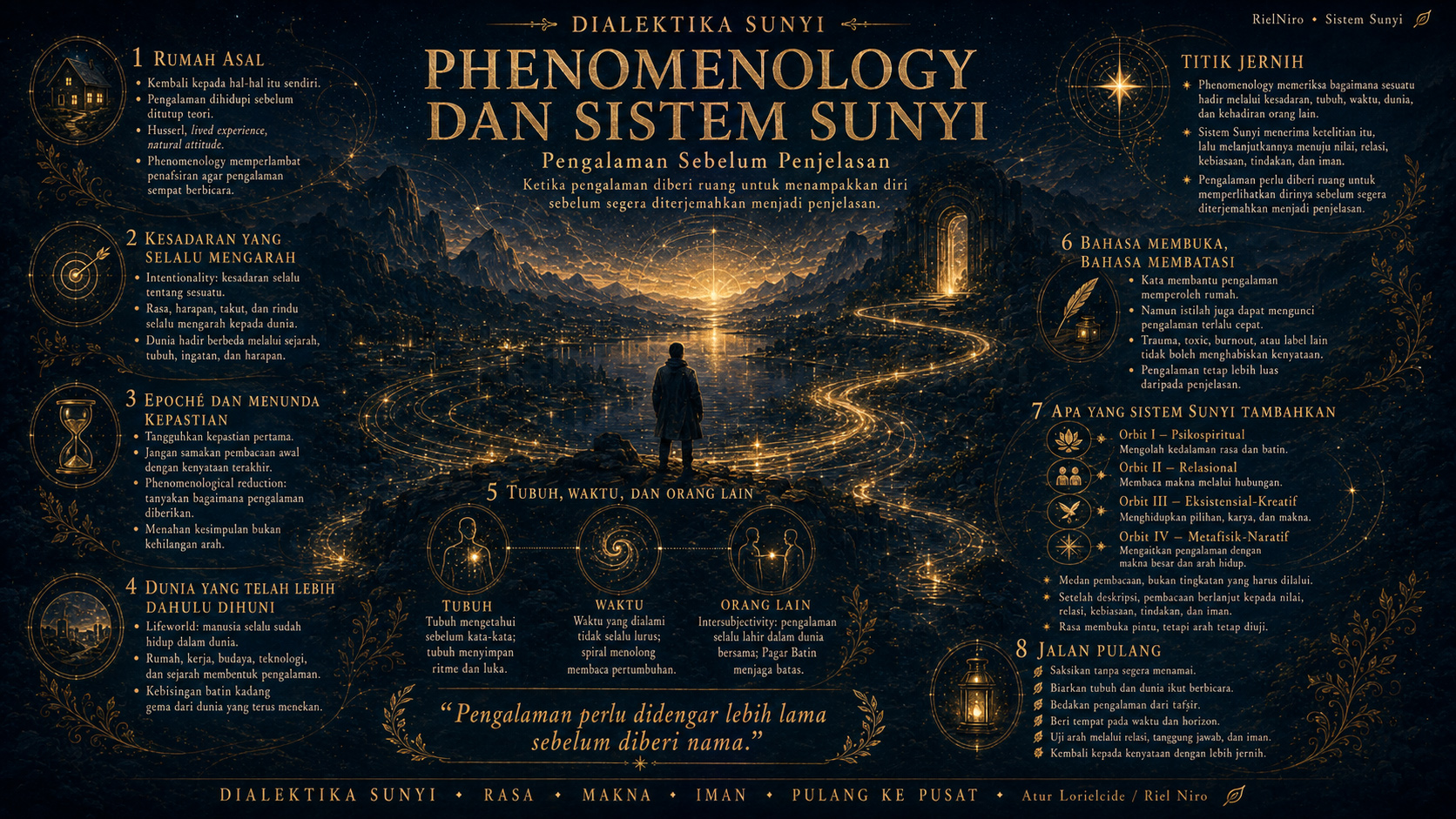
Edmund Husserl formulated one of the most influential calls in modern philosophy: return to the things themselves. The phrase is often misunderstood as an invitation to discover a reality entirely pure, free from history, language, or world. Husserl’s demand was at once simpler and more exacting. He asked that attention return to how something appears before every explanation about it takes over.
In everyday life, human beings almost always live through what Husserl called the natural attitude. The world is simply accepted. A table is taken to be a table. Criticism is taken to be an attack. Praise is taken to be acceptance. We move within a world already full of meaning without often asking how that meaning itself arose. This attitude is not an error; practical life could not proceed without it. Yet when someone wants to understand experience more deeply, the natural attitude must briefly be held at a distance.
From here comes attention to lived experience. Lived experience is not merely private inner content, but experience as actually lived by a person who is embodied, exists in time, relates to the world, and is always with others. Experience never appears as sterile data. It arrives with direction, atmosphere, expectation, and history that make the world appear in a particular way.
Phenomenology therefore differs from the attentional practices now widely popular. Mindfulness, in many of its forms, is primarily a family of practices for training attention or self-regulation. Phenomenology is a philosophical inquiry into the structures of experience itself. They may meet in their care for what is happening, but they do not have the same purpose or responsibility. Their methodological proximity does not give them the same philosophical home.
This distinction also matters for The System of Silence. Reading Feeling, cultivating Silence, or learning to remain with experience can draw much from a phenomenological attitude. Yet this does not make The System of Silence a branch of Phenomenology. What is borrowed is not its home, but its discipline of giving experience room before experience is shaped by language that arrives too hastily.
Consciousness Is Always Directed toward the World
One of Husserl’s most fundamental ideas is intentionality. Consciousness, in his account, never stands as an empty space containing experience. It is always consciousness of something. Fear is directed toward a threat, even when the threat is not yet clear. Hope is directed toward a possibility not yet present. Longing is directed toward a person, a place, or an imagined life. Even confusion remains confusion about something.
The term is often mistaken for moral intention or conscious decision. Husserl did not mean an act of will, but the basic directedness of experience. A child may look toward an exit without intending to leave the room. Someone may feel anxious about the future without being able to name exactly what is feared. Consciousness still has a direction even when that direction has not become a decision.
That consciousness is always directed toward the world also means that experience is never entirely enclosed within the self. Two people may enter the same room, hear the same sentence, and experience completely different worlds. The difference does not arise only from the content of their thoughts, but from the way the world appears through the history, body, memory, hope, and relationships each carries. The world has not changed, but the horizon through which it appears is different.
This correction changes how The System of Silence reads Feeling. Feeling is not an object floating in the Inner Self. It is always moving toward something. Reading Feeling therefore cannot stop with the question, what am I feeling. An equally important question is, what kind of world is appearing through this Feeling. Sometimes what changes is not the Feeling itself, but the way someone begins to see all reality through it.
Epoché and the Courage to Delay Certainty
If experience turns so easily into explanation, how can human beings hear experience itself again? Husserl did not answer by asking people to erase their convictions or deny reality. He offered a subtler discipline: epoché, the willingness to suspend, for a time, the natural acceptance that the world as it appears is already identical with the first way we understand it.
In daily life, people almost always move through certainties they do not recognize as certainties. We assume that the world appearing before us is already exactly as it is. A look is certainly rejection. Stillness is certainly anger. Failure is certainly proof that the self is not good enough. Yet what often appears first is not reality itself, but the way we have learned to read it.
Epoché does not ask human beings to doubt everything without end. It asks for a rare form of courage: the courage to delay certainty until experience has had time to show itself more fully. This suspension is not a rejection of the world, but a refusal to treat the first reading as the final reality.
This is where phenomenological reduction finds its place. Reduction is not an attempt to reduce experience to simple elements. Nor does it abolish the question of truth; it suspends that question for a time so attention can turn toward how is this experience given to me. What is sought is not the fastest explanation, but the structure that allows something to appear as threat, hope, loss, or calling.
This movement is often misunderstood as a practice meant to produce Calmness. Yet there is no guarantee that epoché will make life feel calmer. Sometimes the opposite happens. When an old explanation is suspended, a person may face ambiguities that had long been hidden. An experience that appeared simple becomes more complex, and an answer that once felt solid begins to reveal its cracks.
This discipline also touches the way The System of Silence reads experience. When terms such as Center, Echo, calling, or Spiral appear too quickly, what is first required is not a new interpretation, but the willingness to give experience more time to speak. Delaying a conclusion does not mean losing direction. Often a clearer direction appears only after a person stops rushing to give it a name.
The World We Already Inhabit
Phenomenology never understands experience as something born in a closed inner room. Before human beings begin to think about the world, they are already living in it. They already have a home, language, work, habits, history, technologies, and people who shape how things appear each day. Husserl called this the lifeworld, the world of life that is already there before theory begins to organize it.
Because human beings live within the lifeworld, they almost never encounter an object as neutral. A chair does not first appear as a geometric form. It appears as a place to wait, work, converse, or hear news that changes a life. A hospital is not merely a building. For a patient it may be a place of hope and fear. For a physician it is a place of responsibility. For a family it can be a room filled with anxiety. The same world reveals different faces because human beings inhabit it through different relationships.
This understanding reminds us that experience is never entirely private. What is called personal Feeling has already been woven by a wider world. Anxiety may be shaped by a workplace that continually demands productivity. Insecurity may be formed by a threatening social environment. Even the way someone understands success often comes from a culture that has long determined its measures. Inner experience always has a door opening toward social reality.
In the digital age, the lifeworld has acquired an increasingly complex form. Life no longer unfolds only through physical space. Notifications can summon attention as a human voice summons a name. Algorithms slowly shape what appears important, urgent, and even worthy of anxiety. The digital world is not merely a tool people use; it has become part of the world they inhabit every day.
For The System of Silence, this insight broadens the way inner noise is read. It does not always arise from a failure to listen to oneself. At times, that noise is an Echo of a world that continually produces demands, anxiety, and comparison without pause. Reading the Inner Self without reading the world can lead people to assume that every problem originates within them, even when some wounds are formed by environments far larger than an individual’s power to control.
The Body That Knows before Words
The phenomenological journey does not stop with Husserl. Maurice Merleau-Ponty drew attention to something often neglected by modern philosophy: the body is not merely an object a person owns, but the way a person has a world. Before thought finishes constructing an explanation, the body has already moved, recognized distance, sensed danger, or found the rhythm that makes action possible.
Someone who has long ridden a bicycle no longer calculates balance with every movement. A musician does not think about the location of every note before the fingers move. The body knows more than reflective consciousness can explain. This is not mysterious knowledge, but knowledge formed as life gradually becomes habit.
The same is true when the body remembers injury. Sometimes a person cannot yet explain why a place produces anxiety, but the body has already become alert. A particular smell, tone of voice, or manner of looking can awaken a response far faster than thought can formulate a reason. The body carries its own history.
Yet the body must not be treated as the final judge. The fact that the body reacts does not mean every interpretation that follows is certainly true. The body may remember real danger, but it may also carry traces of an old experience into a very different situation. Reading the body therefore requires both respect and caution. What appears through the body deserves to be heard, but it must still meet the reality now unfolding.
The affinity with The System of Silence becomes visible in their shared attention to Feeling, rhythm, pauses, and vibrations that often emerge through the body before finding language. Yet this affinity does not make the body an infallible center. It is one path into a wider reading, a reading that must also pass through relationship, fact, action, value, and Faith. The body becomes a doorway toward Clarity, not a substitute for Clarity.
Time That Is Never Entirely Straight
Experience always unfolds within time, but lived time is not identical with the time measured by a clock. Five minutes may feel very brief when someone is absorbed in a warm conversation, yet extremely long while waiting for a medical result that may change a life. What changes is not the number on the clock, but the way time appears within experience.
The past is never entirely past. A loss may remain with someone for years, not as passive memory, but as a new way of seeing the world. Hope, conversely, allows the future to begin working within the present. Human beings live between memories that have not finished leaving and possibilities that have not finished arriving.
This awareness of temporality helps The System of Silence understand Spiral more precisely. Spiral is not a rising line that carries human beings away from old territories toward a higher level. It is a movement of growth that returns to experiences, wounds, questions, or hopes already encountered, but with a new depth of reading. What returns does not necessarily signify regression. A wound may acquire a different Meaning as life changes, and a hope may be heard again after years of seeming extinguished. Growth does not always appear as increasing distance from the past; sometimes it appears as the capacity to meet the past without occupying the same inner place.
A World Always Shared with Others
No experience is ever born entirely alone. Even when someone seems to be speaking only with themselves, the language they use was learned from others, the values they defend were formed through relationship, and the world they consider is a world also inhabited by other people. The phenomenological tradition calls this intersubjectivity.
The idea appears simple, but its consequences are extensive. Personal experience cannot be replaced by anyone else, yet it never belongs to a world entirely separated from shared reality. From the beginning, human beings live within networks of gaze, conversation, expectation, judgment, and habit that give experience its form. The world we experience is always a world also experienced by others, though never in exactly the same way.
This awareness leads Phenomenology to reject two tendencies at once. On one side, it does not reduce experience to something entirely objective, as though everyone must see the world in the same way. On the other, it does not allow experience to become a private territory immune from everyone else. Experience is always personal, but never entirely solitary.
Empathy arises within this shared space. Yet empathy does not grant full access to another person’s Inner Self, as though their whole world could become ours. We can move closer, understand in part, and still acknowledge that some region of experience can never be fully possessed by anyone other than the person living it.
Within the reading of The System of Silence, this becomes an important reminder. Silent Reading is never meant to be the power to read another human being completely. The more deeply someone learns to listen to experience, the more clearly they recognize that another person’s experience cannot be reduced to a term, pattern, or diagnosis imposed from outside. The Inner Fence arises precisely from respect for that boundary. Closeness does not grant ownership over another person’s Meaning.
When Experience Is Also Shaped by the Social World
The phenomenological journey later developed in wider directions. Many thinkers recognized that experience is shaped not only by body, time, and interpersonal relations, but also by history, culture, institutions, language, economy, race, gender, and distributions of power. From this development came what is now known as critical phenomenology.
This expansion does not abandon its phenomenological home. It still asks how the world appears to human experience. What changes is the recognition that the world appearing to us has itself been shaped by social structures that are not always visible. When someone fears walking alone at night, that fear may not arise merely from private imagination. It may grow from a long history of violence, collective experience, or a social environment that exposes some people to different levels of vulnerability.
The same applies to a patient who feels disbelieved when describing pain, or a worker who continually regards themselves as a failure because of targets that were impossible from the beginning. These are genuinely inner experiences, but they do not emerge from empty space. They are shaped by institutions, professional language, workplace culture, and social systems that give a particular form to what is regarded as normal.
Critical Phenomenology therefore broadens the phenomenological question. It asks not only how an experience appears, but why particular experiences continue to appear in similar patterns among particular groups of people. Experience has a social history that helps determine how the world is lived.
For The System of Silence, this correction helps prevent inward language from becoming too narrow a way of reading suffering. Inward language can indeed help make sense of life from within, but not every wound can be immediately reduced to a personal problem. Some exhaustion arises from poor discipline. Other exhaustion is continually produced by a work system that is genuinely inhuman. Some wounds require personal repentance; others demand change in relationships, institutions, or wider social structures.
Reading experience therefore cannot stop with a question about the individual Center. It must also ask what kind of world is working behind that experience. Not every Echo comes from the Inner Self; some arise from a world that keeps speaking through body, work, technology, culture, and history.
Language That Opens and Limits Experience
Experience almost always seeks language. Before words arrive, a person may carry a tension that is difficult to distinguish. Something feels wrong, but cannot yet be explained. When a term is finally found, experience seems to acquire a home. What was blurred becomes easier to recognize.
Yet language does not only illuminate experience. It also begins to shape the way experience is understood. After learning a particular term, someone may begin to find it everywhere. A word becomes a lens. What once appeared only as sadness is now called trauma. What was once understood as ordinary conflict is now called toxic. What seemed to be exhaustion is read as burnout. Sometimes such terms clarify reality. Sometimes they also begin to pull reality toward the pattern they carry.
Phenomenology reminds us that experience is always richer than the word used to explain it. No term can exhaust the full structure of human experience. Language gives form, but it also leaves a remainder that cannot be entirely contained.
This kind of correction needs to remain a continuing companion to The System of Silence. KBDS and terms such as Orbit, Center, Echo, calling, and other concepts were created to help human beings read themselves with greater Clarity. Yet these terms must not become molds that force every experience into a form already prepared. When language becomes more powerful than the experience it is meant to read, reading loses the humility required at its beginning.
Mature Silent Reading is willing to let experience refuse the term prepared for it. Some experiences do not fit any available category. Some wounds remain too large for one definition. Some encounters can only be understood over time, not through one name assigned on the first day.
When Experience Cannot Yet Determine Direction
Phenomenology teaches that experience deserves to be heard before it is immediately explained. Yet hearing experience does not mean surrendering an entire life to what is presently felt. Experience can disclose something important, but it never determines by itself what must be done.
Someone may feel relief after avoiding a difficult conversation. The relief is real, but it does not necessarily show that avoidance was the right decision. Conversely, someone may feel anxiety when required to tell the truth or apologize. That anxiety is also real, but it does not necessarily mean the action is wrong.
Phenomenology therefore helps distinguish two things that are often confused. The first is how something appears within experience. The second is how that experience is translated into a decision. They are related, but never identical.
<p>Within The System of Silence, this distinction helps ensure that Feeling does not become a justification for every inner impulse. Feeling opens a door, but direction must still be tested through reality, relationship, responsibility, consequence, value, and Faith. Experience becomes part of wisdom, not a substitute for wisdom itself.
Faith after Suspension
Spiritual experience is not outside this discussion. Peace, consolation, a sense of calling, or an awareness of God’s presence also appear through body, time, language, tradition, and personal history. Such experiences can be deeply decisive, but Phenomenology reminds us that experience is always different from the interpretation later given to it.
This awareness does not diminish Faith. On the contrary, it protects Faith from depending upon certainty reached too quickly. Someone may truly believe they have felt accompanied by God while still acknowledging that their understanding of the experience occurs through human limitation. Epistemic humility does not cancel Faith; it protects Faith from the temptation to make private experience an absolute measure for everyone.
Within The System of Silence, Faith is not an answer that ends the question. It is an orientation that helps human beings keep walking when experience has not yet been fully understood. A reading of Faith must therefore not cut short the descriptive work of Phenomenology. Experience still needs to be heard before it receives theological Meaning, just as a wound must be recognized before it is named a calling or a trial.
Such Faith does not lose the courage to believe, but neither does it lose the courage to keep learning how to read reality honestly.
Why Description Alone Is Not Enough
Ultimately, life cannot be reduced to the ability to describe experience. Human beings must still make decisions, apologize, maintain boundaries, build relationships, care for their bodies, face loss, and take responsibility for the consequences of their actions. Description opens the way to understanding, but life still demands action.
From its conversation with Phenomenology, The System of Silence then moves toward the territory of its own questions. After experience has been given room to reveal itself, reading continues toward the values at stake, the relationships being built, the habits slowly forming character, the actions that must be chosen, and the Faith that gives direction when every answer has not yet been found.
This journey does not cancel the phenomenological lesson. Precisely because experience has been heard more honestly, the Meaning that grows from it has a greater chance of remaining connected to reality. The System of Silence does not seek to replace Phenomenology with its own spiritual language. It continues the work begun by Phenomenology into ethics, lived practice, relationship, and Faith, while remembering that each new step must remain open to correction by experience.
Experience That Remains Larger than Explanation
Every human being ultimately lives between two opposing temptations. The first is to explain experience too quickly, depriving reality of the chance to speak. The second is to remain inside experience indefinitely without daring to build a direction for life. Phenomenology warns against the first danger. The System of Silence seeks to warn against the second.
Their dialogue shows that Clarity is not the ability to find a finished answer for every experience. Clarity more often grows from the willingness to let reality speak longer than our desire to interpret it immediately. From there, Meaning can grow with greater humility, action can arise with greater responsibility, and Faith can learn to walk without mastering the whole mystery of life.
Perhaps this is one of the quietest forms of maturity. It does not appear when a person has explained an entire life, but when they remain willing to stay close to reality, acknowledge the limits of their knowledge, and then step forward with a faithfulness no longer dependent upon the illusion that everything will finally be explained in full.
Dialektika Sunyi (Format 2) adalah ruang dialog antara Sistem Sunyi dan dua puluh empat rumah pemikiran dari berbagai tradisi filsafat, psikologi, etika, teologi, dan pemikiran sosial. Dua puluh empat tulisan ini tidak disusun untuk menjadikan tradisi-tradisi tersebut sebagai bagian dari Sistem Sunyi, melainkan untuk mempertemukan cara pandang yang berbeda agar manusia dapat dibaca dari lebih dari satu pintu.
Sistem Sunyi tidak datang ke dalam dialog dengan rumah yang kosong. Ia sudah membawa cara membaca sendiri: Rasa perlu didengar tanpa segera dijadikan kebenaran, Makna tidak dipaksakan kepada luka, Iman memberi arah tanpa menjadi jawaban instan, dan manusia tidak dapat dihabiskan oleh satu istilah atau satu peta.
Karena itu, setiap rumah pemikiran hadir sebagai ruang dialog yang tetap memiliki bahasa, sejarah, pertanyaan, dan batasnya sendiri. Dialektika Sunyi bukan upaya membuktikan bahwa dua puluh empat tradisi tersebut pada akhirnya mengatakan hal yang sama dengan Sistem Sunyi.
Mengapa dua puluh empat rumah pemikiran?
Karena manusia terlalu luas untuk dibaca melalui satu lensa. Penderitaan dapat hadir sebagai pengalaman batin, pola tubuh, relasi, cerita diri, bahasa, kondisi sosial, struktur kuasa, sejarah, iman, maupun perubahan kehidupan. Satu lensa dapat membuka sesuatu yang penting, tetapi selalu ada wilayah yang berada di luar jangkauannya.
Dua puluh empat rumah pemikiran karena itu membuka percakapan dari berbagai arah. Membuka pintu tidak berarti meninggalkan rumah. Setiap tradisi tetap dibaca sebagai rumahnya sendiri, sementara Sistem Sunyi membiarkan perjumpaan itu memperluas cara melihat tanpa kehilangan batasnya.
Di dalam panel ini, dua puluh empat tulisan dibagi menjadi tiga bagian: Peta I, Peta II, dan Peta III. Ketiganya adalah pembagian navigasi untuk membantu menemukan delapan rumah pemikiran pada masing-masing bagian.
Sebelum masuk ke daftar, dua ruang berikut dapat digunakan untuk melihat keseluruhan Dialektika Sunyi dalam skala yang lebih luas:
Atlas Dialektika Sunyi
24 Percakapan, 24 Peta Pembacaan
Ruang orientasi publik untuk menjelajahi dua puluh empat tradisi yang berdialog dengan Sistem Sunyi tanpa kehilangan rumah pemikirannya masing-masing.
Peta Pengetahuan Dialektika Sunyi
Dua Puluh Empat Rumah. Tidak Ada yang Dilebur Menjadi Satu.
24 Rumah Pemikiran · 20 Kejernihan · 25 Pintu Kehidupan
Ruang untuk melihat bagaimana dua puluh empat tradisi dipertemukan dengan Sistem Sunyi tanpa penyerapan, kemenangan, atau sintesis yang lebih tinggi.
Peta ini hanya membantu menemukan jalan. Pembacaan sebenarnya terjadi di dalam masing-masing tulisan, ketika satu rumah pemikiran dibuka dan dialognya dengan Sistem Sunyi mulai berlangsung.
Paket I bergerak paling dekat dengan pengalaman personal, tetapi tidak membiarkan batin menjadi dunia yang tertutup. Kendali bertemu keadaan, perhatian bertemu makna, kedekatan membawa sejarah relasi, kebebasan berhadapan dengan keterbatasan, dan keheningan diuji oleh doa serta kehidupan yang kembali dijalani.
- Ketika keteguhan tidak berarti mematikan rasa
- Ketika hadir belum berarti memahami
- Ketika hidup tidak hanya meminta penjelasan, tetapi jawaban
- Ketika kebutuhan akan tempat aman ikut membentuk cara manusia mencintai
- Ketika hidup tidak menyediakan kepastian yang dapat memilih atas nama manusia
- Ketika bagian diri yang tidak disadari ikut membentuk cara manusia melihat kenyataan
- Ketika bahasa iman belajar mengakui Tuhan tanpa menjadikan misteri sebagai tempat bersembunyi
- Ketika keheningan di hadapan Tuhan kembali menjadi kasih, kerja, batas, dan tanggung jawab
Paket II memperdalam pertanyaan tentang bagaimana pengalaman sebenarnya terbentuk. Apa yang terasa tidak hadir tanpa tubuh. Apa yang dipahami tidak lahir tanpa bahasa. Agency mempunyai lingkungan. Care mempunyai distribusi beban. Makna dan keyakinan memperoleh ujian ketika mereka meninggalkan jejak dalam kebiasaan, tindakan, dan dunia bersama.
- Ketika kenyataan perlu diberi ruang sebelum kesimpulan mengambil alih
- Ketika tubuh, kebiasaan, alat, relasi, dan dunia ikut membentuk cara manusia memahami dan memilih
- Ketika rasa sakit tidak harus hilang sebelum manusia bergerak menuju yang bernilai
- Ketika motivasi dibaca melalui autonomy, competence, relatedness, dan mutu alasan untuk bergerak
- Ketika kisah hidup memberi arah, tetapi tidak berhak menjadi seluruh kenyataan
- Ketika bahasa, sejarah, tradisi, dan kuasa ikut menentukan apa yang dianggap sebagai kebenaran
- Ketika kebutuhan, dependency, kerja perawatan, kompetensi, dan pembagian beban menjadi persoalan moral
- Ketika gagasan diuji melalui kebiasaan, penyelidikan, konsekuensi, komunitas, dan revisi
Paket III membawa pembacaan ke kondisi yang membuat sebagian pengalaman dipercaya, sebagian dinormalkan, dan sebagian bahkan sulit memperoleh bahasa. Struktur dan sejarah masuk lebih jelas, tetapi manusia tidak dibiarkan menghilang di dalamnya. Karena itu Systems Thinking bertemu Virtue Ethics, Liberation Theology bertemu batas praxis, dan Process Philosophy menutup paket dengan kehidupan yang terus menjadi tanpa kehilangan tanggung jawab.
- Membaca penderitaan di antara batin, ideologi, institusi, ekonomi, dan distribusi kuasa
- Ketika pengetahuan dibentuk oleh posisi, tubuh, bahasa, kredibilitas, dan relasi kuasa
- Bahasa, institusi, dan relasi yang membuat kategori terasa alamiah
- Sejarah, bahasa, representasi, dan kuasa di balik hak untuk menjelaskan manusia lain
- Membaca pola, feedback, penundaan, batas sistem, dan perubahan yang tidak pernah berdiri sendiri
- Karakter, kebiasaan, emosi, teladan, dan kebijaksanaan praktis dalam kehidupan sehari-hari
- Ketika doa, kasih, keselamatan, dan kitab diuji oleh kemiskinan, penindasan, serta tindakan pembebasan
- Identitas, relasi, waktu, dan Pusat yang bertahan tanpa membeku menjadi bentuk final
Lorong Kata adalah ruang refleksi di TokohIndonesia.com tempat gagasan dan kesadaran saling menyeberang. Dari isu publik hingga perjalanan batin, dari hiruk opini hingga keheningan Sistem Sunyi - di sini kata mencari keseimbangannya sendiri.
Berpijak pada semangat merdeka roh, merdeka pikir, dan merdeka ilmu, setiap tulisan di Lorong Kata mengajak pembaca menatap lebih dalam, berjalan lebih pelan, dan mendengar yang tak lagi terdengar.
Atur Lorielcide berjalan di antara kata dan keheningan.
Ia menulis untuk menjaga gerak batin tetap terhubung dengan pusatnya.
Melalui Sistem Sunyi, ia mencoba memetakan cara pulang tanpa tergesa.
Lorong Kata adalah tempat ia belajar mendengar yang tak terlihat.
Baca juga: Dua Ruang, Satu Sunyi: Jejak Atur Lorielcide alias Rielniro