

 Tulisan ini bagian dari sistem kesadaran reflektif
Most of life is sustained not by great decisions, but by people who remain present when attention is already running out.
A child wakes with a fever. Someone immediately rises, looks for medicine, changes the compress, checks the temperature, remembers the last dose, and decides whether the night is safe enough to remain at home or whether they must go to the hospital. Elsewhere, a nurse completes a long shift with almost no pause. An adult child bathes a parent who is beginning to lose memory. A partner quietly carries the entire emotional burden so that the household does not break apart. Most of them may never think of themselves as performing a great moral act.
Yet life continues precisely through work like this. Care rarely appears as a heroic moment. More often, it comes as exhausting repetition: remembering, cleaning, listening, waiting, accompanying, noticing small changes that are almost invisible, and doing it all again the next day. Because it remains so close to ordinary life, this work is often treated as natural, or not treated as work at all.
Care Ethics changes the starting point of morality by bringing this hidden labor into view. It asks not only what the right decision is, but who keeps life going so that such a decision can still be made. Who lifts the burden when another person can no longer do so? Who remembers needs that never enter a report? Why is some of the work most decisive for survival also the work most easily forgotten?
These questions change how moral life is understood. The issue is no longer only the action of an individual, but the network of relationships through which life is sustained. Morality does not speak only about choice. It also speaks about need, dependence, attention, the division of work, and who eventually pays the price for all of it.
The conversation with The System of Silence begins within this tension. Feeling, love, presence, boundaries, and inward orientation never live in a realm separated from the world. Inward life is always supported by people who give their time, energy, attention, and bodies so that the lives of others can continue. The center of the self never truly stands alone.
Recognizing dependency does not mean viewing human beings as permanently powerless. It breaks only the illusion that independence is created by a self that has never owed anything to anyone. Every human being was once an infant whose entire life depended on another person’s attention. Many will need help again through illness, aging, grief, or the loss of some ability. Dependency is not a deviation from life. It is one of life’s basic forms.
When morality no longer begins with the self-standing individual
One important point in the emergence of Care Ethics appears in the work of Carol Gilligan. She questioned why many modern moral theories so easily identified maturity with the ability to decide through abstract and universal principles, while attention to concrete relationships was often treated merely as emotion or private closeness.
Gilligan was not arguing that women are naturally more caring than men, and Care Ethics is not a theory of women’s natural character. The “different voice” is neither shared by all women nor absent from men. Her criticism was directed toward a history of moral philosophy that had long privileged the voice of rules, rights, and individual autonomy, while relational responsibility, attention, and the continuation of shared life were often treated as morally immature.
This correction expands the way human beings are read. Moral life does not appear only when someone defends a principle. It also appears when someone remains beside another, lifts an invisible burden, or preserves a fragile relationship without losing the ability to say no. Morality concerns not only right and wrong, but also how life is preserved from one day to the next.
Virginia Held later expanded Care Ethics into a way of understanding moral life as a whole. What changed was not simply the list of values that mattered, but the starting point of the entire reading. Many ethical theories begin with an individual imagined as already whole, independent, and capable of making decisions alone. Care Ethics begins from an almost opposite reality: from the beginning, human beings live through relationships that make their existence possible.
No one chooses to be born. No one learns to speak, walk, think, or survive without the support of another person’s attention. Even when someone later appears highly independent, that independence still rests on a network of care far wider than the self. Moral life therefore cannot be understood only through individual decisions. It always unfolds within relationships that shape possibility, obligation, hope, and limits.
This shift has major consequences. When morality begins from relationship, the ethical question cannot stop at whether someone has fulfilled an obligation. It must also ask whether the relationships sustaining life are themselves maintained fairly. Is the burden shared? Are needs truly seen? Is there someone who keeps caring for everyone while never receiving room to be cared for?
This correction touches the language of Center, Returning Home, and wholeness directly. All three can sound too individual when they forget the network of care that made survival possible from the beginning. No one truly returns home alone. Behind almost every inward journey are people who once offered space, food, time, attention, or simply the willingness to remain when the whole world felt as if it were collapsing.
Care Ethics therefore cannot simply be equated with the Ethics of Feeling. Both attend to concrete human beings, but Care Ethics arises from its own philosophical history. Its first concern is not inward experience, but care work, dependency, institutions, the distribution of responsibility, and the politics of daily life. The dialogue with The System of Silence becomes richer when each retains its own conceptual home.
Caring is more than feeling concern
Nel Noddings deepened this direction by placing the relationship between the one caring and the cared-for person at the center of care. Care does not end with good intention within the caregiver. It moves toward another person’s concrete need, then remains open to how that attention is received and experienced within the relationship.
The distinction appears simple, but its consequences are large. Someone may feel that much has been sacrificed, while the person receiving care experiences less and less room to live. Attention can slowly become surveillance. Love can unknowingly take over every decision. Help can make it harder for another person to stand on their own. Care Ethics reminds us that intention is never the only measure of successful care.
One important contribution from Noddings is the emphasis on the response of the person receiving care. A caregiver cannot determine alone that care has succeeded merely because the intention was sincere. Something must return from the relationship, not necessarily gratitude or compliance, but a sign that the need was actually grasped, that the cared-for person felt seen, or that the attention made life a little more possible.
Responsiveness does not mean that every desire must be fulfilled. A child who wants to keep playing while ill may still need a limit. A patient may refuse treatment that could save a life. A partner may ask for something harmful to the self or to others. Listening to need means giving the experience a real place, not surrendering all judgment to the first request that appears.
The distinction between being present and taking over becomes important here. Love does not automatically grant the right to believe that one already knows all of another person’s needs. Mature attention can remain close without losing respect for boundaries. The Inner Fence is not the enemy of love. It is often the condition that allows love to remain liberating for both people.
The Ethics of Feeling takes on a very concrete form here. Listening to a person’s experience does not mean fulfilling every desire. Yet the experience remains part of the conversation. The person receiving care must not become an object of the caregiver’s goodness. That person remains a subject with a voice, a history, fears, desires, and a distinct way of experiencing help.
There are situations in which that voice cannot be easily expressed. Infants, people with dementia, unconscious patients, or people with communication limitations still require decisions made by others. Yet this does not remove the duty to read signs, recognize habits, respect a history of choices, and continue testing whether the action truly protects the dignity of the person receiving care.
Joan Tronto and the actual work of care
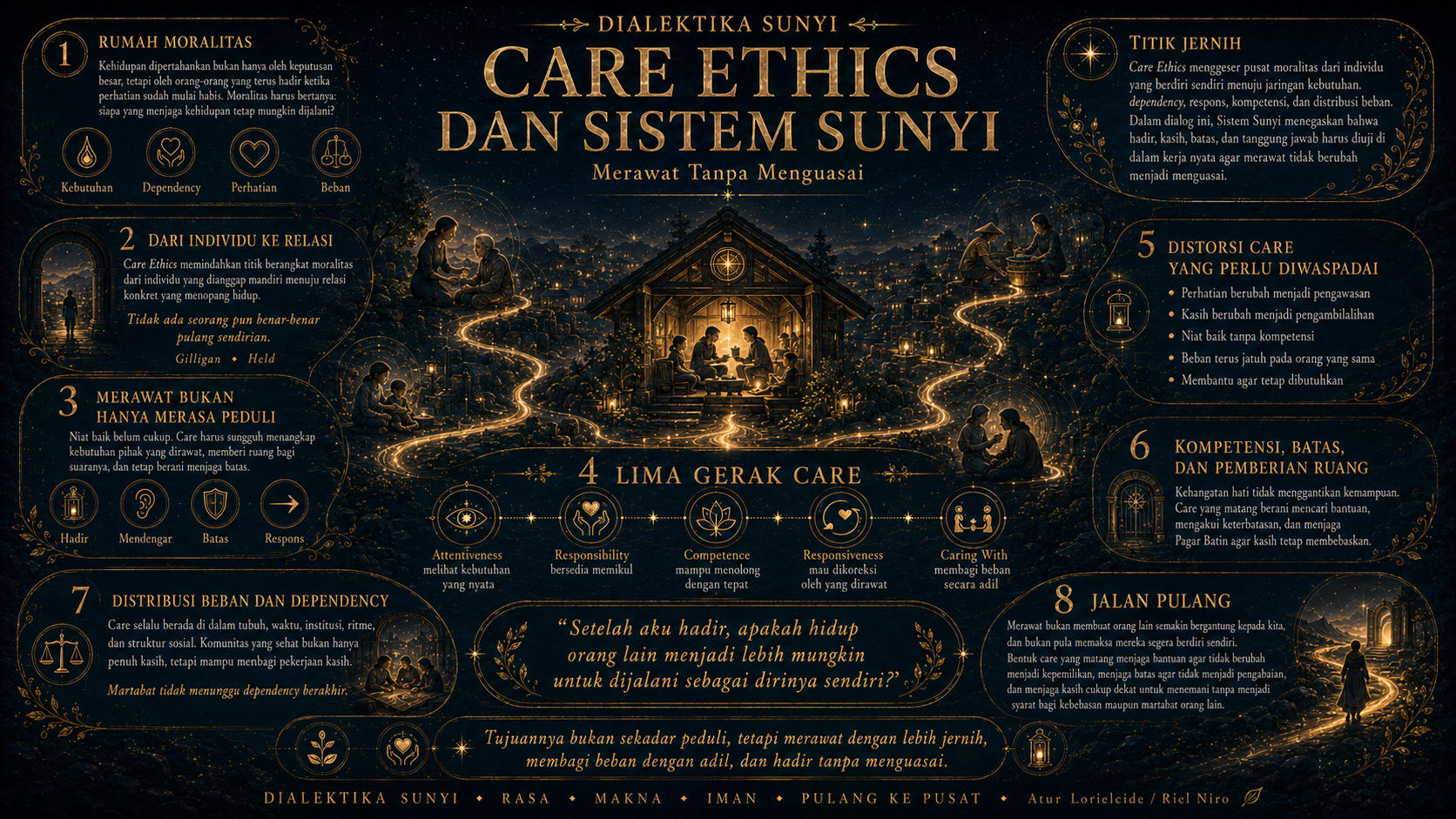
Joan Tronto brought Care Ethics closer to daily life by showing that care is not merely a disposition of the heart. Care moves through several interrelated phases, each calling for a different moral quality. These phases are not rigid steps that always proceed in a straight line. They reveal where attention can break, responsibility can evaporate, or the work of care can fail even when love feels sincere.
Everything begins with attentiveness, the ability to see that a need truly exists. Much suffering continues not because no good person exists, but because no one really sees. A need that is not recognized never has the chance to be answered. Yet seeing is harder than it appears. Human beings notice needs resembling their own experience more easily, while needs that are unfamiliar, quiet, or difficult to measure often remain invisible.
Once a need is recognized, taking care of begins, when attention becomes responsibility. The question is no longer merely who cares, but who will act, who has the ability, who will organize resources, and who will finally carry the burden. Much suffering is known by everyone but never becomes anyone’s actual responsibility.
Then comes care-giving, the concrete work that requires skill, time, energy, and competence. Care does not happen merely because someone has a good heart. It requires real ability so that the help offered actually helps. Love that refuses to learn can wound as concretely as indifference.
Next comes care-receiving, when attention returns to the person receiving care. Here Care Ethics offers an essential correction. Care is not measured only by the caregiver’s feelings, but also by how the action is actually received and whether the real need is answered. Care must be willing to be corrected by its own consequences.
In her later development of the framework, Tronto added caring with. Care here is no longer understood only as a relationship between two individuals, but as a shared responsibility requiring plurality, communication, trust, respect, and solidarity. Love continually placed on the same person eventually becomes a form of injustice, however beautiful the language used to praise it.
Through this framework, Care Ethics reminds us that attention is not merely a feeling. It is work. Every form of work has quality, limits, costs, and consequences that must be read honestly. Care requires time, money, bodies, knowledge, space, institutions, and policy. When these are absent, moral demands are often quietly transferred to the person least able to refuse.
Tronto’s framework also shows that failures of care do not always arise from hatred. Some people see but never act. Some act without skill. Some work competently but never listen to the person receiving care. Some communities contain many loving people but never learn to distribute the work of love. Each failure leaves a different wound.
When love becomes control
Attention is almost always praised as a virtue. Yet attention does not automatically make a relationship healthy. Someone may know every change in a partner’s expression, remember an entire child’s schedule, or read every mood in a family, while all of it slowly becomes a way of controlling another person’s life.
Mature attention always leaves room for the possibility that it has read wrongly. Controlling attention believes it knows another person’s needs better than that person does. What began as concern slowly becomes a right to decide, arrange, and even define another person’s experience.
Not every form of attention begins in love. Some begin in fear, guilt, anxiety about loss, or the need to preserve a place in another person’s life. The difference is often subtle because all of them can use the same language: “I only want to help,” “I am only worried,” or “I am doing this for you.” These sentences may be true. They may also conceal something deeper.
Someone may manage an entire partner’s life not because all of it is truly needed, but because seeing another person decide independently is unbearable. Parents may continue controlling adult children not because the children cannot live, but because losing the role of the person who is always needed feels more frightening than letting go. Leaders may continue holding all the work not because no one else is capable, but because their identity rests on everyone depending on them.
In all these examples, attention may still be present. Love may also remain. Yet love has begun to mix with the need to preserve the self. Human motives are almost always layered. Sincere love can coexist with the need for recognition. Real attention can mix with anxiety. The task is not to condemn every mixed motive, but to become aware of it, because an unrecognized motive more easily controls action than one that has been admitted.
Between these two conceptual homes, the reading of motive must meet consequence. The Ethics of Feeling helps identify where attention is moving from. The Paradox of Kinship shows how closeness can become both home and entanglement. The Inner Fence protects the cared-for person’s space to explain the self. Care Ethics then carries the question beyond the caregiver’s inward life: does this care enlarge another person’s living space, or make that life increasingly narrow?
Care is not tested primarily by what we feel while giving. It is tested by what becomes possible for the person receiving. Does that person become more able to make decisions? Safer in expressing disagreement? Is an unavoidable dependency lived with greater dignity? Or does saying no become more difficult because help always arrives together with a demand for obedience?
Mature love therefore carries a courage rarely discussed. It dares to become less needed. It dares to watch another person grow without continually holding control. It also dares to remain when the cared-for person will never become fully independent. Love does not release in only one way. Sometimes it makes room to stand. Sometimes it offers an arm that will continue to be needed. In both, love does not turn dependence into possession.
Responsibility that does not erase the self
Once attention becomes action, a more difficult question appears: how far is one responsible for another person’s life? Care Ethics never answers that the more burden someone carries, the better that person’s moral quality. Responsibility arises within real relationships, and therefore always has limits, history, ability, and consequences.
Self-erasure is often praised as the highest form of love. Some people continue caring without rest, without the right to say no, and without an opportunity to consider their own needs. While they remain strong, their sacrifice is celebrated. When body or spirit finally collapses, the failure is interpreted as insufficient sincerity.
In many families, workplaces, and faith communities, the most reliable person slowly becomes the place where every burden is deposited. That person is always asked to appear, always asked to understand, always asked to yield. Eventually, the person is no longer praised for love, but treated as naturally available. The language of service, calling, devotion, and sacrifice can make an unjust distribution of burden sound sacred.
The needed distinction here lies between responsibility and the need to become a savior. Presence does not mean constant availability. Care does not mean erasing one’s own life. In the language of The System of Silence, the Inner Fence does not diminish love. It protects love from depending on the destruction of the caregiver.
Yet boundaries must not become a refined language for abandoning all responsibility. Some distance enables people to keep caring, while some merely conceals indifference. The Psychology of Distance is not the art of avoiding relationship, but the ability to find the distance at which love can remain alive. Sometimes self-protection is part of responsibility. At other times, the language of self-protection only hides an unwillingness to be present.
The decision is rarely simple because needs often collide. An adult child may need to care for an ill parent, preserve employment, remain present for a partner, and protect the body at the same time. No answer can satisfy every need. Care Ethics does not remove this conflict. It requires the conflict to be read honestly, the burden not to be hidden, and the decision not always to fall upon the person least able to say no.
Faith as gravity can preserve the orientation that human beings are called not to live for themselves alone. Yet gravity is different from pressure that makes a person feel they are not allowed to have boundaries. Mature service does not require self-erasure as proof of love. A faith community is tested precisely by its ability to see who keeps serving, who is never given a turn to be cared for, and who has long been praised while slowly being left depleted.
Love that refuses to learn can wound
Another correction is easily missed because love is easier to praise than competence is to examine. Care requires competence. Someone may love deeply and still give the wrong medicine, fail to recognize danger, disclose a confidence, or make a decision that worsens the situation. Warmth of heart never replaces ability.
Tronto therefore places competence within the moral structure of care. Competence is not a technical addition after love arrives. It is a form of love itself. Caring means continuing to learn so that attention truly helps, rather than merely allowing the caregiver to feel that something has been done.
Parents may deeply love a child while repeatedly using forms of care that deepen fear. A community may have great enthusiasm for service while failing to protect confidentiality, recognize violence, or understand professional boundaries. A leader may feel responsible, while an inability to delegate makes the entire system dependent on one person.
Competence also has a quieter side. It requires the courage to admit limits. Sometimes the best form of care is not to provide an answer, but to seek someone more capable. Sometimes referring a person to a doctor, psychologist, teacher, social worker, or another family member is the most responsible act of love.
A person who truly cares does not have to remain the person who knows most. It is enough to love sufficiently to say, “I cannot do this alone.” Mature care is not built on the need to remain the center of rescue, but on the willingness to protect life, even when that means allowing someone else to take the more appropriate role.
Competence is not merely an individual matter. It is unjust to demand that health workers, teachers, caregivers, or family members continue offering the best care when they lack time, energy, training, protection, or resources. A personal mistake may be the symptom of a system forcing human beings to care under conditions in which good care is impossible.
The Ecology of Silence extends this reading toward rhythms, environments, habits, and structures that sustain or drain the capacity to care. Good care requires places for rest, shared tasks, access to knowledge, protection from violence, and policy that does not depend on endless sacrifice. When an entire system lives from the exhaustion of caregivers, the problem is not insufficient love, but the way shared life has been arranged.
Care changes as life changes
The longer one lives, the clearer it becomes that no single form of care fits every relationship. The way a mother cares for an infant differs from the way she cares for an adolescent. The way someone accompanies a depressed partner differs from the way that person accompanies a parent who is beginning to lose memory. Care changes as the person receiving it changes.
Care Ethics therefore never treats love as an action learned once and completed forever. Care is the ability to read change. What once required protection may now require trust. What once required another person to decide may now require room for self-determination. Healthy care remains willing to change alongside the person being cared for.
This is especially clear in the relationship between parent and child. Early in life, almost every need of a child must be answered by someone else. The child cannot identify every danger, protect the body, or regulate every emotion. Care at this stage is necessarily active. Yet its purpose is not to preserve dependence forever.
As a person grows, care gradually shifts from controlling to accompanying, from deciding to entering dialogue, and from protecting every step to helping someone take responsibility for that step. Mature love moves toward the freedom of the person being loved. Care fails when it keeps another person dependent so that the caregiver can remain useful.
Yet movement toward freedom cannot become the only measure of care. Some people live with long-term dependency. Some bodies will not return to what they once were. Dementia, profound disability, chronic illness, and terminal conditions cannot be resolved through a story of independence. Here the purpose of care is not to make dependency disappear, but to keep dependency from erasing dignity, voice, relationship, and the right to be treated as a whole human being.
A similar change appears when people begin to care for their own parents. A relationship that once moved mainly from parent to child slowly turns. The child now remembers medication, accompanies appointments, explains results, and becomes a witness as memory fades. The child loves the parent and is also tired, wants to remain present and also has a family, wants to be patient while the body is being depleted. Care Ethics does not ask this ambivalence to be hidden. Love does not erase exhaustion. Fidelity does not remove grief. Care does not cancel one’s own needs.
Caring for a partner who is ill or experiencing psychological distress brings another form of complexity. Roles change, plans change, conversations change, and sometimes the identity of the relationship itself changes. The danger is not the change, but the demand that everything continue to feel as it did before. Many relationships collapse not only because of illness, but because the present is continually compared with a version of life that cannot return. Care sometimes means learning to love a relationship whose form has changed.
Communities are not exempt from the problem of care. In almost every group, a few people remember birthdays, call when someone disappears, reconcile conflict, listen to every complaint, ensure that events continue, and keep showing up. Eventually, the community treats their presence as natural. Ironically, these are often the people least frequently asked, “How are you?”
Care Ethics reads this pattern not as a problem of personality, but as a problem in the distribution of burden. When only a few people continue caring for an entire community, the community is living from a sacrifice that has never been discussed. A healthy community is not only a community full of love. It is a community able to distribute the work of love.
A reading of burden distribution extends Orbit II without turning Care Ethics into part of it. Relationships cannot be read through emotional closeness alone. They must also be read through the distribution of attention, the rhythm of giving and receiving, and the community’s ability to ensure that no one person is slowly depleted in order to keep everyone else whole. Sometimes the most mature form of love is not to add more to what we do, but to allow more people to share the work of care.
Caring without taking possession
In the end, Care Ethics returns moral life to something at once very simple and very difficult. Human beings live because someone cares. No one is born, grows, heals, learns, or ages without depending on another person’s attention. This fact does not make human beings weak. It makes shared life possible.
Care Ethics also reminds us that attention alone is not enough. Care requires attentiveness that truly sees, responsibility willing to carry, competence capable of acting, responsiveness willing to be corrected, and caring with that distributes burden fairly. Love requires structure.
The correction from Care Ethics becomes sharpest when the inward Center, boundaries, and quietness sound too clean. Behind the room in which someone is able to find the self, it remains necessary to ask who cooks, accompanies, cleans, watches, listens, and carries emotional labor. Returning Home is not only an inward journey. It also depends on a world caring enough that a person is not continually forced to live in survival.
At the same time, the work of care contains a territory that the recognition of need and the distribution of burden do not fully explain. Love can mingle with anxiety about loss, the desire to control, or the need to remain needed. Here the distinctions of The System of Silence find their place: presence differs from taking over, care from control, responsibility from self-erasure, and boundaries from abandonment. These distinctions do not diminish love. They keep love from turning closeness into a form of possession.
Clarity of motive is still not the final measure. Need may remain unseen, help may arrive without competence, the recipient’s voice may be ignored, and burden may continue to fall upon the same person even when intention feels clean. Inward reading must therefore be willing to meet actual work, bodies, time, institutions, consequences, and the distribution of responsibility.
The dialogue brings attention into view as a praxis involving feeling, body, relationship, institutions, competence, the distribution of burden, dependency, freedom, and justice. It asks not only, “Do I truly care?” A harder question follows: “After I have been present, has another person’s life become more possible to live as their own?”
The answer does not always end in independence. Sometimes care succeeds when a person regains greater ability to decide. Sometimes care succeeds when someone who remains dependent can live more safely, be heard, and be respected. Dignity does not wait for dependency to end.
Perhaps the most mature form of care is neither making another person increasingly dependent on us nor forcing that person to stand alone too quickly. It keeps help from becoming possession, boundaries from becoming abandonment, and love close enough to accompany without making itself the condition of another person’s freedom or dignity.
Dialektika Sunyi (Format 2) adalah ruang dialog antara Sistem Sunyi dan dua puluh empat rumah pemikiran dari berbagai tradisi filsafat, psikologi, etika, teologi, dan pemikiran sosial. Dua puluh empat tulisan ini tidak disusun untuk menjadikan tradisi-tradisi tersebut sebagai bagian dari Sistem Sunyi, melainkan untuk mempertemukan cara pandang yang berbeda agar manusia dapat dibaca dari lebih dari satu pintu.
Sistem Sunyi tidak datang ke dalam dialog dengan rumah yang kosong. Ia sudah membawa cara membaca sendiri: Rasa perlu didengar tanpa segera dijadikan kebenaran, Makna tidak dipaksakan kepada luka, Iman memberi arah tanpa menjadi jawaban instan, dan manusia tidak dapat dihabiskan oleh satu istilah atau satu peta.
Karena itu, setiap rumah pemikiran hadir sebagai ruang dialog yang tetap memiliki bahasa, sejarah, pertanyaan, dan batasnya sendiri. Dialektika Sunyi bukan upaya membuktikan bahwa dua puluh empat tradisi tersebut pada akhirnya mengatakan hal yang sama dengan Sistem Sunyi.
Mengapa dua puluh empat rumah pemikiran?
Karena manusia terlalu luas untuk dibaca melalui satu lensa. Penderitaan dapat hadir sebagai pengalaman batin, pola tubuh, relasi, cerita diri, bahasa, kondisi sosial, struktur kuasa, sejarah, iman, maupun perubahan kehidupan. Satu lensa dapat membuka sesuatu yang penting, tetapi selalu ada wilayah yang berada di luar jangkauannya.
Dua puluh empat rumah pemikiran karena itu membuka percakapan dari berbagai arah. Membuka pintu tidak berarti meninggalkan rumah. Setiap tradisi tetap dibaca sebagai rumahnya sendiri, sementara Sistem Sunyi membiarkan perjumpaan itu memperluas cara melihat tanpa kehilangan batasnya.
Di dalam panel ini, dua puluh empat tulisan dibagi menjadi tiga bagian: Peta I, Peta II, dan Peta III. Ketiganya adalah pembagian navigasi untuk membantu menemukan delapan rumah pemikiran pada masing-masing bagian.
Sebelum masuk ke daftar, dua ruang berikut dapat digunakan untuk melihat keseluruhan Dialektika Sunyi dalam skala yang lebih luas:
Atlas Dialektika Sunyi
24 Percakapan, 24 Peta Pembacaan
Ruang orientasi publik untuk menjelajahi dua puluh empat tradisi yang berdialog dengan Sistem Sunyi tanpa kehilangan rumah pemikirannya masing-masing.
Peta Pengetahuan Dialektika Sunyi
Dua Puluh Empat Rumah. Tidak Ada yang Dilebur Menjadi Satu.
24 Rumah Pemikiran · 20 Kejernihan · 25 Pintu Kehidupan
Ruang untuk melihat bagaimana dua puluh empat tradisi dipertemukan dengan Sistem Sunyi tanpa penyerapan, kemenangan, atau sintesis yang lebih tinggi.
Peta ini hanya membantu menemukan jalan. Pembacaan sebenarnya terjadi di dalam masing-masing tulisan, ketika satu rumah pemikiran dibuka dan dialognya dengan Sistem Sunyi mulai berlangsung.
Paket I bergerak paling dekat dengan pengalaman personal, tetapi tidak membiarkan batin menjadi dunia yang tertutup. Kendali bertemu keadaan, perhatian bertemu makna, kedekatan membawa sejarah relasi, kebebasan berhadapan dengan keterbatasan, dan keheningan diuji oleh doa serta kehidupan yang kembali dijalani.
- Ketika keteguhan tidak berarti mematikan rasa
- Ketika hadir belum berarti memahami
- Ketika hidup tidak hanya meminta penjelasan, tetapi jawaban
- Ketika kebutuhan akan tempat aman ikut membentuk cara manusia mencintai
- Ketika hidup tidak menyediakan kepastian yang dapat memilih atas nama manusia
- Ketika bagian diri yang tidak disadari ikut membentuk cara manusia melihat kenyataan
- Ketika bahasa iman belajar mengakui Tuhan tanpa menjadikan misteri sebagai tempat bersembunyi
- Ketika keheningan di hadapan Tuhan kembali menjadi kasih, kerja, batas, dan tanggung jawab
Paket II memperdalam pertanyaan tentang bagaimana pengalaman sebenarnya terbentuk. Apa yang terasa tidak hadir tanpa tubuh. Apa yang dipahami tidak lahir tanpa bahasa. Agency mempunyai lingkungan. Care mempunyai distribusi beban. Makna dan keyakinan memperoleh ujian ketika mereka meninggalkan jejak dalam kebiasaan, tindakan, dan dunia bersama.
- Ketika kenyataan perlu diberi ruang sebelum kesimpulan mengambil alih
- Ketika tubuh, kebiasaan, alat, relasi, dan dunia ikut membentuk cara manusia memahami dan memilih
- Ketika rasa sakit tidak harus hilang sebelum manusia bergerak menuju yang bernilai
- Ketika motivasi dibaca melalui autonomy, competence, relatedness, dan mutu alasan untuk bergerak
- Ketika kisah hidup memberi arah, tetapi tidak berhak menjadi seluruh kenyataan
- Ketika bahasa, sejarah, tradisi, dan kuasa ikut menentukan apa yang dianggap sebagai kebenaran
- Ketika kebutuhan, dependency, kerja perawatan, kompetensi, dan pembagian beban menjadi persoalan moral
- Ketika gagasan diuji melalui kebiasaan, penyelidikan, konsekuensi, komunitas, dan revisi
Paket III membawa pembacaan ke kondisi yang membuat sebagian pengalaman dipercaya, sebagian dinormalkan, dan sebagian bahkan sulit memperoleh bahasa. Struktur dan sejarah masuk lebih jelas, tetapi manusia tidak dibiarkan menghilang di dalamnya. Karena itu Systems Thinking bertemu Virtue Ethics, Liberation Theology bertemu batas praxis, dan Process Philosophy menutup paket dengan kehidupan yang terus menjadi tanpa kehilangan tanggung jawab.
- Membaca penderitaan di antara batin, ideologi, institusi, ekonomi, dan distribusi kuasa
- Ketika pengetahuan dibentuk oleh posisi, tubuh, bahasa, kredibilitas, dan relasi kuasa
- Bahasa, institusi, dan relasi yang membuat kategori terasa alamiah
- Sejarah, bahasa, representasi, dan kuasa di balik hak untuk menjelaskan manusia lain
- Membaca pola, feedback, penundaan, batas sistem, dan perubahan yang tidak pernah berdiri sendiri
- Karakter, kebiasaan, emosi, teladan, dan kebijaksanaan praktis dalam kehidupan sehari-hari
- Ketika doa, kasih, keselamatan, dan kitab diuji oleh kemiskinan, penindasan, serta tindakan pembebasan
- Identitas, relasi, waktu, dan Pusat yang bertahan tanpa membeku menjadi bentuk final
Atur Lorielcide berjalan di antara kata dan keheningan.
Ia menulis untuk menjaga gerak batin tetap terhubung dengan pusatnya.
Melalui Sistem Sunyi, ia mencoba memetakan cara pulang tanpa tergesa.
Lorong Kata adalah tempat ia belajar mendengar yang tak terlihat.
Baca juga: Dua Ruang, Satu Sunyi: Jejak Atur Lorielcide alias Rielniro