
 Tulisan ini bagian dari sistem kesadaran reflektif
Human beings do not choose to be born, yet once present they are continually asked to choose how their existence will be lived.
Human beings awaken inside a life they did not choose. They do not determine the age into which they are born, their first body, family, language, preceding history, or most of the conditions that initially shape them. Yet from within those unchosen conditions, life continues to present choices. Not choosing also becomes a form of choice. Delaying, following the current, obeying, rebelling, remaining silent, enduring, leaving, believing, or refusing belief all participate in shaping who a person becomes.
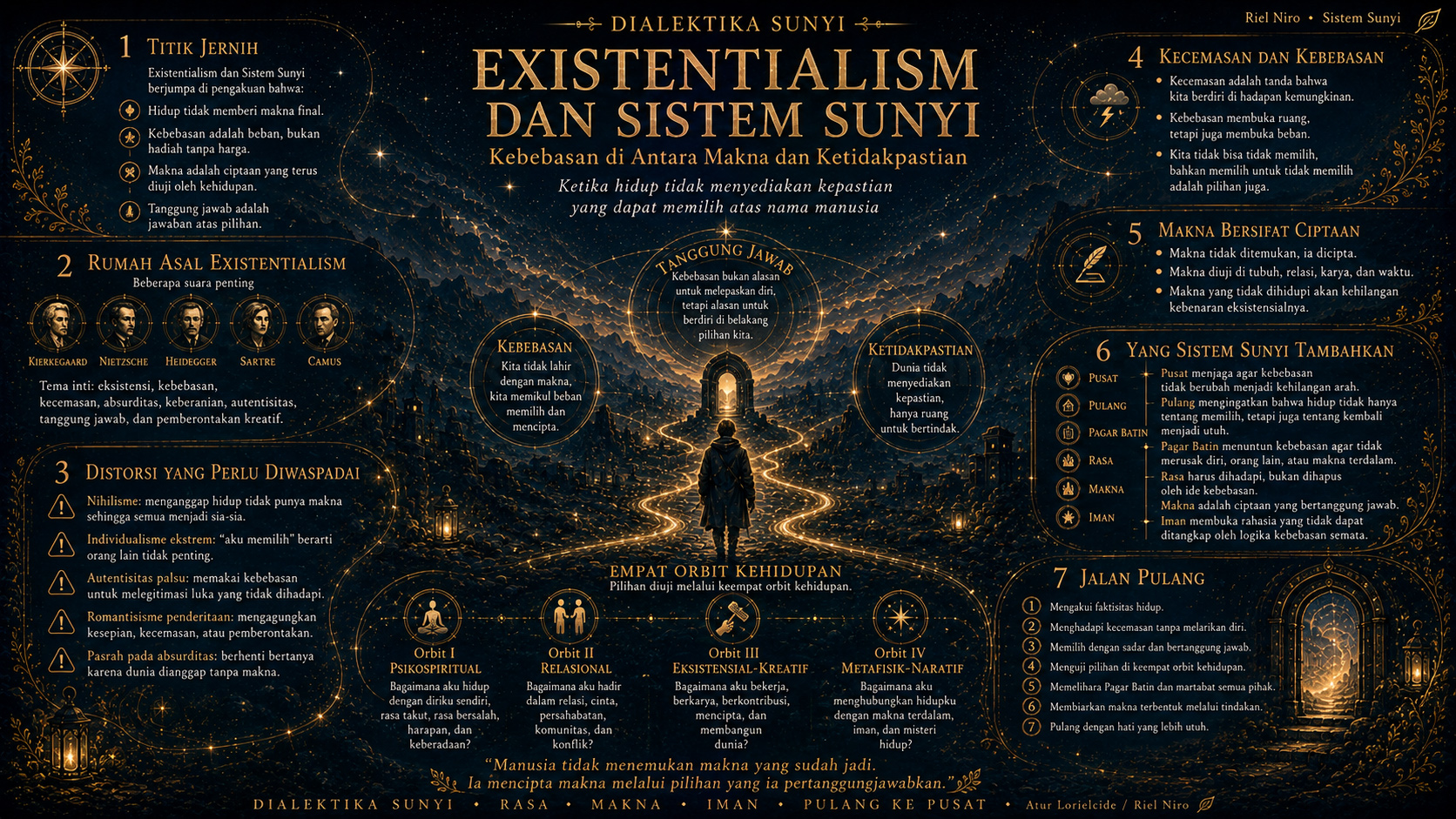
It is here that existentialism acquires its unsettling force. Existentialism is not a single uniform doctrine. Thinkers commonly gathered beneath the name did not always accept the label, did not agree about God, meaning, freedom, morality, or human nature, and often occupied positions in direct tension. Kierkegaard speaks from the struggle of faith and the individual before God. Nietzsche dismantles inherited values and confronts nihilism. Heidegger examines being, thrownness, everydayness, and death. Sartre emphasizes freedom, facticity, choice, and self-deception. Beauvoir brings freedom into relationship, embodiment, gender, and concrete circumstance. Camus confronts absurdity without accepting that cosmic silence must end in surrender.
This essay therefore does not attempt to reduce the whole of existentialism to a single voice. It examines a family of recurring problems: life that cannot be completed by definition, freedom that never appears without limits, anxiety before possibility, the human tendency to hide from responsibility, and the need to form a way of life when certainty is unavailable.
The System of Silence meets these problems from another direction. It is not an existentialist philosophy and does not arise from the same history. It reads how feeling leaves an echo, how emotion, morality, and spirituality order one another, and how choice is tested in relationship, work, meaning, and faith. Beneath the encounter lies a related question: how can human beings live honestly when no formula can replace the courage to be present?
The four orbits of The System of Silence are not used as stages toward a higher human being. They become fields of examination: whether freedom can read wound and body, whether choice honors the freedom of others, whether orientation takes form in work, and whether faith remains alive without erasing uncertainty.
Existence Cannot Be Completed by Definition
Human beings can be explained through biology, psychology, sociology, economics, history, and culture. All such explanations matter. Existentialism nevertheless rejects the assumption that a person has been fully understood once all causal factors are mapped.
A human being is not only something already made. A person is also a relationship to what has happened, a project not yet complete, and a capacity to give meaning to limits that were not chosen. There is facticity: body, past, social class, mortality, and irreversible decisions. Yet human beings also move beyond facticity through interpretation, choice, and action.
This tension protects existentialism from two reductions. The first is a determinism that makes human beings appear to be nothing more than results of causes. Wounds explain everything. Social structures determine every possibility. Diagnosis becomes identity. The past turns into a sentence.
The second is a romanticization of freedom that assumes human beings can create themselves without regard for body, power, poverty, trauma, discrimination, and history.
Mature existentialism need not choose between the two. Freedom lives within circumstance. Circumstance limits, but does not always exhaust. Human beings are not absolute sovereigns over their lives, yet neither are they always merely objects of what happens to them.
The System of Silence reads this tension as the relationship between blueprint and embodied life. Patterns are inherited, but patterns are not the whole of destiny. Conditions exert pressure, but not every response has already been determined. The Theory of Inner Echo helps identify what continues to reverberate from the past, while The System of Silence Model (MSS) refuses two reductions: making feeling destiny or ignoring it in the name of abstract freedom.
Freedom may be narrow, covered over, or require support before it can be used. Yet even a small space carries weight. It becomes the place where human beings weigh what remains possible without denying body, history, social class, trauma, and relations of power.
Thrownness: Being in the World before Being Ready
Heidegger uses the language of thrownness to name the fact that human beings always find themselves already in the world. They do not begin from a neutral point. They arrive inside relationships, obligations, language, mortality, possibilities, and histories already in motion.
Thrownness does not mean that a person has literally been thrown by someone. It marks a basic condition: we always begin from something we did not arrange ourselves.
This awareness can free human beings from the mythology of self. Not every achievement is solely the product of personal will. Not every failure proves a defect of character. Much depends on time, access, body, family, opportunity, and structure.
Thrownness, however, does not eliminate responsibility. Precisely because human beings find themselves somewhere, they must answer from there. The available choices may not be ideal, but life still moves through the response given.
Human beings often reject their point of departure in two ways. The System of Silence recognizes the first movement when people regard themselves as entirely victims, leaving no action possible. The other appears when they construct a story of being purely self-made so that dependence and fortune need not be acknowledged.
Clarity begins when a person can say, “This was not wholly my choice, but it has now become part of my responsibility.”
Anxiety as an Experience of Possibility
In much existentialist thought, anxiety is not merely a symptom to be removed. It can disclose that human beings have possibilities and no perfect guarantee concerning what should be chosen.
Fear usually has an object. A person fears losing work, being rejected, becoming ill, or failing. Existential anxiety is harder to point toward. It appears when life feels open, when an older identity no longer suffices, or when one recognizes that no other person can choose completely in one’s place.
Anxiety may be the price of freedom. Every choice closes another possibility. Every commitment includes loss. Even a responsible decision does not always arrive with certainty.
Yet not every anxiety should be given philosophical meaning. The body can experience anxiety disorders, trauma, panic attacks, exhaustion, or medical conditions that require care. Turning all anxiety into a summons to authenticity can prevent people from receiving the help they need.
The System of Silence distinguishes anxiety as information, pattern, bodily condition, and existential experience. Sometimes courage to choose is needed. Sometimes sleep, safety, therapy, medication, or departure from a harmful condition is needed. Depth lies not in assigning one interpretation to every symptom, but in reading the responsibility of each layer.
Freedom Is Never Pure
The language of freedom is often misunderstood as though existentialism taught that human beings can become anything by choice alone.
Existential freedom, however, lives within facticity. Human beings do not choose every card they receive, but they still form a relationship to those cards. Freedom is not the ability to obtain every result. It is the impossibility of completely escaping one’s position as the one who responds.
This makes freedom heavy. Human beings are not only free to choose; they are responsible for the meaning given to choice.
Sartre sharpens this burden through the idea that people often flee freedom by treating themselves as things. They say, “That is simply who I am,” “My role requires it,” “Everyone does it,” or “I had no choice,” even when some space remains that they do not wish to acknowledge.
The opposite can also be deception: pretending that conditions do not limit. Human beings may deny age, body, history, obligations, or consequences and call the denial freedom.
The System of Silence understands freedom as an inner distance that makes response possible, not as sovereignty without limits. The distance may be very small. A person may not yet be able to change the situation, but may still refuse to make hatred the only language. Someone may not yet be able to leave, but can begin to build protection. A person may be unable to find meaning, but can refuse false certainty.
Bad Faith: Hiding from Oneself
Bad faith is often translated as ill will, but the problem is closer to self-deception. Human beings know and simultaneously attempt not to know that they are free, limited, or responsible.
They may hide behind a role. A leader says that office compels the decision, as though no personal choice existed in the exercise of power. Someone remains in a destructive relationship and says that love offers no choice. Another avoids commitment in the name of self-discovery while actually fearing the loss of other possibilities.
Self-deception is not always a conscious lie. It can become a structure of narrative maintained so long that the person no longer sees the part deliberately left in darkness.
This territory has a strong affinity with the reading offered by The System of Silence. Inner distortions often endure not because information is absent, but because certain information threatens identity, safety, or advantage.
The concept of bad faith must nevertheless be used humbly. Not every inconsistency is self-deception. A person may be confused, divided, wounded, or still without language. Easily accusing others of inauthenticity can become a new form of superiority.
Authenticity Is Not the Command to “Be Yourself”
Popular culture turns authenticity into spontaneous expression: saying what one feels, following desire, and resisting social adjustment. Existentialism presents a harder problem.
Who is the “self” to be followed when selfhood is continually formed through history, relationship, habit, and choice? Is every impulse a deepest voice? Does rejecting every norm make a person authentic?
Authenticity is not obedience to impulse. It is closer to a willingness to acknowledge circumstance, freedom, limitation, and consequence without hiding behind roles or the crowd.
Heidegger describes the tendency to live as “they” live: enjoying what they enjoy, judging as they judge, and treating common choice as proof of truth. Yet leaving the crowd does not mean despising society. Human beings always live with others.
Beauvoir offers a crucial correction: one’s freedom does not mature when built by taking away the freedom of others. Authenticity is not a private project indifferent to the world. Freedom gains ethical substance when it opens possibilities for other freedoms.
Authenticity, in the reading of The System of Silence, is an alignment continually tested, not a pure identity found once and for all. The honest self is not always the comfortable self. Honesty may require admitting that a desire is unjust, that faith is being used to evade responsibility, or that an image of calm rests upon silenced feeling.
Meaning: Created, Discovered, or Received?
Here the differences within the existential family become unmistakable. In some atheistic readings, no transcendent value or purpose arrives beforehand to define human beings. Meaning is formed through projects, choices, commitments, and relationships. In Kierkegaard, human existence cannot be separated from faith and the individual’s decision before God. In Camus, the question of meaning confronts an indifferent world and the absurd, but the answer need not be despair. Human beings may continue to live, revolt, love, and act without demanding that the universe provide justification.
No single formula allows The System of Silence to settle these differences. It makes room for meaning formed through living, discovered in responsibility, received through relationship and faith, and tested by its consequences in reality.
Meaning treated as purely created may become personal justification when severed from others and the world. Meaning treated as simply discovered may become authority immune to correction. Meaning said to be received from God may conceal private desire. Conversely, rejecting every meaning beyond the self is also a philosophical decision, not a neutral fact.
The System of Silence therefore subjects meaning to discernment. Where does it come from? What does it demand? Who bears its consequences? Can it receive correction? Does it make human beings more present to reality or more protected from reality?
Absurdity and the Life Still Lived
Camus begins with the tension between the human longing for clarity and a world that does not provide a corresponding answer. The absurd is not simply that life is bad or meaningless. It arises in the meeting between the human demand for meaning and the silence of the world.
The response to absurdity need not be illusion. Camus resists a leap that closes the tension too quickly. He preserves lucidity, revolt, and life without false reconciliation.
Here existentialism poses an important challenge to The System of Silence. Its language of Returning Home, center, faith, and orientation may too quickly make life appear to possess a ready-made order. Yet some experiences receive no conclusion. The death of a child, mass violence, devastating illness, or unexplained loss must not be forced into a harmonious narrative.
Mature silence must be able to remain before what is unfinished. Faith does not always provide a reason. Meaning does not always explain. Returning Home sometimes means living without the former home, not recovering an intact form.
Absurdity, however, need not become total identity. The fact that the universe does not answer every question does not make love, responsibility, and justice empty. Values may be lived even when outcomes do not guarantee them.
Death as a Limit That Gives Form
Existentialism treats death not only as the final event, but as a limit that transforms the reading of life. The awareness that time is finite exposes the falseness of endless postponement. Human beings often live as though important decisions can always be delayed, relationships repaired at any time, the body perpetually available, and the desired life begun after every condition is satisfied.
The awareness of death can also be misused as pressure to live spectacularly. Not everyone must pursue grand experiences. Finitude may instead return people to the ordinary: being present in conversation, completing responsibility, apologizing, caring for the body, and refusing to give every day to what they do not believe.
Death clarifies proportion in the reading of The System of Silence. It reveals how much noise gains power because human beings forget what is finite. Yet death must not be romanticized. Grief, fear, and unwillingness remain human.
Relationship and the Freedom of Others
Existentialism is often criticized for being overly individualistic. The criticism has grounds in some forms of the tradition, but it does not exhaust it.
Beauvoir shows that freedom always exists in a shared world. Human beings do not only choose themselves; their actions open or close possibilities for others. A freedom that turns another person into an object is not mature freedom.
Relationship carries tension. We need the recognition of others, but cannot control how they see us. We love, but cannot compel love. We build commitments, yet the other remains free.
Distance, boundaries, and relational gravity form the field through which The System of Silence reads this tension. Much suffering arises when human beings try to convert another’s freedom into certainty for themselves. They monitor, demand, interpret, or surrender themselves so that the relationship will not change.
To love someone is to accept that they are not an extension of our project. The freedom of another can wound, but the abolition of freedom is not love.
Faith without the Erasure of Uncertainty
Existentialism has no single relation to faith. Kierkegaard places faith within an existential decision that cannot be replaced by a rational system. Sartre constructs freedom without divine foundation. Camus rejects what he sees as a metaphysical leap that closes absurdity.
The System of Silence must not treat these differences as stages toward a supposedly higher position. Faith is not an automatic answer to existentialism. Existentialism can instead test faith. Does a person believe because they have genuinely chosen and entrusted themselves, or because they fear life without certainty? Does the language of God’s will open responsibility, or evade choice? Does prayer make a person more honest toward mortality, freedom, and limitation, or become a place to deny them?
In The System of Silence, faith as gravity does not erase anxiety. It offers direction when certainty is absent. Yet the direction of faith must be distinguished from psychological certainty. Human beings may believe while still not knowing every reason.
Faith unable to bear questions easily becomes a fortress. Mature faith can live with parts of life that have not received answers.
What Existentialism Requires of The System of Silence
Existentialism tests the tendency of The System of Silence to speak of Returning Home, center, orientation, and faith in language that can sound too complete. It insists that human beings do not always discover a direction already waiting to be recognized. Sometimes direction must be formed through decisions without full guarantees.
One test concerns the language of Returning Home. Returning to the Center can be a consoling metaphor, but it can also be misunderstood as though the self possessed a stable, complete original home that only needed to be recovered. Existentialism reminds us that human beings do not merely return to something already made. They also form themselves through choice, commitment, failure, repair, and relationships that change how the past is read.
This correction does not abolish the Center. It keeps the Center from becoming a frozen essence immune to history. The Center is better understood as an orientation under continual examination: a place from which human beings test whether life remains honest toward reality, value, relationship, and responsibility, rather than a pure identity that erases change.
Orientation therefore must not replace choice. Faith, value, and meaning can provide direction, but they do not always determine a concrete answer. Two choices may both carry risk, two paths may both involve loss, and no inner sign may guarantee that one is correct. In such conditions, clarity is not certainty about the outcome. It is the capacity to see honestly enough before bearing a decision.
Orbit III matters because embodied life demands decision, work, and responsibility. Silence does not choose in place of the human being. It keeps action from arising entirely out of panic, imitation, or the need for false certainty.
Anxiety also needs to be read within a wider field of possibility. It can arise when life is out of alignment, but also when a person faces possibilities that are genuinely open. Anxiety is not always an Echo of a wound that needs to be healed, nor evidence that a choice is wrong. At times, it arises from the recognition that no one else can fully make the decision or bear its consequences on our behalf.
The psychospiritual orbit needs to distinguish anxiety as trauma trace, response to danger, clinical condition, and experience of freedom. This distinction prevents all unease from being treated through one language. It also prevents calm from becoming the only sign of right direction, because some responsible choices still arrive with trembling.
Existentialism then reminds The System of Silence that human beings continue becoming. The System of Silence is rich in structural language, yet inner structure is never wholly finished. A present choice can change how the past is read, open new habits, and give a different form to the future. Even long-held values must remain open to examination so that they do not become inherited commitments preserved merely because they are familiar. Nietzsche’s critique of inherited values belongs here: dismantling is not enough, but neither should something be called true simply because it has long been received.
The Architecture of the Soul is therefore not a final building, but neither is it an arrangement that can be altered at whim. It continues to read awareness as ground, intention as foundation, value as walls, meaning as roof, and faith as gravity preserving wholeness. Yet the whole structure is continually inhabited, maintained, tested, and renovated through habit, relationship, work, loss, and responsibility.
From here, unfinishedness gains dignity. The desire to find a center can become pressure to feel whole, calm, and complete too quickly. Existentialism gives room to a life that remains open, ambiguous, and unresolved. The reading offered by The System of Silence gains depth when silence is not used to close a question, but to remain with it without losing the capacity to act.
What The System of Silence Adds to the Reading of Freedom
Human beings still have to choose. From there, The System of Silence asks from what body, history, relationship, and capacity a choice arises. Freedom is not cancelled by conditions, but neither can it be imagined as though everyone possesses the same room.
Freedom always lives in a body. A tired, ill, threatened, or traumatized body does not provide the same decision space as a safe body. Choice still carries weight, but the capacity to choose can narrow. The language of responsibility must therefore travel together with regulation, support, care, and safety so that freedom does not become a cruel demand.
The Theory of Inner Echo reads how older experience enters a new situation. Yet an echo does not automatically cancel choice, and choice does not automatically erase the echo. Both need to be read together: what is being repeated, what is actually dangerous, what remains possible, and what support is needed so that the space of response does not close further.
The reading offered by The System of Silence also carries a further insistence: feeling is more than an existential mood disclosing reality. Feeling may carry information, but it may also carry distortion, attachment patterns, the need for recognition, and relational echoes. The System of Silence Model (MSS) places emotion alongside morality and spirituality so that experience does not immediately become final truth.
Anger may disclose violation, fear may read danger, and emptiness may reveal loss of meaning. Each still needs to be weighed through value, consequence, context, and the freedom of others. Beauvoir matters here: freedom is not a private project. A choice called authentic must still be tested by whether it opens or closes the possibilities of other lives.
Chosen meaning is not yet fully alive until it descends into rhythm. It must enter habit, work, the use of time, the treatment of others, and the capacity to complete something. The existential-creative orbit removes the rhetorical luxury from authenticity. It tests authenticity through discipline, work, fidelity, repair, and the willingness to bear consequences when the first feeling no longer supplies energy.
In the territory of faith, The System of Silence places faith within relationship, not only within metaphysical answers. Faith as gravity is not certainty about every reason, but an orientation that preserves hope and responsibility when explanation is unavailable. Such faith does not erase absurdity or force grief into harmony. It refuses to make incomprehension a reason to stop loving, working, or repairing.
Silence then provides space before decision. Existential decisions do not always arise from complete argument. The pause allows feeling, impulse, social pressure, inherited value, and fear to become visible before a person chooses. Yet the pause is not a permanent dwelling. Silence loses its force when used to delay continually while waiting for certainty that will never arrive.
At some point, human beings still have to move without knowing every consequence. The System of Silence does not offer freedom from uncertainty. It offers a way for decision to arise from a fuller reading and then take form in body, relationship, work, and faith without treating human beings as absolute masters of outcome.
When the language of freedom conceals reality
The encounter between existentialism and The System of Silence can produce a liberating language, but that same language can also be used to conceal reality. One of the earliest distortions appears when existentialism is reduced to nihilism. The rejection of absolute certainty is then misread as proof that all values are empty and no commitment is worth sustaining. Yet Sartre demands that human beings bear the weight of their choices, Kierkegaard emphasizes the decision of faith, Nietzsche confronts the crisis of values, and Camus refuses surrender to absurdity. The absence of guarantees is not the same as the absence of weight.
The language of authenticity can also shift into a justification for egoism. The slogan “be yourself” is used to reject responsibility, faithfulness, correction, or social commitment. Freedom then comes to mean doing whatever one wants without reading the consequences. Yet mature authenticity is not the expression of impulse. It is the willingness to live honestly within a shared world, including when one’s own desires must be restrained so that the freedom of others is not taken away.
Another danger appears when freedom is exaggerated until people are blamed for the entirety of their circumstances. The body, trauma, social class, violence, discrimination, and unequal power disappear from the reading. Suffering is then treated as the consequence of having failed to choose correctly. Mature freedom instead recognizes facticity and differences in capacity. Responsibility must be distinguished from the accusation that people create every condition that befalls them.
Anxiety, too, can be romanticized. Severe distress is granted philosophical nobility, while therapy, sleep, medication, safety, or medical help are treated as less authentic. A reading like this does not deepen the human person; it neglects the body. Existential anxiety can indeed open possibilities, but clinical disorders and trauma still require appropriate forms of care.
From the religious side, faith can be used to close off absurdity. Religious answers are offered too quickly so that grief, protest, injustice, and unknowing can immediately appear ordered. Loss is forced into a plan, wounds into lessons, and mystery into certainty. Mature faith does not have to explain every reason. It can preserve direction while allowing tears, questions, and unresolved realities to retain their place.
The opposite movement is also possible: absurdity can be used to avoid responsibility. Because the world offers no guarantees, people may feel released from commitments to love, justice, truth, or repair. Absurdity then becomes a reason not to care. Yet life without guarantees can still be lived through resistance to injustice, faithfulness to others, and work whose outcome is never assured.
These six distortions converge in a single pattern: ideas that should open space are used to erase something that a person does not want to bear. Freedom erases conditions, authenticity erases others, anxiety erases the body, faith erases absurdity, and absurdity erases responsibility. A mature reading keeps all of these tensions visible.
Living without Guarantees, Choosing without Becoming Alone
Human beings live between conditions not chosen and decisions that cannot be wholly handed to others. Existentialism keeps that tension open. In The System of Silence, every choice arises from an inner life with history, body, relationship, value, and a need for orientation.
Between the two, authenticity is neither loyalty to momentary feeling nor obedience to a center assumed to be final. It is the courage to weigh conditions, choose honestly, receive correction, and continue forming a life without erasing unchosen limits. Freedom does not stand alone because every decision has a body that bears it, relationships affected by it, and a world that may be opened or narrowed through it.
The four orbits examine freedom from several directions without becoming stages. The psychospiritual orbit reads echoes and capacity. The relational orbit weighs the freedom of others, boundaries, and power. The existential-creative orbit asks choice to become work and habit. The metaphysical-narrative orbit prevents faith from becoming a false answer and uncertainty from becoming nihilism.
Faith as the Gravity of The System of Silence does not provide a complete map. It preserves direction when human beings still have to choose without certainty that they understand the whole of reality. Surrender is not the cancellation of freedom, but the recognition that human beings are responsible without being absolute masters of outcome.
An honest life does not always feel complete. It may continue to carry anxiety, loss, and questions. Yet unfinishedness need not stop presence. Human beings can still work, protect relationships, repair wrongs, and form meaning open to correction.
Between thrownness and choice, human beings do not find pure freedom. They find enough room to answer. That room may be small, but there life takes form.
Dialektika Sunyi (Format 2) adalah ruang dialog antara Sistem Sunyi dan dua puluh empat rumah pemikiran dari berbagai tradisi filsafat, psikologi, etika, teologi, dan pemikiran sosial. Dua puluh empat tulisan ini tidak disusun untuk menjadikan tradisi-tradisi tersebut sebagai bagian dari Sistem Sunyi, melainkan untuk mempertemukan cara pandang yang berbeda agar manusia dapat dibaca dari lebih dari satu pintu.
Sistem Sunyi tidak datang ke dalam dialog dengan rumah yang kosong. Ia sudah membawa cara membaca sendiri: Rasa perlu didengar tanpa segera dijadikan kebenaran, Makna tidak dipaksakan kepada luka, Iman memberi arah tanpa menjadi jawaban instan, dan manusia tidak dapat dihabiskan oleh satu istilah atau satu peta.
Karena itu, setiap rumah pemikiran hadir sebagai ruang dialog yang tetap memiliki bahasa, sejarah, pertanyaan, dan batasnya sendiri. Dialektika Sunyi bukan upaya membuktikan bahwa dua puluh empat tradisi tersebut pada akhirnya mengatakan hal yang sama dengan Sistem Sunyi.
Mengapa dua puluh empat rumah pemikiran?
Karena manusia terlalu luas untuk dibaca melalui satu lensa. Penderitaan dapat hadir sebagai pengalaman batin, pola tubuh, relasi, cerita diri, bahasa, kondisi sosial, struktur kuasa, sejarah, iman, maupun perubahan kehidupan. Satu lensa dapat membuka sesuatu yang penting, tetapi selalu ada wilayah yang berada di luar jangkauannya.
Dua puluh empat rumah pemikiran karena itu membuka percakapan dari berbagai arah. Membuka pintu tidak berarti meninggalkan rumah. Setiap tradisi tetap dibaca sebagai rumahnya sendiri, sementara Sistem Sunyi membiarkan perjumpaan itu memperluas cara melihat tanpa kehilangan batasnya.
Di dalam panel ini, dua puluh empat tulisan dibagi menjadi tiga bagian: Peta I, Peta II, dan Peta III. Ketiganya adalah pembagian navigasi untuk membantu menemukan delapan rumah pemikiran pada masing-masing bagian.
Sebelum masuk ke daftar, dua ruang berikut dapat digunakan untuk melihat keseluruhan Dialektika Sunyi dalam skala yang lebih luas:
Atlas Dialektika Sunyi
24 Percakapan, 24 Peta Pembacaan
Ruang orientasi publik untuk menjelajahi dua puluh empat tradisi yang berdialog dengan Sistem Sunyi tanpa kehilangan rumah pemikirannya masing-masing.
Peta Pengetahuan Dialektika Sunyi
Dua Puluh Empat Rumah. Tidak Ada yang Dilebur Menjadi Satu.
24 Rumah Pemikiran · 20 Kejernihan · 25 Pintu Kehidupan
Ruang untuk melihat bagaimana dua puluh empat tradisi dipertemukan dengan Sistem Sunyi tanpa penyerapan, kemenangan, atau sintesis yang lebih tinggi.
Peta ini hanya membantu menemukan jalan. Pembacaan sebenarnya terjadi di dalam masing-masing tulisan, ketika satu rumah pemikiran dibuka dan dialognya dengan Sistem Sunyi mulai berlangsung.
Paket I bergerak paling dekat dengan pengalaman personal, tetapi tidak membiarkan batin menjadi dunia yang tertutup. Kendali bertemu keadaan, perhatian bertemu makna, kedekatan membawa sejarah relasi, kebebasan berhadapan dengan keterbatasan, dan keheningan diuji oleh doa serta kehidupan yang kembali dijalani.
- Ketika keteguhan tidak berarti mematikan rasa
- Ketika hadir belum berarti memahami
- Ketika hidup tidak hanya meminta penjelasan, tetapi jawaban
- Ketika kebutuhan akan tempat aman ikut membentuk cara manusia mencintai
- Ketika hidup tidak menyediakan kepastian yang dapat memilih atas nama manusia
- Ketika bagian diri yang tidak disadari ikut membentuk cara manusia melihat kenyataan
- Ketika bahasa iman belajar mengakui Tuhan tanpa menjadikan misteri sebagai tempat bersembunyi
- Ketika keheningan di hadapan Tuhan kembali menjadi kasih, kerja, batas, dan tanggung jawab
Paket II memperdalam pertanyaan tentang bagaimana pengalaman sebenarnya terbentuk. Apa yang terasa tidak hadir tanpa tubuh. Apa yang dipahami tidak lahir tanpa bahasa. Agency mempunyai lingkungan. Care mempunyai distribusi beban. Makna dan keyakinan memperoleh ujian ketika mereka meninggalkan jejak dalam kebiasaan, tindakan, dan dunia bersama.
- Ketika kenyataan perlu diberi ruang sebelum kesimpulan mengambil alih
- Ketika tubuh, kebiasaan, alat, relasi, dan dunia ikut membentuk cara manusia memahami dan memilih
- Ketika rasa sakit tidak harus hilang sebelum manusia bergerak menuju yang bernilai
- Ketika motivasi dibaca melalui autonomy, competence, relatedness, dan mutu alasan untuk bergerak
- Ketika kisah hidup memberi arah, tetapi tidak berhak menjadi seluruh kenyataan
- Ketika bahasa, sejarah, tradisi, dan kuasa ikut menentukan apa yang dianggap sebagai kebenaran
- Ketika kebutuhan, dependency, kerja perawatan, kompetensi, dan pembagian beban menjadi persoalan moral
- Ketika gagasan diuji melalui kebiasaan, penyelidikan, konsekuensi, komunitas, dan revisi
Paket III membawa pembacaan ke kondisi yang membuat sebagian pengalaman dipercaya, sebagian dinormalkan, dan sebagian bahkan sulit memperoleh bahasa. Struktur dan sejarah masuk lebih jelas, tetapi manusia tidak dibiarkan menghilang di dalamnya. Karena itu Systems Thinking bertemu Virtue Ethics, Liberation Theology bertemu batas praxis, dan Process Philosophy menutup paket dengan kehidupan yang terus menjadi tanpa kehilangan tanggung jawab.
- Membaca penderitaan di antara batin, ideologi, institusi, ekonomi, dan distribusi kuasa
- Ketika pengetahuan dibentuk oleh posisi, tubuh, bahasa, kredibilitas, dan relasi kuasa
- Bahasa, institusi, dan relasi yang membuat kategori terasa alamiah
- Sejarah, bahasa, representasi, dan kuasa di balik hak untuk menjelaskan manusia lain
- Membaca pola, feedback, penundaan, batas sistem, dan perubahan yang tidak pernah berdiri sendiri
- Karakter, kebiasaan, emosi, teladan, dan kebijaksanaan praktis dalam kehidupan sehari-hari
- Ketika doa, kasih, keselamatan, dan kitab diuji oleh kemiskinan, penindasan, serta tindakan pembebasan
- Identitas, relasi, waktu, dan Pusat yang bertahan tanpa membeku menjadi bentuk final
Atur Lorielcide berjalan di antara kata dan keheningan.
Ia menulis untuk menjaga gerak batin tetap terhubung dengan pusatnya.
Melalui Sistem Sunyi, ia mencoba memetakan cara pulang tanpa tergesa.
Lorong Kata adalah tempat ia belajar mendengar yang tak terlihat.
Baca juga: Dua Ruang, Satu Sunyi: Jejak Atur Lorielcide alias Rielniro