

 Tulisan ini bagian dari sistem kesadaran reflektif
Motivation can be powerful without ever becoming the true possession of the person who lives by it. Someone may work hard from conscious choice, but may also be driven by guilt, threat, the need to preserve love, or the fear of losing a sense of worth.
Many conversations about motivation stop at one simple question: whether someone is motivated enough. The question sounds reasonable because life does require energy. Work must be completed, families cared for, promises kept, bodies tended, and decisions cannot be postponed forever. Yet human beings do not only need energy in order to move. They also need to know what kind of energy is moving them.
Two people may work with the same intensity, complete the same task, and even receive similar recognition. One moves because the person understands why the work matters and is willing to bear its weight. The other moves from fear of disappointing parents, losing a job, no longer being needed, or becoming unworthy by stopping. From the outside, both appear equally diligent. From within, they live in different worlds.
This distinction immediately changes how we read many behaviors that have long been treated as simple. A person may appear highly disciplined, even though no room has ever been made for genuine choice. A person may seem deeply responsible, while carrying every responsibility in order not to lose love. A person may even appear devout, while that devotion is sustained by the fear of a guilt that never ends.
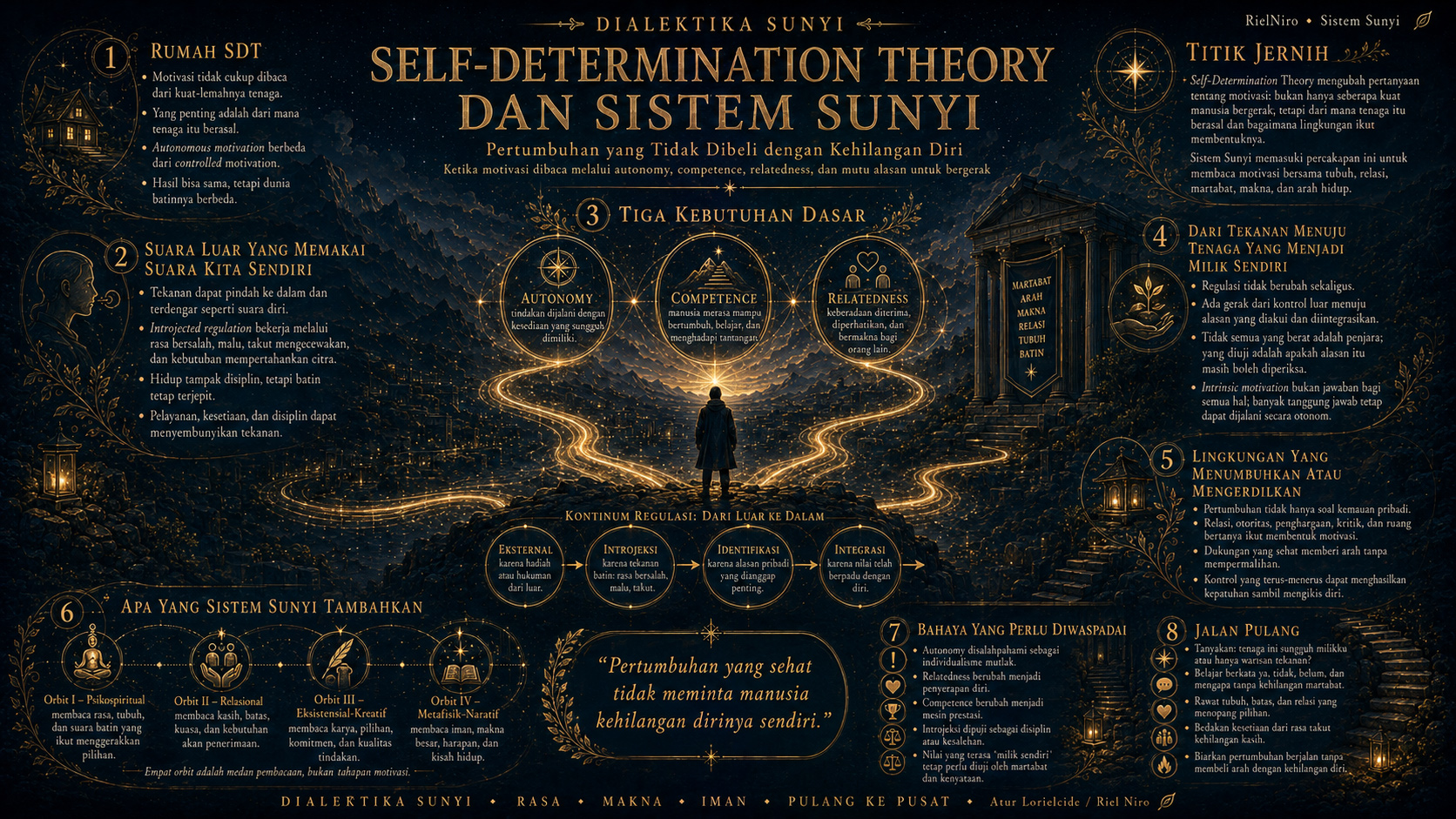
Self-Determination Theory calls action undertaken with willingness, interest, or genuine endorsement autonomous motivation. By contrast, controlled motivation arises when action is driven by external pressure or by inner pressure that works like a supervisor. This does not mean that controlled motivation always fails to produce results. Quite the opposite: it often produces high achievement. Many organizations survive through threat, many families preserve order through guilt, and many educational systems secure compliance through fear of failure.
The outward results often look impressive. The problem appears only when all energy depends on pressure. Life slowly loses its flexibility. Human beings begin to work no longer because they know why they are moving, but because they no longer know how to stop. They continue meeting targets, protecting an image, and becoming the person others can rely on, yet one small failure can bring their entire sense of worth down with it.
At this point, SDT’s question comes very close to the reading offered by The System of Silence. The question is no longer, “Is this life successful?” but, “Who is actually moving this life?” For a person may produce extraordinary work while slowly losing the self. A person may become an example to many, yet live each day in fear that one day the same expectations can no longer be met. Achievement keeps increasing, while inner freedom steadily diminishes.
The System of Silence reads this condition as one of the most subtle forms of alienation. Human beings appear to move with great energy, yet the direction of their lives is gradually determined by measures that come entirely from outside. They live by standards that can never be fully met. They work for a voice that never truly falls silent.
Motivation therefore cannot be judged only by the results it produces. Two actions that look the same may arise from entirely different inward worlds. One enlarges life. The other merely prolongs pressure in a more orderly form. SDT does not ask human beings to abandon discipline, achievement, or responsibility. It asks a more fundamental question: do all these things still belong to you, or are they being carried out in order to preserve something that continually threatens to disappear?
From that question emerges a different way of seeing human development. Self-Determination Theory does not view human beings as passive creatures who merely react to reward and punishment. Nor does it assume that people automatically grow simply because they are given freedom. The theory begins from the idea that human beings have an organismic tendency to grow: to organize experience, connect different parts of life, and gradually make what first came from outside something genuinely accepted from within.
This process is called internalization. Commands, rules, or values do not have to remain external voices. They may begin to be taken in and then worked through with very different qualities: sometimes becoming little more than inward pressure, sometimes understood and endorsed, sometimes eventually integrated. Yet this process is never automatic. The environment may support it, but it may also obstruct it. A rule given with respect can help a person grow. The same rule, when filled with threat and humiliation, may instead build a life that continues to depend on control.
SDT always reads human beings together with the environments in which they live. Growth is never only a matter of personal will. It also depends on the quality of relationships, the way authority is exercised, the forms of recognition a person receives, and the room available for someone to understand the reasons behind their own actions. This is where SDT differs from approaches to motivation that seek only the quickest technique for increasing enthusiasm. It does not merely ask how human beings can become more productive, but whether that productivity helps them become more whole.
This idea closely aligns with how The System of Silence understands the Center. The Center does not suddenly appear in a single moment of illumination. It is formed through thousands of small decisions as human beings gradually stop living solely from pressure and begin to recognize reasons that genuinely belong to them. Yet resonance does not mean that everything internalized becomes true. Human beings can turn guilt into identity, perfectionism into calling, or control into a form of love. The journey toward self-ownership therefore does not end with the question of whether a value has become part of life. It must still ask whether that value is worthy of becoming a home for the life being built.
When an outer voice learns to speak as our own
Pressure does not always remain outside. Over time, a rule can move inward and begin to sound like one’s own voice. No one else needs to watch because the watcher has become part of the inner conversation. Its sentences often sound familiar: I must always be strong; if I fail, I disappoint everyone; good people do not say no; if I stop working, I am lazy.
In SDT, this condition is read through introjected regulation. The behavior still appears disciplined and its energy remains intense, but that energy arises from guilt, shame, fear of losing approval, or the need to preserve a self-image. At this point, many lives look successful from the outside while continuing to exhaust the person within. Human beings no longer obey others directly. They have learned to punish themselves.
Introjection can hide behind noble language. Service becomes an obligation to remain constantly available. Humility becomes a prohibition against having needs. Fidelity becomes an inability to admit that a relationship has caused harm. Discipline becomes hatred toward a tired body. Even personal growth can become an endless project to prove that the self is still not good enough.
The Phenomenon of the Inner Fence offers another language for reading voices that have long settled within and restricted movement from the inside. The two are not identical. Introjection has its own theoretical home within SDT, while the Phenomenon of the Inner Fence is a reflective reading within The System of Silence. Yet they can meet in the same experience: human beings do not always know whether the voice they are obeying arises from choice, fear, love, an old wound, or a rule that has lived within them for too long.
One of Self-Determination Theory’s greatest strengths is its account of motivation as something that does not change all at once. Organismic Integration Theory describes different qualities of regulation along a continuum from the more controlled toward the more autonomous. This is not a developmental staircase that everyone must climb in a straight line; several reasons can inhabit the same action at once. Under external regulation, action still depends on reward, punishment, threat, or demand from outside. That pressure may move inward and become introjected regulation. Yet the journey does not have to stop there.
There are times when a person begins to understand why an action matters, even without always enjoying the process. A patient undergoes rehabilitation in order to walk again. A student studies not only for grades, but because the meaning of knowledge for life is beginning to appear. A child cares for a parent not merely because of cultural obligation, but because the relationship has genuinely been accepted as something the child wants to live out. SDT calls this change identified regulation: a reason that first came from outside begins to be acknowledged—“I really do choose this.”
A value that has been acknowledged can move deeper and find a place among the other parts of life. There it becomes integrated regulation. Integration is not a state without conflict. Human beings can be workers and parents, leaders and learners, faithful persons who are still able to ask questions. Wholeness never means that every tension disappears. It means that a person does not have to extinguish one part of the self so that another part can continue living.
Because the term intrinsic motivation has become so popular, SDT is often reduced to an invitation for everyone to find enjoyable work or follow a passion. Yet much of life consists of actions that are not intrinsically motivated. Caring for someone who is ill, paying bills, handling administration, undergoing therapy, and keeping promises do not always bring joy. Such actions can still be undertaken autonomously when their value is understood and endorsed. Intrinsic motivation means engaging in an activity for the interest or satisfaction inherent in the activity itself; it is not the same as every action that has become one’s own.
Not every “I must” is a prison. Promises, work, care, faith, and responsibility do carry demands. Someone can say, “I do not enjoy this, but I understand why I choose it.” The demand remains heavy, but it is no longer entirely foreign. The problem begins when reasons can no longer be examined. Questions are called weakness, boundaries selfishness, rest decline, and change betrayal. A person can travel very far under such pressure and gradually lose the ability to distinguish fidelity from fear, responsibility from guilt, and discipline from the need to preserve an identity.
Freedom does not begin outside relationship
Self-Determination Theory names autonomy, competence, and relatedness as three basic psychological needs. They are often imagined as components that can be examined one by one. In life, they remain intertwined. A person may feel highly capable while losing the freedom to choose. Someone may feel free to determine a direction but have no relationships that can support it. A person may live among many others while every closeness is purchased by the loss of an individual voice.
Autonomy itself is often misunderstood as absolute freedom or the ability to live entirely independently. Yet SDT uses the term to describe the experience of undertaking an action willingly. A person may follow parental advice, obey organizational rules, practice spiritual discipline, or even make sacrifices for family autonomously when the reasons for those actions are genuinely understood and endorsed. Conversely, a decision that appears highly independent may not be autonomous at all when it is actually driven only by pride, fear, or the need to prove oneself.
Autonomy is never built in empty space. Human beings learn to choose within family, language, tradition, body, social class, and relationships they did not initially choose. They need relatedness, the experience of being accepted, attended to, and significant to others. In a mature relationship, the two do not cancel each other. I can still say no without losing love. I can differ without losing my place. I can receive correction without feeling that my entire existence has been rejected.
The first place a person learns about motivation is not a classroom or a workplace, but a home. There a person first discovers how love is given, how rules are explained, how success is celebrated, and how failure is carried. A child learns whether a voice can be present without losing love, whether mistakes can be repaired without losing dignity, and whether closeness requires the erasure of self.
Not all love is given safely. Some families remain warm while a child succeeds and become cold when the child fails. No explicit threat is required. A changed tone, a withdrawn conversation, or emotional distance can be enough. Gradually the child learns that love is not something to trust, but something to maintain.
One important concept in SDT is conditional regard. It helps explain how attention or acceptance is made contingent on performance and compliance. A person shapes the self to meet the needs of others. They learn to please, not to object, not to ask, and to become strong too soon. From the outside, all of this appears to be maturity. Yet what often develops is the ability to adapt in order to preserve the relationship. Relatedness appears to be fulfilled, while autonomy gradually disappears.
The Paradox of Kinship reads the same tension from the home of The System of Silence: roots can sustain life, but roots can also tighten around it. The Psychology of Distance does not teach that withdrawal is always freedom, just as closeness is not automatically a loss of self. What matters is whether a person can still say yes, no, not yet, and why without having to surrender dignity.
An environment can support one need while thwarting another. Feedback that increases competence may destroy autonomy when it is controlling. A relationship that gives acceptance may erase autonomy when every difference is treated as a threat. Wide choice may still feel empty when a person lacks the competence to act or the relatedness that would sustain action.
SDT therefore distinguishes between need satisfaction and need frustration. A need that is not yet fulfilled is not necessarily being actively injured. Feeling unskilled while learning differs from repeated humiliation. Loneliness after moving to a new place differs from deliberate exclusion. This distinction keeps people from treating every discomfort as proof that life is on the wrong path, while also refusing to normalize environments that repeatedly damage autonomy, competence, or relatedness.
SDT calls an environment that gives room for choice, explains reasons, and acknowledges experience autonomy-supportive. This does not mean an environment without boundaries or demands. A teacher can set high standards while listening to a student’s objection. Parents can establish limits while explaining the reasons behind them. Leaders can ask for accountability without making fear the main engine of an organization. At this point, the Ethics of Feeling takes on a very concrete form. Listening to a person’s experience does not mean that every desire must be fulfilled. The experience is still acknowledged as part of the conversation.
Conversely, an environment that pursues compliance alone often appears effective. Schools become more orderly, organizations more disciplined, and families easier to manage. Yet behind that order, motivation slowly turns into controlled motivation. People learn to meet demands rather than to own their actions. They become compliant. But they do not necessarily grow. The System of Silence reads this distinction as one of the deepest tests for any community: not only whether people do what is right, but whether they still have room to choose it as something that genuinely belongs to them.
The language of autonomy must not romanticize injustice. Poverty, illness, family obligation, precarious labor, discrimination, and economic dependence genuinely narrow possibility. Someone may not be able to choose an entire path of life, but may still choose the reasons to hold and the parts of the self not to surrender. That small space matters. Yet the ability to find space under pressure never makes the oppressive system worthy of preservation.
When ability becomes the measure of worth
Human beings need the experience of succeeding. They need to feel that their actions have consequences, that learning makes change possible, and that challenges can still be faced. SDT calls this need competence. It is not merely technical skill, nor is it praise for those who always excel. Competence concerns the experience that human beings can grow in the world, make progress, and are not completely powerless before the tasks they undertake.
Competence easily mixes with something more fragile. Achievement slowly becomes identity. Success becomes proof of worth. Failure becomes proof that the person has failed as a human being. At that point ability becomes a prison. A person no longer learns in order to master something, but works to preserve the right to remain respected, loved, or accepted.
Feedback therefore plays a far greater role than evaluation alone. Healthy correction speaks about an action. Destructive correction speaks about identity. “This way has not worked yet” leaves open the possibility of learning. “You are simply incapable” closes the entire space of growth. An environment that supports competence does not remove high standards. It can uphold standards without humiliating the person who is learning.
An environment that supports competence also does not make every task easy or protect a person from failure. A teacher can break a difficult lesson into stages that remain possible to master. A parent can allow a child to keep trying without immediately taking over when the result is still imperfect. A leader can offer clear correction, provide opportunities to learn, and distinguish mistakes that can be repaired from negligence that must be held accountable. Such support does not lower standards. It helps people see the relationship between effort, learning, and progress.
By contrast, an environment concerned only with final results can turn learning into a judgment on self-worth. Mistakes are no longer read as information about what needs to be improved, but as proof of incapacity. People then choose safer tasks, conceal their difficulties, avoid asking questions, or work only to preserve the appearance of competence. From the outside, they may continue to achieve. Yet competence does not genuinely grow because their energy is spent avoiding failure rather than learning something.
Cognitive Evaluation Theory does not claim that every reward always damages motivation. It asks about the experienced function of rewards, evaluations, and feedback: do they convey information about competence, or do they become instruments of control? Fair pay need not be turned into bait, and appreciation or praise can help when it recognizes effort without taking willingness away. Yet expected rewards made contingent on performance can narrow the reasons for acting, especially in activities that were already interesting in themselves. Learning becomes about grades, work about bonuses, service about praise, and prayer about being accepted. Activities that once carried meaning of their own slowly become stages for proving oneself.
The creative world makes this change especially visible. Many people begin to create through curiosity, delight, or love of process. Autonomy gives creators room to determine how they work. Competence grows through practice, criticism, and honest learning. Relatedness emerges when the work finds readers, community, or conversation, so that creative labor does not fall into a void.
Once the work meets the market, deadlines, algorithms, public judgment, and economic need, the quality of motivation can change. Recognition is not the enemy, and professionalization is not betrayal. Yet when all of life’s energy depends on external response, creators begin to lose track of whether they are still creating or merely trying to keep themselves from disappearing from other people’s view.
Karya-Only Philosophy and the Aesthetics of Inner Discipline become useful when work is read as a form of life that must be completed without turning results into the measure of dignity, and when discipline protects rhythm without feeding self-hatred. Work, skill, and persistence matters. Yet a human being must not have to succeed before being permitted to remain human.
When energy is gone and the world calls it insufficient will
Not everyone who stops moving lacks discipline. Some people have learned for too long that effort changes nothing. They try, fail, are humiliated, try again, and encounter the same result. Eventually the relationship between action and outcome becomes unclear. They no longer see the value of what must be done, do not believe themselves capable, or feel that no available choice can genuinely change the situation. SDT calls this amotivation.
Amotivation must not become a new name for laziness, nor is it simply another word for burnout. It can arise from repeated failure, environments that damage competence, irrational rules, work that offers no influence, or lives that have made action feel without value or effect for too long. A person may not have lost all desire. What has been lost is trust that desire still has a path toward reality.
The body is often the first to bear all of this. Burnout is easily read as not being strong enough, not managing time well enough, or not being grateful enough. Yet human beings can remain highly motivated while slowly losing energy. They keep working, keep showing up, and keep producing, but everything is driven by pressure that gives the body no real chance to recover. Stopping feels shameful, resting feels selfish, and sleeping feels like wasting time.
The body is eventually treated no longer as part of life, but as an instrument of production. Yet competence was never meant to become a machine that keeps running without limit. The body is not an interruption to motivation. It is precisely a condition for motivation to endure. Work requires discipline. But healthy discipline always leaves room for recovery. Otherwise, what survives is not the work, but only the habit of forcing the self.
Controlled motivation can help accelerate exhaustion, but it is not the only cause. Workload, value conflict, injustice, lack of support, emotional demands, illness, lack of sleep, and material conditions also exert their force. Sleep, safety, care burdens, and economic pressure are not footnotes in a discussion of will. All of them help determine how much room for choice still remains.
The Ecology of Silence helps us read motivation as something that lives within environments, rhythms, habits, relationships, and spaces that can sustain or drain it. Recovery therefore cannot be reduced to asking individuals to change the way they think. Sometimes what must change is the schedule, the rules, the division of labor, the relations of power, or a system that has long obtained results from bodies kept under pressure.
A good goal may still grow from an unhealthy reason
SDT also distinguishes between intrinsic goals and extrinsic goals through Goal Contents Theory. This concerns the content of goals; it is not another name for intrinsic and extrinsic motivation. Intrinsic goals are commonly associated with personal growth, close relationships, health, community, and contribution. Extrinsic goals more often center on wealth, fame, image, status, or external recognition. The distinction helps show that the content of a goal, not only the way it is pursued, can shape well-being.
Yet these categories must not become a simplistic morality. Personal growth, family, service, contribution, and faith may look noble while still being pursued for reasons that wound. Money, status, and material success can become fragile centers of life, but they may also be tied to leaving poverty, caring for family, obtaining treatment, or escaping humiliating dependence. The name of a goal never tells the whole story of a life.
The desire for money may arise from greed, but also from the need to leave poverty, care for family, obtain treatment, or live without humiliating dependence. The desire to contribute may arise from love, but may also become a way to gain moral superiority. Personal growth itself can become a narcissistic project when an entire life is spent perfecting the self without becoming truly present to others.
This is where it becomes important to distinguish the content of a goal from the quality of its regulation. A person may pursue a relational goal because of fear of rejection. A person may serve in order to continue being seen as good. A person may exercise because of hatred toward the body. A person may seek an income with clear willingness because the responsibilities being carried are understood. The name of a goal is not enough to explain the energy that gives rise to it.
Internalization does not automatically make a value true. Human beings can turn guilt into identity, perfectionism into calling, or control into love. A value may be genuinely accepted and integrated while still requiring examination. Does it enlarge dignity? Does it make shared life more human? Does it produce actual love, or merely refine a new form of domination?
The movement of regulation from outside toward the self is not a staircase toward holiness. Integrated values can still be reexamined. Human beings may live with different forms of regulation in different areas of life. They may approach work with willingness, family with guilt, and faith with a mixture of love and fear that has not yet been fully distinguished.
Growth therefore asks not only whether a person has found a reason that belongs to the self. It also asks whether that reason is worthy of becoming a home for the life being built. Healthy motivation supplies energy, but the direction of that energy still requires moral, relational, and social judgment. A person can feel free to choose, capable, and accepted within a group that is nevertheless building violence.
Faith, surrender, and fear that speaks sacred language
A faith community can become a place of profound relatedness. It offers tradition, language, meaning, example, and room to learn how to live something larger than personal desire. Obedience therefore does not automatically mean controlled motivation. A person may accept authority, practice spiritual discipline, and surrender the will with genuine willingness. Surrender is not always the loss of self. It can become a form of freedom when human beings understand to whom and for what they are surrendering.
The same community, however, can become a place of control when questions are called rebellion, doubt is treated as sin, and compliance becomes the primary measure of fidelity. Introjection then easily disguises itself as spirituality. Guilt sounds like the voice of God. Shame is understood as repentance. Fear of losing acceptance becomes obedience.
Guilt itself is not always destructive. It can open responsibility when a person has genuinely harmed another. Repentance is not simply feeling bad about oneself. It acknowledges wrong, bears consequences, and seeks repair. Destructive shame works differently: it does not say that an action was wrong, but that the entire self is unworthy. When the two are mixed, people may hate themselves while believing that hatred is purifying them.
Doubt is not automatically a virtue either. Some questions arise from honesty, while others are used so that commitment never has to be made. Mature faith need not approve every hesitation, but it also does not fear questions. Love that is strong enough does not require the threat of losing one’s place in order to keep someone near.
Silence, Faith, and the Way Home offers a language for faith as an orientation that preserves the movement of Returning Home. SDT brings an important correction: Returning Home must not become an answer prepared before experience has had a chance to speak, and obedience must not be made immune to questions about pressure. Some people do need to return to values and faith they once left behind. Others cannot return to an old form because the home itself took part in the harm.
Faith as gravity does not provide a complete map for every decision. It preserves direction while human beings still choose within uncertainty. Gravity is not pressure. It does not require the threat of losing love in order to keep someone within its orbit. Mature fidelity can acknowledge wounds, establish boundaries, receive correction, and preserve commitment without requiring a person to disappear so that God, family, or community may appear whole.
Center, Returning Home, and a life that must not be completed too quickly
Self-Determination Theory offers The System of Silence an uncomfortable correction. The language of discipline, work, Center, and Returning Home can easily sound good because all of them point toward order and direction. Yet order can be built by shame, direction can be inherited without ever being examined, and the Center can be misused as a new name for an authority whose voice has moved inward.
The question is not whether the Center must be rejected, but how that orientation is tested. Does it make a person more capable of seeing reality, receiving correction, caring for the body, respecting another person’s freedom, and bearing the consequences of action? Or does it make every change feel like a threat to an identity believed to be complete?
Returning Home does not always mean returning to an old form. Some lives find wholeness by returning to values, relationships, faith, or ways of being present that were once abandoned. Yet there are also human beings who have never had a safe home to return to. For them, Returning Home may mean building a way of life that was not previously available, rather than returning to a self imagined as already complete.
This kind of correction does not invalidate The System of Silence. It keeps reflective language from becoming immune to the history through which a person was formed. The Center is not found through inward contemplation alone. It is also shaped by spaces in which human beings are allowed to say yes, no, not yet, and why without losing their dignity. Silence must be honest enough to hear all those who have already been speaking within the self.
At the same time, The System of Silence places a limit before SDT. Autonomy, competence, and relatedness describe important conditions of growth, but they do not automatically determine moral direction. Harmful groups can provide belonging. Manipulative organizations can provide a sense of competence. Closed communities can provide identity and clear choice. Need satisfaction does not make every life good.
Needs are not rights to dominate. Relatedness does not grant the right to force closeness. Competence does not grant the right to dominate a space. Autonomy does not mean freedom from consequences. Motivation is not the final judge; choices must still be weighed through dignity, consequences, love, responsibility, and the willingness to receive correction.
Dialectic comes alive when the two homes do not resolve one another. SDT makes The System of Silence more sensitive to pressure that hides within noble language. The System of Silence keeps SDT from stopping at the question of whether motivation feels autonomous and moves the conversation toward another question: what kind of life is being built by that energy?
Growth that is not purchased by losing the self
In the end, Self-Determination Theory changes the way we understand motivation. Its greatest question is no longer, “Am I motivated enough?” but, “Does the energy moving my life truly belong to me?” The change appears simple. Yet it changes almost the entire way we read life.
Discipline may arise from love or from fear. Fidelity may grow from freedom or from the need to preserve acceptance. Sacrifice may be an act of love or a way to preserve identity. Growth therefore can never be measured by results alone. It must also be read through the quality of the energy that gives birth to those results.
Autonomy without love can easily become alienation. Relatedness without boundaries can easily become the absorption of the self. Competence without dignity can easily become an achievement machine. Mature growth does not eliminate the three. It keeps them continually correcting one another.
Human beings do not grow merely because they are given freedom. Nor do they grow merely because they are given rules. Growth happens when choice, structure, relationship, challenge, and meaning meet within a life that increasingly becomes one’s own. A healthy environment does not leave people without direction, but it also does not use fear as its primary engine.
Within The System of Silence, the Center is not found through inward contemplation alone. It is also shaped by spaces in which people are allowed to say yes, no, not yet, and why without losing their dignity. Homes, schools, workplaces, communities, bodies, and relationships all teach whether it is safe for a person’s voice to be heard. Some lives appear orderly because everyone is afraid to say no. Some lives appear successful because failure has never been allowed to remain human.
Leaving that pattern does not always mean leaving work, family, community, or faith. Change often begins more slowly: acknowledging that the weight is real, distinguishing fidelity from fear, accepting that ability has limits, and learning that saying no does not always cancel love. Those small decisions can unsettle an order that has long gained stability from the erasure of the self.
Motivation that is truly alive is not motivation without demands. It is energy that belongs sufficiently to a person for responsibility to be lived without sacrificing inner freedom, and for growth to unfold without asking human beings to lose themselves.
Dialektika Sunyi (Format 2) adalah ruang dialog antara Sistem Sunyi dan dua puluh empat rumah pemikiran dari berbagai tradisi filsafat, psikologi, etika, teologi, dan pemikiran sosial. Dua puluh empat tulisan ini tidak disusun untuk menjadikan tradisi-tradisi tersebut sebagai bagian dari Sistem Sunyi, melainkan untuk mempertemukan cara pandang yang berbeda agar manusia dapat dibaca dari lebih dari satu pintu.
Sistem Sunyi tidak datang ke dalam dialog dengan rumah yang kosong. Ia sudah membawa cara membaca sendiri: Rasa perlu didengar tanpa segera dijadikan kebenaran, Makna tidak dipaksakan kepada luka, Iman memberi arah tanpa menjadi jawaban instan, dan manusia tidak dapat dihabiskan oleh satu istilah atau satu peta.
Karena itu, setiap rumah pemikiran hadir sebagai ruang dialog yang tetap memiliki bahasa, sejarah, pertanyaan, dan batasnya sendiri. Dialektika Sunyi bukan upaya membuktikan bahwa dua puluh empat tradisi tersebut pada akhirnya mengatakan hal yang sama dengan Sistem Sunyi.
Mengapa dua puluh empat rumah pemikiran?
Karena manusia terlalu luas untuk dibaca melalui satu lensa. Penderitaan dapat hadir sebagai pengalaman batin, pola tubuh, relasi, cerita diri, bahasa, kondisi sosial, struktur kuasa, sejarah, iman, maupun perubahan kehidupan. Satu lensa dapat membuka sesuatu yang penting, tetapi selalu ada wilayah yang berada di luar jangkauannya.
Dua puluh empat rumah pemikiran karena itu membuka percakapan dari berbagai arah. Membuka pintu tidak berarti meninggalkan rumah. Setiap tradisi tetap dibaca sebagai rumahnya sendiri, sementara Sistem Sunyi membiarkan perjumpaan itu memperluas cara melihat tanpa kehilangan batasnya.
Di dalam panel ini, dua puluh empat tulisan dibagi menjadi tiga bagian: Peta I, Peta II, dan Peta III. Ketiganya adalah pembagian navigasi untuk membantu menemukan delapan rumah pemikiran pada masing-masing bagian.
Sebelum masuk ke daftar, dua ruang berikut dapat digunakan untuk melihat keseluruhan Dialektika Sunyi dalam skala yang lebih luas:
Atlas Dialektika Sunyi
24 Percakapan, 24 Peta Pembacaan
Ruang orientasi publik untuk menjelajahi dua puluh empat tradisi yang berdialog dengan Sistem Sunyi tanpa kehilangan rumah pemikirannya masing-masing.
Peta Pengetahuan Dialektika Sunyi
Dua Puluh Empat Rumah. Tidak Ada yang Dilebur Menjadi Satu.
24 Rumah Pemikiran · 20 Kejernihan · 25 Pintu Kehidupan
Ruang untuk melihat bagaimana dua puluh empat tradisi dipertemukan dengan Sistem Sunyi tanpa penyerapan, kemenangan, atau sintesis yang lebih tinggi.
Peta ini hanya membantu menemukan jalan. Pembacaan sebenarnya terjadi di dalam masing-masing tulisan, ketika satu rumah pemikiran dibuka dan dialognya dengan Sistem Sunyi mulai berlangsung.
Paket I bergerak paling dekat dengan pengalaman personal, tetapi tidak membiarkan batin menjadi dunia yang tertutup. Kendali bertemu keadaan, perhatian bertemu makna, kedekatan membawa sejarah relasi, kebebasan berhadapan dengan keterbatasan, dan keheningan diuji oleh doa serta kehidupan yang kembali dijalani.
- Ketika keteguhan tidak berarti mematikan rasa
- Ketika hadir belum berarti memahami
- Ketika hidup tidak hanya meminta penjelasan, tetapi jawaban
- Ketika kebutuhan akan tempat aman ikut membentuk cara manusia mencintai
- Ketika hidup tidak menyediakan kepastian yang dapat memilih atas nama manusia
- Ketika bagian diri yang tidak disadari ikut membentuk cara manusia melihat kenyataan
- Ketika bahasa iman belajar mengakui Tuhan tanpa menjadikan misteri sebagai tempat bersembunyi
- Ketika keheningan di hadapan Tuhan kembali menjadi kasih, kerja, batas, dan tanggung jawab
Paket II memperdalam pertanyaan tentang bagaimana pengalaman sebenarnya terbentuk. Apa yang terasa tidak hadir tanpa tubuh. Apa yang dipahami tidak lahir tanpa bahasa. Agency mempunyai lingkungan. Care mempunyai distribusi beban. Makna dan keyakinan memperoleh ujian ketika mereka meninggalkan jejak dalam kebiasaan, tindakan, dan dunia bersama.
- Ketika kenyataan perlu diberi ruang sebelum kesimpulan mengambil alih
- Ketika tubuh, kebiasaan, alat, relasi, dan dunia ikut membentuk cara manusia memahami dan memilih
- Ketika rasa sakit tidak harus hilang sebelum manusia bergerak menuju yang bernilai
- Ketika motivasi dibaca melalui autonomy, competence, relatedness, dan mutu alasan untuk bergerak
- Ketika kisah hidup memberi arah, tetapi tidak berhak menjadi seluruh kenyataan
- Ketika bahasa, sejarah, tradisi, dan kuasa ikut menentukan apa yang dianggap sebagai kebenaran
- Ketika kebutuhan, dependency, kerja perawatan, kompetensi, dan pembagian beban menjadi persoalan moral
- Ketika gagasan diuji melalui kebiasaan, penyelidikan, konsekuensi, komunitas, dan revisi
Paket III membawa pembacaan ke kondisi yang membuat sebagian pengalaman dipercaya, sebagian dinormalkan, dan sebagian bahkan sulit memperoleh bahasa. Struktur dan sejarah masuk lebih jelas, tetapi manusia tidak dibiarkan menghilang di dalamnya. Karena itu Systems Thinking bertemu Virtue Ethics, Liberation Theology bertemu batas praxis, dan Process Philosophy menutup paket dengan kehidupan yang terus menjadi tanpa kehilangan tanggung jawab.
- Membaca penderitaan di antara batin, ideologi, institusi, ekonomi, dan distribusi kuasa
- Ketika pengetahuan dibentuk oleh posisi, tubuh, bahasa, kredibilitas, dan relasi kuasa
- Bahasa, institusi, dan relasi yang membuat kategori terasa alamiah
- Sejarah, bahasa, representasi, dan kuasa di balik hak untuk menjelaskan manusia lain
- Membaca pola, feedback, penundaan, batas sistem, dan perubahan yang tidak pernah berdiri sendiri
- Karakter, kebiasaan, emosi, teladan, dan kebijaksanaan praktis dalam kehidupan sehari-hari
- Ketika doa, kasih, keselamatan, dan kitab diuji oleh kemiskinan, penindasan, serta tindakan pembebasan
- Identitas, relasi, waktu, dan Pusat yang bertahan tanpa membeku menjadi bentuk final
Lorong Kata adalah ruang refleksi di TokohIndonesia.com tempat gagasan dan kesadaran saling menyeberang. Dari isu publik hingga perjalanan batin, dari hiruk opini hingga keheningan Sistem Sunyi - di sini kata mencari keseimbangannya sendiri.
Berpijak pada semangat merdeka roh, merdeka pikir, dan merdeka ilmu, setiap tulisan di Lorong Kata mengajak pembaca menatap lebih dalam, berjalan lebih pelan, dan mendengar yang tak lagi terdengar.
Atur Lorielcide berjalan di antara kata dan keheningan.
Ia menulis untuk menjaga gerak batin tetap terhubung dengan pusatnya.
Melalui Sistem Sunyi, ia mencoba memetakan cara pulang tanpa tergesa.
Lorong Kata adalah tempat ia belajar mendengar yang tak terlihat.
Baca juga: Dua Ruang, Satu Sunyi: Jejak Atur Lorielcide alias Rielniro