
 Tulisan ini bagian dari sistem kesadaran reflektif
Human beings cannot always choose what arrives, yet they must still answer for how they will stand before what arrives.
The desire to master life often appears precisely when a person feels most powerless. We make plans, seek certainty, read signs, replay conversations, weigh possibilities, and try to manage the responses of others. Some of this effort is necessary. Without planning, attention, and action, life would easily be surrendered to chance. Yet there is a point at which the effort to improve circumstances becomes an attempt to make all reality submit to the will.
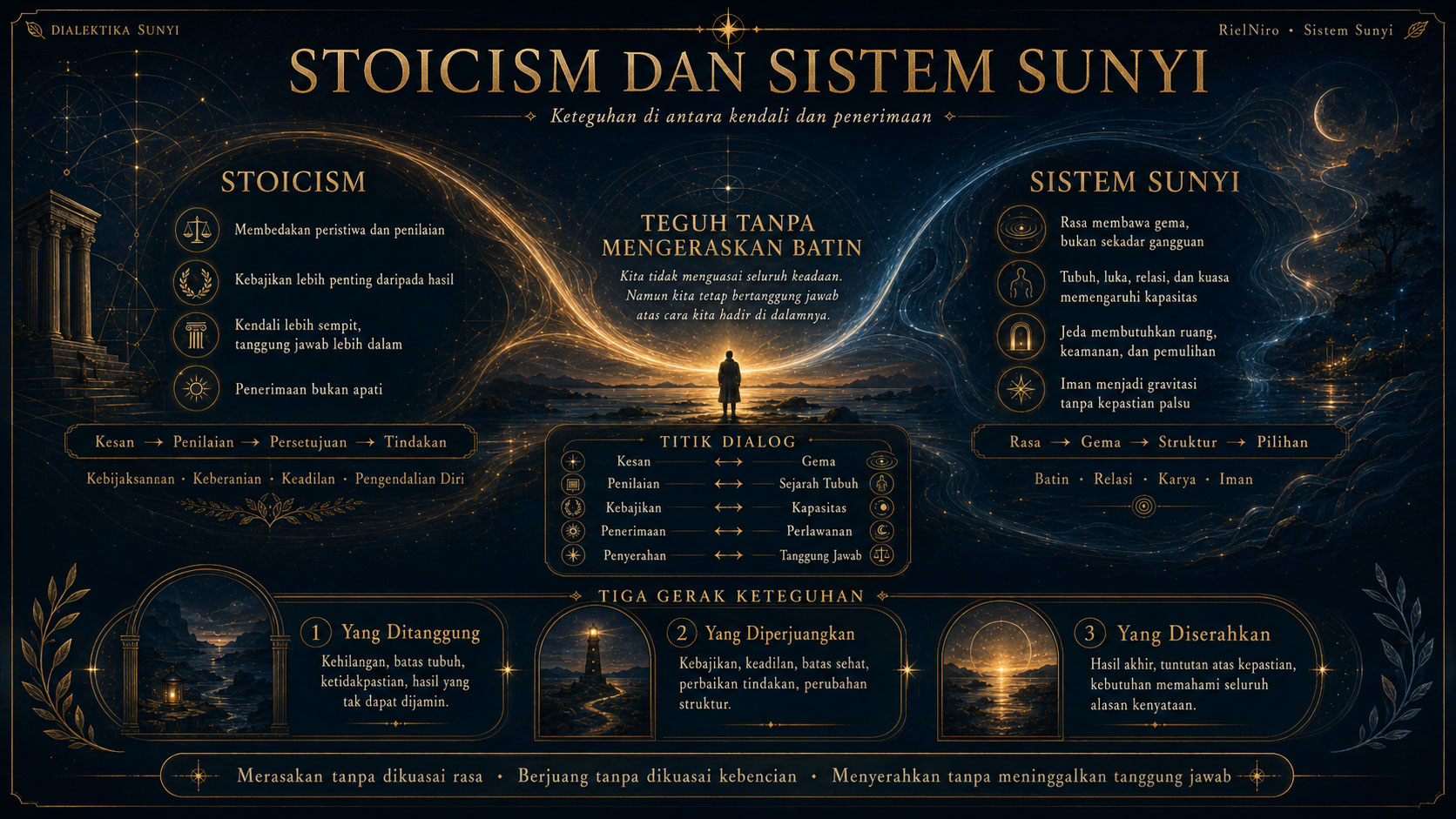
It is here that Stoicism and The System of Silence meet.
Stoicism reminds us that not everything touching our lives lies within our power. Reputation can shift with the judgments of others. The body can become ill despite careful attention. A relationship can end despite faithful effort. Position, wealth, weather, political decisions, and the responses of other people always contain elements that cannot be fully possessed. What remains the responsibility of a human being is how one assents to impressions, forms judgments, chooses actions, directs desire, and lives according to virtue.
The System of Silence recognizes this distinction, but enters the experience from another direction. The Theory of Inner Echoes asks what continues to reverberate when something uncontrollable pulls at feeling, presses upon the body, awakens an old wound, or alters a relationship. The Model of The System of Silence then reads how emotion, moral judgment, and spiritual orientation order one another so that the first reaction does not become the final decision, while principle is not used to silence what still needs to be heard.
Knowing that something lies beyond one’s power does not automatically enable the inner life to release it. A true sentence has not always become a position one can genuinely inhabit. The System of Silence therefore attends to capacity: how much pause is actually available, whether the body feels safe, how power is operating, and what support is needed so that inner freedom does not become merely a demand placed upon someone already overwhelmed.
The meeting, therefore, is not between identical teachings. Stoicism is an ancient philosophical tradition whose logic, physics, and ethics form an interconnected system. The System of Silence is a system of reading that traces movement from feeling to echo, from echo to structure and choice, and then tests that choice through relationship, work, meaning, and faith. Its four orbits are not stages of advancement, but fields for examining whether steadfastness remains human, accountable, embodied, and open to surrender. The two can come very close in the discipline of steadfastness, but they do not need to be merged for their conversation to matter.
Stoicism is not merely the art of not caring
In everyday usage, the word stoic often describes someone who shows no emotion, makes no complaint, or remains silent in suffering. This picture captures part of the surface, but it becomes misleading when treated as the whole.
Stoicism does not begin by teaching people to extinguish feeling. It asks how an impression becomes a judgment, how judgment shapes desire and aversion, and how human beings can preserve inner freedom by refusing to assent too quickly to what arises in the mind.
An insult occurs. The body tightens. Heat rises in the face. Memory immediately searches for a similar wound. The mind forms a sentence: “He has humiliated me, therefore my worth has been taken away.” For Stoicism, the event and the judgment are not identical. The insult may indeed be unjust, but moral damage does not automatically occur in the person who is insulted. The quality of the inner life is determined by how one judges, chooses, and acts afterward.
There is immense strength here. A person does not have to surrender the whole of inner life to another person’s actions. One can oppose injustice without allowing hatred to become the ruler. One can lose position without losing the ability to act honorably. One can grieve without concluding that life no longer has value.
Yet Stoicism is not merely a technique of mental resilience. Virtue stands at its center. The aim is not to make a person feel calmer by any available means, but to live with wisdom, courage, justice, and self-command. Calm gained through deception, avoidance, or indifference toward another’s suffering is not a Stoic victory.
Stoicism therefore differs from a productivity culture that uses the language of “control” to keep people functioning. It also differs from a hardened image of masculinity that treats tears as failure. Stoic steadfastness is not a body that never reacts, but the ability not to let the first reaction become the final command.
A large philosophical home that must not be reduced to quotations
Stoicism arose as one of the major philosophical systems of the Hellenistic age and continued to develop through the Roman period. It did not speak only about coping with personal difficulty. It addressed logic, nature, causation, providence, virtue, social life, and the place of the human being within a larger cosmos.
When Stoicism is removed from this larger home, it easily becomes a collection of tips. “Focus on what you can control.” “Do not care what people think.” “Accept your fate.” Each sentence can be useful, but without an ethical context it can also justify individualism, political apathy, or indifference toward structures that wound.
For the Stoics, the human being is not an island saving itself from the world. A person is rational and social. Virtue is not practiced only in private. It appears in friendship, family, leadership, citizenship, service, and responsibility toward others. What does not lie within our power is not therefore unworthy of effort. We can work to help, reform laws, protect the vulnerable, or heal disease while still recognizing that the final result is not wholly in our hands.
This distinction matters greatly. Releasing ownership of the outcome is different from abandoning responsibility for the process.
The System of Silence must approach Stoicism in its strongest form. It should not compare its architecture of inner life with a social-media version reduced to private motivation. For the dialogue to be honest, Stoicism must appear as a philosophy of virtue and life, not as a caricature of cold composure.
Narrower control, deeper responsibility
The opening of Epictetus’s Enchiridion is famous for distinguishing what lies within our power from what does not. In modern readings, however, the language of “control” can suggest that a person possesses complete command over thoughts, emotions, and actions.
Everyday experience shows a more complicated reality. Thoughts can arise without invitation. The body can panic before conscious judgment forms. An old wound can activate a response that was never chosen. A person may know the right action and still lack the capacity, safety, or support to carry it out easily.
A more careful reading does not turn the dichotomy of control into a division between “I completely master this” and “I have no relationship to that.” It is better understood as a distinction between what belongs to our moral agency and what cannot have its outcome guaranteed.
We do not govern every first impression, but we are responsible for how we work with it and what assent we give. We do not control whether a good action succeeds, but we are responsible for acting as well as we can bear. We do not control the judgments of others, but we are responsible for ensuring that the desire for recognition does not destroy integrity.
Here Stoicism sharpens The System of Silence. The System of Silence uses the language of center, orbit, gravity, feeling, and inner ordering. That language can be rich, but it can also become too elastic unless joined to a firm question about responsibility in action. Stoicism presses a simple question that cannot easily be avoided: within all of this, what truly belongs to your moral work?
The question can cut through much noise. We may not control whether an apology is accepted, but we can ensure that the apology is not used to purchase forgiveness. We may not be able to guarantee that a relationship is restored, but we can stop manipulating the outcome. We may not be able to remove injustice in a single day, but we can still choose not to reproduce it.
Control becomes narrower, but responsibility becomes deeper.
Judgment, impression, and the space before assent
One of Stoicism’s sharpest contributions is its attention to the relationship between impression and assent.
An impression arrives. Something appears threatening, shameful, pleasurable, or promising. Yet a human being does not have to turn every impression into final reality. There is a space, however small, in which the impression can be examined before it acquires authority as judgment.
This space is close to silence, but it is not identical with it.
In The System of Silence, silence is not merely a cognitive pause. It is a space in which feeling, thought, body, meaning, and faith can be read without consuming one another. Stoicism more directly examines the quality of judgment: is what appears bad truly a moral evil, or merely something we dislike? Does the loss of reputation make us bad people, or does it only remove something once enjoyed? Does fear prove danger, or does it reveal that the inner life is anticipating loss?
The System of Silence can widen this space by asking why certain impressions receive assent so quickly. Criticism may feel like annihilation not only because of a present judgment, but because inner history once joined error with the loss of love. The desire to control a partner may arise not only from false judgment, but from a body that has learned to read distance as abandonment. Fear of failure may be embedded in an identity built entirely upon achievement.
Stoicism teaches that impressions should not be believed immediately. The System of Silence helps us read why particular impressions possess such powerful gravity.
Both meet in the need for a pause. Yet the pause is not a reason to reject emotion. It is an opportunity for emotion not to carry the tasks of evidence, judge, and command all at once.
Must emotions be corrected or heard?
The most compelling difference between Stoicism and The System of Silence appears in the domain of emotion.
In classical Stoicism, various passions are understood in relation to mistaken judgments about good and evil. Fear, for instance, is not merely bodily sensation, but contains a judgment that something bad is approaching. Disordered desire treats an external as a good that must be possessed. Devastating grief can involve the belief that an external loss has taken away the highest good.
Yet the image of the Stoic ideal as someone who feels nothing is also inaccurate. The tradition recognizes first movements that can arise before assent, as well as eupatheiai, good feelings aligned with right judgment and virtue. Stoic clarity is not affective emptiness.
The System of Silence speaks with a somewhat different emphasis. Feeling is not merely a judgment awaiting correction. It is also a way reality leaves an echo within us. Feeling can carry information about need, wound, relationship, boundary, longing, and orientation. It is not automatically correct about the world, but neither is it wise always to treat it as a cognitive error awaiting repair.
A grieving person may know that death is not a moral evil. That knowledge does not stop the body from searching for the voice that has disappeared. A betrayed person may understand that another’s action does not take away personal worth. Yet the body and relationships still need time to rebuild safety. A worker treated unjustly may correct a judgment about self-worth, but anger can still carry moral information that a boundary has been violated.
Here The System of Silence reminds us that not every feeling must immediately be moved from its place. Some must be heard until what they are protecting becomes clear. Stoicism, however, reminds us that hearing feeling is not the same as granting it all authority.
The healthy relationship is not “Stoicism corrects thought, The System of Silence defends emotion.” Both are more complex. Stoicism protects feeling from turning externals into the highest good. The System of Silence protects the correction of judgment from becoming subtle violence toward the body and inner history.
Apatheia is not numbness
The term apatheia is easily mistaken for apathy. They are not the same.
In modern usage, apathy points to a loss of care, energy, or engagement. Stoic apatheia points to freedom from passions that dominate through mistaken judgment. A person does not become free by ceasing to love, but by refusing to turn what is loved into property that must submit to the will.
One can care for a child without imagining that the child’s life lies within one’s control. One can love a partner without turning closeness into a permanent guarantee. One can serve society without demanding the outcome as proof of personal worth.
In modern practice, however, the language of freedom from attachment can hide avoidance. A person says acceptance has been reached when, in fact, loss is too frightening to feel. One calls oneself rational while the body is frozen. One treats the need for closeness as weakness in order not to face the fear of rejection.
The System of Silence reads the difference between distance that heals and distance that freezes. Healthy inner distance gives space so that a person is not consumed by a pull. Defensive distance diminishes feeling so that nothing can wound.
Stoicism helps clarify that love need not become possession. The System of Silence helps clarify that freedom from possession need not become an inability to attach, grieve, or receive human need.
Mature steadfastness is not a heart that cannot be wounded. It is a heart that does not use the wound as a reason to abandon virtue, while also refusing to force itself to appear whole before it has truly been given space to heal.
Virtue, not calm, as the aim
One of Stoicism’s most important corrections to modern culture is that calm is not the highest aim.
A person can be calm because reality has been understood. A person can also be calm because nothing matters. Anxiety can be reduced by accepting limits. It can also be reduced by allowing others to bear the cost. A feeling of peace does not by itself prove moral quality.
Stoicism places virtue as the genuine good. Wealth, health, reputation, and comfort can be selected or valued, but they do not determine whether a life is morally good. A person can still live honorably in illness, poverty, or loss, even though these conditions need not be sought or praised.
This offers essential discipline to The System of Silence. The language of return, center, silence, and harmony can sound beautiful. Yet a person can feel “returned” to an inner space that is actually avoiding responsibility. One can feel aligned after ending a conversation that should have been faced. One can use spiritual calm as evidence that an action was right.
Stoicism asks whether the action was wise, just, courageous, and self-governed.
The System of Silence then adds: is that virtue truly embodied in the body, relationships, the use of power, the capacity to rest, and the way one treats the parts of the self that have not yet healed?
Virtue without an inner reading can become a harsh demand that fails to recognize wounds. Inner reading without virtue can become an ever-expanding self-understanding that never takes form as action.
Each needs the other, but neither replaces the other.
Acceptance is not agreement with injustice
The language of acceptance always carries political and relational risk.
A person in an oppressive situation can be advised to accept what cannot be controlled. A worker is told to regulate responses rather than question an exploitative system. A victim of violence is asked to preserve inner peace while the perpetrator remains untouched. An oppressed community is taught resilience so that the structures causing harm can remain comfortable.
Such a reading turns Stoicism into an instrument of adjustment to injustice. Yet acknowledging that outcomes are not wholly within our power does not cancel the obligation to act. Justice is a virtue. Human beings can resist, testify, protect, organize, and take moral risks without guaranteeing victory. Acceptance concerns the limits of power over results, not the legitimacy of a wrongful condition.
The System of Silence strengthens this distinction through relational and structural reading. Not every disturbance comes from an inner life that is poorly ordered. Some are responses to environments that are genuinely unsafe. Not every anger must be calmed. Some must be clarified so that it can become energy for boundaries, protection, and change.
Yet The System of Silence also needs to hear Stoicism: righteous resistance can lose itself when hatred becomes the center of orientation. Injustice must be opposed, but the opponent should not be given total power to determine the shape of our soul.
Mature acceptance says, “I do not command the outcome, but I remain responsible for my courage.” It is not surrender to the perpetrator. It is the release of the demand that a good action is worth taking only when victory can be guaranteed.
Living according to nature and the question of faith
Classical Stoicism does not stand upon a neutral worldview. It understands the cosmos as rationally ordered, interconnected, and in many formulations providential. To live according to nature is to live according to the human being’s character as rational and social, while also living in accord with the order of the whole.
Here the distance from The System of Silence begins to appear.
The System of Silence places faith as an inner gravity that gives deepest orientation, but it does not treat everything that happens as proof that every event has been arranged in a way easily understood. Faith can live with mystery, protest, uncertainty, and the experience of meaning not yet visible.
Stoicism can understand acceptance as harmony with nature and cosmic order. The System of Silence is more cautious about giving meaning too quickly to suffering. Not every loss must immediately be named a necessary part of the whole. Not every wound must be explained as an appointed path in order to be accepted.
Yet The System of Silence can learn from Stoicism’s cosmic scale. Modern people easily turn life into a personal project whose value is measured entirely by comfort and success. Stoicism reminds us that the human being is a part, not the center of the whole. A good life involves a willingness to place oneself within an order larger than private desire.
The difference should remain. The System of Silence need not adopt the whole of Stoic cosmology. Stoicism need not be translated into the language of faith used by The System of Silence. What meets is the willingness not to make the ego the final measure of reality.
What Stoicism Sharpens within The System of Silence
Stoicism forces The System of Silence to answer a question that cannot be resolved through depth of feeling alone: once a person understands the origin of a reaction, what still remains their responsibility? Inner history may explain, but it does not always release someone from the duty to repair action.
The Stoic emphasis on virtue, judgment, and practice provides an important boundary so that the language of wounds, echoes, and healing does not become justification. It reminds The System of Silence that inner life gains dignity when it produces a way of acting that can be held accountable.
Moral Responsibility Must Be Distinguished from Inner Condition
The System of Silence is rich in reading why someone moves, clings, freezes, or loses orientation. Stoicism insists that an explanation of a pattern’s origin is not the same as freedom from responsibility.
A wound may explain why someone fears abandonment, but it does not justify controlling a partner. Exhaustion may explain anger, but it does not remove the need to apologize. Anxiety may narrow the room for choice, but it does not make the consequences of action unreal for others.
This correction matters for the Model of The System of Silence. Emotion needs to be heard, but the moral layer still weighs intention, choice, and consequence. Spirituality must not soften wrongdoing into an “inner process” that never reaches repair.
Outcome Is Not the Sole Measure of Action
The System of Silence attends to fruit, resonance, and embodied life. That attention can become distorted when external success quietly turns into a moral measure. Stoicism reminds it that a right action may fail and a wrong action may produce an advantageous result.
An apology may be refused. Honest work may remain unknown. A just struggle may not yet prevail. A wise decision may still bring loss. The value of action is not exhausted by outcomes beyond one’s control.
For Orbit III, this means that work must not be measured only by reception, reach, or immediate effect. Karya-Only gains depth when intention, process, and virtue remain precise even when the world gives no confirmation.
Calm Must Be Tested by Virtue
Peace may arise from alignment, but also from avoiding conflict, transferring responsibility to others, or bodily freezing. Stoicism helps The System of Silence resist treating calm as final proof of truth.
Clarity needs testing through wisdom, courage, justice, and self-command. The question is not only, “Am I calm?” but also, “Does this calm make me more truthful, just, courageous, and capable of restraining harmful impulse?”
Faith as gravity must likewise not be measured by a peaceful feeling alone. Healthy gravity preserves the direction of virtue when feeling, outcome, and atmosphere change.
The Human Being Belongs to a Moral Community
Returning inward is not the end. Stoicism places human beings within a wider rational and moral community. Virtue is not possessed for private comfort, but embodied in how someone treats others and participates in common life.
Orbit II of The System of Silence receives a correction here. Distance and inner boundaries protect integrity, but they must not become reasons to abandon relational obligation. A healthy boundary is not freedom from care; it determines a form of care that neither controls nor disappears.
Orbit IV is also pushed beyond interiority. Faith that only calms a private center but does not form justice, solidarity, and social responsibility loses moral force.
Practice Must Be Stronger than Inspiration
Stoicism is a philosophy practiced through examining impressions, remembering mortality, disciplining desire, daily reflection, and repeated action. It does not depend upon one illuminating experience.
The System of Silence has language that easily touches feeling. Yet resonance does not always become change. Understanding echo, center, or orbit may feel true without altering habits of speech, work, or boundary-setting.
Stoicism asks inner language to descend into practice. The pause must be trained, not admired. Work must be completed, not merely imagined. Boundaries must be spoken, not only understood. Steadfastness grows through small repetitions that do not always feel profound.
What The System of Silence Adds to the Reading of Steadfastness
The System of Silence does not correct Stoicism by claiming to be more complete. It broadens the kinds of questions asked when Stoic principle meets body, wound, relationship, power, work, and faith. Steadfastness is weighed not only by the strength of judgment, but also by the condition of the human being being asked to endure.
The four orbits provide different layers. The psychospiritual orbit reads the source of vibration and pattern; the relational orbit examines who is close, who has power, and who bears the cost; the existential–creative orbit tests principle through work; and the metaphysical–narrative orbit asks how human beings surrender what cannot be explained without whitening suffering.
First Impressions Also Carry a Bodily History
Stoicism distinguishes impression from assent. The System of Silence adds that the force of an impression is often shaped by experience embedded in body and relationship. An impression does not enter a neutral inner room.
The space before assent is not equally wide for everyone. Trauma, sleep deprivation, threat, illness, and unequal power can narrow it. A body reading danger may not reach reflection with the same speed as a body that feels safe.
Responsibility remains, but the way toward freedom may require more than correcting judgment: safety, time, regulation, accompaniment, and new relational experience. This distinction prevents virtue from becoming punishment for a capacity not yet restored.
Feeling Does Not Carry Only Error
Feeling may contain distortion, but it may also disclose need, loss, value, and boundary. Anger is not automatically a bad judgment; it may show that dignity has been violated. Fear does not always need defeat; it may protect the body from danger.
The Theory of Inner Echoes reads feeling as a reverberation carrying history and possible meaning. The Model of The System of Silence then asks that feeling neither rule nor be removed before its message is heard.
Steadfastness here is not the victory of reason over emotion. It is the capacity to hold the vibration, distinguish information from distortion, and choose an action aligned with value without despising the part of the self that remains fragile.
Acceptance Needs a Place for Grief
Accepting that loss lies beyond control is not the same as being finished with grief. Correct understanding does not always change bodily rhythm. Grief moves through repetition, memory, absence, and changes of identity that cannot be accelerated by argument.
The System of Silence makes room for the echo of loss. What is gone continues to reverberate in habit and relationship. Mature acceptance does not sever the echo, but allows it to change form until life can move without erasing love.
Faith here is not an explanation of why loss had to occur. It becomes gravity holding a person together when no answer is available. Surrender proceeds with grief rather than replacing it.
Power Changes the Meaning of Advice
Advice to accept has a different effect when given by someone safe to someone carrying injustice. A sentence that sounds wise can become a tool for preserving the comfort of those who do not pay its cost.
The Psychology of Distance and the Ethics of Feeling require attention to position. Who speaks? Who can leave? Who depends? Who bears the consequence if nothing changes? Acceptance of limited control must not release those with power from the duty to repair structures.
The steadfastness of a victim must never become a reason for an offender, institution, or community not to change. Personal virtue and structural justice do not cancel one another.
Faith Does Not Always Mean Reading the Cosmos as an Answer
Classical Stoicism is related to a rationally ordered cosmos. The System of Silence need not adopt that entire framework. It makes room for faith that remains alive when the reason for suffering is unknown and the world does not appear to offer a readable answer.
The metaphysical–narrative orbit does not require every event to find a place in a neat providential story. Mystery need not be forced into explanation. Faith can work as orientation and surrender without turning ignorance into false certainty.
This preserves epistemic humility. Human beings may choose virtue, care for hope, and continue to pray without claiming to understand why reality had to take this form.
Six distortions that must be guarded against
Turning the dichotomy of control into the illusion of total power over the self
Human beings do not choose every thought, sensation, or first reaction. Blaming someone for not yet being able to control a traumatic response is not mature Stoicism. Responsibility must be distinguished from the fantasy that inner life works like a switch.
Using acceptance to avoid conflict
Some conditions cannot be changed today, but still need to be opposed. Acceptance of the limits of outcomes does not justify silence before injustice.
Calling freezing apatheia
Numbness can resemble calm. Yet an inability to feel is not freedom from passion. It may be a bodily protection requiring care, not a virtue to be praised.
Using virtue to punish the vulnerable parts of the self
Courage does not mean the body may not fear. Self-command does not mean every need must be denied. Wisdom does not arise from contempt for the parts of the self that cannot yet move as quickly as principle.
Turning Stoicism into a strategy of achievement
Popular Stoicism is sometimes used to make people work longer, become immune to criticism, and pursue outcomes more efficiently. Resilience devoted wholly to ambition loses its ethical center.
Using The System of Silence to feel more complete than an ancient tradition
The System of Silence need not claim that its attention to feeling and faith makes it automatically more complete. Stoicism possesses depth, discipline, and a philosophical structure tested across a long history. Difference in scope is not proof of hierarchy.
Steadfastness That Does Not Harden the Inner Life
Stoicism carries a philosophical structure that cannot simply be relocated into The System of Silence. Virtue, living according to nature, the discipline of judgment, and cosmopolitanism have their own history and home. The encounter becomes clear not when The System of Silence claims to complete Stoicism, but when each tests the other where their concerns genuinely meet.
Stoicism challenges The System of Silence not to end in self-understanding. Echo must reach responsibility. Inner boundaries must not become separation from moral community. Faith as gravity must appear in virtue, not only in tranquil feeling. Work must be sustained through discipline when resonance and inspiration disappear.
The System of Silence, in turn, slows the application of principle so that body, relational history, power, and grief are not erased. It shows that the capacity to assent to or reject an impression does not grow in the same room for everyone. Steadfastness may require the restoration of capacity, not merely the strengthening of will.
Between them, acceptance takes a cleaner form. It is not submission to injustice, not the belief that all suffering has already been explained, and not the naming of numbness as virtue. It is the capacity to distinguish what can be borne, what must be resisted, and what needs surrender without abandoning love or responsibility.
Preserving Virtue When the World Cannot Be Mastered
Stoicism gives firm language to inner freedom. It reminds us that human beings often suffer twice: first because of the event, then because of the demand that the event must never have occurred. It also refuses the idea that a good life must wait for a safe outcome. Virtue remains possible when success cannot be guaranteed.
The System of Silence carries this question through its whole architecture. The psychospiritual orbit reads the echo that allows one event to continue living in body and thought. The relational orbit tests whether steadfastness preserves the dignity of all involved or merely makes someone appear strong. The existential–creative orbit asks principle to become work, habit, and actual repair. The metaphysical–narrative orbit protects human beings from two false certainties: the belief that all suffering has already been explained and the belief that life loses direction when explanation is unavailable.
Within the Model of The System of Silence, emotion is not discarded so that virtue can become possible. Emotion supplies energy and information, morality gives direction, and spirituality places the self before something larger than its own will. Faith as gravity does not guarantee that the world will match hope. It preserves the capacity to choose love, justice, and responsibility when outcomes move beyond one’s grasp.
From Stoicism, The System of Silence learns that inner depth must take form as virtue. From The System of Silence, a Stoic reading is slowed so that body, grief, trauma, unequal power, and the need to restore capacity are not erased by a correct principle. Acceptance then does not mean submission to injustice or the naming of numbness as steadfastness. It means distinguishing what must be borne, what needs repair, what must be resisted, and what finally needs surrender.
This encounter produces no winner. It produces a clearer discipline: human beings can lose control over many circumstances without surrendering the way they choose to be human. They can feel without being ruled by feeling, struggle without making hatred the center of life, and believe without claiming to understand every reason reality has taken its form.
Tulisan ini merupakan bagian dari Dialektika Sunyi, kategori yang membaca ulang berbagai konsep umum melalui lensa orbit dan spiral kesadaran Sistem Sunyi. Tujuannya bukan menolak pemahaman luar, tetapi menunjukkan bagaimana sebuah konsep berubah arah ketika dilihat dari pusat batin Sistem Sunyi.
Sistem Sunyi lahir dari perjalanan batin manusia, bukan dari mesin atau algoritma. Ia tumbuh dari luka, jeda, doa, dan keberanian untuk diam. Orbit, spiral, dan gema bukan formula buatan, melainkan kosmologi yang muncul dari pengalaman hidup yang jujur.
Untuk memahami asal-usulnya lebih jauh, lihat juga Origin Story Sistem Sunyi: Ruang Orientasi · .
Pengutipan sebagian atau keseluruhan isi diperkenankan dengan mencantumkan sumber: RielNiro – TokohIndonesia.com (Sistem Sunyi)
Lorong Kata adalah ruang refleksi di TokohIndonesia.com tempat gagasan dan kesadaran saling menyeberang. Dari isu publik hingga perjalanan batin, dari hiruk opini hingga keheningan Sistem Sunyi — di sini kata mencari keseimbangannya sendiri.
Berpijak pada semangat merdeka roh, merdeka pikir, dan merdeka ilmu, setiap tulisan di Lorong Kata mengajak pembaca menatap lebih dalam, berjalan lebih pelan, dan mendengar yang tak lagi terdengar.
Atur Lorielcide berjalan di antara kata dan keheningan.
Ia menulis untuk menjaga gerak batin tetap terhubung dengan pusatnya.
Melalui Sistem Sunyi, ia mencoba memetakan cara pulang tanpa tergesa.
Lorong Kata adalah tempat ia belajar mendengar yang tak terlihat.
Baca juga: Dua Ruang, Satu Sunyi: Jejak Atur Lorielcide alias Rielniro