
 Tulisan ini bagian dari sistem kesadaran reflektif
Contemplative prayer does not carry human beings away from life. It teaches them to remain before God until the ways they see, love, work, and bear the world begin to change.
Human beings come to prayer carrying the whole of life. They bring tired bodies, unfinished thoughts, unacknowledged anger, unnamed longing, guilt, faith, doubt, relational wounds, work, family, and a world that continues to move. Even when the mouth is silent, this whole history remains present.
Silence in Christian tradition is therefore not a sterile space emptied of life. It is a place where life is brought before God without having to be arranged immediately into a coherent explanation.
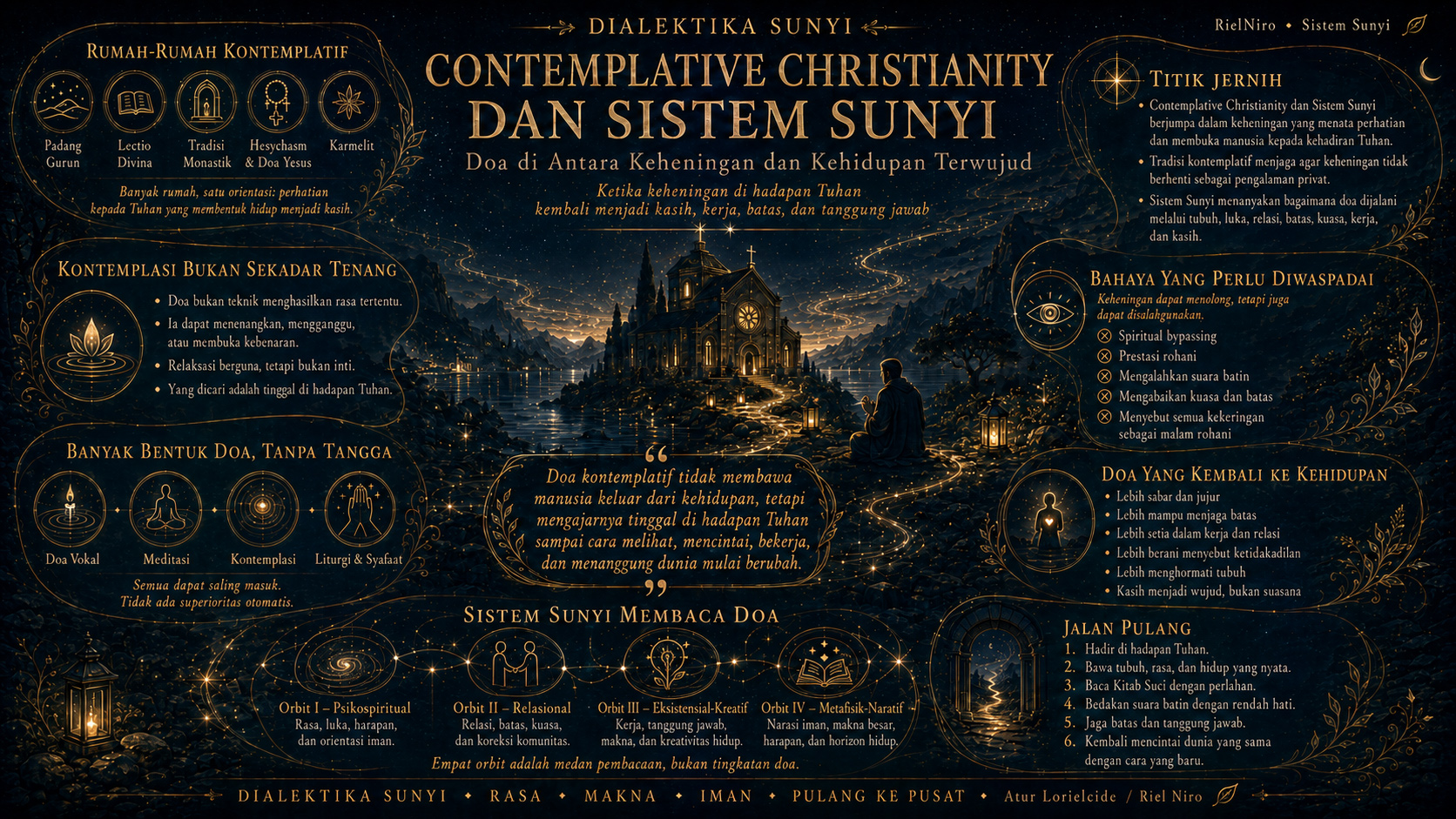
Contemplative Christianity has many homes. It lives in the prayer of the desert mothers and fathers, monastic rhythms, lectio divina, the Psalms, hesychasm and the Jesus Prayer, Carmelite traditions, silent prayer, retreats, liturgy, and modern forms of contemplation. These traditions are not identical. They differ in language, discipline, theology, relation to community, and understanding of prayerful experience.
What joins them is not a single technique, but an orientation: attention to God, receptivity to a love that cannot be manufactured by effort, and willingness to be formed so that life becomes increasingly conformed to the love of Christ.
The System of Silence has strong affinities with this territory. It also makes room for Quietness, pause, inner ordering, faith, attention, and Returning Home. Yet the boundary is firm: The System of Silence is a home for reflective reading of human experience, not a tradition of ecclesial prayer and not another form of Contemplative Christianity.
In this conversation, the four orbits of The System of Silence are not treated as levels of prayer or four steps that must be completed. They become fields of reading for body and feeling, relationship and power, work and ordinary life, and the faith and narratives that accompany human beings in prayer.
Their meeting must preserve two homes at once. Contemplative traditions must not be reduced to stress-management techniques. The System of Silence must not attach Christian names to inner practices and then treat the two as identical. What is sought is a conversation about how silence can become attention, prayer, moral formation, bodily restoration, love, work, and surrender without erasing their theological differences.
Contemplation Is Not Merely Feeling Calm
Modern culture often imagines contemplation as peacefulness, an empty mind, regulated breathing, and distance from noise. All may accompany prayer, but none defines its center.
Contemplative prayer is not a technique for producing a particular feeling. It does not succeed simply because the body becomes calm, thoughts grow quiet, or spiritual warmth appears. It is relationship. In Christian tradition, human beings come before God not to master experience, but to remain, receive, listen, surrender, and be shaped by love.
Because it is relationship, prayer may feel full or dry. It may bring peace or uncover wounds that have long been hidden. It may console or reveal that one’s life is out of alignment with the words being prayed.
This distinguishes contemplation from relaxation. Relaxation has value, and bodies need regulation. Prayer, however, must not be evaluated only by its success in reducing tension. Some prayer calms. Some prayer disturbs because human beings begin to see truths they have avoided.
The System of Silence learns here that silence is not the final goal. Quietness may be an inner condition, but in Christian contemplative traditions it is directed toward encounter, repentance, love, and fidelity.
Many Forms of Prayer without a Ladder of Superiority
Christian tradition recognizes vocal prayer, meditation, and contemplation. The distinction is useful, but it can easily become a ladder: words are treated as lower, meditation as intermediate, and silence as the highest level.
Such a reading is misleading. Vocal prayer involves body and community. The Psalms, the Lord’s Prayer, liturgy, song, intercession, and brief invocations are not immature forms. Words can carry human beings when they cannot compose prayer for themselves.
Meditation engages thought, imagination, memory, feeling, and will. Human beings ponder Scripture, the life of Christ, or the reality of life before God. They do not seek ideas alone, but allow truth to touch the way they live.
Contemplation gives greater room to simple attention and love without many words. Yet contemplative silence does not abolish words. Words often become the wood that kindles fire and then rests once attention has gathered.
The three may enter one another. Vocal prayer may become contemplative. Meditation may rest in silence. Silence may return as intercession.
This warning also applies to the way The System of Silence understands “Quietness.” It must not be turned into a superior identity. A person who speaks much is not automatically shallow, and one who speaks little is not automatically closer to God.
Traditional Homes That Must Not Be Collapsed
Contemplative Christianity took shape across a long history. The desert mothers and fathers developed attentiveness to thoughts, temptation, humility, prayer, manual work, fasting, and mercy. Monasticism formed rhythms of prayer and labor, silence and community, discipline and hospitality.
Lectio divina cultivated a slow, attentive, prayerful reading of Scripture. In Benedictine traditions, reading does not end in information. The word is received, pondered, prayed, and allowed to shape life.
In Eastern Christianity, hesychasm emphasizes stillness, watchfulness, repentance, and prayer of the heart, especially through the Jesus Prayer. The practice cannot be separated from the life of the Church, humility, guidance, and asceticism. Breathing techniques or posture are not a self-standing essence.
The Carmelite tradition, through Teresa of Ávila and John of the Cross, offers profound language for friendship with God, purification, dryness, night, love, and union that does not erase human personhood.
Modern developments such as Centering Prayer and other forms of silent prayer attempt to translate contemplative heritage for lay life. They have broad influence as well as debates concerning sources, method, and relationship to wider tradition.
All these cannot be fused into one practice called “Christian meditation.” Theological and historical differences deserve respect. Similarity in silence does not mean identity of home.
Entering Prayer with a Real Body
Prayer is not performed by a mind without a body. Posture, breath, exhaustion, illness, hormones, trauma, environment, and safety shape the capacity to be present. Sitting in silence may calm one person and evoke hypervigilance, flashbacks, or entrapment in another.
One form of prayer therefore does not suit everyone in every condition. A person may need to pray while walking, read Psalms aloud, light a candle, kneel, write, or pray with others. Another may remain in silence.
Turning silence into a universal obligation can injure people whose nervous systems do not yet experience stillness as safe. Treating distraction as moral failure may also enlarge guilt.
The System of Silence contributes here through attention to body and trauma. Yet it also learns from contemplative tradition that the body is not merely an instrument of regulation. The body prays. Standing, bowing, singing, fasting, eating, working, and resting can belong to relationship with God.
Scripture: The Word Read until It Reads the Reader
Christian contemplation does not arise from silence emptied of content. It is rooted in Christ, Scripture, the prayer of the Church, and the story of salvation.
In lectio divina, the text is not treated solely as an object of analysis. Human beings read slowly, notice a word or phrase that holds attention, ponder it, answer in prayer, and rest before God.
Contemplative reading, however, is not permission to ignore context. A verse that “speaks to me” still belongs to language, history, genre, and a community of interpretation. Personal experience does not replace hermeneutical responsibility.
The System of Silence tends to read resonance. The tradition of lectio helps distinguish resonance from ownership. A word may touch someone personally without making the personal interpretation the only meaning.
Scripture does not merely affirm experience. It can correct, disturb, and open a world larger than the reader’s inner needs.
Distraction as a Door to Recognition
Many people enter prayer expecting the mind to become quiet quickly. When memories, work, fantasy, fear, or lists of tasks appear, they feel they have failed.
That expectation is too narrow for contemplative tradition. Minds move, bodies carry needs, and hearts have attachments. Prayer does not become holy because all of these disappear.
Distraction may simply be mental habit to be released gently. At times, however, it carries information. A mind repeatedly returning to conflict may reveal a wound requiring attention. Fantasies of recognition may disclose the hunger of ego. Persistent worry may show that life has become too crowded or unsafe.
The difference lies in response. Human beings need not follow every thought, but neither must they always strike it away. They may recognize, surrender, and return to prayer.
The System of Silence reads this movement as the formation of inner distance. In Christian prayer, however, distance is not only observation. It is a space in which attention is returned to God.
Dryness and Faith without Feeling
One of the deepest tests in prayer occurs when there is no felt presence, peace, or meaning.
Those accustomed to evaluating prayer through experience may assume that God has withdrawn, faith has failed, or the method no longer works. They search for a new technique, retreat, teacher, or intensity.
Contemplative traditions know dryness as a territory that cannot be read in only one way. It may belong to ordinary life: exhaustion, depression, illness, conflict, or bodily change. At other times, a spiritual habit may indeed have become mechanical. Dryness may also loosen dependence upon feeling.
The language of “night” in John of the Cross is also often misused. Not every depression, trauma, or psychological collapse is a spiritual night. Romanticization can delay needed care.
Faith without feeling is not the denial of feeling. It is fidelity that does not make emotional experience the only measure of relationship with God.
The System of Silence can help distinguish psychological, bodily, relational, and spiritual layers. Yet the distinction must remain humble. Not all dryness can be explained, and not every obscurity needs immediate meaning.
Asceticism: Ordering Desire, Not Hating the Body
Contemplative life often involves asceticism: fasting, simplicity, vigil, disciplined time, limitation, and letting go.
Asceticism is easily misunderstood as war against the body. In destructive form, it can glorify pain, suppress need, and create room for unhealthy spiritual control.
Mature asceticism does not make the body an enemy. It orders desire so that human beings are not governed by every impulse. Fasting is not hatred of food, but an exercise of freedom and solidarity. Silence is not hatred of sound, but recovery of attention. Simplicity is not contempt for matter, but limitation so that possession does not become the center.
Asceticism must also read conditions. A practice safe for one person may be dangerous for another. A history of eating disorders, illness, pregnancy, trauma, or physical labor changes responsibility.
The System of Silence stands firmly by the principle of proportion. A discipline that damages the body, enlarges spiritual narcissism, or diminishes love is not evidence of depth.
Discernment of Spirits and the Danger of Divinizing the Inner Voice
Contemplative traditions do not treat every inner movement as coming from God. Thoughts may arise from habit, fear, desire, guilt, wounds, temptation, imagination, or the need for recognition. A life of prayer therefore requires discernment.
Discernment is not the search for the most peaceful feeling. A responsible decision may bring fear. A harmful desire may feel calm because it suits the ego.
Inner movement needs testing through Scripture, the character of Christ, love, truth, community, reason, facts, time, and consequences for others. Traditions weigh these elements differently, but mature forms of contemplation generally resist the claim that private experience is sufficient.
The language of Inner Echoes, resonance, and faith as gravity makes this question especially close to The System of Silence. Here Contemplative Christianity sets a boundary that must not be softened: an inner voice is not automatically the voice of God. “I feel called” does not free anyone from examination.
Spiritual Guides, Community, and the Limits of Power
Contemplative traditions developed through guides, monasteries, communities, and lines of spiritual transmission. Guidance can protect human beings from illusion, pride, and error.
Spiritual power, however, can be abused. A guide may treat obedience as a right over the whole life of a disciple. A community may turn humility into submission without limits. Inner secrets may be used for control. Criticism may be named ego. Boundaries may be called lack of faith.
Spiritual depth does not abolish consent, law, accountability, or the right to leave. No tradition should give someone unlimited power over another person’s body, money, relationships, or decisions.
The System of Silence brings its reading of power and the Inner Fence into this territory to recognize such abuse. Yet it must also receive correction from community. A system dependent solely upon the judgment of its creator easily becomes an echo chamber.
Healthy guidance enlarges responsible freedom rather than permanent dependence.
Contemplation Returning as Love
Contemplative prayer is not measured only by the experience that occurs during prayer. Its fruit appears in the way human beings return to the world.
Do they become more patient with those who do not admire them? More honest about power? More able to apologize? More courageous in speaking when injustice occurs? More faithful in unseen work? More able to care for body and boundaries?
Silence that merely allows human beings to enjoy their own depth can become spiritual narcissism. Christian contemplation is oriented toward love of God and neighbor. It does not abolish action, but purifies its source.
This does not mean that every person of prayer must become an activist in the same form. Callings differ. Yet Christian contemplation cannot mature while the suffering of others is treated as an interruption of private peace.
The System of Silence calls this territory embodied life. What is read in silence must return as rhythm, choice, work, relationship, and responsibility.
Work, Home, and Ordinary Life
Contemplation is often imagined in chapels, monasteries, forests, or retreats. Yet most of life unfolds in kitchens, offices, streets, vehicles, care rooms, and imperfect conversations.
Monastic tradition itself does not separate prayer from labor. Rhythms of prayer return work to proportion, while work tests whether prayer is producing humility.
For lay people, contemplative life may mean pausing before answering a message, remembering God during work, reading Scripture slowly, praying while caring for a child, or accepting that attention will repeatedly break and return.
The holiness of ordinary life lies not in making every activity feel spiritual, but in bringing attention, love, honesty, and responsibility into it.
The System of Silence is closely related to this territory. It can help translate contemplative attention into habits. Yet prayer must not become a form of inner productivity. Its worth does not depend upon how efficient a person becomes afterward.
Spiritual Bypassing: When Prayer Distances Us from Our Wounds
Spiritual language can be used to avoid psychological and relational reality. A person forgives before acknowledging violence. They surrender to God so that no boundary needs to be set. Anger is called sin so that injustice need not be faced. Peace is pursued so that grief does not have to be felt. Prayer then becomes a detour around the wound.
Mature contemplation does not make emotion an enemy. It brings emotion before God, discerns its content, and allows truth to work. Forgiveness is not identical with reconciliation without conditions. Surrender is not passivity. Love does not abolish protection.
The System of Silence rejects spiritual bypassing through its language of distortion, the Inner Fence, and the ordering of feeling. Yet another boundary must also be kept: psychological analysis must not replace prayer. Some things require understanding, and some require surrender while a complete explanation remains unavailable.
Grace That Cannot Be Produced by Practice
Contemplative life requires rhythm. Human beings set aside time, learn to be present, read Scripture, care for the body, pray with others, and return when attention is scattered. Practice, however, does not produce God or purchase divine nearness.
Discipline can prepare space, but grace is still received. A breathing technique may help the body become present, but it does not summon God like a switch. Silence may help human beings listen, but it does not turn divine love into the result of skill.
This distinction protects prayer from becoming a project of self-optimization. A person who can sit longer, concentrate more strongly, or follow a stricter rhythm is not automatically closer to God. Spiritual achievement easily turns humility into comparison.
Grace is also not a reason to abandon practice. Fidelity makes room for relationship, just as friendship requires time without being produced by a schedule. Human beings practice not to master presence, but to remain willing to receive and be formed.
Prayer Is Formed by Christ, the Church, and Shared Life
Christian contemplation is not attention to the Divine in general. It is rooted in Christ: in the way he prays, loves, touches excluded bodies, confronts power, bears the cross, and opens hope through resurrection.
The cross prevents contemplation from becoming a spirituality of comfort. It does not glorify suffering, but reveals a love that does not abandon truth when fidelity carries a cost. Resurrection prevents silence from ending in separation; prayer returns to the world with hope to repair, care, and begin again.
Prayer is also formed by the Church. The Psalms, the Lord’s Prayer, liturgy, the calendar of faith, sacraments, confession, intercession, and service provide language when private experience is insufficient. Christian traditions weigh these elements differently, but contemplative life does not stand as an individual project detached from the body of community.
Community is not only a boundary of correction. It is also a home in which human beings learn to receive the prayers of others, carry needs that are not their own, and acknowledge that faith is not built by private experience alone.
Wounds Need Care, Sin Needs Repentance
Prayer may uncover wounds, but not everything that appears in silence is only a wound to be understood. Some lies need to be confessed, pride needs to be relinquished, power needs to be limited, and damage needs to be repaired.
The language of sin must be used carefully. It must not accuse victims, force people to accept violence, or turn symptoms of trauma into moral failure. Yet removing the language of sin entirely also deprives human beings of a way to acknowledge their own responsibility.
Repentance is not hatred of the self. It is the courage to see a wrong direction, receive forgiveness, change action, and repair consequences as far as possible. Prayer sometimes brings consolation. At other times it brings someone to an apology that has long been avoided.
Mature discernment asks: is this a wound requiring safety, a bodily condition requiring help, a sin requiring repentance, or a conflict requiring shared responsibility? The answer is not always singular, and these layers may be present together.
Forgiveness Does Not Erase Boundaries and Justice
Forgiveness may be a fruit of prayer, but it is not denial of what happened. Reconciliation requires truth, change, safety, accountability, and the restoration of trust. Not every relationship can or should return to its former shape.
Praying for someone who caused harm does not mean returning power to that person. Love does not require a victim to reopen access without limits. A boundary can be a form of truth, protection, and responsibility toward the life entrusted by God.
Justice is not the enemy of contemplation. Prayer may purify the motives of action so that resistance is not ruled by hatred, but prayer can also enlarge courage to name violence, protect the vulnerable, and demand accountability.
Mature silence does not deprive the world of a voice. It helps human beings speak without being ruled by the impulse to retaliate, while refusing a false peace built upon the muting of victims.
Two Homes That Correct Each Other without Taking Each Other Over
Contemplative Christianity reminds The System of Silence that Quietness is not an end in itself. Within the Christian home, silence is directed toward relationship with God, repentance, love, and fidelity. Calm is not the summit, and psychophysiological benefit is not identical with prayer.
From its own home, The System of Silence raises questions about body, trauma, relational patterns, the Inner Fence, power, work, and effects. These questions help contemplative language remain close to concrete human beings. Yet The System of Silence has no right to take over the content of Christian faith or interpret it as though the difference between their homes had been resolved.
Returning Home in The System of Silence remains a movement toward a more whole condition, not another name for returning to God or entering Christian prayer. Contemplative traditions use their own language of repentance, communion, vocation, and fidelity. Affinity does not erase the boundaries of meaning.
The four orbits may help read prayerful experience without becoming levels, modules, or a spiritual map. The System of Silence Model (MSS) may help listen to feeling, weigh moral responsibility, and acknowledge the orientation of faith, but it does not turn an inner voice into private revelation. Scripture, community, facts, time, and the fruit of life remain necessary.
Correction moves in both directions, and both sides need to be heard clearly. The System of Silence refuses to turn prayer into psychological analysis. Contemplative traditions, for their part, must not use mystery, obedience, or surrender to ignore body, boundaries, and power.
From Silence Back into Life
Contemplative prayer does not carry human beings out of the world. It brings the world before God, then returns human beings to the world with ways of seeing and loving that are slowly being reshaped.
Mature contemplation does not always make human beings calm. Sometimes it consoles, sometimes it disturbs, and sometimes it simply sustains fidelity in dryness. Its fruit is not an experience that continually rises, but more honest love, a body treated with greater respect, power held within firmer limits, and a life more willing to be corrected.
Silence finds direction not when human beings succeed in preserving a particular atmosphere, but when prayer returns as attention to others, diligent work, healthy boundaries, courage before injustice, and surrender that does not abandon responsibility.
Between words and silence, human beings do not learn to become experts over God. They learn to remain, receive, discern, repent, and return to love the same world in a way that is no longer entirely the same.
Dialektika Sunyi (Format 2) adalah ruang dialog antara Sistem Sunyi dan dua puluh empat rumah pemikiran dari berbagai tradisi filsafat, psikologi, etika, teologi, dan pemikiran sosial. Dua puluh empat tulisan ini tidak disusun untuk menjadikan tradisi-tradisi tersebut sebagai bagian dari Sistem Sunyi, melainkan untuk mempertemukan cara pandang yang berbeda agar manusia dapat dibaca dari lebih dari satu pintu.
Sistem Sunyi tidak datang ke dalam dialog dengan rumah yang kosong. Ia sudah membawa cara membaca sendiri: Rasa perlu didengar tanpa segera dijadikan kebenaran, Makna tidak dipaksakan kepada luka, Iman memberi arah tanpa menjadi jawaban instan, dan manusia tidak dapat dihabiskan oleh satu istilah atau satu peta.
Karena itu, setiap rumah pemikiran hadir sebagai ruang dialog yang tetap memiliki bahasa, sejarah, pertanyaan, dan batasnya sendiri. Dialektika Sunyi bukan upaya membuktikan bahwa dua puluh empat tradisi tersebut pada akhirnya mengatakan hal yang sama dengan Sistem Sunyi.
Mengapa dua puluh empat rumah pemikiran?
Karena manusia terlalu luas untuk dibaca melalui satu lensa. Penderitaan dapat hadir sebagai pengalaman batin, pola tubuh, relasi, cerita diri, bahasa, kondisi sosial, struktur kuasa, sejarah, iman, maupun perubahan kehidupan. Satu lensa dapat membuka sesuatu yang penting, tetapi selalu ada wilayah yang berada di luar jangkauannya.
Dua puluh empat rumah pemikiran karena itu membuka percakapan dari berbagai arah. Membuka pintu tidak berarti meninggalkan rumah. Setiap tradisi tetap dibaca sebagai rumahnya sendiri, sementara Sistem Sunyi membiarkan perjumpaan itu memperluas cara melihat tanpa kehilangan batasnya.
Di dalam panel ini, dua puluh empat tulisan dibagi menjadi tiga bagian: Peta I, Peta II, dan Peta III. Ketiganya adalah pembagian navigasi untuk membantu menemukan delapan rumah pemikiran pada masing-masing bagian.
Sebelum masuk ke daftar, dua ruang berikut dapat digunakan untuk melihat keseluruhan Dialektika Sunyi dalam skala yang lebih luas:
Atlas Dialektika Sunyi
24 Percakapan, 24 Peta Pembacaan
Ruang orientasi publik untuk menjelajahi dua puluh empat tradisi yang berdialog dengan Sistem Sunyi tanpa kehilangan rumah pemikirannya masing-masing.
Peta Pengetahuan Dialektika Sunyi
Dua Puluh Empat Rumah. Tidak Ada yang Dilebur Menjadi Satu.
24 Rumah Pemikiran · 20 Kejernihan · 25 Pintu Kehidupan
Ruang untuk melihat bagaimana dua puluh empat tradisi dipertemukan dengan Sistem Sunyi tanpa penyerapan, kemenangan, atau sintesis yang lebih tinggi.
Peta ini hanya membantu menemukan jalan. Pembacaan sebenarnya terjadi di dalam masing-masing tulisan, ketika satu rumah pemikiran dibuka dan dialognya dengan Sistem Sunyi mulai berlangsung.
Paket I bergerak paling dekat dengan pengalaman personal, tetapi tidak membiarkan batin menjadi dunia yang tertutup. Kendali bertemu keadaan, perhatian bertemu makna, kedekatan membawa sejarah relasi, kebebasan berhadapan dengan keterbatasan, dan keheningan diuji oleh doa serta kehidupan yang kembali dijalani.
- Ketika keteguhan tidak berarti mematikan rasa
- Ketika hadir belum berarti memahami
- Ketika hidup tidak hanya meminta penjelasan, tetapi jawaban
- Ketika kebutuhan akan tempat aman ikut membentuk cara manusia mencintai
- Ketika hidup tidak menyediakan kepastian yang dapat memilih atas nama manusia
- Ketika bagian diri yang tidak disadari ikut membentuk cara manusia melihat kenyataan
- Ketika bahasa iman belajar mengakui Tuhan tanpa menjadikan misteri sebagai tempat bersembunyi
- Ketika keheningan di hadapan Tuhan kembali menjadi kasih, kerja, batas, dan tanggung jawab
Paket II memperdalam pertanyaan tentang bagaimana pengalaman sebenarnya terbentuk. Apa yang terasa tidak hadir tanpa tubuh. Apa yang dipahami tidak lahir tanpa bahasa. Agency mempunyai lingkungan. Care mempunyai distribusi beban. Makna dan keyakinan memperoleh ujian ketika mereka meninggalkan jejak dalam kebiasaan, tindakan, dan dunia bersama.
- Ketika kenyataan perlu diberi ruang sebelum kesimpulan mengambil alih
- Ketika tubuh, kebiasaan, alat, relasi, dan dunia ikut membentuk cara manusia memahami dan memilih
- Ketika rasa sakit tidak harus hilang sebelum manusia bergerak menuju yang bernilai
- Ketika motivasi dibaca melalui autonomy, competence, relatedness, dan mutu alasan untuk bergerak
- Ketika kisah hidup memberi arah, tetapi tidak berhak menjadi seluruh kenyataan
- Ketika bahasa, sejarah, tradisi, dan kuasa ikut menentukan apa yang dianggap sebagai kebenaran
- Ketika kebutuhan, dependency, kerja perawatan, kompetensi, dan pembagian beban menjadi persoalan moral
- Ketika gagasan diuji melalui kebiasaan, penyelidikan, konsekuensi, komunitas, dan revisi
Paket III membawa pembacaan ke kondisi yang membuat sebagian pengalaman dipercaya, sebagian dinormalkan, dan sebagian bahkan sulit memperoleh bahasa. Struktur dan sejarah masuk lebih jelas, tetapi manusia tidak dibiarkan menghilang di dalamnya. Karena itu Systems Thinking bertemu Virtue Ethics, Liberation Theology bertemu batas praxis, dan Process Philosophy menutup paket dengan kehidupan yang terus menjadi tanpa kehilangan tanggung jawab.
- Membaca penderitaan di antara batin, ideologi, institusi, ekonomi, dan distribusi kuasa
- Ketika pengetahuan dibentuk oleh posisi, tubuh, bahasa, kredibilitas, dan relasi kuasa
- Bahasa, institusi, dan relasi yang membuat kategori terasa alamiah
- Sejarah, bahasa, representasi, dan kuasa di balik hak untuk menjelaskan manusia lain
- Membaca pola, feedback, penundaan, batas sistem, dan perubahan yang tidak pernah berdiri sendiri
- Karakter, kebiasaan, emosi, teladan, dan kebijaksanaan praktis dalam kehidupan sehari-hari
- Ketika doa, kasih, keselamatan, dan kitab diuji oleh kemiskinan, penindasan, serta tindakan pembebasan
- Identitas, relasi, waktu, dan Pusat yang bertahan tanpa membeku menjadi bentuk final
Lorong Kata adalah ruang refleksi di TokohIndonesia.com tempat gagasan dan kesadaran saling menyeberang. Dari isu publik hingga perjalanan batin, dari hiruk opini hingga keheningan Sistem Sunyi - di sini kata mencari keseimbangannya sendiri.
Berpijak pada semangat merdeka roh, merdeka pikir, dan merdeka ilmu, setiap tulisan di Lorong Kata mengajak pembaca menatap lebih dalam, berjalan lebih pelan, dan mendengar yang tak lagi terdengar.
Atur Lorielcide berjalan di antara kata dan keheningan.
Ia menulis untuk menjaga gerak batin tetap terhubung dengan pusatnya.
Melalui Sistem Sunyi, ia mencoba memetakan cara pulang tanpa tergesa.
Lorong Kata adalah tempat ia belajar mendengar yang tak terlihat.
Baca juga: Dua Ruang, Satu Sunyi: Jejak Atur Lorielcide alias Rielniro