
 Tulisan ini bagian dari sistem kesadaran reflektif
People often imagine that life can begin only after pain has ended. Acceptance and Commitment Therapy asks a more unsettling question: what if the endless struggle to eliminate pain is precisely what slowly narrows life?
Nearly everyone knows pain. Loss, rejection, shame, anxiety, fear, anger, and grief are not deviations from life. They arise because people love, hope, choose, fail, and inhabit a world that can never be fully controlled. What often escapes notice is not only the pain itself, but what a person begins to build around it.
Someone avoids a conversation because rejection feels unbearable. They work without stopping so they never have to return to loneliness. They please everyone because the guilt of saying no feels heavier than the loss of self. They fill every hour with activity so the question waiting at night never receives enough silence to be heard.
From the outside, such a life may look productive, generous, responsible, even devout. From within, its direction is slowly organised by one command: do not let that pain return.
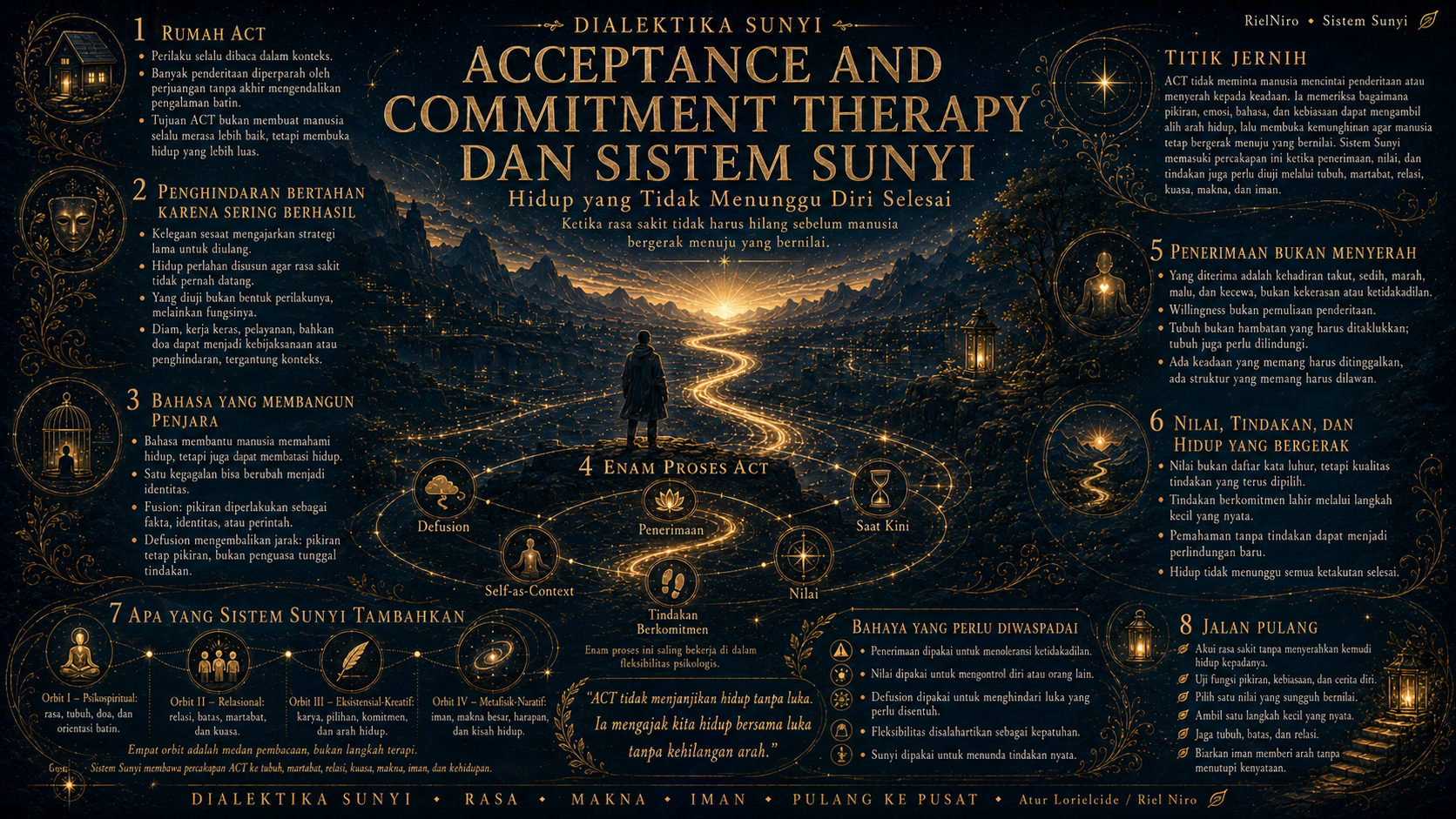
Acceptance and Commitment Therapy, or ACT, grew within contextual behavioural science from a simple yet radical reading. Psychological suffering is shaped not only by difficult experience, but also by the relentless struggle to control that experience. A person does not merely live with fear. They begin constructing an entire life around the hope of never meeting fear again.
ACT calls one form of this pattern experiential avoidance. The issue is not simply that people would prefer uncomfortable inner experience to lessen. Avoidance becomes rigid when enormous effort is spent changing, suppressing, or escaping thoughts and feelings even as the strategy begins to narrow valued action. Nor does avoidance always look like obvious flight. It may wear a highly respected face: discipline that never allows the body to rest, service that never permits a person to say enough, patience that buries anger, or religious language used so that a wound never has to be honestly touched.
This is where ACT differs from many popular accounts of mental health. Its purpose is not to make people feel better at all times. It asks how life loses breadth when almost all available energy is spent ensuring that discomfort never arrives.
Avoidance survives because it often works
Avoidance does not survive because it always fails. On the contrary, it often works.
Postponing a conversation does reduce anxiety today. Withdrawing does prevent the possibility of rejection. Constant work does make loneliness harder to hear. Apologising before knowing whether one has done wrong can end a conflict. Each small relief teaches the same lesson: repeat the strategy.
The cost becomes visible only after enough time has passed. Opportunities once open are abandoned. Relationships grow narrower. The body continues carrying tension. The world is organised around a list of things that must never happen. Life still goes on, but it is no longer a life being chosen. It has become a vast project of maintaining safety.
ACT never says that every act of moving away is a mistake. Leaving violence can save a life. Avoiding a toxic environment can be an act of wisdom. Setting a boundary can be an expression of care for oneself and for others. What matters is not the outward form of the behaviour, but its function.
The question of function stands near the foundation of ACT. Two behaviours that look identical can carry entirely different meanings. Silence may be wisdom, but it may also be fear. Hard work may be beloved craft, but it may also ensure that a person never has to meet emptiness. Even prayer may be honest presence before God, or a hiding place where anger never has to be admitted.
This correction matters to The System of Silence because the language of love, sacrifice, service, faithfulness, and faith does not automatically prove that an action arises from freedom. Precisely when a virtue feels beyond question, avoidance may find its safest home.
ACT’s home: behaviour always has a context
ACT therefore does not begin its reading with the content of a thought or the name of an emotion. It begins with the relationship among the person, the behaviour, the history of learning, the environment, and the consequences that follow. An action is never understood only by how it looks. The question is: what is this action actually doing within a person’s life?
This framework separates ACT from accounts that reduce it to mindfulness exercises with a list of values attached. Present-moment awareness matters, but it is one process within a model that also includes acceptance, cognitive defusion, self-as-context, values, and committed action. The six do not function as steps climbed in a fixed sequence. Together they alter the function of experience and action within the context of an actual life.
Crying therefore does not always serve the same function. It may express loss, ask for help, seek protection, or release a body that has carried too much for too long. Laughter may express joy, but it may also protect a person from shame. Silence may be wisdom, but it may also be fear. A person who apologises constantly may be showing humility. They may also be living under the conviction that their very existence is an inconvenience to others.
This kind of reading refuses moral shortcuts. An action is not good merely because its language sounds good. It is not bad merely because its form is uncomfortable. Function, context, consequence, and room for choice must be read together.
For The System of Silence, this means that reading feeling cannot stop at asking what is being felt. A harder question follows: what kind of relationship is this feeling building with the world? Is it helping a person see, or reducing all reality to one threat? Does the action that follows protect dignity, or repeat an old pattern under a more beautiful name?
Language that builds a prison
One of ACT’s greatest contributions lies not mainly in its techniques, but in how it understands language.
Relational Frame Theory is a contextual behavioural account of language and cognition that helps explain one foundation of ACT. People do not respond only to the physical properties of what is present. They learn to relate events symbolically: larger and smaller, before and after, mine and yours, the present self and the imagined self, and the function of an experience can change through those learned relational networks.
Through this capacity, experiences that were never present together can nevertheless alter one another. One failure becomes an identity. One criticism becomes evidence that the self has never been good enough. One rejection develops into the belief that every relationship will eventually end in the same way. One feeling of anxiety is read as proof that the situation is truly dangerous. Such symbolic relations accumulate until people live not only in the world unfolding before them, but also in a world built through the verbal networks they have learned.
This capacity is among humanity’s greatest strengths. It makes science, culture, law, faith, promises, history, and the ability to plan a future possible. Yet the same capacity also allows people to suffer because of something that has never happened. Someone can lose sleep over a conversation that has not taken place. A sentence spoken years ago can still govern a choice made today. An identity formed in childhood can continue directing a life even after the world has changed.
ACT does not view suffering chiefly as the problem of having a particular emotion. What often traps a person is the function of relations built through language. When words, judgements, and stories about the self are no longer recognised as activities of thought within a context, language slowly changes from a tool into an environment in which a person lives. It no longer merely describes reality. It begins to replace it.
This reading resonates strongly with The System of Silence. Many wounds endure not because the event itself is still unfolding, but because certain words continue to bind the whole of experience to a single center of explanation: “I always fail.” “I am simply unworthy.” “This is who I am.” A narrative that once helped make sense of experience can gradually harden into a wall that constrains what life may still become.
Yet this affinity also confronts The System of Silence with questions about its own language. Canonical terms such as Center, Echo, Returning Home, Gravity, or Calling can help illuminate life, but they too can harden. A person may stop asking questions because they believe they have found the Center. They may shut out correction in the name of a Calling. They may use the language of Returning Home to treat every doubt as failure. A conceptual home safeguards the meaning of its terms, but it does not make those terms immune to the life they are meant to read.
Language is always a map, never the territory. It should open a path towards reality, not replace reality itself. When a term becomes more immune to question than the life it was meant to help read, language that was meant to open a reading begins to close it. Freedom begins to return when people can use language without having to live entirely under its rule.
When thought becomes reality
A thought repeated often enough can lose its distance from the person thinking it. “I might fail” slowly begins to sound like “I will fail.” A possibility becomes reality. Fear becomes prophecy. One sentence begins to organise an entire life.
ACT calls this cognitive fusion. Fusion occurs when a thought is no longer seen as a thought, but as fact, identity, or command. “They will reject me” becomes a reason never to show up. “I must always be strong” makes receiving help feel shameful. “Good people do not get angry” allows violence to continue without resistance.
Fusion does not appear only through negative thoughts. It often speaks in language that sounds noble. “I must always give way.” “Sacrifice is always sacred.” “If I am tired, I must be less faithful.” “True faith never doubts.” Each sentence may contain truth in a particular context. Once severed from the reality being faced, however, it becomes an automatic rule.
ACT does not ask people to dispute every thought or replace it with a positive affirmation. It seeks to restore the ability to see that a thought remains a thought. The sentence is present. It has a history. It may be useful, or it may no longer fit the present. It does not automatically earn the right to govern an entire life.
Here ACT offers one of its most distinctive movements, cognitive defusion. Defusion is not an attempt to erase thought. It is not positive thinking. Nor is it a way of proving that a particular thought is false. What changes is the person’s relationship with the thought: an apparently distance-less command becomes a mental event that can be noticed, tested for usefulness, and placed back within context.
The sentence “I am incapable” is no longer treated as an identity. It begins to be seen as “I am having the thought that I am incapable.” The change appears modest. Yet that small space restores the possibility of choosing.
The thought may remain. Fear may remain. Doubt may not disappear. But a person regains the freedom to decide whether an entire life must obey the thought. Defusion does not win a war against the mind. It stops the mind from becoming the sole ruler of action.
The System of Silence reads a similar principle through a different language. Silence does not try to mute every inner voice. It gives enough room for each voice to be heard according to its place. Some thoughts deserve to be followed. Some need to be questioned. Some can simply be acknowledged and allowed to pass. The ability to distinguish among them matters more than eliminating them all.
ACT’s correction becomes especially important when it is turned back toward the language of The System of Silence itself. Terms such as Center, Echo, Returning Home, Gravity, Orbit, or Calling can help people read their lives, but these terms too can become fused. Once they are no longer open to examination, the map has begun to replace the territory. The System of Silence loses its clarity precisely when canonical language becomes a reason to stop listening to reality.
Overthinking that postpones life
Fusion often travels with a habit that appears deeply intellectual: thinking without end.
ACT sees that overthinking is not always an effort to find a solution. Very often it is avoidance in its most subtle form. As long as every possibility is still being analysed, no step has to be taken. As long as every scenario remains under calculation, a decision can be delayed. As long as every reason is still being gathered, failure does not yet have to be faced.
From the outside, a person may appear to be working hard to understand themselves. From within, life has stopped moving.
ACT is not hostile to reflection. It asks one question that is difficult to evade: is this thinking helping life move, or has it begun to replace life?
The question touches one of contemplation’s own dangers. Silence may be a path toward clarity. It may also become a room so comfortable that a person never returns to life. Sometimes one more theory is not what is needed. One conversation is. One apology. One boundary. One actual step.
Clarity is not the opposite of action. Clarity is tested when a person finally acts without waiting for every fear to end.
Acceptance is not surrender
When people hear the word acceptance, many imagine resignation. They fear that acceptance means ceasing to resist injustice, leaving a wound open, or accepting circumstances without trying to change them. ACT draws an important boundary against that misunderstanding.
Acceptance is not agreement with suffering. In ACT, it is flexible openness to inner experience that is already present when the struggle to eliminate it is making life increasingly narrow. What is accepted is not the violence, humiliation, or injustice. What is given room is the fact that fear, sadness, anger, shame, or disappointment is present, so action no longer has to be organised entirely by the war against that experience.
A person can accept that fear is present while still leaving a dangerous relationship. They can accept grief after loss without ceasing to build a new life. They can acknowledge anger without allowing anger to become the sole ruler of action.
Acceptance is not the opposite of change. It is often the condition that allows change to stop being driven by panic.
Its boundary, however, must be stated clearly. The language of acceptance must never legitimise remaining inside violence. Some situations must be left. Some structures must be resisted. Some relationships destroy dignity when they are preserved in the name of acceptance. Accepting that fear is present is not the same as accepting the person who keeps creating that fear.
ACT therefore also speaks of willingness. Willingness is not the capacity to endure as much suffering as possible. It is the courage to carry discomfort when that discomfort accompanies a life that has been chosen.
A father speaks honestly to his child even though he fears rejection. A lecturer returns to the classroom after the death of someone deeply loved even though grief is unfinished. A worker raises an objection to a supervisor even while the body trembles.
They are not pursuing pain. Nor are they waiting for fear to disappear. They are allowing the feeling to walk with them without handing it the steering wheel.
This willingness is very different from glorifying suffering. ACT never asks people to prove maturity by suffering more. Psychological flexibility includes persisting in or changing behaviour as the context requires when doing so serves a valued direction. Persistence therefore does not always mean pressing forward; it may take the form of changing course, stopping, or acknowledging that the body has reached its limit.
A person living with trauma may need a far smaller step. At times the most valued action is not approaching fear, but building safety, asking for help, or admitting that the body cannot yet move as far as others demand.
The body is not an obstacle to be conquered. It is part of the life that also needs protection.
The System of Silence deepens this reading through respect for human rhythm. Growth does not always move at the same speed. There are times when courage means moving forward. There are also times when courage means admitting that today the body cannot travel as far as it did yesterday.
The present is never truly empty
ACT is also known for attention to the present moment. Presence, however, is often misunderstood as a request to forget the past and stop thinking about the future.
ACT means something simpler and more difficult. Presence is the ability to return to what is actually happening without allowing all attention to be seized by the story thought immediately constructs.
Yet the present never arrives in an empty room. A woman who has survived violence enters a new space. Her body reacts before thought finishes explaining why. A worker humiliated for years may still feel the heart race in a meeting with a new manager who has never harmed them.
Such a response is not the body’s stupidity. It is history still at work. ACT helps a person distinguish what is actually happening from the network of predictions old experience immediately produces.
Presence does not erase history. It prevents history from remaining the only interpreter of the present.
The System of Silence reads the echoes of the past with similar care, but it must also resist romanticising them. Not everything that keeps returning is a deepest truth that must be followed. Some echoes carry a truth not yet heard. Others reveal how thoroughly one wound, one rule, or one fear has been trained to dominate attention.
A self wider than its story
Among ACT’s concepts, few are easier to misunderstand than self-as-context. The phrase can quickly be turned into a theory of a pure soul or a metaphysical core. ACT is making no such claim.
What it seeks to restore is simpler. People almost always carry stories about themselves: “I am shy.” “I always fail.” “I am the child who must please everyone.” “I am not worthy of love.”
Such stories help create continuity. When a story becomes an identity that is never allowed to change, however, the future can be imagined only as a repetition of the past.
Self-as-context reminds us that thoughts, emotions, memories, and roles can be present without exhausting the person who experiences them. Someone can have a history of failure without becoming failure itself. They can carry the wound of rejection without making rejection the only explanation for every relationship.
This is not an invitation to forget history. It gives history a more truthful place. A wound remains part of life, but it does not earn the right to become the whole identity, every possibility, and every reason not to move.
This affinity becomes especially clear in how The System of Silence understands the Center. The Center was never meant to be a fixed identity or another name for self-as-context. It is a canonical orientation that allows a person to continue reading themselves without losing direction. If the Center is used to say, “this is who I am, and nothing more needs to be questioned,” it no longer functions as an orientation. It has become a wall.
The Center is not the end of the journey, but the space in which the journey can continue. It does not free a person from history. It keeps history from becoming the only force that determines direction. This affinity opens a conversation; it does not prove that the two concepts belong to the same theoretical home.
ACT and The System of Silence resist two opposite temptations. The first is to imagine that a person is entirely determined by the story of the past. The second is to imagine that life can begin again without carrying any history at all. A mature life does neither. It acknowledges history without surrendering the whole future to it.
Values chosen and inherited
Once a person gains some distance from thought, ACT asks a question more important than how to feel better: what is this life for?
This is where values become central. In ACT, a value is neither a moral possession nor a target that can be reached and completed. It names a quality of action that can continue to be enacted. Finishing a book is a goal. Writing with honesty is a direction that can be lived through many actions. Marriage is an event. Living love, respect, and responsibility within a relationship is a quality that must be chosen again as circumstances change.
Yet people do not choose values in empty space. Family, religion, culture, class, gender, wounds, success, and fear all shape what appears important.
Someone may pursue achievement not because they love the work, but because they learned early that worth depends on success. Another may continue sacrificing because they fear losing love if they stop pleasing everyone. Even devotion can grow from anxiety that has never been examined.
Values clarification is therefore more than arranging noble words. It is an inquiry into the origin and fruit of a direction. Where did this value come from? Does it widen life or make it smaller? Was it chosen, or inherited as a command that has never been allowed to face a question?
This test matters equally to The System of Silence. The language of love, faithfulness, calling, and faith cannot be judged by the nobility of its sound alone. A value must be tested by its fruits. Does it deepen the capacity to love without erasing freedom? Does it strengthen responsibility without sustaining guilt? Does the dignity of the other person also grow, or is only one side continually asked to sacrifice itself?
When action becomes work, and work is tested again
ACT does not stop with the discovery of values. Values take form through committed action: patterns of behaviour built and rebuilt in a chosen direction even when thought and feeling do not fully cooperate. Commitment here is not a vow to preserve one behaviour regardless of consequence. It includes learning from what follows, repairing a step, and acting again.
Committed action is rarely heroic. It usually appears in small decisions repeated over time: making the call long avoided, saying no with respect, asking for help, completing one page while the mind calls everything pointless, leaving a room that continues to diminish dignity, or returning to a relationship without waiting for fear to disappear.
Commitment is not stubbornness. The form of action can change when reality changes. What remains is not one method, but a direction that continues to be tested.
Here ACT exposes a habit that can easily develop in reflective writing: treating understanding as the end of the journey. A person may recognise a wound, understand a pattern, name a fear, and still change nothing in life. Understanding that never touches action can become another form of protection. It makes a person feel movement while only the explanation is moving.
The System of Silence cannot exempt itself from this criticism. Silence, reading, and inner ordering must enter embodied life. Some clarity takes form only when an apology is offered. Some boundaries become real only when spoken. Some faith reveals its fruit only when it refuses to help hide violence. This conversation does not turn ACT into scientific proof for the language of The System of Silence; it makes that language more accountable to action.
A conversation with Karya-Only Philosophy in Orbit III of The System of Silence becomes relevant. Karya-Only does not measure life by how visibly busy a person appears. It begins with suspicion toward busyness that disguises itself as presence. Not everything active is moving in a direction. Some activity merely quiets anxiety, maintains an image, or keeps a person from meeting the self.
Work, in Karya-Only, is therefore not proof of worth. It is a space of inner discipline. Silence before movement is not passivity, but precision: time in which intention is cleared so that a step is truly a step rather than an escape. Focus is placed above display. Dedication is distinguished from ambition that continually needs witnesses. Silence does not replace hard work. It keeps hard work from being lost to speed, attention, and the need to remain visible.
ACT brings a sharp question to Karya-Only: what function is this work serving in the life of the person doing it? Two people may labour with equal persistence while moving from entirely different directions. One is building something loved. The other works so that loneliness never has to be heard. One chooses focus. The other uses focus to close off relationship, the body, and correction. Both may produce work. Their actions do not necessarily serve the same function.
Karya-Only, in turn, extends the conversation by insisting that value-directed action must also preserve the quality of its inner direction. An action may be right in purpose yet distorted by the need for recognition. It may be consistent while losing clarity. It may produce a great deal while slowly erasing the body, relationships, and the life of the person carrying it.
This is where Signal-to-Noise Ratio and the Aesthetics of Inner Discipline add context from Orbit III. Not every voice requires an answer. Not every opportunity deserves pursuit. Not every fast rhythm signals progress. Commitment requires the ability to filter noise and build a discipline that can breathe, rather than a rigidity that punishes. Committed action is not action that moves without rest. It is action clear enough to know when to continue, when to change form, when to stop, and when to examine direction again.
The meeting between ACT and Karya-Only therefore cannot be reduced to the slogan that values must become action. Their deeper meeting lies in a harder question: does this action truly preserve the chosen direction, or merely give avoidance a respectable form? Mature work does not depend on applause, but neither does it turn silence into a fortress immune to the world. It leaves a trace because it is carried out honestly, precisely, and responsibly.
Flexibility is not compliance
ACT’s processes converge in what it calls psychological flexibility: contacting the present moment more fully as a conscious human being, then persisting in or changing behaviour when doing so serves valued ends. Flexibility is neither directionless adaptability nor the ability to comply with every demand.
Sometimes flexibility means staying. Sometimes it means leaving. Sometimes it means speaking. Sometimes silence is the wiser act. No form of behaviour is automatically more mature. What matters is the relationship among action, values, context, consequence, and room for choice.
This is where flexibility can be misused. Organisations ask workers to become more flexible under inhuman workloads. Survivors are asked to regulate emotion while perpetrators are never required to change. The language of adaptation becomes an instrument for preserving the structure that produces suffering.
ACT itself does not require such misuse. Its attention to function and context means that behaviour cannot be separated from the environment and consequences that sustain it. Yet ACT as a clinical approach does not by itself supply every political or social analysis required to read a structure. Conversation with other homes of knowledge remains necessary without burdening ACT with claims that are not its own.
This issue becomes more sharply defined when read through The System of Silence. Silence must not become a neutral space in which people make peace with every form of oppression. There are times when clarity gives rise to acceptance. There are also times when clarity leads a person to finally say that something is indeed wrong and must be stopped.
Humility does not mean surrendering moral judgement. Calm does not mean neutrality toward violence.
ACT’s correction of The System of Silence
After remaining long enough within ACT’s own home, its correction of The System of Silence becomes difficult to avoid. The correction does not arrive as a verdict from outside, but as a question about what a language is actually doing within a life.
Silence may slow reaction and open perception. It may also postpone a frightening decision. A Pause can restore choice, yet it can also keep fear from ever being tested by action. Function cannot be determined by the beauty of a name or the calm visible from outside.
Nor is Echo automatically the deepest truth. Something may return because it has not yet been heard. It may also return because trauma, habits of attention, language, and learning have made one pathway exceptionally strong. What repeats deserves to be heard without immediately being crowned.
The language of The System of Silence must remain open to examination. The Center, Returning Home, Calling, Gravity, and Orbit must not become words immune to reality. If a term makes a reader more afraid to question, more dependent upon one interpretation, or less able to receive correction, it has lost its function as a language of reading even when its definition can still be repeated correctly.
ACT also refuses to make clarity a prerequisite for action. Not every decision arrives after the whole inner life has been ordered. Sometimes a person receives only enough light for one step. They are still afraid. They do not understand the whole of life. Yet one conversation must still happen, one boundary must still hold, and one request for help must still be made.
This correction does not diminish The System of Silence. It protects it from a temptation close to every reflective tradition: turning depth into a place to hide from reality.
The space The System of Silence opens in conversation with ACT
The System of Silence accepts that thought and feeling do not have to end before life can move. It does not stop, however, at an individual’s capacity to become more flexible. Body, relationship, dignity, power, meaning, faith, and the world that shapes choice re-enter the reading. This addition is not a clinical completion of ACT, but a field of questions that must be held within the conceptual home of The System of Silence itself.
What appears to be avoidance does not always arise from an unwillingness to face feeling. A body that has lived under threat may continue guarding long after danger has passed. A person may need safety, time, treatment, support, or a changed environment before they can make room for what they have avoided.
Values also do not arise in private space. They are shaped by family, religion, culture, work, class, and those with the power to reward or punish. Choice therefore must be tested in relationship. Does it protect dignity? Does it make love more truthful? Is one person’s freedom purchased through the narrowing of another person’s life?
The System of Silence also brings faith as gravity rather than instant answer. Faith may help a person walk when feeling changes and outcomes remain uncertain. Yet faith lives through language, habit, story, and community. All of these can become fused. “I must be grateful,” “I must not be angry,” or “sacrifice is always holy” still need to be tested through love, truth, freedom, and the fruit of life.
Not every form of suffering needs only a new relationship with experience. Some doors must be opened. Some burdens must be reduced. Some perpetrators must be stopped. Some bodies need care. Some communities must take responsibility.
Psychological flexibility must not become a new name for an individual’s ability to endure a world that refuses to change.
A life that does not wait for the self to be finished
In the end, ACT does not offer a life without pain. Nor does it promise a mind that is always calm or emotion that is fully stable.
What it seeks to restore is simpler and more difficult: the human relationship with the whole of experience.
Fear may remain. Grief may continue walking beside us. Old thoughts may return. None of them must hold the steering wheel of life.
This is where ACT and The System of Silence genuinely meet. Both refuse a life that waits for perfect clarity before it begins. Both refuse a peace purchased by making life increasingly narrow.
The meeting does not close the question, nor does it become scientific validation for The System of Silence. ACT reminds us that people do not have to wait for pain to end before they begin to live. The System of Silence keeps movement accountable to direction. The two draw near around several concerns while remaining answerable to their own methods and homes of knowledge.
Does the chosen action enlarge the capacity to love? Are one’s own dignity and the dignity of others protected? Does faith remain alive without being used to cover reality? Does courage create wider room for life, or merely replace one form of domination with another?
Life may never wait for a person to be fully finished. It arrives with fear, loss, doubt, and the possibility of failure. Readiness does not always mean that pain has gone. Sometimes readiness begins when pain is no longer granted the right to determine the whole direction of life.
Dialektika Sunyi (Format 2) adalah ruang dialog antara Sistem Sunyi dan dua puluh empat rumah pemikiran dari berbagai tradisi filsafat, psikologi, etika, teologi, dan pemikiran sosial. Dua puluh empat tulisan ini tidak disusun untuk menjadikan tradisi-tradisi tersebut sebagai bagian dari Sistem Sunyi, melainkan untuk mempertemukan cara pandang yang berbeda agar manusia dapat dibaca dari lebih dari satu pintu.
Sistem Sunyi tidak datang ke dalam dialog dengan rumah yang kosong. Ia sudah membawa cara membaca sendiri: Rasa perlu didengar tanpa segera dijadikan kebenaran, Makna tidak dipaksakan kepada luka, Iman memberi arah tanpa menjadi jawaban instan, dan manusia tidak dapat dihabiskan oleh satu istilah atau satu peta.
Karena itu, setiap rumah pemikiran hadir sebagai ruang dialog yang tetap memiliki bahasa, sejarah, pertanyaan, dan batasnya sendiri. Dialektika Sunyi bukan upaya membuktikan bahwa dua puluh empat tradisi tersebut pada akhirnya mengatakan hal yang sama dengan Sistem Sunyi.
Mengapa dua puluh empat rumah pemikiran?
Karena manusia terlalu luas untuk dibaca melalui satu lensa. Penderitaan dapat hadir sebagai pengalaman batin, pola tubuh, relasi, cerita diri, bahasa, kondisi sosial, struktur kuasa, sejarah, iman, maupun perubahan kehidupan. Satu lensa dapat membuka sesuatu yang penting, tetapi selalu ada wilayah yang berada di luar jangkauannya.
Dua puluh empat rumah pemikiran karena itu membuka percakapan dari berbagai arah. Membuka pintu tidak berarti meninggalkan rumah. Setiap tradisi tetap dibaca sebagai rumahnya sendiri, sementara Sistem Sunyi membiarkan perjumpaan itu memperluas cara melihat tanpa kehilangan batasnya.
Di dalam panel ini, dua puluh empat tulisan dibagi menjadi tiga bagian: Peta I, Peta II, dan Peta III. Ketiganya adalah pembagian navigasi untuk membantu menemukan delapan rumah pemikiran pada masing-masing bagian.
Sebelum masuk ke daftar, dua ruang berikut dapat digunakan untuk melihat keseluruhan Dialektika Sunyi dalam skala yang lebih luas:
Atlas Dialektika Sunyi
24 Percakapan, 24 Peta Pembacaan
Ruang orientasi publik untuk menjelajahi dua puluh empat tradisi yang berdialog dengan Sistem Sunyi tanpa kehilangan rumah pemikirannya masing-masing.
Peta Pengetahuan Dialektika Sunyi
Dua Puluh Empat Rumah. Tidak Ada yang Dilebur Menjadi Satu.
24 Rumah Pemikiran · 20 Kejernihan · 25 Pintu Kehidupan
Ruang untuk melihat bagaimana dua puluh empat tradisi dipertemukan dengan Sistem Sunyi tanpa penyerapan, kemenangan, atau sintesis yang lebih tinggi.
Peta ini hanya membantu menemukan jalan. Pembacaan sebenarnya terjadi di dalam masing-masing tulisan, ketika satu rumah pemikiran dibuka dan dialognya dengan Sistem Sunyi mulai berlangsung.
Paket I bergerak paling dekat dengan pengalaman personal, tetapi tidak membiarkan batin menjadi dunia yang tertutup. Kendali bertemu keadaan, perhatian bertemu makna, kedekatan membawa sejarah relasi, kebebasan berhadapan dengan keterbatasan, dan keheningan diuji oleh doa serta kehidupan yang kembali dijalani.
- Ketika keteguhan tidak berarti mematikan rasa
- Ketika hadir belum berarti memahami
- Ketika hidup tidak hanya meminta penjelasan, tetapi jawaban
- Ketika kebutuhan akan tempat aman ikut membentuk cara manusia mencintai
- Ketika hidup tidak menyediakan kepastian yang dapat memilih atas nama manusia
- Ketika bagian diri yang tidak disadari ikut membentuk cara manusia melihat kenyataan
- Ketika bahasa iman belajar mengakui Tuhan tanpa menjadikan misteri sebagai tempat bersembunyi
- Ketika keheningan di hadapan Tuhan kembali menjadi kasih, kerja, batas, dan tanggung jawab
Paket II memperdalam pertanyaan tentang bagaimana pengalaman sebenarnya terbentuk. Apa yang terasa tidak hadir tanpa tubuh. Apa yang dipahami tidak lahir tanpa bahasa. Agency mempunyai lingkungan. Care mempunyai distribusi beban. Makna dan keyakinan memperoleh ujian ketika mereka meninggalkan jejak dalam kebiasaan, tindakan, dan dunia bersama.
- Ketika kenyataan perlu diberi ruang sebelum kesimpulan mengambil alih
- Ketika tubuh, kebiasaan, alat, relasi, dan dunia ikut membentuk cara manusia memahami dan memilih
- Ketika rasa sakit tidak harus hilang sebelum manusia bergerak menuju yang bernilai
- Ketika motivasi dibaca melalui autonomy, competence, relatedness, dan mutu alasan untuk bergerak
- Ketika kisah hidup memberi arah, tetapi tidak berhak menjadi seluruh kenyataan
- Ketika bahasa, sejarah, tradisi, dan kuasa ikut menentukan apa yang dianggap sebagai kebenaran
- Ketika kebutuhan, dependency, kerja perawatan, kompetensi, dan pembagian beban menjadi persoalan moral
- Ketika gagasan diuji melalui kebiasaan, penyelidikan, konsekuensi, komunitas, dan revisi
Paket III membawa pembacaan ke kondisi yang membuat sebagian pengalaman dipercaya, sebagian dinormalkan, dan sebagian bahkan sulit memperoleh bahasa. Struktur dan sejarah masuk lebih jelas, tetapi manusia tidak dibiarkan menghilang di dalamnya. Karena itu Systems Thinking bertemu Virtue Ethics, Liberation Theology bertemu batas praxis, dan Process Philosophy menutup paket dengan kehidupan yang terus menjadi tanpa kehilangan tanggung jawab.
- Membaca penderitaan di antara batin, ideologi, institusi, ekonomi, dan distribusi kuasa
- Ketika pengetahuan dibentuk oleh posisi, tubuh, bahasa, kredibilitas, dan relasi kuasa
- Bahasa, institusi, dan relasi yang membuat kategori terasa alamiah
- Sejarah, bahasa, representasi, dan kuasa di balik hak untuk menjelaskan manusia lain
- Membaca pola, feedback, penundaan, batas sistem, dan perubahan yang tidak pernah berdiri sendiri
- Karakter, kebiasaan, emosi, teladan, dan kebijaksanaan praktis dalam kehidupan sehari-hari
- Ketika doa, kasih, keselamatan, dan kitab diuji oleh kemiskinan, penindasan, serta tindakan pembebasan
- Identitas, relasi, waktu, dan Pusat yang bertahan tanpa membeku menjadi bentuk final
Lorong Kata adalah ruang refleksi di TokohIndonesia.com tempat gagasan dan kesadaran saling menyeberang. Dari isu publik hingga perjalanan batin, dari hiruk opini hingga keheningan Sistem Sunyi - di sini kata mencari keseimbangannya sendiri.
Berpijak pada semangat merdeka roh, merdeka pikir, dan merdeka ilmu, setiap tulisan di Lorong Kata mengajak pembaca menatap lebih dalam, berjalan lebih pelan, dan mendengar yang tak lagi terdengar.
Atur Lorielcide berjalan di antara kata dan keheningan.
Ia menulis untuk menjaga gerak batin tetap terhubung dengan pusatnya.
Melalui Sistem Sunyi, ia mencoba memetakan cara pulang tanpa tergesa.
Lorong Kata adalah tempat ia belajar mendengar yang tak terlihat.
Baca juga: Dua Ruang, Satu Sunyi: Jejak Atur Lorielcide alias Rielniro