

 Tulisan ini bagian dari sistem kesadaran reflektif
A problem is often traced back to the person who makes it most visible, even when what has been shaping it is an entire chain of relationships. Exhaustion, conflict, and failure rarely begin at a single point. They grow through patterns that repeat until what belongs to a system begins to look like a personal trait.
Burnout often begins with a story that sounds simple. A worker is told that they do not manage time well. They are sent to productivity training, encouraged to sleep better, taught to say no, and asked to become more disciplined. Any of this may help. Yet a few weeks later, the same exhaustion returns. Targets continue to rise, the workload remains unchanged, meetings keep multiplying, and the organization continues to reward those who are available without limit.
At this point, the question begins to shift. Perhaps the problem does not lie primarily in one person who has failed to adapt, but in a pattern of relationships that keeps producing the same exhaustion. One person recovers and another begins to struggle. The problem moves from one individual to the next while the system that gives rise to it remains untouched.
Systems Thinking begins with this change in attention. It moves away from the search for a single cause and toward the relationships through which different parts shape one another. The individual still matters, but always lives within a network of habits, rules, information flows, technologies, incentives, and earlier decisions that help form what becomes possible.
The central question is no longer only, “Who is at fault?” It becomes, “What pattern keeps allowing this condition to return?” This shift does not remove personal responsibility. It prevents a complex problem from being reduced too quickly to a failure of character.
The dialogue with The System of Silence opens here. The System of Silence has long spoken of Orbits, dynamics, ecology, and the interconnected movement of inward life. Systems Thinking asks whether the language of systems is actually being used to read relationships that shape one another, or whether it remains a spacious metaphor that says little about how change truly occurs.
From a system to a way of seeing
Systems Thinking is often associated with diagrams, arrows, and organizational models. Yet the deepest change does not begin with a tool. It begins with sight. The question moves from “What caused this problem?” toward something more difficult: “What relationships keep producing it?”
The shift may appear modest, but its consequences are not. As long as attention remains fixed on one actor, one symptom, or one event, a response tends to stay near the surface. Once relationships enter the picture, the problem no longer appears as an object waiting to be removed. It is being continually produced through connected decisions, ordinary habits, and consequences from the past that quietly shape the present.
An important root of this way of seeing can be found in Ludwig von Bertalanffy’s General Systems Theory. Beginning with living organisms, Bertalanffy showed that a whole cannot be understood merely by adding its parts together. Life arises not only from what each element contains, but from the ways those elements exchange, constrain, and make room for one another.
The whole, then, is not simply a larger container for its parts. It has an organization, a rhythm of exchange, and ways of sustaining its own continuity. An organism, a family, an organization, or a society does not become understandable merely because every component has been listed. What happens between the components also matters: who shapes whom, what is allowed to circulate, what remains blocked, and which patterns continue to be maintained.
The tradition of cybernetics developed from related questions, turning attention toward communication, control, and feedback. A system does not move only because of an initial force. Information about the consequences of its own actions returns and begins to affect what happens next.
Cybernetics therefore draws attention to a system’s ability to read its own effects. Returning information may be used to change direction, but it may also be absorbed only to the extent that the old arrangement remains undisturbed. Receiving information is not the same as learning. A system can become increasingly skilled at preserving the same pattern while appearing to adjust.
Jay Forrester later gave these questions a more specific form through system dynamics. Stocks, flows, feedback, and delays make visible why many changes cannot be read as isolated events. What looks sudden may have been accumulating for a long time. What looks motionless may already be changing, only more slowly than human attention is prepared to notice.
Yet the language of systems requires care when it is used to read human beings. An organization may be optimized as though it were a machine. A person cannot be fully understood as a component carrying out a purpose assigned from elsewhere. Any systemic account of human life must still leave room for freedom, meaning, relationship, and moral choice.
Systems Thinking has now grown far beyond General Systems Theory. It appears in ecology, public health, education, organizations, public policy, and complexity studies. The fields differ, but a shared thread remains: large problems rarely come from a single cause, and lasting change almost always depends on the relationships holding a system together.
At this point, Systems Thinking touches one of the foundations of The System of Silence. From the beginning, The System of Silence has read a person not as a collection of separable parts, but as a life moving among Feeling, relationship, meaning, history, and faith. Yet this affinity brings an important correction: to speak of a system cannot remain metaphorical. If a system is truly being described, its relationships, currents of influence, delayed consequences, and recurring patterns must also become visible.
When an effect returns as a cause
One of the deepest changes introduced by Systems Thinking concerns the way cause and effect are understood. Everyday thought often places the cause behind and the effect ahead. The order appears linear, making it seem sufficient to return to one point of origin in order to explain what followed.
In many situations, however, an effect does not remain an effect. An action produces a response. That response changes the next action, which produces another response in turn. Systems Thinking calls this movement a feedback loop. An outcome never remains entirely at the end. It enters the relationship again, takes on a new meaning, and begins to shape what follows.
A loop that amplifies its own movement is called a reinforcing loop. The more someone is praised for working late into the night, the more that behavior appears worth sustaining. The longer it continues, the more the organization treats it as a standard of success. Eventually no explicit command is needed. The pattern has learned to preserve itself.
It then spreads without being formally announced. Other workers begin to feel that they must do the same to be seen as committed. Those who keep boundaries appear less serious. Endless availability becomes a measure of professionalism, and the organization forgets that this measure grew from a habit already wearing people down.
A balancing loop moves differently. A tired body forces a person to rest. Spending is reduced when money begins to run out. Conflict in a family temporarily subsides because one person chooses silence. The system moves toward a certain kind of equilibrium.
Because reinforcing loops often lead to escalation, they are easily treated as harmful. Balancing loops, by contrast, are often praised for creating stability. The judgment comes too quickly.
Reinforcing loops can also serve life. Trust encourages cooperation; cooperation creates good experiences; those experiences deepen the trust that follows. Learning, love, solidarity, and healthy discipline often grow through patterns that continue to strengthen themselves.
Nor does a balancing loop necessarily heal. Many systems maintain equilibrium in ways that allow damage to continue. Symptoms are quieted while their sources remain untouched. What is preserved is not the health of the system, but its ability to survive within a condition that has already become unhealthy.
Systems Thinking does not provide an automatic moral judgment. It reveals the pattern at work. The question of what kind of life deserves to be sustained still requires a wider ethical reading.
Stability, then, is not the same as clarity. A system can operate with great efficiency while losing love, dignity, and the room in which a human being can truly live. A change that first disturbs equilibrium may become the beginning of a deeper restoration. Systems Thinking can show what balance is being preserved; The System of Silence carries a question that no diagram can settle on its own: what kind of life is that balance protecting?
The same question changes how inward dynamics are read. Fear shapes an action; the action elicits a response; the response strengthens the first belief; the belief then forms the next action. What feels entirely private may be living through a relational circle. Until the circle becomes visible, a person may assume that the whole problem lies within, as though the self were both its source and its only possible place of repair.
Help that preserves the old system
Once a pattern begins to appear, another question follows. Why does so much well-intentioned help fail to change the condition?
Some solutions relieve the symptom. They help the system function again without touching the place from which the problem continues to arise. Systems Thinking recognizes this pattern as shifting the burden.
Burnout is met with mindfulness, self-care, or productivity training. Each may offer something useful. But when such help takes the place of changing workloads, incentives, leadership, and a culture of constant availability, the system is not being restored. Responsibility is being relocated.
A symptomatic solution feels easier because it does not require the rules to change. It can be introduced without redistributing power, without admitting that the old arrangement has caused harm, and without asking those who benefit most to lose anything.
The more often this kind of solution is used, the less able the system becomes to touch the source of the problem. Individuals become better at enduring, while the organization becomes less practiced at changing.
A similar pattern may enter inward life. Someone learns to calm themselves whenever a boundary is violated, yet never gains the room to name the relationship as harmful. Calmness then becomes one more instrument through which the old condition survives.
At this point, The System of Silence must accept a correction that is anything but small. The Practice of Silence, the Inner Fence, and the Homeward Path must not become subtle ways of adapting a person to a system that causes harm. Inward restoration needs to grow alongside the courage to read and change structures.
Otherwise, the language of healing can become the language of compliance. A person is invited to recover only to re-enter the same pattern, while the system receives new evidence that it has no need to change.
Why change can feel as though it is failing
The experience is familiar. Someone begins a new habit. Nothing seems to happen during the first few days. Another week passes without visible results. The effort is then judged a failure.
Many systems work through delays. Cause and effect do not always arrive at the same time. Education needs time before it changes thought. Trust does not return immediately after an apology. A change in diet becomes visible in the body long after the first decision. Damage can also arrive late. Exhaustion built over many months may appear to erupt because of a single day that was not especially difficult.
When such intervals go unnoticed, overreaction becomes easy. An intervention is intensified because its results have not appeared. Targets rise because change seems too slow. Medication is increased because the symptom remains. Yet the system may not have had time to reveal the effects of what has already changed.
A delay can also make a damaging decision look successful. An organization shortens the time given to each service encounter, and queues immediately shrink. Months later, errors increase, complaints multiply, and the workload becomes heavier. The delayed consequence made the first decision look correct only because its full cost had not yet arrived.
Inward growth almost always moves more slowly than human desire. The System of Silence recognizes the distance between a decision to begin Returning Home and a life that has actually begun to change through that decision. Yet the language of process must not protect a practice that never bears fruit. Patience requires as much honesty as endurance: is something truly growing even if it cannot yet be seen, or is waiting being prolonged because the path itself has not been brought under examination?
What is actually accumulating
Not every change appears immediately. Some changes resemble water entering a vessel, one small measure at a time. What is changing is not the event of the day, but something that has been quietly accumulating for months.
Systems Thinking describes this through stocks and flows. A flow is what continues to enter or leave. A stock is what gradually takes shape because of those movements. Knowledge, trust, exhaustion, debt, skill, reputation, and even a sense of safety can be understood as accumulations that change little by little.
Burnout, for example, rarely comes from one difficult week. It usually emerges when demands continue to add to exhaustion while the flow of restoration remains too small to balance them. At a certain point, a person seems to collapse “suddenly,” although the deeper event has been accumulating for far longer.
This way of reading changes how a response is understood. A reaction that looks disproportionate may not come only from what is happening now. It may be the edge of a long accumulation that no one else has seen. Yet accumulation does not erase responsibility. A history of pain can help explain a response without automatically justifying everything that follows from it.
This insight deepens the way The System of Silence reads habit. A habit is not merely an action repeated. It is a flow that slowly forms a person. Each small decision may seem almost invisible today, yet it continues to add to or take away from something deeper: the capacity to trust, the ability to listen, the courage to speak honestly, or the tendency to flee.
What eventually changes is not only the behavior, but the person living through it.
The whole that arises through relationship
Some experiences cannot be found by looking at individuals alone. The culture of an organization, the atmosphere of a family, the sense of safety in a city, or the quality of a community does not reside in any one person. It arises through relationships that continue over time.
Systems Thinking calls this emergence. Emergence occurs when the whole takes on qualities that none of its parts possesses in isolation. Traffic congestion is not located inside one car. The trust of a team is not contained in one member. The atmosphere of a home does not belong to one inhabitant. Something appears through the way all the parts relate.
This awareness loosens the habit of searching for a scapegoat whenever a system begins to fail. Yet it also introduces another risk.
Once everything is called “a product of the system,” individual responsibility can disappear. No one feels required to answer for what happened because every failure is attributed to a larger pattern.
Systems Thinking does not require that conclusion. Patterns arise through the relationships of many people, but those relationships are still built through actual decisions. Some people hold greater power, wider access to information, and more ability to alter the rules than others. Emergence does not make the actors disappear. It reveals that they act within a network larger than themselves.
Within The System of Silence, the Four Orbits were never meant to become separate rooms. A human life is formed through movement among them. An experience in one Orbit may take on a different force, direction, or wound when it meets another. A small change in one region may therefore travel into another with consequences out of proportion to its beginning. Life does not develop according to the boundaries a model draws in order to read it.
Why life rarely moves in a straight line
Human beings are drawn to simple relationships. Greater effort is expected to produce greater results. A small problem is assumed to create a small consequence. A minor change is expected to have only a minor effect. Life often refuses this proportion.
Systems Thinking uses the term nonlinearity for relationships in which cause and effect do not grow at the same rate.
A seemingly minor change can sometimes alter the direction of an entire life. One brief conversation may begin to repair a relationship fractured for years. Elsewhere, a series of costly training programs changes nothing because the basic rules of the organization remain the same.
What matters is not only the size of an effort, but where it enters the wider network of relationships. Prediction becomes more humble once this is understood. The more complex a system becomes, the harder it is to guarantee that a particular action will lead to a particular result. Sequence, initial conditions, timing, and the relations among different elements may matter more than the force of the intervention itself.
This lesson sharpens the way The System of Silence reads inward growth. Inward growth does not follow a straight path. There are seasons when change appears to have stopped even while something is taking root beneath the surface. There are also moments when a small experience opens an entirely new way of reading life.
The System of Silence therefore refuses to promise that a single practice will produce the same result for every person. What can be preserved is fidelity to the work of reading patterns, together with the recognition that a human being will always exceed the model trying to understand them.
When a solution gives rise to another problem
Many problems are born from good intentions. An organization adds rules to make work more orderly, and employees become increasingly afraid to make decisions. A road is widened to reduce congestion, but more vehicles arrive because new capacity has been created. An application is designed to bring people closer and instead deepens the habit of comparison.
Systems Thinking describes these as unintended consequences. The problem is not necessarily a failure of intention. The problem is that a system responds to intervention. When one part changes, other parts begin to adjust. A solution that works on one side may move the burden somewhere else.
This awareness makes action more responsible. An intervention cannot be judged only by what it meant to accomplish, but also by the life it actually produces. Change therefore requires continuing attention, not the confidence that one decision will settle everything.
The same demand reaches into the house of The System of Silence. Inward practices, communal rules, and terms within KBDS do not become immune to examination because they began with good intentions. If a practice deepens guilt, closes dialogue, or draws a person farther from an integrated life, faithfulness is not shown by preserving it. The practice must be examined precisely because its first purpose still matters.
Fidelity to a purpose must never prevent the courage to revise the way it is pursued.
Where change is most likely to begin
Once a system is understood as a network of relationships, a question becomes difficult to avoid. Where should change begin?
Human instinct usually moves toward what is most visible. A symptom is treated, a minor rule adjusted, a procedure added, or another training program introduced. Any of these may help. Yet large changes often fail to appear because the place being touched is not where the system is truly moving.
Donella Meadows called such places leverage points. Not every part of a system carries the same influence. Some changes alter only the numbers at the surface. A smaller change elsewhere may transform the way the whole system works.
An organization may keep improving employee training while the deeper problem lies in the distribution of work. A family may repeatedly learn healthier communication while never touching the unwritten rule about who must always yield. A community may improve its procedures and still reproduce the same relationships because its underlying purpose has never been questioned.
Important change may therefore begin far from the place attracting the most attention. Yet a leverage point is not a magical switch. The deeper the change reaches, the greater the resistance it may encounter. A system almost always develops ways of preserving itself.
The next point of encounter concerns inward change, which also rarely begins with the symptom. In the reading of The System of Silence, it usually begins in the way someone understands the self, other people, and life. A changed reading opens different decisions. Decisions form habits. Habits shape relationships. Relationships slowly alter an environment.
The Center is not a shortcut. It is one possible leverage point in a human life.
Who decides what counts as the problem
Not every problem arrives with an agreed definition. In many human situations, different parties do not even see the same system.
Peter Checkland developed Soft Systems Methodology from the recognition that human situations are rarely structured with clean edges. A model does not merely discover a problem already waiting to be found. It helps different parties speak about how they understand the situation.
A manager may see declining productivity. Workers see an unreasonable burden. Those receiving the service see care losing its dignity. These are not merely different opinions. They arise from different experiences, purposes, and risks. A problem does not always exist before it is named. The way it is framed determines who will appear responsible, what data will be gathered, which solutions will seem reasonable, and whose voice will not be needed.
Situations such as poverty, education, mental health, climate change, and violence are often described as wicked problems. They have no entirely neutral definition and no final solution. Every intervention changes the situation being read. A solution opens another problem. Different groups bear different consequences. Action cannot wait until every part of the complexity has been understood.
What becomes possible is action marked by humility: open to correction and aware that the same solution may look profoundly different from another position. This lesson meets the Epistemic Boundary held by The System of Silence. A map is limited not only because knowledge remains incomplete. Its limits also arise from the position of the reader, the language being used, and the experiences allowed to speak.
Who is included in the map
A quieter question now appears. What is actually being called “the system”?
Every analysis has a boundary. No model can contain everything. Someone must decide what will count as relevant and what will remain outside the picture. The decision may look technical, but it is almost always ethical.
A company can describe itself as highly efficient as long as it counts only internal costs. Once worker exhaustion, pressure carried by families, or environmental damage enters the calculation, the picture changes. A service system may look successful when it measures speed alone, yet appear very different when the quality of recovery and the dignity of those receiving care are included.
System boundaries determine more than what can be seen. They also determine who becomes invisible. Systems Thinking is therefore never entirely neutral. To draw a boundary is to decide whose life will count, whose suffering will be recorded, and which consequences deserve attention.
Care Ethics offers an important correction here. Relationships, dependence, vulnerability, and the voices most easily ignored need to take part in shaping the boundary itself. A system that counts only what can be measured easily may become highly efficient while steadily losing the human being.
The System of Silence holds an epistemic humility that accords with this awareness of limits. Not every experience fits within one Orbit, and not every wound immediately finds a name. Life will always exceed the categories prepared to read it. A model becomes useful not when every experience has been forced inside, but when it still knows where its knowledge ends.
A human being is always larger than the map being used to read them.
When the measure takes over the purpose
Data helps a system see itself. Yet data never appears without choices. Someone selects the categories, indicators, period of measurement, and outcomes that will matter. Once an indicator becomes a target, behavior begins to adapt to the number. Schools pursue scores. Services pursue speed. Organizations pursue engagement. People learn to do what is measured, which is not always what is needed.
A measure turned into a goal can lose its ability to measure well. The number continues to rise while the reality it was meant to protect slowly disappears. The pattern known as eroding goals appears when standards are lowered so that a system can continue to look successful. Waiting times improve because a category is changed. Quality is called adequate because the earlier target has become too difficult. The system protects its image by asking less of itself.
A dashboard can be immaculate and still conceal human life. Trust, dignity, care, safety, and the quality of a relationship cannot always be counted without remainder. Feeling has a place here that a dashboard often cannot provide. It is not a substitute for data, and it does not always explain itself correctly. Yet Feeling can become a disturbance worth hearing: a sign that something is happening before the model has found a category, a number, or a language for it.
The measure must return to the purpose, and the purpose to the life it was meant to protect. Numbers should help human beings become visible, not allow them to disappear behind the success of the numbers.
Technology that learns from human response
Digital systems reveal feedback loops at a speed rarely found elsewhere. Users respond to recommendations. Their responses become data. The data changes the next recommendation. New behavior then returns to strengthen the system. A platform optimizing engagement does not merely read preferences. It helps form them through what it repeatedly displays, hides, ranks, or makes easy to find.
Reinforcing loops can intensify polarization. Content that provokes a reaction receives attention. Attention brings wider distribution. Distribution deepens the impression that the world contains only two opposing sides. Automated systems of judgment also change behavior. People begin to adapt themselves to what a machine rewards, while the machine’s decision appears neutral because it emerged from data.
Yet data carries the history of earlier decisions. If inequality already lives in the data, an algorithm can repeat it more quickly and in a language that is harder to challenge.
Systems Thinking places technology inside a human system rather than outside values. The question is not only whether a technology works, but what patterns it reinforces, where it moves its costs, and who has the power to change its purpose.
Technology demands another reading when it enters the house of The System of Silence. It must also be read through attention, rhythm, relationship, and the direction of a life. More efficient communication does not automatically create closeness, just as a greater volume of information does not necessarily create clarity.
Survival is not always healthy
The word resilience is often used as praise. A system that survives is called successful. A person who keeps going is called strong. Systems Thinking carries the question farther. What, exactly, is being preserved?
Some highly resilient systems preserve injustice. They absorb criticism, change their language, make minor adjustments, and then return to the same way of operating. Their resilience is not a sign of health, but of how effectively they protect an older pattern.
The same can happen within a human life. Someone may survive for years in a damaging environment. From the outside, this looks like resilience. From within, the person may simply have learned to live beside a wound that was never given time to heal.
Resilience cannot be separated from a moral question. At times healing means strengthening the capacity to remain. At other times it means finding the courage to change the rules. There are also moments when restoration begins only after a person leaves a system that no longer deserves to be preserved.
The System of Silence needs to hold this distinction because the Homeward Path can be misunderstood as the ability to endure anything without losing calm. Yet endurance is not an end in itself. What is being cared for is not merely the capacity to survive, but a life that still carries an orientation toward wholeness. At times, that orientation requires a person to stop calling survival a form of healing.
Complexity is not a reason to stop acting
The deeper someone enters Systems Thinking, the easier it becomes to see that nearly every problem is connected to another. Ironically, this awareness can lead to paralysis. If every problem has dozens of causes, every solution creates further consequences, and every change opens another difficulty, when can action begin?
Systems Thinking does not ask anyone to wait until everything has been understood. It makes possible a more humble way of acting.
A decision is made from the best reading available today, while remaining open to correction when the system reveals consequences that were not anticipated. Complexity does not erase action. It removes the pride that assumes an action must be right.
Another danger is quieter. Systemic language can blur responsibility. Violence is called “a product of dynamics.” Discrimination becomes “a cultural outcome.” Neglect is described as “system failure.” Each phrase may contain truth, yet the people who acted begin to disappear from the conversation.
The System of Silence refuses this disappearance. Patterns need to be read, but patterns are lived through people making actual decisions. A system does not replace responsibility. It shows that individual responsibility always unfolds within a network larger than any one person.
A correction moving in both directions
After this encounter, Systems Thinking cannot remain a collection of additional terms attached to the architecture of The System of Silence. It brings a more fundamental correction: do not privatize the problem. An inward wound may carry a relational, institutional, economic, technological, and ecological history. Changing the way a person speaks inwardly may matter, but it does not by itself change the conditions that continue to cause harm.
This correction asks the Four Orbits to remain fields moving into one another rather than separate rooms. It also asks more of the word system. If feedback, delays, stocks, flows, boundaries, purposes, and distributions of power never become visible, the system can become a generous-sounding metaphor without revealing how a condition is actually produced.
The consequence reaches the Homeward Path. Returning Home cannot become an individual answer to a structure that continues to wound, as though the work were complete once a person had made peace with the self. Sometimes Returning Home changes the way a person lives within relationships. Sometimes it calls for changes in rules, institutions, and the distribution of resources. A peace that only enables someone to endure injustice more quietly may not yet be a liberating peace.
The correction must also be allowed to enter the model. Every practice and term needs to be tested by its consequences, not only its intention. A practice meant to heal can become a form of shifting the burden. A map created to help can silence an experience that does not fit. Experience must therefore retain the right to correct The System of Silence Model (MSS); the model cannot move through life merely searching for proof that its architecture was right from the beginning.
Yet the correction does not move in only one direction. Systems Thinking must also pause before what cannot be settled by the breadth of its map. A person does live within a network, but is never exhausted by a position in that network. A human being is more than a node through which different influences pass.
Dignity is not an optimization variable. A system may produce more, reduce waiting time, and improve its numbers while leaving people with less room to feel, choose, rest, or say no. Exhaustion, fear, constriction, or the loss of meaning may reveal a cost the model has not recognized. Feeling does not always explain itself correctly, but the life experiencing the consequence cannot be treated as less real because it has not entered the calculation.
The Center is not a control center. It offers orientation without turning life into a mechanism whose results can be guaranteed. The Inner Fence protects a person from systems that always ask for more, while also keeping pain from becoming a wall against every relationship and every correction. Faith as gravity points toward an inward orientation that no institution possesses, even when the purpose of that institution has been expressed in the noblest terms.
Love and meaning have real consequences, but neither can be fully treated as a stock, an indicator, or an output. At this limit, The System of Silence does not reject the model. It returns the model to the life it was meant to read. A model is needed so that patterns do not disappear. Humility is needed so that human beings do not disappear within the pattern.
Systemic language that makes the human being disappear
Systemic language first arose to give form to relationships that could not easily be seen. The same language loses its direction when every problem is called systemic so that no one has to answer for it. Violence dissolves into dynamics, decisions become processes, and those with the greatest power appear to be only small parts of a mechanism that no one controls.
Another distortion begins when a person slowly becomes a node, a resource, a user, a beneficiary, or a unit of behavior. Technical names allow analysis to work, but they also create distance. Beyond a certain distance, an exhausted person is no longer seen as an exhausted person. They become reduced capacity, a retention risk, or an obstacle to output.
Efficiency can then take the place of the highest purpose. Anything that does not increase output becomes an impediment: time to listen, room to grieve, the need for rest, even the right to refuse. The diagram begins to appear more real than experience. When someone says that the model does not describe their life, the experience itself is asked to conform to the map.
Some distortions arise not from simplicity, but from fascination with complexity. Action is postponed because everything is connected to too many other things. A leverage point is sought as though it were a hidden switch. Resilience is used to keep people enduring, self-care to move the burden, and every relationship is called a feedback loop until the term no longer sharpens anything.
The System of Silence does not stand outside this danger. The Center can be treated as a single solution. The Four Orbits can harden into technical boxes. The language of Returning Home can send a structural problem back into the individual. A language created to care for life needs particular sensitivity to the moment it begins to take the place of the life it meant to serve.
Systemic language should make relationships more visible without making the human being indistinct. When the opposite occurs, the problem is no longer only the limitation of a term. The way of seeing has turned against its first purpose.
When the problem does not live in one place
The exhausted worker from the beginning remains there after every pattern has been mapped. This is still someone who needs sleep, boundaries, recognition, and the possibility of saying that the prevailing way of working cannot continue. Yet the exhaustion no longer has to be read as theirs alone. Around it are targets, rewards, fears, examples, communication devices, and earlier decisions that continue to work even when no one is issuing an order.
Here Systems Thinking enlarges the way The System of Silence reads life. Habits shape relationships. Relationships form institutions. Institutions then determine which habits are easy to live and which exact a greater cost. Causes and effects pursue one another in a circle that remains invisible when attention stops at the person who happens to collapse first.
Yet that worker must not disappear once the system has been found. A person is not merely a node where different influences meet. There is dignity that cannot wait until the organization has finished changing, responsibility that still belongs to real choices, and a life that cannot be fully explained by its position within a network.
The dialogue therefore does not end in a choice between the individual and the system. Inward change can alter how a person enters a relationship. A changed relationship may form a different rule. A healthier structure can then make possible a form of growth that was previously too difficult. The movement can begin in many places, but no place works alone.
A problem rarely stays in one place. Neither does restoration. It moves from the body into conversation, from conversation into habit, from habit into rules, and then back into the human lives that will feel the consequences. The pattern must remain visible, but not at the cost of losing sight of the people who live within it.
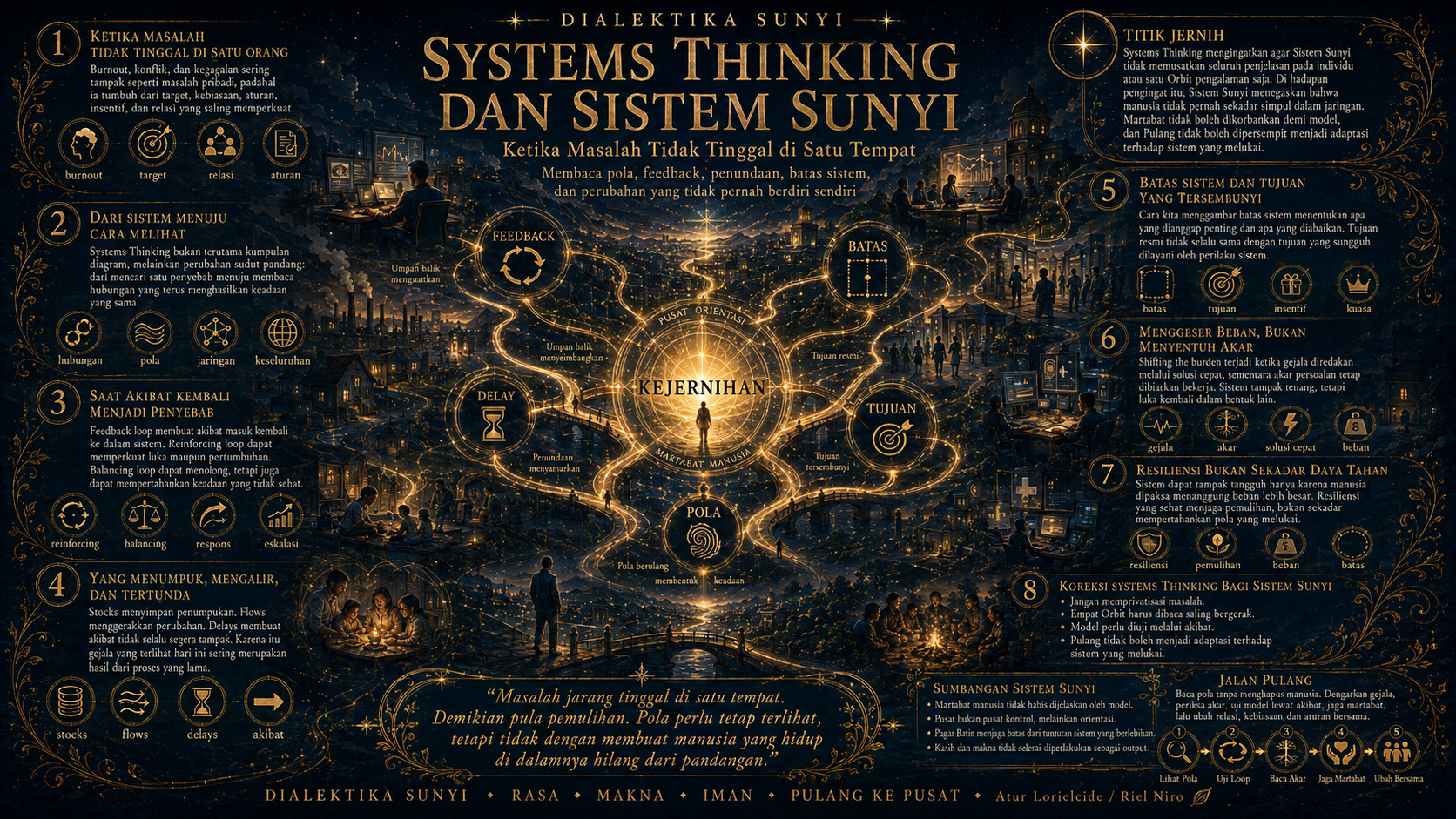
Tulisan ini merupakan bagian dari Dialektika Sunyi, kategori yang membaca ulang berbagai konsep umum melalui lensa orbit dan spiral kesadaran Sistem Sunyi. Tujuannya bukan menolak pemahaman luar, tetapi menunjukkan bagaimana sebuah konsep berubah arah ketika dilihat dari pusat batin Sistem Sunyi.
Sistem Sunyi lahir dari perjalanan batin manusia, bukan dari mesin atau algoritma. Ia tumbuh dari luka, jeda, doa, dan keberanian untuk diam. Orbit, spiral, dan gema bukan formula buatan, melainkan kosmologi yang muncul dari pengalaman hidup yang jujur.
Untuk memahami asal-usulnya lebih jauh, lihat juga Origin Story Sistem Sunyi: Ruang Orientasi · · .
Pengutipan sebagian atau keseluruhan isi diperkenankan dengan mencantumkan sumber: RielNiro – TokohIndonesia.com (Sistem Sunyi)
Lorong Kata adalah ruang refleksi di TokohIndonesia.com tempat gagasan dan kesadaran saling menyeberang. Dari isu publik hingga perjalanan batin, dari hiruk opini hingga keheningan Sistem Sunyi — di sini kata mencari keseimbangannya sendiri.
Berpijak pada semangat merdeka roh, merdeka pikir, dan merdeka ilmu, setiap tulisan di Lorong Kata mengajak pembaca menatap lebih dalam, berjalan lebih pelan, dan mendengar yang tak lagi terdengar.
Atur Lorielcide berjalan di antara kata dan keheningan.
Ia menulis untuk menjaga gerak batin tetap terhubung dengan pusatnya.
Melalui Sistem Sunyi, ia mencoba memetakan cara pulang tanpa tergesa.
Lorong Kata adalah tempat ia belajar mendengar yang tak terlihat.
Baca juga: Dua Ruang, Satu Sunyi: Jejak Atur Lorielcide alias Rielniro