
 Tulisan ini bagian dari sistem kesadaran reflektif
Faith speaks of God because it cannot remain wholly silent, then draws its language back because it knows that God is never exhausted by the names human beings utter.
There are moments when the name of God feels too small for the God being named. Human beings say that God is good, loving, just, near, holy, living, light, Father, Friend, King, Shepherd, or the source of all that exists. Such language arises from Scripture, worship, experience, tradition, testimony, and the human need to respond. Without language, faith cannot be taught, shared, prayed, or made responsible.
Yet every word carries a limit. The goodness known by human beings does not exhaust the goodness of God. Love experienced in relationship cannot become a measure capable of containing divine love. Even the most exalted name remains formed through language, history, culture, wounds, hope, and human imagination. A word can point, but cannot possess. It can open, but cannot close mystery.
Apophatic Theology grows within this tension. It does not reject the language of faith, but rejects the arrogance that language has mastered what it names. It affirms, then denies that the affirmation applies to God in the same manner in which it applies to creatures. It speaks, then allows the word to break before the One beyond every name.
A genuine affinity with this posture also appears in The System of Silence because it makes room for silence, epistemic limits, inner discernment, faith, and mystery. Yet the affinity carries risk. The language of silence, center, gravity, or Returning Home can become a symbol that feels more certain than the experience it was meant to read.
The apophatic correction therefore reaches the architecture of The System of Silence itself. The Theory of Inner Echo must not make every reverberation feel like a hidden message. The System of Silence Model (MSS) must not make spiritual reading an authority exempt from correction by body, feeling, morality, relationship, community, and fact. Faith as gravity must remain a metaphor of orientation, not a literal account of how God works.
The meeting of Apophatic Theology and The System of Silence is not a merging of terms, but a discipline of restrained claims. Apophatic Theology has its home in a long theological, liturgical, and contemplative tradition. The System of Silence is a reflective reading system that reads Feeling, Echo, relationship, work, Meaning, and Faith without treating its architecture as an explanation of God.
The four orbits of The System of Silence are not used to explain God, nor are they stages toward higher spiritual knowledge. They are fields of reading that help examine the human being speaking of God: what body and Feeling are present, what relations of power are active, how belief becomes embodied, and whether the narrative of Faith remains open to mystery and correction.
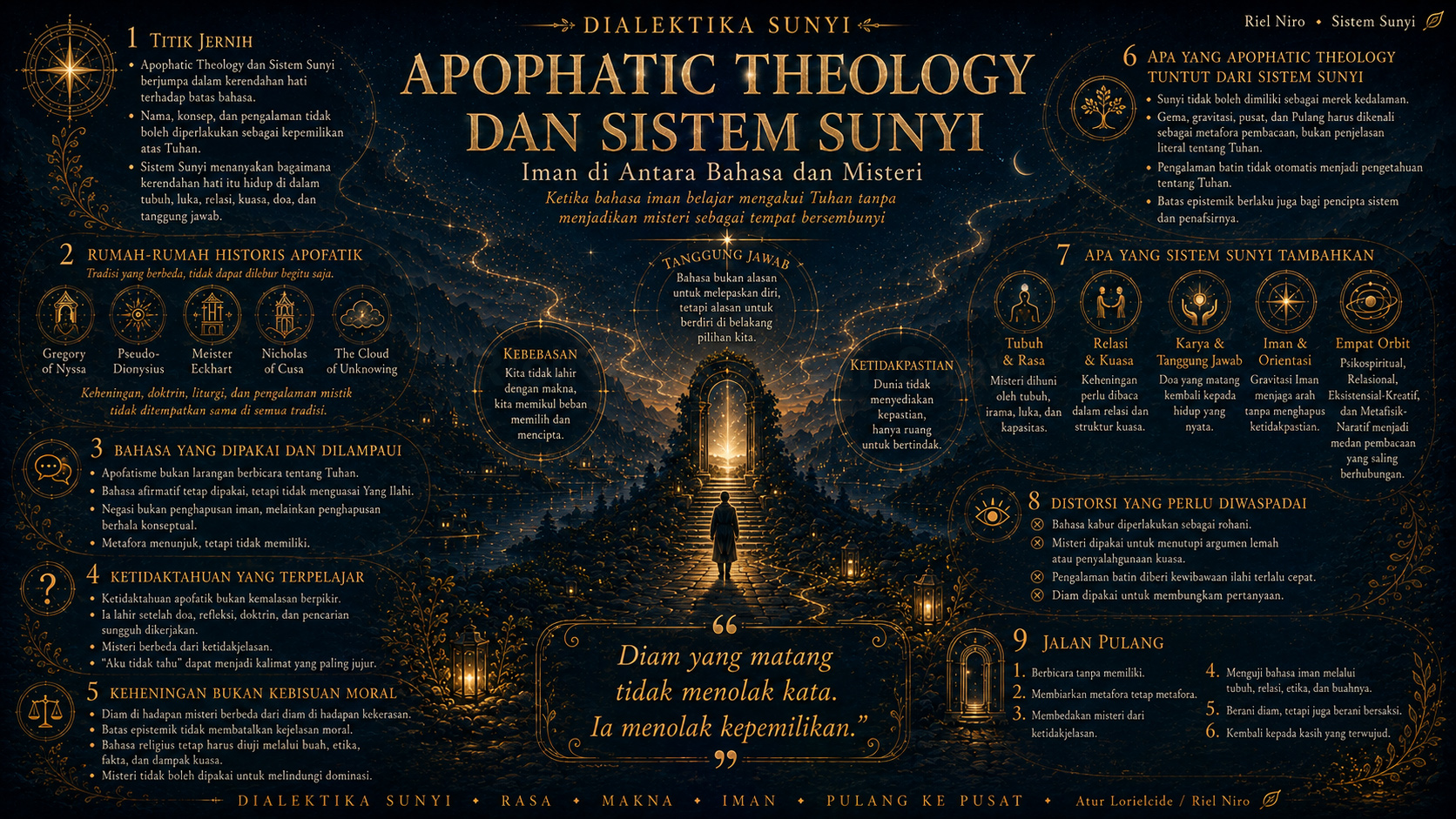
Apophaticism Is Not a Prohibition against Speaking of God
Apophatic Theology is often translated as negative theology. The name easily creates the misunderstanding that its task consists only in saying what God is not.
Mature apophaticism does not live without affirmative theology. Human beings still say that God is good, wise, living, and loving. Yet they recognize that such words do not operate univocally, as though “good” meant exactly the same thing when spoken of a human being and of God.
In traditions shaped by Pseudo-Dionysius, the affirmative and negative ways belong together. Divine names are given, contemplated, and praised. Human beings then move beyond the ordinary understanding of those names. God is not “good” as one good being among other beings. God exceeds the very category through which goodness is understood.
Negation is not the abolition of faith. It is the dismantling of conceptual idols. Apophaticism therefore differs from the claim that nothing at all can be known and every statement about God is equally empty. The apophatic tradition remains within revelation, prayer, community, and the language of faith. What it refuses is not knowledge itself, but the assumption that human knowledge is proportionate to the reality of God.
Here The System of Silence insists that epistemic limits are not a reason to cease discerning. Humility is not relativism. Not every image of God bears the same fruit. Language that legitimizes violence, humiliation, or domination still needs to be examined and rejected, even though God exceeds all language.
The God Who Exceeds Language Also Reveals Himself
To confess that God exceeds every name does not mean that Faith stands before an emptiness. The Christian tradition speaks not only of the human inability to comprehend God, but also of God who reveals himself. Scripture, the history of salvation, the life of the community, and above all Christ give concrete content to the language of Faith, even though that content never makes God a possession of human thought.
Apophaticism must therefore walk with revelation. When negation is used to empty every confession of Faith, humility becomes indifference. Yet when revelation is treated as though it has removed all mystery, human beings begin to equate a true formulation with complete mastery. Faith knows truly, but never exhaustively.
In Christian Faith, this tension takes its sharpest form in Christ. The One whom concepts cannot contain enters history, body, language, relationship, suffering, and love. The Incarnation does not make divine mystery simple. It refuses two escapes at once: God must not be confined within an abstraction remote from life, but neither may God be reduced to a human image that can be mastered.
Doctrine lives within the same tension. It is not a complete map of God, but neither is it an empty fence. Doctrine gives shared language, preserves the confession of Faith, and protects the community from arbitrary spiritual claims. Yet even the most precise formulation points toward a reality greater than the sentence that formulates it.
Mature apophaticism therefore neither erases revelation nor opposes doctrine. It keeps both from becoming instruments of possession. What is withdrawn is not fidelity to truth, but the arrogance of the interpreter who imagines having escaped the limits of being human.
Historical Homes That Cannot Simply Be Fused
Apophatic Theology is not a single school. It appears in different forms across times and traditions.
Gregory of Nyssa writes of a journey toward God that does not end in mastery, but moves ever deeper into mystery. Pseudo-Dionysius, writing in the late fifth or early sixth century, developed an enormously influential relationship among affirmative theology, negative theology, symbol, hierarchy, and union with God in a “darkness” beyond knowledge. His tradition later shaped thinkers in both East and West.
In the Latin world, Meister Eckhart, Nicholas of Cusa, and other mystical traditions developed distinct languages of divine incomprehensibility, learned ignorance, detachment, and the birth of God in the soul. The Cloud of Unknowing, an anonymous fourteenth-century English work, guides contemplative prayer through love beyond the mind’s ability to grasp God.
These figures must not be blended as though they taught one system. They inhabit different ecclesial, philosophical, and spiritual contexts. Even within Christianity, apophaticism relates differently to doctrine, sacraments, Scripture, liturgy, and mystical experience.
These differences matter because modern readers can easily merge negative theology, mysticism, contemplative prayer, symbolic language, and the limits of knowledge into a single inward method. Yet each tradition places silence, doctrine, liturgy, Scripture, and mystical experience in a different relationship. Their distinct historical homes need to be respected so that affinity does not collapse into simplification.
For The System of Silence, these differences also serve as a reminder that “Silence” is not a single universal technique. Silence in monastic prayer, the silence of trauma, silence after loss, silence in worship, and silence born from fear of speaking do not carry the same meaning.
Language That Must Be Used and Surpassed
Human beings cannot live without metaphor. To call God light is to use sensory experience to point toward what exceeds the senses. To call God Father is to use relational language that can carry love, protection, and authority, but also the full history of wounds associated with human fathers.
Theological language is therefore never neutral. It opens possibilities and carries risks. Apophaticism does not solve the risk by discarding metaphor. It teaches that metaphor must not be treated as a literal portrait. God may be called light, but is not physical light. God may be called Father, but is not limited by gender, body, or human failure. Every name must be allowed to point beyond itself.
The same responsibility applies to the language of The System of Silence. “Faith as gravity” may help people understand faith’s orienting force, but God is not a physical force and faith does not always feel steadily attractive. Returning Home may name a movement toward a more whole life, but God is not an inner location reached through technique.
A healthy metaphor knows that it is a metaphor. It does not lose its power; it loses its arrogance.
Unknowing Is Not Intellectual Laziness
Apophatic language often speaks of unknowing, darkness, or cloud. All can be misused as rejection of reason.
Yet apophatic unknowing is not an unwillingness to learn. It emerges after language, doctrine, Scripture, and reflection have been taken seriously. Human beings know enough to understand that what they know is insufficient.
Nicholas of Cusa speaks of learned ignorance. The more human beings understand the distance between finite thought and the Infinite, the more clearly they recognize the limits of conceptual certainty.
This differs from saying, “Nothing can be known, so nothing needs to be examined.” Mature unknowing increases precision. Because human beings know they can err, they become more open to correction, tradition, facts, and consequences.
This distinction helps The System of Silence keep the language of mystery from becoming a hiding place when arguments are weak, evidence is absent, or criticism arises. “It is a mystery” is not a legitimate answer for concealing abuse of power, doctrinal error, psychological manipulation, or untested claims of experience.
Silence Is Not Moral Muting
Silence holds great dignity within contemplative traditions. It makes room for prayer without many words, attention, surrender, and the cessation of the impulse to master God through concepts.
Yet silence is not always holy. There is the silence of the afraid. The silence of a victim who is not believed. The silence of a community protecting a leader. Silence born of shame, threat, or dependence. There is also silence imposed by those in power so that questions cannot be heard.
Apophatic Theology must not be used to collapse these forms into one. Silence before mystery differs from silence before violence. The incomprehensibility of God does not make human conduct immune from judgment.
The System of Silence treats Silence as a space for reading, not as a universal command not to speak. At times Stillness means restraining the impulse to react so that reality can be heard more clearly. At other times fidelity to truth requires a voice.
Silence can also become a superior identity. Those who speak little are assumed to be deeper, while protest, argument, or tears are treated as signs of immaturity. When that happens, Silence no longer opens space for listening. It becomes an image that places some people above others.
Mature spiritual Silence does not make victims less visible. It sharpens hearing for voices that have been suppressed.
Mystical Experience and the Danger of Certainty
Apophatic traditions often stand near mystical experience: a sense of presence, luminous darkness, union, loss of ego boundaries, deep love, or silence felt as fullness.
Such experiences can transform life. Yet experience does not interpret itself. Peace does not automatically mean that God approves a decision. Intensity does not automatically establish divine origin. Religious imagery may be shaped by memory, culture, need, trauma, or hope. Even an authentic experience does not give complete knowledge of God.
Apophaticism provides a boundary against mystical inflation. If God exceeds experience, no person can turn private experience into ownership of God.
Body and psyche extend this discernment within The System of Silence. Spiritual experience should be read alongside nervous-system conditions, sleep, medication, wounds, environment, tradition, and effects. This does not reduce faith to psychology. It refuses premature certainty.
A genuinely deep experience usually does more than make someone feel special. It enlarges humility, love, responsibility, and the capacity to receive correction.
Prayer When God Cannot Be Mastered
Apophatic prayer does not always seek the correct words. It can become the willingness to remain before God without forcing a particular experience, answer, or feeling.
In The Cloud of Unknowing, love occupies a place that thought cannot replace. Not because reason is evil, but because God cannot be grasped as an ordinary object of knowledge.
Such prayer challenges the human need always to feel successful. There is no simple measure of the depth of prayer. The absence of feeling is not proof of God’s absence. Silence does not always mean closeness, but neither does it always mean failure.
Practices of remaining, waiting, and not forcing inner movement form a point of affinity with The System of Silence. Yet prayer must not be reduced to a regulation technique. The body may become calm, but prayer is not identical with calm. It is relationship, including when relationship feels dark, dry, or unanswered.
Mystery Is Not the Same as Obscurity
The word mystery is often applied to what is merely unclear because it has not been examined. In theology, mystery is not simply information that has not yet been discovered. It points toward a reality that cannot be exhausted by understanding even when genuinely revealed and contemplated.
Obscurity can be improved through definition, data, or explanation. Mystery remains beyond exhaustion after explanation has done its work.
This distinction matters because religious language is sometimes made deliberately vague so that it sounds profound. An unclear sentence is treated as spiritual. Questions are taken as lack of faith. The inability to explain is renamed mystery.
Mature Apophatic Theology demands precision. It does not call everything obscure divine. It distinguishes the limits of language from weak thinking.
The System of Silence also needs to ensure that poetic language does not replace clarity. Depth is not measured by the abundance of metaphor. Sometimes the most honest sentence is simple: “I do not know.”
Body, Wounds, and Images of God
Human beings do not form theology through thought alone. Body and relational history shape how God is felt.
A person raised under harsh authority may hear “Almighty God” as threat. Someone who experienced neglect may struggle to trust divine nearness. Survivors of spiritual abuse may fear prayer, worship, or the very name of God.
Apophaticism can help by freeing God from harmful images. God is not identical with the figure who used God’s name to control.
Negation alone, however, does not always heal the body. Wounds require safety, time, community, and sometimes clinical care. Saying that God exceeds every image does not automatically convince the nervous system that closeness is safe.
The System of Silence brings this dimension into the dialogue. Theological language needs to be read not only for doctrinal precision, but also for the way it lives within body and relationship. Truth does not change because of trauma, but the way a person can receive it is shaped by history.
God Exceeds Concepts, but Human Claims Remain Testable
One misuse of apophaticism is to make all religious claims appear beyond examination. Because God exceeds reason, leaders feel no need to explain. Because spiritual experience is personal, a community must not ask questions. Because mystery exists, contradiction is treated as irrelevant.
This reverses the purpose of apophaticism. That God exceeds concepts does not mean that human speech exceeds criticism. Precisely because human speech is limited, it must become more responsible.
Claims about the will of God require testing through Scripture, tradition, reason, community, facts, ethics, and fruit. Traditions weigh these elements differently, but there is no humility in demanding that others obey a voice heard by only one person.
The System of Silence treats epistemic limits as a boundary against domination. “I feel” is not the same as “God says.” “I see meaning” is not the same as “this is the only meaning.”
What Apophatic Theology Requires of The System of Silence
Apophatic Theology tests the tendency of every system to feel that its terms have captured reality. The test is especially close for The System of Silence because the language of Center, Echo, Resonance, Gravity, and Returning Home carries strong symbolic power. That power can help human beings read life, but it can also make a metaphor feel more certain than the reality it was meant to illuminate.
Silence must therefore not be owned as a brand of depth. It lives within many traditions, cultures, bodies, and forms of life. The System of Silence may have its own language and editorial voice, but it has no right to make them the single road toward depth or a universal measure of inner life.
Gravity of Faith must also remain a metaphor. It helps describe the orienting force of Faith while thought and Feeling move, but God is not a force of inner physics and Faith does not work mechanically. A metaphor illuminates one side while concealing another. Awareness of that limit keeps language useful without turning it into an untested ontology.
Likewise, Returning Home is not a technique for reaching God or a promise that the whole destination will become clear. It is a movement toward a more whole life. In the life of Faith, that movement sometimes reveals only the next step. Unknowing need not be closed by a map drawn too quickly.
Inner experience must not become automatic knowledge of God. Peace, bodily warmth, an inner voice, a dream, or a sense of Presence may carry spiritual value, but their intensity proves neither divine origin nor interpretive truth. Every reading must remain open to correction by body, Feeling, morality, relationship, community, tradition, fact, and the fruit of life.
Epistemic boundaries must finally apply to the person who creates the terms, maps, and architecture of The System of Silence. Founding experience may be deeply convincing, but it must still be distinguished from universal claim. Humility is not a rule for readers alone. It also protects the creator of a system from self-mythology and keeps the system open to revision.
What The System of Silence Adds to Apophatic Life
The recognition that God exceeds every concept brings apophatic life toward questions closer to ordinary living: how is unknowing inhabited through the body, relationships, choices, work, and responsibility? Mystery is not preserved by language alone. The way human beings carry mystery into life also needs to be examined.
Unknowing is never experienced in the abstract. For some, it may feel liberating; for others, it appears as anxiety, freezing, disorientation, or the return of an old wound. Bodies do not inhabit mystery at the same rhythm. Unknowing therefore should not be romanticized as an elevated state that everyone ought to be able to endure.
Silence also changes meaning when it is situated within relations of power. It can become prayer, humility, or protection, but it can also be imposed by leaders, families, institutions, and communities that do not want to be examined. Asking who benefits from silence and who loses a voice does not diminish spiritual life. It helps protect spiritual life from abuse.
The limits of knowledge do not erase moral clarity. A person may not understand the reason for suffering, yet can still recognize violence, deception, humiliation, and the need for help. Unknowing about God is not a reason to postpone moral obligations that are already clear enough.
Apophatic prayer gains its weight not only when it loosens the need to master God, but also when a person returns to life with humbler language, more restrained uses of power, and more tangible love. Silence that never changes how one treats the body and relationships can easily become a private space that is never tested.
Faith, too, lives alongside Feeling without being governed by it. Dryness does not prove that God is absent, and calmness does not prove that every interpretation is true. Feeling provides information, but it is not the sole judge. The Gravity of Faith preserves orientation amid changes in Feeling, while still being tested through love, freedom, responsibility, and humility.
When Language Bows without Silencing Life
Apophatic Theology gives The System of Silence the courage to draw back its claims. It reminds the system that clear terms are still not God, and powerful inner experience is still not unlimited knowledge.
The next question comes from The System of Silence: does epistemic humility make human beings more able to protect bodies, hear victims, limit power, work honestly, and believe without forcing explanation?
Between the two, silence does not become a rejection of language. It becomes a discipline preventing words from becoming possession while refusing to use silence to avoid witness and responsibility.
Speaking without Possessing, Remaining Silent without Abandoning
Faith requires language, yet language never becomes a house wide enough for God. Apophatic Theology preserves this tension so that human beings may still pray, confess, praise, and think without believing that their names have mastered the Divine.
The System of Silence carries this tension into the four orbits as fields of reading, not spiritual stages. The experience of mystery may be read through body and Feeling, relationship and power, work and responsibility, and the larger narrative of Faith that remains open to correction. No orbit stands as an explanation of God. Each only helps human beings examine how they live, speak, and act before mystery.
The System of Silence Model (MSS) helps prevent Feeling from becoming private revelation. Emotional, moral, spiritual, relational, and factual readings must continue correcting one another so that personal conviction is not immediately given divine authority.
Mature silence does not reject words. It rejects possession. Mature language does not erase mystery. It dares to name love, justice, violence, and responsibility while acknowledging that God remains greater than every formulation.
Between speech and silence, human beings do not gain mastery. They gain reverence: speaking with proportion, withdrawing arrogance, continuing to listen, and not abandoning a world in which love must become embodied.
Dialektika Sunyi (Format 2) adalah ruang dialog antara Sistem Sunyi dan dua puluh empat rumah pemikiran dari berbagai tradisi filsafat, psikologi, etika, teologi, dan pemikiran sosial. Dua puluh empat tulisan ini tidak disusun untuk menjadikan tradisi-tradisi tersebut sebagai bagian dari Sistem Sunyi, melainkan untuk mempertemukan cara pandang yang berbeda agar manusia dapat dibaca dari lebih dari satu pintu.
Sistem Sunyi tidak datang ke dalam dialog dengan rumah yang kosong. Ia sudah membawa cara membaca sendiri: Rasa perlu didengar tanpa segera dijadikan kebenaran, Makna tidak dipaksakan kepada luka, Iman memberi arah tanpa menjadi jawaban instan, dan manusia tidak dapat dihabiskan oleh satu istilah atau satu peta.
Karena itu, setiap rumah pemikiran hadir sebagai ruang dialog yang tetap memiliki bahasa, sejarah, pertanyaan, dan batasnya sendiri. Dialektika Sunyi bukan upaya membuktikan bahwa dua puluh empat tradisi tersebut pada akhirnya mengatakan hal yang sama dengan Sistem Sunyi.
Mengapa dua puluh empat rumah pemikiran?
Karena manusia terlalu luas untuk dibaca melalui satu lensa. Penderitaan dapat hadir sebagai pengalaman batin, pola tubuh, relasi, cerita diri, bahasa, kondisi sosial, struktur kuasa, sejarah, iman, maupun perubahan kehidupan. Satu lensa dapat membuka sesuatu yang penting, tetapi selalu ada wilayah yang berada di luar jangkauannya.
Dua puluh empat rumah pemikiran karena itu membuka percakapan dari berbagai arah. Membuka pintu tidak berarti meninggalkan rumah. Setiap tradisi tetap dibaca sebagai rumahnya sendiri, sementara Sistem Sunyi membiarkan perjumpaan itu memperluas cara melihat tanpa kehilangan batasnya.
Di dalam panel ini, dua puluh empat tulisan dibagi menjadi tiga bagian: Peta I, Peta II, dan Peta III. Ketiganya adalah pembagian navigasi untuk membantu menemukan delapan rumah pemikiran pada masing-masing bagian.
Sebelum masuk ke daftar, dua ruang berikut dapat digunakan untuk melihat keseluruhan Dialektika Sunyi dalam skala yang lebih luas:
Atlas Dialektika Sunyi
24 Percakapan, 24 Peta Pembacaan
Ruang orientasi publik untuk menjelajahi dua puluh empat tradisi yang berdialog dengan Sistem Sunyi tanpa kehilangan rumah pemikirannya masing-masing.
Peta Pengetahuan Dialektika Sunyi
Dua Puluh Empat Rumah. Tidak Ada yang Dilebur Menjadi Satu.
24 Rumah Pemikiran · 20 Kejernihan · 25 Pintu Kehidupan
Ruang untuk melihat bagaimana dua puluh empat tradisi dipertemukan dengan Sistem Sunyi tanpa penyerapan, kemenangan, atau sintesis yang lebih tinggi.
Peta ini hanya membantu menemukan jalan. Pembacaan sebenarnya terjadi di dalam masing-masing tulisan, ketika satu rumah pemikiran dibuka dan dialognya dengan Sistem Sunyi mulai berlangsung.
Paket I bergerak paling dekat dengan pengalaman personal, tetapi tidak membiarkan batin menjadi dunia yang tertutup. Kendali bertemu keadaan, perhatian bertemu makna, kedekatan membawa sejarah relasi, kebebasan berhadapan dengan keterbatasan, dan keheningan diuji oleh doa serta kehidupan yang kembali dijalani.
- Ketika keteguhan tidak berarti mematikan rasa
- Ketika hadir belum berarti memahami
- Ketika hidup tidak hanya meminta penjelasan, tetapi jawaban
- Ketika kebutuhan akan tempat aman ikut membentuk cara manusia mencintai
- Ketika hidup tidak menyediakan kepastian yang dapat memilih atas nama manusia
- Ketika bagian diri yang tidak disadari ikut membentuk cara manusia melihat kenyataan
- Ketika bahasa iman belajar mengakui Tuhan tanpa menjadikan misteri sebagai tempat bersembunyi
- Ketika keheningan di hadapan Tuhan kembali menjadi kasih, kerja, batas, dan tanggung jawab
Paket II memperdalam pertanyaan tentang bagaimana pengalaman sebenarnya terbentuk. Apa yang terasa tidak hadir tanpa tubuh. Apa yang dipahami tidak lahir tanpa bahasa. Agency mempunyai lingkungan. Care mempunyai distribusi beban. Makna dan keyakinan memperoleh ujian ketika mereka meninggalkan jejak dalam kebiasaan, tindakan, dan dunia bersama.
- Ketika kenyataan perlu diberi ruang sebelum kesimpulan mengambil alih
- Ketika tubuh, kebiasaan, alat, relasi, dan dunia ikut membentuk cara manusia memahami dan memilih
- Ketika rasa sakit tidak harus hilang sebelum manusia bergerak menuju yang bernilai
- Ketika motivasi dibaca melalui autonomy, competence, relatedness, dan mutu alasan untuk bergerak
- Ketika kisah hidup memberi arah, tetapi tidak berhak menjadi seluruh kenyataan
- Ketika bahasa, sejarah, tradisi, dan kuasa ikut menentukan apa yang dianggap sebagai kebenaran
- Ketika kebutuhan, dependency, kerja perawatan, kompetensi, dan pembagian beban menjadi persoalan moral
- Ketika gagasan diuji melalui kebiasaan, penyelidikan, konsekuensi, komunitas, dan revisi
Paket III membawa pembacaan ke kondisi yang membuat sebagian pengalaman dipercaya, sebagian dinormalkan, dan sebagian bahkan sulit memperoleh bahasa. Struktur dan sejarah masuk lebih jelas, tetapi manusia tidak dibiarkan menghilang di dalamnya. Karena itu Systems Thinking bertemu Virtue Ethics, Liberation Theology bertemu batas praxis, dan Process Philosophy menutup paket dengan kehidupan yang terus menjadi tanpa kehilangan tanggung jawab.
- Membaca penderitaan di antara batin, ideologi, institusi, ekonomi, dan distribusi kuasa
- Ketika pengetahuan dibentuk oleh posisi, tubuh, bahasa, kredibilitas, dan relasi kuasa
- Bahasa, institusi, dan relasi yang membuat kategori terasa alamiah
- Sejarah, bahasa, representasi, dan kuasa di balik hak untuk menjelaskan manusia lain
- Membaca pola, feedback, penundaan, batas sistem, dan perubahan yang tidak pernah berdiri sendiri
- Karakter, kebiasaan, emosi, teladan, dan kebijaksanaan praktis dalam kehidupan sehari-hari
- Ketika doa, kasih, keselamatan, dan kitab diuji oleh kemiskinan, penindasan, serta tindakan pembebasan
- Identitas, relasi, waktu, dan Pusat yang bertahan tanpa membeku menjadi bentuk final
Lorong Kata adalah ruang refleksi di TokohIndonesia.com tempat gagasan dan kesadaran saling menyeberang. Dari isu publik hingga perjalanan batin, dari hiruk opini hingga keheningan Sistem Sunyi - di sini kata mencari keseimbangannya sendiri.
Berpijak pada semangat merdeka roh, merdeka pikir, dan merdeka ilmu, setiap tulisan di Lorong Kata mengajak pembaca menatap lebih dalam, berjalan lebih pelan, dan mendengar yang tak lagi terdengar.
Atur Lorielcide berjalan di antara kata dan keheningan.
Ia menulis untuk menjaga gerak batin tetap terhubung dengan pusatnya.
Melalui Sistem Sunyi, ia mencoba memetakan cara pulang tanpa tergesa.
Lorong Kata adalah tempat ia belajar mendengar yang tak terlihat.
Baca juga: Dua Ruang, Satu Sunyi: Jejak Atur Lorielcide alias Rielniro