
 Tulisan ini bagian dari sistem kesadaran reflektif
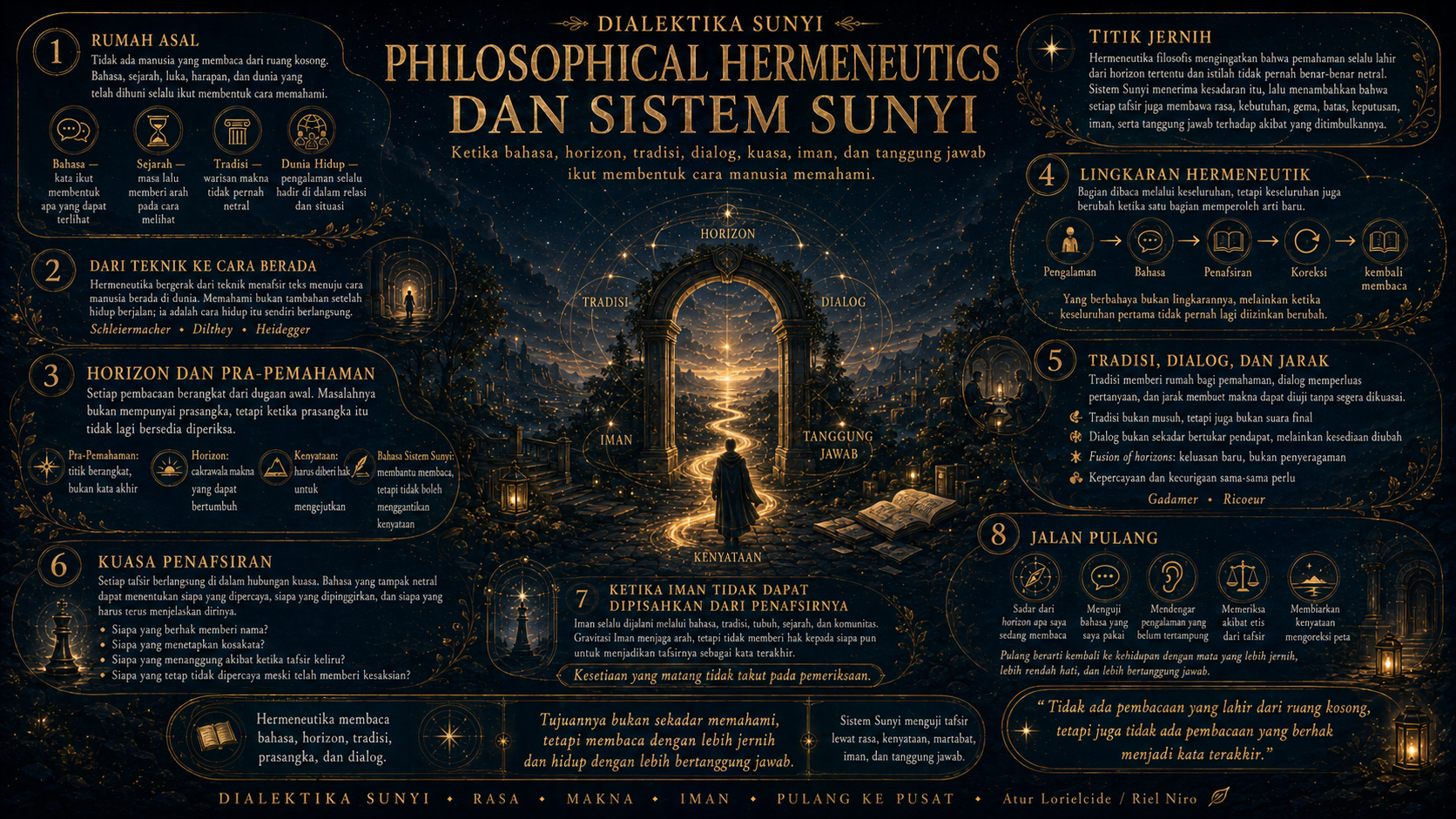
No human being reads the world from an empty space. Even before a word is understood, the reader already brings language, history, hope, wounds, and a particular way of seeing reality.
Imagine two people reading the same sentence. The words do not change, yet the meanings they receive may be entirely different. One finds consolation, while the other hears a threat. One feels understood, while the other feels judged. The difference does not arise merely because the text is vague, but because every act of reading meets someone who has already lived before beginning to read.
Every person brings their own history into every encounter. The language learned in childhood, the family that shaped how the world was seen, experiences of loss, education, convictions, and even wounds that remain unresolved all quietly enter the attempt to understand. Thus the apparently simple claim, “I am only seeing things as they are,” conceals a larger problem: even what is taken to be “as it is” has already arisen through a particular way of seeing reality.
Philosophical hermeneutics moves within this terrain. Its primary question is not how to produce an interpretation untouched by the reader, but how understanding becomes possible when readers never arrive empty-handed. Understanding does not begin only after every prejudice has been cleared away. It is through these prior inheritances that the movement of understanding can begin at all.
Hermeneutics first developed as a discipline for interpreting law, literature, and scripture. Gradually, however, its question became far more fundamental. The issue was no longer simply how to read a text correctly, but how human beings live as creatures who are always already interpreting. The world never comes to us as a lifeless object waiting to be photographed. It always appears as something that has already been given meaning.
Experience and language can never be completely separated. Human beings do live before they can explain their lives, but once experience begins to receive a name, language helps determine what can finally be seen. A term may bring what was once vague into view while pushing aside what does not fit its frame. Language does not merely report experience; it helps shape the experience that can be recognized.
The encounter with The System of Silence begins at this point. Terms such as Center, Echo, Returning Home, Wholeness, or Inner Fence may help someone read life in ways that were previously unavailable. Yet these terms are not transparent glass. They carry histories, conceptual choices, and particular angles of vision. Every word opens something while also risking the closure of something else.
The hermeneutic task, then, is not primarily to erase the reader’s horizon. It is to recognize that the horizon is always at work, and then to give reality the opportunity to widen, correct, or even unsettle it. Mature understanding does not arise when someone becomes free of history, but when they become humble enough to let that history itself be reread.
From a Technique of Reading to a Way of Being in the World
A major shift in hermeneutics occurred when interpretation was no longer confined to the rules of reading within particular fields. Friedrich Schleiermacher expanded it into an art of understanding across domains. He distinguished a grammatical movement, which reads an utterance within a shared language, from a technical or psychological movement attentive to the distinctive way an author forms thought. Wilhelm Dilthey then brought hermeneutics into the human sciences, since historical life cannot be understood through the causal patterns of the natural sciences alone.
The most fundamental turn came through Martin Heidegger. Hermeneutics was no longer treated primarily as a technique for reading texts or a method for the human sciences, but as a way of understanding human existence itself. Human beings do not first stand outside the world and then interpret it from a neutral position. From the beginning, they already live within a world of meaning, relationships, tasks, anxiety, hope, and possibility. Understanding is not an additional activity performed after experience; it belongs to the human way of being in the world.
Understanding is practical before it becomes theoretical. Human beings know how to open a door, recognize an angry face, or avoid danger long before they can explain a theory of those actions. When something is disrupted, a tool breaks, a habit fails, or the world no longer proceeds as expected, the structure of understanding that had remained hidden begins to appear.
Inner reading works in a similar way. Even Feeling that seems most spontaneous never appears in a vacuum. It arises within a world already shaped by bodily history, relationships, language, and habits of life. Even an inner fracture is often not only a fracture within the self, but also a sign that the world in which someone has lived can no longer be understood in the same way as before.
The first humility arising from this encounter is the recognition that inner reading never begins from a sterile Center. Every attempt to read oneself starts from a world that has already shaped how one feels, asks, and searches for meaning. The journey toward Center is not an attempt to discard history, but a practice of reading that history with continually deepening Clarity.
Imagine someone who for years has known themselves as a dependable worker. As long as work continues, this understanding feels so natural that it is hardly noticed. But when the body becomes ill and the old rhythm can no longer be sustained, more than a schedule is disrupted. The world in which dignity, usefulness, and relationships with others were understood also begins to fracture. The disruption reveals that this practical identity had rested on a network of habits and recognition wider than personal consciousness.
At such a moment, reading oneself cannot be reduced to finding the deepest feeling and naming it as the truth of an inner core. The world that makes the feeling intelligible must also be read: the culture of work, the language of achievement, family demands, the condition of the body, and the relationships that have supported or constrained a life. Heidegger helps keep inner reading from becoming a search for an essence detached from the world in which a person actually lives.
Every Understanding Begins from Something Already There
Once we recognize that no reading truly begins from an empty space, another question immediately appears. If every person already carries a history, is clear understanding still possible? Or will human beings simply remain trapped within the prejudices they bring from the beginning?
Hans-Georg Gadamer answers this question in a surprising way. The problem, he argues, is not how to discard every prejudice before understanding, but how to recognize which prejudices allow understanding to begin and which quietly close the possibility of seeing something new.
Gadamer uses prejudice not primarily to mean a discriminatory attitude or a judgment that is necessarily false. It names a prior judgment that allows understanding to begin. Before a sentence has been fully read, the reader already carries an expectation about what is being said. Before an action is understood, an image of the person acting has begun to take shape. Without such an initial movement, understanding would have no place from which to start.
The problem is not that human beings have pre-understanding. The problem begins when an initial expectation quietly becomes a verdict that no longer agrees to be examined. At that point, the horizon that once helped begins to turn into a fence.
Imagine two people watching someone remain silent during a conversation. One immediately reads the silence as anger because, in their family, silence always preceded punishment. The other sees it as respect because their tradition teaches that not every Feeling must be spoken at once. No reading is born without a point of departure, but that point of departure can still change when reality shows something that had never been anticipated.
The same movement returns when people read themselves through particular terms. Words such as Echo, Distortion, Center, or Inner Fence may open experiences that previously had no name. The same terms may also become a new way of forcing every experience into an available pattern. Language that once helped can slowly harden into a lens too narrow for life.
A Horizon Does Not Only Limit; It Can Also Grow
Because every reader brings a history, Gadamer speaks of a horizon. A horizon is the range of possibilities through which something can appear meaningful at a particular time. It is shaped by language, education, community, past experience, and even by the questions currently regarded as important.
A horizon is not a wall that seals human beings off from the world. It is closer to a line of sight that moves with the journey of life. The farther someone travels, the more they may be able to see. Yet this widening does not happen merely because new terms are learned or more books are read. A horizon changes when reality compels someone to ask questions they had never before considered necessary.
Genuine dialogue is not primarily directed toward winning an argument. Mature dialogue can alter the question each participant brings. Sometimes an answer remains out of reach because the real matter becomes visible only after a conversation has been allowed to continue long enough.
An encounter between horizons does not automatically widen either one. A person may learn a new language only to defend an old conviction more elegantly. They may learn the concept of trauma so that every conflict once again confirms a story they have long believed. They may recognize manipulation in others without asking whether their own language of care is also being used to control.
A horizon widens only when reality is granted the right to surprise the reader. As long as every experience is used as evidence for what was believed from the beginning, the horizon of understanding has not truly moved.
Atlas, KBDS, and the terms within The System of Silence were never meant to become finished maps. They are provisional horizons that offer orientation. A map remains useful only while it can be corrected by the life being mapped. Once the map begins to determine what may be experienced, it ceases to be an instrument of reading and becomes a substitute for reality.
The Part Always Changes the Whole
Awareness of horizon leads to one of the best-known ideas in hermeneutics: the hermeneutic circle. A sentence is understood through the whole text, yet the whole text also changes whenever one sentence receives a new meaning. This movement never fully comes to an end.
The movement between part and whole also appears when human beings read their own lives. A failure is understood through the story a person already holds about themselves, yet that story may change when the failure gradually finds a different place within it. New experience changes the whole story, and the altered story then changes the meaning of experiences that follow.
The hermeneutic circle is not an error in reasoning that must be broken. It shows that understanding moves through an initial projection that can be tested and revised. Danger begins when the first image of the whole is never allowed to change. Every part is then forced to become evidence for a story whose conclusion has already been decided.
The same discipline reaches the architecture of The System of Silence. Its architecture helps readers understand each term, but what remains uncontained must also be allowed to correct the way the whole has been arranged. If the whole always defeats the part, reading becomes a machine of confirmation. It no longer discovers new reality, but merely repeats what it wanted to believe from the beginning.
The consequences must be concrete. When an experience repeatedly resists the available terms, the reader must not immediately accuse the experience of lacking Clarity. A term may be suspended, its definition examined, and the map of reading reopened. A correction need not instantly revise the entire architecture, but an anomaly must not be discarded merely to keep the system looking orderly.
The right to correct the language of The System of Silence does not belong only to those who designed the system. Readers who experience the consequences of a term, people whose lives are being interpreted, and realities that remain uncontained all bear testimony that must be heard. Hermeneutic humility becomes real only when a system creates room for experience to say that a particular reading is unhelpful, inaccurate, or even harmful.
Tradition Is Not a Burden from the Past, but the Place from Which Every Reading Begins
No human being begins understanding the world alone. Long before someone chooses their own convictions, they have inherited language, stories, symbols, habits, and ways of asking questions from the community in which they grew. Tradition is not merely a collection of old ideas preserved for remembrance. It lives within the ways human beings name reality, decide what matters, and distinguish questions worth asking from questions that never even occur to them.
Tradition is not the enemy of understanding. Without it, human beings would have to create their whole world from the beginning. Inherited language first makes experience intelligible. Precisely because tradition gives understanding a home, it also has the power to determine what appears normal and what is regarded as impossible.
Yet the inheritance that shapes understanding is never truly singular. Every community contains dominant voices and voices barely heard, official stories and memories deliberately forgotten, celebrated practices and experiences continually pushed aside. The phrase “tradition teaches” may sound simple, but it always conceals further questions: whose tradition, from which period, and who was given the right to decide which inheritance represents the whole?
The problem of tradition can arise within The System of Silence as well. Its terms may one day become a small inheritance that helps readers find clearer language while quietly shaping a particular way of seeing the world. Fidelity is not measured by keeping every formulation intact, but by the courage to let an inheritance continue to be examined by reality.
Dialogue Is Not an Exchange of Opinions, but a Willingness to Be Changed
From here, Gadamer brings hermeneutics toward the idea of dialogue. A genuine conversation is not simply an opportunity for two people to defend their respective views. Dialogue occurs when the matter under discussion gradually takes hold of the conversation and compels both sides to ask questions they had never previously imagined.
Listening is not merely giving another person a turn to speak. It means accepting the possibility that something long considered certain may be too narrow to hold the reality now appearing. Sometimes what changes is not the answer, but the question itself.
Dialogue is possible only when both parties genuinely have room to differ. If one side possesses the power to punish, expel, humiliate, or decide who may speak, the agreement that emerges may not be mutual understanding. It may simply be obedience wearing the language of consensus.
The fusion of horizons must not be imagined as a condition in which everyone finally holds the same view. The identities of the speakers do not merge into one; what changes is the breadth from which the matter can be seen. After a good dialogue, someone may still disagree, but can no longer return to seeing the world in exactly the same way.
The dialogical test of every term in The System of Silence lies here. A term must not only explain experience; experience must also be allowed to change how the term is understood. If every conversation ends in the victory of the system, what has taken place is not dialogue but repetition.
Learning to Trust, Learning to Suspect
For Ricoeur, trust and suspicion form a tension that need not be resolved by choosing one over the other. Understanding requires openness to the world of meaning a symbol or text may disclose. It also requires critique of the interests, illusions, and powers that may be concealed within language.
Trust allows symbols, texts, and experiences to open a world larger than themselves. Without trust, every meaning is immediately treated as deception. Yet suspicion also has its place. Language may conceal power, hide interests, or preserve illusions about the self. Reading means making room for the possibility that something is not as simple as it first appears.
Ricoeur gives an important place to distanciation, especially when discourse becomes text. Writing acquires distance from the author’s intention and its original situation, so that meaning is not exhausted by the first intention. This distance is not a refusal of meaning, but a condition under which the structure of a text can be explained and the world it opens can be understood. Readers need not submit to one frozen intention, but neither are they free to make the text mean anything they wish.
In practice, hermeneutic distance limits the temptation to master another person’s life through interpretation. The vocabulary of The System of Silence can also become an instrument of control when someone believes they understand another person’s Center merely because they know certain terms. The richer the language one possesses, the greater the responsibility not to treat a life that is not one’s own as already explained.
The Psychology of Distance and the Inner Fence remind us that understanding is never identical with possession. Some experiences can be read only as far as the person living them is willing to open them. A mature interpretation is not merely intelligent; it is humble enough to know when interpretation must stop.
Ricoeur also resists an easy separation between understanding and explanation. Explanation examines the structures, contexts, language, and relations at work within a text. Understanding receives the world the text opens for its reader. The movement from explanation toward understanding allows each to correct the other: understanding without explanation easily becomes projection, while explanation without understanding can treat life as an object dissected from the outside.
Suspicion also has a shadow. A person may become so skilled at exposing power, interests, and illusion that they can no longer accept the possibility that a symbol genuinely carries Hope, that a tradition still preserves wisdom, or that another person may speak without a hidden agenda. Suspicion that once liberated can become an intellectual identity that feels safe only when every meaning has been unmasked as disguise.
Understanding Always Means Choosing How to Act
For Gadamer, application is not a stage added after a text has already been understood. Understanding always takes place from within a present situation, where meaning meets a concrete question and begins to shape a way of living. Hermeneutics does not end with a successful explanation of meaning. Every understanding enters life through decisions, relationships that are sustained, boundaries that are protected, and the ways people treat themselves and others.
Understanding is never entirely neutral. How someone interprets forgiveness will determine how perpetrators and victims are treated. How responsibility is read will influence who is burdened and who is released. Even apparently simple terms such as “mature,” “obedient,” or “recovered” carry real consequences for those who must live beneath them.
Hermeneutics becomes an ethical question precisely when interpretation begins to shape the possibilities of life. The issue is no longer merely whether a reading makes sense, but what becomes possible after that reading is believed and applied. An interpretation can sound beautiful while quietly justifying injustice. Conversely, an uncomfortable interpretation may open space for dignity that had long been denied.
When interpretation enters the body and relationships, Feeling, needs, Echo, and bodily experience help determine what can be heard and what feels threatening. Criticism may sound like rejection because the body still remembers an old wound. Distance may feel like betrayal because the history of a relationship has not yet healed. This is where the vocabulary of The System of Silence becomes useful, provided Feeling is read alongside fact, context, and the freedom of others rather than enthroned as the final judge.
Language Helps Us See, but Must Not Replace Reality
A newly learned term can reveal something that was previously difficult to recognize. Words such as trauma, gaslighting, attachment, or Distortion allow experiences that once felt vague to begin taking form. Language creates new possibilities for understanding the self.
Yet language’s ability to illuminate experience also carries dangers of its own. After finding one concept that seems to explain life, human beings easily begin to see it everywhere. Language once used for reading slowly starts to determine what may be read. Experiences that do not fit are pushed aside so that the map can remain whole.
The relation between experience and language must always move in both directions. Terms help read life, but life also has the right to correct a term when reality proves wider than the available definition. A good concept is not one that explains everything, but one that remains willing to be revised when it fails to honour the complexity of life.
KBDS was born from this spirit. It is not a list of diagnoses, nor a classification machine that determines who someone truly is. It is an interpretive instrument that helps experience become more readable. For that very reason, the dictionary itself must remain able to learn from the life it is reading.
Not Every Interpretation Carries the Same Weight
Recognizing that every reading has a horizon does not mean that every interpretation is equally true. Hermeneutics is not an invitation to surrender to relativism. A reading can still be questioned through fact, historical context, testimony, coherence, moral consequence, and its ability to explain without erasing realities that do not fit.
No single measure can serve as judge over every interpretation. Facts require context. Coherence can be used to conceal violence. Consequences that appear good today may produce harm later. Evaluation therefore proceeds through several sources of correction that keep watch over one another.
Hermeneutic humility does not mean refusing to take a position. It means having the courage to explain why one interpretation is considered more responsible while still acknowledging that the reasons themselves can be examined. A mature position is not immune to correction. Its willingness to remain tested is precisely what makes it worth defending.
The same applies to The System of Silence. It may possess a clear orientation, but that orientation does not grant it the right to speak from outside history. Fidelity to the system does not release its readers from the duty to examine evidence, listen to different experiences, and observe the real consequences of the reading they choose. A clear position has value only while the reasons supporting it remain open to examination.
Power Always Helps Determine Who Has the Right to Give Meaning
Recognizing that every interpretation is historical does not by itself explain how power shapes a conversation. Here philosophical hermeneutics must meet sharper forms of institutional and social critique. Teachers, parents, religious leaders, therapists, media, educational institutions, and even small communities possess the power to decide which stories count as reasonable and which remain at the margins.
Power does not work only through prohibition. It also works through the vocabulary regarded as legitimate. Those who control language often control social reality as well. People without an official term for their experience are easily judged confused, irrational, or untrustworthy, when perhaps they have simply not found a language recognized by their surroundings.
Interpretive power also works through institutions that decide who must keep explaining themselves. A child may live for years beneath a family story that they are too sensitive. A patient may be judged uncooperative because the language of pain does not fit clinical categories. A member of a faith community may be called disobedient because their lived experience disrupts the official reading. In all these situations, interpretation does not remain an idea. It shapes reputation, access, safety, and even the possibility of being believed.
A critique of power cannot stop at asking who speaks the loudest. It must examine who is allowed to establish the vocabulary, who may revise definitions, who bears the consequences when an interpretation is wrong, and who remains disbelieved even after giving testimony. Language that appears neutral can become an instrument of power when only one party has the right to determine meaning.
When Faith Cannot Be Separated from Its Interpreter
Faith is never lived without language, tradition, body, history, and community. Scripture is read through inherited vocabulary. Spiritual experience is recognized through symbols that were taught beforehand. Even a statement about the will of God is spoken by a human being who carries a horizon, interests, wounds, hopes, and limitations.
Recognizing this does not mean that Faith is merely a construction of the interpreter. Hermeneutic awareness does not deny the possibility that human beings genuinely encounter a truth beyond themselves. It only refuses the premature leap from experience or text to the claim that one human interpretation has become identical with the Voice of God.
Authority must remain willing to be examined. Religious leaders, communities, traditions, and individual readers may help meaning become visible, but none has the right to close every conversation by claiming divine legitimacy. An interpretation that asks victims to remain within violence, silences questions, or shields power from accountability does not become holy merely because it uses the language of Faith.
Faith as Gravity gives life orientation without forcing every question into an immediate answer. It preserves direction while understanding remains limited. Within the architecture of The System of Silence, Faith gives courage to walk, while hermeneutic humility keeps that journey from trampling experiences that have not yet been understood.
Mature faithfulness is therefore not afraid of examination. It can hold conviction sincerely while admitting that human ways of understanding, applying, and expressing it can still be wrong. What is protected is not the interpreter’s prestige, but the willingness for Faith to continue producing honesty, Love, dignity, and responsibility.
Reading Without Ceasing to Learn How to Read
In the end, philosophical hermeneutics reminds us that understanding is not a condition achieved once and then completed. It is a way of life that keeps moving between experience and language, tradition and renewal, trust and suspicion, closeness and distance, conviction and humility.
The entire architecture of The System of Silence, including Atlas, KBDS, Silent Dialectics, and its other instruments of reading, belongs within this movement. They were built to help human beings see life with greater Clarity. Yet that Clarity is preserved only when each instrument remains willing to be reread whenever reality reveals something the available language cannot yet contain.
Revision is not a sign that the Center has been lost. Often it is precisely through revision that human beings preserve faithfulness to reality. A term that can no longer read life must be repaired. A map that no longer shows direction must be drawn again. What is preserved is not the form, but the willingness to keep walking toward truth.
Perhaps this is the quietest lesson hermeneutics offers. No reading is born from an empty space, but no reading has the right to become the final word. Maturity does not mean finally discovering an interpretation that cannot be wrong. It is the ability to live with conviction strong enough to act, and with humility deep enough to keep learning how to reread what had long been considered understood.
Dialektika Sunyi (Format 2) adalah ruang dialog antara Sistem Sunyi dan dua puluh empat rumah pemikiran dari berbagai tradisi filsafat, psikologi, etika, teologi, dan pemikiran sosial. Dua puluh empat tulisan ini tidak disusun untuk menjadikan tradisi-tradisi tersebut sebagai bagian dari Sistem Sunyi, melainkan untuk mempertemukan cara pandang yang berbeda agar manusia dapat dibaca dari lebih dari satu pintu.
Sistem Sunyi tidak datang ke dalam dialog dengan rumah yang kosong. Ia sudah membawa cara membaca sendiri: Rasa perlu didengar tanpa segera dijadikan kebenaran, Makna tidak dipaksakan kepada luka, Iman memberi arah tanpa menjadi jawaban instan, dan manusia tidak dapat dihabiskan oleh satu istilah atau satu peta.
Karena itu, setiap rumah pemikiran hadir sebagai ruang dialog yang tetap memiliki bahasa, sejarah, pertanyaan, dan batasnya sendiri. Dialektika Sunyi bukan upaya membuktikan bahwa dua puluh empat tradisi tersebut pada akhirnya mengatakan hal yang sama dengan Sistem Sunyi.
Mengapa dua puluh empat rumah pemikiran?
Karena manusia terlalu luas untuk dibaca melalui satu lensa. Penderitaan dapat hadir sebagai pengalaman batin, pola tubuh, relasi, cerita diri, bahasa, kondisi sosial, struktur kuasa, sejarah, iman, maupun perubahan kehidupan. Satu lensa dapat membuka sesuatu yang penting, tetapi selalu ada wilayah yang berada di luar jangkauannya.
Dua puluh empat rumah pemikiran karena itu membuka percakapan dari berbagai arah. Membuka pintu tidak berarti meninggalkan rumah. Setiap tradisi tetap dibaca sebagai rumahnya sendiri, sementara Sistem Sunyi membiarkan perjumpaan itu memperluas cara melihat tanpa kehilangan batasnya.
Di dalam panel ini, dua puluh empat tulisan dibagi menjadi tiga bagian: Peta I, Peta II, dan Peta III. Ketiganya adalah pembagian navigasi untuk membantu menemukan delapan rumah pemikiran pada masing-masing bagian.
Sebelum masuk ke daftar, dua ruang berikut dapat digunakan untuk melihat keseluruhan Dialektika Sunyi dalam skala yang lebih luas:
Atlas Dialektika Sunyi
24 Percakapan, 24 Peta Pembacaan
Ruang orientasi publik untuk menjelajahi dua puluh empat tradisi yang berdialog dengan Sistem Sunyi tanpa kehilangan rumah pemikirannya masing-masing.
Peta Pengetahuan Dialektika Sunyi
Dua Puluh Empat Rumah. Tidak Ada yang Dilebur Menjadi Satu.
24 Rumah Pemikiran · 20 Kejernihan · 25 Pintu Kehidupan
Ruang untuk melihat bagaimana dua puluh empat tradisi dipertemukan dengan Sistem Sunyi tanpa penyerapan, kemenangan, atau sintesis yang lebih tinggi.
Peta ini hanya membantu menemukan jalan. Pembacaan sebenarnya terjadi di dalam masing-masing tulisan, ketika satu rumah pemikiran dibuka dan dialognya dengan Sistem Sunyi mulai berlangsung.
Paket I bergerak paling dekat dengan pengalaman personal, tetapi tidak membiarkan batin menjadi dunia yang tertutup. Kendali bertemu keadaan, perhatian bertemu makna, kedekatan membawa sejarah relasi, kebebasan berhadapan dengan keterbatasan, dan keheningan diuji oleh doa serta kehidupan yang kembali dijalani.
- Ketika keteguhan tidak berarti mematikan rasa
- Ketika hadir belum berarti memahami
- Ketika hidup tidak hanya meminta penjelasan, tetapi jawaban
- Ketika kebutuhan akan tempat aman ikut membentuk cara manusia mencintai
- Ketika hidup tidak menyediakan kepastian yang dapat memilih atas nama manusia
- Ketika bagian diri yang tidak disadari ikut membentuk cara manusia melihat kenyataan
- Ketika bahasa iman belajar mengakui Tuhan tanpa menjadikan misteri sebagai tempat bersembunyi
- Ketika keheningan di hadapan Tuhan kembali menjadi kasih, kerja, batas, dan tanggung jawab
Paket II memperdalam pertanyaan tentang bagaimana pengalaman sebenarnya terbentuk. Apa yang terasa tidak hadir tanpa tubuh. Apa yang dipahami tidak lahir tanpa bahasa. Agency mempunyai lingkungan. Care mempunyai distribusi beban. Makna dan keyakinan memperoleh ujian ketika mereka meninggalkan jejak dalam kebiasaan, tindakan, dan dunia bersama.
- Ketika kenyataan perlu diberi ruang sebelum kesimpulan mengambil alih
- Ketika tubuh, kebiasaan, alat, relasi, dan dunia ikut membentuk cara manusia memahami dan memilih
- Ketika rasa sakit tidak harus hilang sebelum manusia bergerak menuju yang bernilai
- Ketika motivasi dibaca melalui autonomy, competence, relatedness, dan mutu alasan untuk bergerak
- Ketika kisah hidup memberi arah, tetapi tidak berhak menjadi seluruh kenyataan
- Ketika bahasa, sejarah, tradisi, dan kuasa ikut menentukan apa yang dianggap sebagai kebenaran
- Ketika kebutuhan, dependency, kerja perawatan, kompetensi, dan pembagian beban menjadi persoalan moral
- Ketika gagasan diuji melalui kebiasaan, penyelidikan, konsekuensi, komunitas, dan revisi
Paket III membawa pembacaan ke kondisi yang membuat sebagian pengalaman dipercaya, sebagian dinormalkan, dan sebagian bahkan sulit memperoleh bahasa. Struktur dan sejarah masuk lebih jelas, tetapi manusia tidak dibiarkan menghilang di dalamnya. Karena itu Systems Thinking bertemu Virtue Ethics, Liberation Theology bertemu batas praxis, dan Process Philosophy menutup paket dengan kehidupan yang terus menjadi tanpa kehilangan tanggung jawab.
- Membaca penderitaan di antara batin, ideologi, institusi, ekonomi, dan distribusi kuasa
- Ketika pengetahuan dibentuk oleh posisi, tubuh, bahasa, kredibilitas, dan relasi kuasa
- Bahasa, institusi, dan relasi yang membuat kategori terasa alamiah
- Sejarah, bahasa, representasi, dan kuasa di balik hak untuk menjelaskan manusia lain
- Membaca pola, feedback, penundaan, batas sistem, dan perubahan yang tidak pernah berdiri sendiri
- Karakter, kebiasaan, emosi, teladan, dan kebijaksanaan praktis dalam kehidupan sehari-hari
- Ketika doa, kasih, keselamatan, dan kitab diuji oleh kemiskinan, penindasan, serta tindakan pembebasan
- Identitas, relasi, waktu, dan Pusat yang bertahan tanpa membeku menjadi bentuk final
Atur Lorielcide berjalan di antara kata dan keheningan.
Ia menulis untuk menjaga gerak batin tetap terhubung dengan pusatnya.
Melalui Sistem Sunyi, ia mencoba memetakan cara pulang tanpa tergesa.
Lorong Kata adalah tempat ia belajar mendengar yang tak terlihat.
Baca juga: Dua Ruang, Satu Sunyi: Jejak Atur Lorielcide alias Rielniro