
 Tulisan ini bagian dari sistem kesadaran reflektif
We often think we are seeing reality as it is, when part of what we call real has long been shaped by language, habit, institutions, and the stories society repeats. What begins as an explanation slowly becomes an identity; what begins as custom eventually feels like a law of nature.
Almost everyone has known a moment when a description slowly becomes a way of seeing oneself. A child is repeatedly called stubborn until every refusal is read as proof that the label was right. A quiet worker is never trusted to lead, not because ability is absent, but because others have already decided who that person is. At some point, what governs the situation is no longer the person’s conduct, but the story built around it.
Such change often unfolds so gradually that it is barely noticed. A word first describes one experience. It is then repeated in daily conversation, used in small decisions, reinforced by the expectations of others, and eventually becomes part of how someone understands the self. What seemed to be a description slowly becomes social reality.
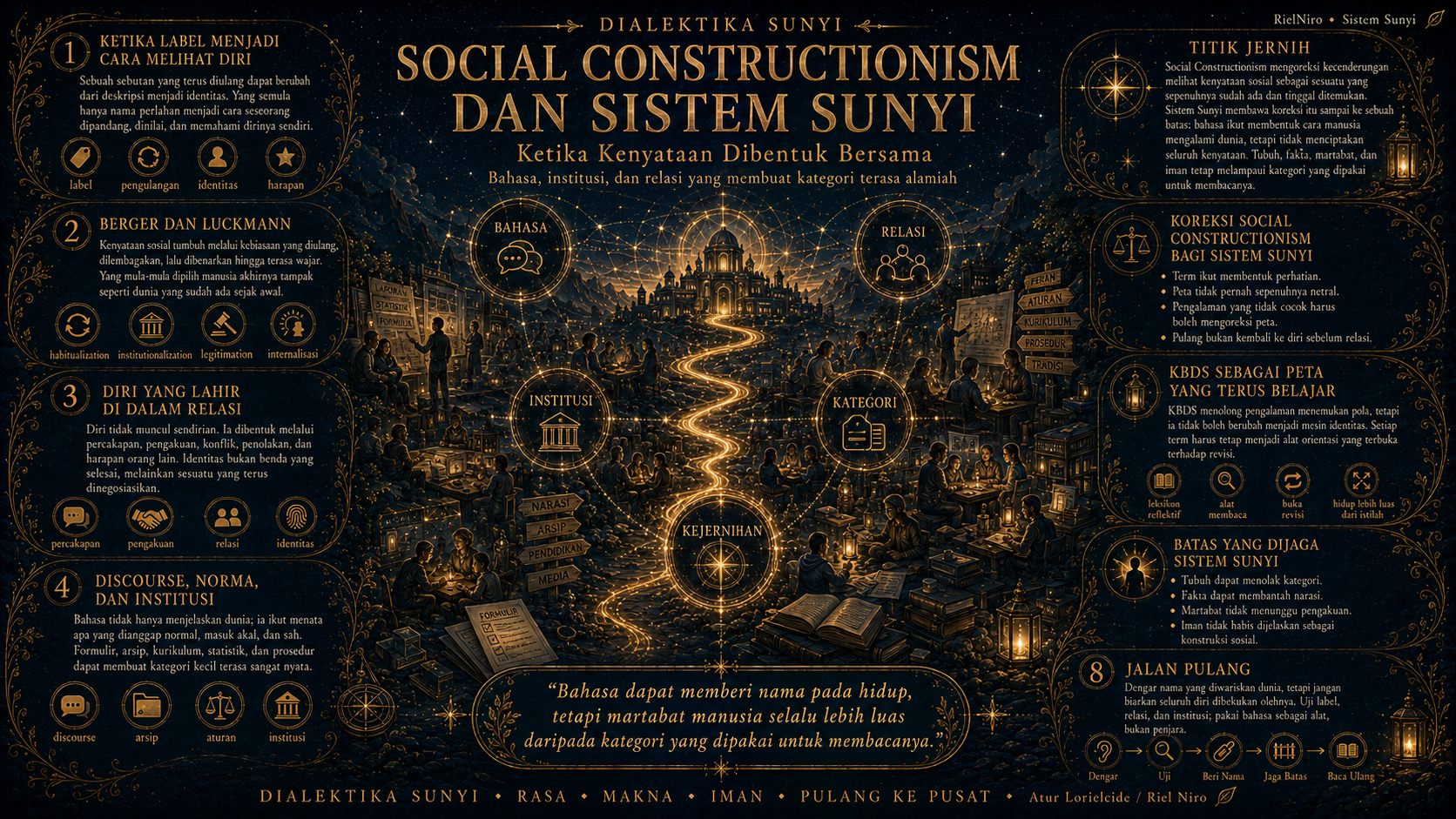
Social Constructionism begins here. It does not first ask whether an identity, emotion, or category is simply true or false. Its first questions are more basic: how does something come to be accepted as natural? How does a way of speaking become a way of seeing the world? Why do some definitions endure so long that it becomes difficult to imagine they ever had a history?
Social Constructionism therefore does not say that everything is merely created by language or social agreement. Bodies still suffer, death still occurs, poverty still has material consequences, and human experience retains dimensions that cannot be erased by changing a term. What it examines is how these experiences are named, arranged into categories, given meaning, and inherited as something that feels natural.
This question reaches directly into the conceptual home of The System of Silence. The language of the Center, Echo, the Inner Fence, distortion, Returning Home, and wholeness is used to read inner life. Social Constructionism reminds us that every language of interpretation carries the power to shape. A term does not merely help us see something already there; it also directs attention, determines what is regarded as important, and gradually shapes how a person comes to understand themselves. Language must therefore be treated with a responsibility equal to that owed to the experience it seeks to read.
Within the history of social thought, this question did not enter through one door. The sociology of knowledge had already shown that ways of understanding the world grow inside a shared lifeworld. Alfred Schutz helped reveal that before theory is written, people already inhabit habits, expectations, and everyday meanings that feel ordinary because they are shared.
Berger and Luckmann then traced how such ordinariness is built and inherited. Kenneth Gergen brought the inquiry closer to the self that emerges in relationship. Other currents turned toward discourse, normalization, and institutional power. These differences matter because Social Constructionism cannot be reduced to the claim that everything is merely language.
It must also be distinguished from constructivism. Constructivism often emphasizes how individuals build knowledge, while Social Constructionism more strongly asks how language, relationships, practices, and institutions provide the world of meaning within which individuals learn to know. The two can overlap, but they do not begin from exactly the same place.
Berger and Luckmann: How Reality Comes to Feel Ordinary
One of the most influential accounts of this process comes from Peter L. Berger and Thomas Luckmann. Social reality does not simply fall from the sky. It grows through human action repeated until it is no longer recognized as the result of choice.
Everything begins with habit. When a way of acting makes shared life easier, people tend to repeat it. Repetition reduces the need for constant deliberation. What was once consciously chosen begins to feel automatic. Berger and Luckmann call this process habitualization.
Personal habit alone is not yet enough to form social reality. Habit begins to acquire greater force when it is shared with others, passed on, and then institutionalized. This is where institutionalization takes place. A pattern of life is no longer followed merely because it is considered useful, but because “that is simply how things are done.” After that comes the next movement: legitimation. Society begins to build stories, theories, rules, traditions, and even moral explanations that make the institution appear valid and reasonable.
Behind these terms lies a longer movement. People place their actions into the world through habits and rules. Berger and Luckmann call this externalization. When the pattern is repeated, it begins to appear self-standing. It no longer feels like a human decision, but like a reality already there. This is objectivation.
Later generations are born into a world already organized. They learn names, roles, prohibitions, and expectations before they are old enough to ask who first shaped them. Social reality returns into consciousness through internalization. What human beings once made begins to make those who come after them.
In daily life, this process is almost invisible. Teacher, parent, leader, patient, good child, exemplary worker, or troubled person become categories that seem to have been available from the beginning. Berger and Luckmann call this typification: people build social types so the world can be navigated. Without them, every encounter would have to begin from nothing.
Trouble begins when a social type stops being an aid to orientation and becomes a substitute for the person. Someone is no longer seen as a life still unfolding, but as an example of a category decided in advance. The label precedes experience, and new experience is admitted only when it strengthens the label already in place.
A similar risk appears within The System of Silence. Orbits, terms, and inner maps do help reduce the obscurity of experience, just as typification helps human beings understand the social world. Yet that benefit always carries the possibility that categories may slowly come to feel more real than the life they are meant to read. Every term must therefore remain a signpost, not an identity that freezes a person in place. A map is made so that human beings can return to seeing their lives with greater clarity, not so that life must finally submit to the map.
That risk does not remain confined to inner life. Once a category is repeated and used collectively, it begins to acquire far greater institutional power. The repetition is not stored only in memory. Institutions preserve it in forms, archives, curricula, statistics, certifications, procedures, and systems of evaluation. A seemingly minor category can determine who receives services, who is considered eligible, and who remains unseen because their life does not fit the available boxes.
The power to name is therefore unevenly distributed. Not everyone can create an official category, reject a label, correct data, determine evidence, or change a rule. Some people continue living inside definitions made by others, not because those definitions are most truthful, but because institutions have the power to make them operative.
Yet criticism of institutions does not mean that every institution is merely oppressive. Forms, rules, and standards can protect fairness and coordination. The problem begins when devices meant to help life cease learning from the lives that do not fit within them.
The Self That Emerges in Relationship
If Berger and Luckmann show how society builds reality together, Kenneth Gergen moves attention closer to another question: where is the human self formed? The answer does not begin in an inner room fully separated from the world, but in relationships that continue across a lifetime.
In Gergen’s view, the self is not an object completed in advance and only afterward brought into relationship. On the contrary, human beings gradually come to recognize themselves through conversation, recognition, expectation, rejection, conflict, and the many forms of relationship they live through. What is called “I” always comes into being alongside the presence of “the other”. Identity is not merely something one possesses; it is continually negotiated.
This does not mean that people lose continuity or lack real inward experience. Bodies carry memory, experience leaves traces, and every life has its own continuity. Yet that continuity is understood through language and relationships already available. The way someone explains the self often echoes conversations that began long before words could be freely chosen.
A child continually treated as a source of trouble may learn to read the self through the language of trouble. A worker valued only when productive may begin to believe that worth depends entirely on output. Conversely, someone repeatedly entrusted may gradually grow into the courage to see the self as capable. Identity takes shape through relational repetition that is rarely noticed while it is happening.
Within the self, these conversations do not arrive as one voice. There is the voice of family teaching what is proper, the voice of school deciding who is intelligent, the voice of religion giving language to guilt and hope, the voice of class shaping what seems possible, and the voice of past relationships that continues speaking after the relationship has ended.
These voices do not always agree. Someone may feel called to move while also hearing inherited fear. A person may know they are capable while still carrying an older language that says they are not enough. A relational self is not an empty self, but a self learning which voices must be received, examined, or released.
The Center can still be understood as an orientation toward Returning Home, but The System of Silence does not read the path toward the Center as a movement unfolding in a vacuum. The way a person recognizes the Center has been shaped by family, culture, education, faith communities, everyday language, and even by those who have wounded or welcomed them. Returning Home to oneself does not mean returning to an essence that has never been touched by relationship, because such an essence may never truly have existed.
The Center need not be imagined as a pure self already complete before relationship. Yet The System of Silence does not reduce it to a product of discourse either. The Center can be understood as an orientation continually read amid the body, history, conversation, faith, and responsibility. Returning Home is not a return to a place the world has never touched, but the discovery of direction amid everything that has taken part in shaping us.
Language That Does More Than Describe the World
Once attention shifts toward relationship, language becomes larger than it first appeared. Language does not simply move experience from the mind into a sentence. Every word selects what deserves attention, what is ignored, who is given a place, and how an experience comes to be understood.
When someone is called firm, stubborn, traumatized, lazy, professional, or troubled, more than vocabulary changes. Each term carries a network of expectations, judgments, and social responses. A word becomes an action. It does not merely report reality; it helps arrange it.
Social Constructionism therefore gives great attention to discourse, the patterns of language, practice, and speech that live within a society. Discourse shapes which questions seem sensible, who is trusted, what counts as evidence, and which answers remain available. Medical, legal, religious, media, and family discourses do not build the same world.
The difference becomes clear when one experience moves from one discourse to another. Sadness may be read as a clinical symptom, a trial of faith, a weakness of character, or a fitting response to loss. The event remains, but its meaning changes because the language around it changes.
Discourse does not live only in sentences. It works through who may ask, who is treated as reasonable, what enters the archive, and which conduct is repeatedly examined. Michel Foucault helps show how knowledge can move with surveillance and normalization. An institution does not only describe a subject; through records, examination, and standards, it helps form the kinds of subjects it can recognize.
Language can open new rooms of understanding. Terms such as trauma, emotional labor, burnout, or coercive control help people name experiences that once remained obscure. Language gives a place to what was previously difficult to say.
Yet language carries an equal danger. When a term expands without limit, experience is forced into the same category. Every conflict becomes trauma. Every relationship becomes toxic. Every discomfort becomes a psychological disorder. Language stops explaining reality and begins replacing it.
A loop can form here. A label changes how others treat someone. Treatment changes the opportunities that remain available. Opportunity shapes behavior, and behavior is then taken as proof that the original label was right. Language appears merely to read reality, while part of the evidence it discovers has been created by the way that language works.
The System of Silence itself works through language. Terms such as the Center, Echo, the Inner Fence, distortion, and Returning Home do help us read human experience. Yet every term must remain conscious of its limitations. A term must never become the final destination of interpretation. It is only a window that helps life appear with greater clarity. When readers begin adjusting their lives to fit a term, instead of using the term to understand their lives, language has taken over the place that must continue to belong to reality itself.
How Something Comes to Feel Normal
Repeated language eventually shapes how society decides what is normal. Something is called normal not only because it occurs often, but because history, education, media, institutions, law, and habit keep teaching that this is how the world ought to work.
Normality is therefore not merely statistical. It is also the result of a long social process. Clothing, work rhythms, family forms, standards of success, and emotional expression change across periods without people noticing that the standards themselves have histories.
The word normal often merges measures that are actually different. There is normal as what happens most often, normal as what is judged good, normal as a professional standard, and normal as an administrative category. When these are blended together, numbers can disguise themselves as moral duties, while old customs appear as the only legitimate form of life.
Social Constructionism asks not only who fits a standard, but how that standard was born, who benefits from it, and who must keep adjusting in order to be considered worthy.
The question of normality needs to remain open without turning every norm into a suspect. In the reading of The System of Silence, some norms are necessary for shared life to remain possible. What must be examined is not the existence of norms themselves, but whether they still protect human dignity or instead make some people lose the room to live as themselves.
When a Name Begins to Change Experience
One of language’s greatest powers is its ability to change how people experience themselves. Once an experience receives a name, it is no longer only felt; it begins to be understood through the network of meaning carried by that name. What changes is not only how others see us, but how we interpret the life already lived.
Diagnosis shows this process clearly. For many people, diagnosis brings relief because an explanation finally becomes available. Guilt lessens, patterns appear, and access to help becomes possible. At the same time, diagnosis also begins to shape how someone reads the past, interprets the body, and even imagines the future. Experiences that once seemed separate are reorganized through a new language.
This does not mean that diagnosis is merely a social construction. Illness, disorder, and biological conditions do not disappear when terminology changes. Social Constructionism reads another layer: how a society chooses categories, how those categories are used, who gains access through them, and when a term stops explaining and becomes an identity that closes other possibilities.
Ian Hacking helps explain that a category does not stop working once it is given. A category is created, people are recognized through it, and people respond. That response can change conduct, speech, expectation, and the services required. The category itself may then be widened, narrowed, or strengthened. Name and experience continue changing one another.
Clinical diagnosis, administrative category, self-diagnosis, social label, popular language, and KBDS term therefore cannot be placed at the same level of authority. Clinical diagnosis has procedures and a role in care. Administrative categories open or close access. Popular terms support conversation, while KBDS terms work reflectively. When these functions blur, language can claim authority it does not possess.
The same phenomena appears in popular language. Terms such as toxic, trauma, healing, trigger, or narcissistic help people name what was once difficult to understand. Yet the success of a term often carries it far beyond its original boundary. Language meant to clarify begins to simplify reality.
KBDS must therefore guard the boundary against diagnostic function. The System of Silence treats every term as a reading tool, not a verdict about who someone is. A term should reveal a pattern that was difficult to see, not close a life inside a definition that can no longer be questioned.
Success Also Has a History
The same process appears when society defines a successful life. Many people believe they are pursuing private aspirations, while the measure of success has long been shaped by family, education, media, markets, and work culture.
Work is the clearest example. In many modern societies, identity is introduced through profession. The first question is often not how someone lives, but what they do. Work slowly stops being one part of life and becomes the main language through which worth is judged.
This way of seeing appears so ordinary that it is rarely questioned. Position, productivity, income, and reputation come to look like objective measures. Yet this entire arrangement also has a social history. It has been built through economic institutions, education, and culture, all of which continue to connect success with particular forms of life.
As a result, many other forms of work lose visibility. Caring for family, building community, accompanying the sick, or sustaining relationships are treated as personal obligations rather than work worthy of recognition. What changes is not only the distribution of reward, but the way people understand their own lives.
Karya-Only Philosophy meets Social Constructionism’s correction at this boundary. The System of Silence continues to see work as one path through which people bring meaning into the world, but the value of work cannot be determined entirely by market logic. Social language about productivity must remain open to examination so that work does not lose its human dimension merely because society’s measures have changed.
The correction must go further. Not everyone has equal room to choose a profession, refuse promotion, slow a rhythm, or work without being visible. Some can place quality before visibility because life is secure enough. Others must keep appearing, moving quickly, and explaining their value because today’s income decides whether tomorrow remains possible.
Karya-Only Philosophy is a canonical concept of The System of Silence in Orbit III. It does not glorify productivity or claim that people are worthy only when producing. It reads work as inner discipline: silence before movement as precision, focus that does not constantly seek a stage, and dedication that places quality before the need to prove oneself.
Social Constructionism reveals the social conditions that make quiet work possible. Karya-Only Philosophy keeps the value of work from being equated with price and prevents recognition from taking over the function of the Center. Their dialogue keeps market critique from erasing responsibility for quality, while preventing inner discipline from hiding class, economic need, and care work made invisible.
A World Built Through Repetition
In the time of Berger and Luckmann, reality was shaped mainly through family, school, institutions, and mass media. Today that process has acquired a much faster machine: digital algorithms.
Media never merely photograph the world. They select what deserves reporting, order attention, repeat certain themes, and slowly build an impression of what matters. Algorithms intensify the process by arranging a different world for each user.
What appears on a screen is not merely a reflection of private interest. Previous choices are used to shape later choices. Attention is directed toward information most likely to sustain engagement. The longer someone remains inside the pattern, the more natural that world begins to feel.
Categories of success, beauty, danger, identity, and fear are no longer inherited only through family or school. They are produced daily through images, statistics, comments, recommendations, and measures of popularity. What appears often begins to look like the most common reality, even when it may simply reflect platform distribution.
Platforms do not only select what appears. They classify users, build profiles, predict conduct, and place people inside commercial categories they rarely see. Those categories then shape recommendations, advertising, information order, and the worlds repeatedly placed before them.
The loop moves quickly. Choice produces a profile. The profile produces recommendations. Recommendations reinforce habit. Habit is then read as proof that the original profile was correct. People slowly inhabit a predictive image produced by a system while continuing to feel that every choice came only from within.
The Ecology of Silence expands this reading. Attention hygiene cannot be reduced to an individual ability to resist distraction. Digital environments help shape the kinds of attention people can sustain. Personal discipline matters, but it must stand beside awareness of technological design, business models, and economic structures that systematically produce noise.
Construction Is Not the Same as Illusion
This is where Social Constructionism is most often misunderstood. Many people hear the term social construction and immediately conclude that something constructed cannot be truly real. Yet the point is almost the opposite. Many things built socially can have consequences far more tangible than the physical objects surrounding us.
Money, law, citizenship, institutions, positions, degrees, and reputation developed through social agreement across history. None is a law of nature. Yet no one can live as though they were merely fiction. Social constructions organize access to education, work, health, safety, and the possibility of living with dignity.
The same is true of race, gender, class, and disability. The ways societies build these categories have long histories, but their consequences take material form in human bodies. Constructed does not mean without consequence; precisely because something becomes shared reality, it can shape a life.
Material reality, social reality, institutional reality, and social meaning therefore need to be distinguished without being absolutely separated. A category may not be biological, yet its effects enter the body through wages, housing, stigma, services, and safety. Conversely, bodies and material facts can limit stories a society wants to preserve.
This lesson expands the reading without erasing the boundaries of reality. The System of Silence affirms that language shapes how people read the world, but the world is never completely obedient to language. Bodies can resist definitions. Facts can challenge simplified narratives. Experience can exceed the terms used to explain it.
The task of a reading system is not to replace reality with categories, but to let categories remain answerable to the reality they seek to read. When the map begins to think it matters more than the territory, reading loses its own clarity.
Language Shapes Us, but Does Not Own Us
If Social Constructionism ends by saying that all life is only the result of language and social relations, people lose the ground from which to act. If identity is imagined as arising purely from within, untouched by history, culture, or institutions, people also fail to understand how the world has shaped them. A clearer path emerges precisely when both are held together.
People enter a world already filled with names, categories, rules, and expectations. No one chooses a first language, the social classification of identity, or the stories that existed before birth. Yet people are not passive products. They can reinterpret, refuse, widen, and build new ways of living together.
Personal responsibility does not disappear simply because social reality is shaped collectively. On the contrary, precisely because human beings help sustain the world through words, habits, and everyday relationships, every action carries weight beyond itself. The way a person names things, listens to others, uses terms, or responds to experience helps determine the social reality being built.
Yet the ability to refuse is not equally distributed. Legal status, class, health, social networks, and institutional access determine how costly it is to reject a category. Agency remains, but its room can be widened or narrowed by the social world.
Personal responsibility must therefore not become language for blaming victims. A person cannot be required to confront alone a definition maintained by law, economics, data, and powerful institutions. Support, protection, and collective action are often needed before the choices morally demanded become genuinely available.
At the same time, social explanation does not erase consequences. Culture, identity, and discourse can help explain why someone acted, but they do not automatically remove responsibility for harm. People are shaped, and they also continue shaping.
Dignity That Does Not Wait for Recognition
Social Constructionism reminds us that social recognition has concrete consequences. Categories can open or close education, work, legal protection, health care, and opportunities to speak. Changes in language and institutions are not cosmetic; they alter lives.
Sometimes injustice appears through something small. A form provides no fitting option. A service refuses support because a life has no administrative category. A relationship is not recognized by law, or suffering is treated as unreal because public language has not learned to name it. A mismatch between life and definition becomes a loss of protection.
At this boundary, The System of Silence stands firm. Human dignity must not depend entirely on social recognition. If a person’s worth exists only when society acknowledges it, anyone excluded from a legitimate category will lose the ground on which to remain standing.
Here inward reading has a place. Language can shape how someone is treated, but it does not fully determine who that person is. Social recognition matters, yet dignity is not created by recognition. Dignity is precisely why just recognition must continue to be pursued.
The System of Silence holds this tension without sacrificing either side. Inner dignity alone can make social change appear unnecessary. Conversely, depending entirely on social legitimacy can make people lose something deeper than public acceptance. Dignity and the struggle for just recognition need to keep moving together.
Faith, Language, and Reality Beyond Words
Religion itself shows how language and reality meet without negating one another. Every faith tradition is passed down through scripture, liturgy, symbols, interpretations, rituals, and communities. All of these are real forms of social construction. The way human beings speak about God is always shaped by the history and culture in which that language developed.
Tradition therefore cannot be named a social construction and considered finished. It can be a home of memory, a language joining generations, a space of belonging, and a path toward depth. Yet the same home can carry hierarchy and interpretations that make some experiences difficult to speak. Tradition must be honored as a home and opened as a field of examination.
For believers, relationship with God does not end with the language used to describe it. Language is an entrance, not the destination. It enables people to share faith, but never fully possesses the reality it seeks to express.
The critique of religious language reaches an important territory in this dialogue. The System of Silence opens itself to an examination of how language can be used to preserve power, shame, or unhealthy hierarchies. Yet it stands firm against the simplification that all religious experience is merely a product of discourse. Language does shape how human beings understand faith, but faith cannot be fully explained by language alone.
Epistemic Boundaries gain their meaning in this territory. What must be examined is not only the content of belief, but the ways people speak about belief. Human interpretation remains limited even when it speaks of what is believed to exceed the human.
KBDS as a Map That Keeps Learning
The conversation finally returns to the language used by The System of Silence itself. KBDS helps readers discover hidden patterns, connect experiences that seem separate, and find orientation when life feels obscure.
Kamus Besar Dialektika Sunyi (KBDS) is not merely a list of terms. It is an independent reflective lexicon and an ecosystem for reading meaning, connecting terms, conceptual families, comparisons, maps, Kompas Pulang, and permanent term pages. These doors help readers move from quick orientation toward a fuller examination of experience.
Social Constructionism reminds us that every system of terms has power to shape how readers understand themselves. The more complete a dictionary becomes, the greater the temptation to imagine that life can finally be mapped in full. At that point, a map becomes dangerous.
The architecture of terms is never completely neutral. Decisions about names, boundaries, conceptual families, relations among terms, and paths of reference shape what readers can easily see. The more complete the system, the greater its power of categorization, even when its first intention is only to help.
KBDS must keep asking uncomfortable questions: who gives names, which experiences remain outside, whether a term truly reads a distinct mechanism, and whether relations among terms deepen clarity or simply multiply routes toward labels.
At the same time, KBDS must not become an identity machine. Every term must remain a reading tool open to revision. Experience has the right to exceed the language used to explain it. When life no longer fits an available category, what should be examined first is not the life, but the map.
Humility becomes necessary precisely because language has power. The System of Silence does not seek to build a dictionary that closes every possible reading of the human being. It builds a space that helps readers see life more clearly without losing the freedom to continue growing.
KBDS becomes a map that keeps learning when experience can correct its architecture, redundancy is examined, similar mechanisms are distinguished, and terms are returned to their original function as reading tools. Linguistic humility is not lack of firmness. It is the courage to revise a map when the territory reveals what the map has not yet seen.
What Social Constructionism Requires of The System of Silence
Social Constructionism requires The System of Silence to acknowledge that the Center does not stand outside language and relationship. The ways people recognize inward direction have been shaped by family, education, faith communities, class, culture, and conversations that came before them.
It also requires awareness that terms do not merely discover experience. Orbits, maps, and categories make some experiences more visible, give names to particular differences, and guide readers toward particular paths of interpretation.
Returning Home therefore must not mean returning to a self that existed in full before relationship. KBDS must not be treated as a neutral architecture. And experience that does not fit must retain the right to correct the map, rather than being forced to admit that life itself is what has gone wrong.
This correction does not ask The System of Silence to abandon its language. What it demands is responsibility for the shaping power that appears whenever that language is handed on to readers.
What The System of Silence Adds to Reading Language and Social Reality
Language shapes without creating all reality. The System of Silence preserves this boundary because bodies can resist categories, facts can challenge narratives, and experience can exceed even the most carefully made term.
The Center is not a pure self before relationship, but neither is it merely an effect of discourse. The Inner Fence gives people room to hear the names society provides without immediately surrendering the whole self to those names.
The Ethics of Feeling tests not only whether a term can explain, but where it leads. Does it open honesty, protect dignity, widen responsibility, or provide a new reason to avoid reality?
Dignity does not wait for recognition, agency remains even when uneven, and faith is not exhausted by social construction. These boundaries keep the person from disappearing inside the categories used to read them.
When All Reality Is Treated as Only Language
Social Constructionism loses clarity when construction is equated with fiction. It then becomes easy to imagine that facts are only narratives, bodies are only texts, and consequences can be changed simply by replacing words.
Clarity also disappears when every category is treated as equally arbitrary. Clinical diagnosis, safety rules, propaganda, administrative categories, and reflective terms do not share the same basis, function, or consequences.
Responsibility can disappear when people are treated only as products of discourse. Social explanation is then used to close the room for choice, regret, change, and accountability.
Identity can be imagined as entirely fluid, critique of norms can become rejection of all standards, the language of justice can be used to end examination, religion can be reduced to social function, and KBDS can be imagined capable of mapping all life.
Reading these distortions does not mean restoring old categories as laws of nature. The aim is to keep critique open to bodies, facts, consequences, dialogue, and the possibility that even liberating language can become a new place to hide.
When Reality Is Made Together
Social Constructionism asks us to see that the human world is born among conversations, habits, institutions, and histories handed from one generation to another. What feels most natural is often the result of repetition so long that its beginning has been forgotten.
At this final boundary, language does not merely describe experience. The System of Silence acknowledges that language helps decide which experiences can be recognized, which receive a place, and which remain without a name. Every term therefore requires responsibility, not only definitional precision.
Human beings do not live entirely inside language. The System of Silence affirms that bodies can resist the categories imposed upon them, facts can challenge simplified stories, and dignity carries weight before society succeeds in recognizing it. For believers, the deepest reality is also never fully exhausted by words.
In the end, the question raised by Social Constructionism is not whether reality is constructed or discovered. What matters more is how human beings live responsibly within a reality that is always being shaped together. We receive language from the world before we are born, but we also pass language on to the world that will come after us. Between these two movements, human beings continue to help determine what kind of reality will ultimately become our shared home.
Dialektika Sunyi (Format 2) adalah ruang dialog antara Sistem Sunyi dan dua puluh empat rumah pemikiran dari berbagai tradisi filsafat, psikologi, etika, teologi, dan pemikiran sosial. Dua puluh empat tulisan ini tidak disusun untuk menjadikan tradisi-tradisi tersebut sebagai bagian dari Sistem Sunyi, melainkan untuk mempertemukan cara pandang yang berbeda agar manusia dapat dibaca dari lebih dari satu pintu.
Sistem Sunyi tidak datang ke dalam dialog dengan rumah yang kosong. Ia sudah membawa cara membaca sendiri: Rasa perlu didengar tanpa segera dijadikan kebenaran, Makna tidak dipaksakan kepada luka, Iman memberi arah tanpa menjadi jawaban instan, dan manusia tidak dapat dihabiskan oleh satu istilah atau satu peta.
Karena itu, setiap rumah pemikiran hadir sebagai ruang dialog yang tetap memiliki bahasa, sejarah, pertanyaan, dan batasnya sendiri. Dialektika Sunyi bukan upaya membuktikan bahwa dua puluh empat tradisi tersebut pada akhirnya mengatakan hal yang sama dengan Sistem Sunyi.
Mengapa dua puluh empat rumah pemikiran?
Karena manusia terlalu luas untuk dibaca melalui satu lensa. Penderitaan dapat hadir sebagai pengalaman batin, pola tubuh, relasi, cerita diri, bahasa, kondisi sosial, struktur kuasa, sejarah, iman, maupun perubahan kehidupan. Satu lensa dapat membuka sesuatu yang penting, tetapi selalu ada wilayah yang berada di luar jangkauannya.
Dua puluh empat rumah pemikiran karena itu membuka percakapan dari berbagai arah. Membuka pintu tidak berarti meninggalkan rumah. Setiap tradisi tetap dibaca sebagai rumahnya sendiri, sementara Sistem Sunyi membiarkan perjumpaan itu memperluas cara melihat tanpa kehilangan batasnya.
Di dalam panel ini, dua puluh empat tulisan dibagi menjadi tiga bagian: Peta I, Peta II, dan Peta III. Ketiganya adalah pembagian navigasi untuk membantu menemukan delapan rumah pemikiran pada masing-masing bagian.
Sebelum masuk ke daftar, dua ruang berikut dapat digunakan untuk melihat keseluruhan Dialektika Sunyi dalam skala yang lebih luas:
Atlas Dialektika Sunyi
24 Percakapan, 24 Peta Pembacaan
Ruang orientasi publik untuk menjelajahi dua puluh empat tradisi yang berdialog dengan Sistem Sunyi tanpa kehilangan rumah pemikirannya masing-masing.
Peta Pengetahuan Dialektika Sunyi
Dua Puluh Empat Rumah. Tidak Ada yang Dilebur Menjadi Satu.
24 Rumah Pemikiran · 20 Kejernihan · 25 Pintu Kehidupan
Ruang untuk melihat bagaimana dua puluh empat tradisi dipertemukan dengan Sistem Sunyi tanpa penyerapan, kemenangan, atau sintesis yang lebih tinggi.
Peta ini hanya membantu menemukan jalan. Pembacaan sebenarnya terjadi di dalam masing-masing tulisan, ketika satu rumah pemikiran dibuka dan dialognya dengan Sistem Sunyi mulai berlangsung.
Paket I bergerak paling dekat dengan pengalaman personal, tetapi tidak membiarkan batin menjadi dunia yang tertutup. Kendali bertemu keadaan, perhatian bertemu makna, kedekatan membawa sejarah relasi, kebebasan berhadapan dengan keterbatasan, dan keheningan diuji oleh doa serta kehidupan yang kembali dijalani.
- Ketika keteguhan tidak berarti mematikan rasa
- Ketika hadir belum berarti memahami
- Ketika hidup tidak hanya meminta penjelasan, tetapi jawaban
- Ketika kebutuhan akan tempat aman ikut membentuk cara manusia mencintai
- Ketika hidup tidak menyediakan kepastian yang dapat memilih atas nama manusia
- Ketika bagian diri yang tidak disadari ikut membentuk cara manusia melihat kenyataan
- Ketika bahasa iman belajar mengakui Tuhan tanpa menjadikan misteri sebagai tempat bersembunyi
- Ketika keheningan di hadapan Tuhan kembali menjadi kasih, kerja, batas, dan tanggung jawab
Paket II memperdalam pertanyaan tentang bagaimana pengalaman sebenarnya terbentuk. Apa yang terasa tidak hadir tanpa tubuh. Apa yang dipahami tidak lahir tanpa bahasa. Agency mempunyai lingkungan. Care mempunyai distribusi beban. Makna dan keyakinan memperoleh ujian ketika mereka meninggalkan jejak dalam kebiasaan, tindakan, dan dunia bersama.
- Ketika kenyataan perlu diberi ruang sebelum kesimpulan mengambil alih
- Ketika tubuh, kebiasaan, alat, relasi, dan dunia ikut membentuk cara manusia memahami dan memilih
- Ketika rasa sakit tidak harus hilang sebelum manusia bergerak menuju yang bernilai
- Ketika motivasi dibaca melalui autonomy, competence, relatedness, dan mutu alasan untuk bergerak
- Ketika kisah hidup memberi arah, tetapi tidak berhak menjadi seluruh kenyataan
- Ketika bahasa, sejarah, tradisi, dan kuasa ikut menentukan apa yang dianggap sebagai kebenaran
- Ketika kebutuhan, dependency, kerja perawatan, kompetensi, dan pembagian beban menjadi persoalan moral
- Ketika gagasan diuji melalui kebiasaan, penyelidikan, konsekuensi, komunitas, dan revisi
Paket III membawa pembacaan ke kondisi yang membuat sebagian pengalaman dipercaya, sebagian dinormalkan, dan sebagian bahkan sulit memperoleh bahasa. Struktur dan sejarah masuk lebih jelas, tetapi manusia tidak dibiarkan menghilang di dalamnya. Karena itu Systems Thinking bertemu Virtue Ethics, Liberation Theology bertemu batas praxis, dan Process Philosophy menutup paket dengan kehidupan yang terus menjadi tanpa kehilangan tanggung jawab.
- Membaca penderitaan di antara batin, ideologi, institusi, ekonomi, dan distribusi kuasa
- Ketika pengetahuan dibentuk oleh posisi, tubuh, bahasa, kredibilitas, dan relasi kuasa
- Bahasa, institusi, dan relasi yang membuat kategori terasa alamiah
- Sejarah, bahasa, representasi, dan kuasa di balik hak untuk menjelaskan manusia lain
- Membaca pola, feedback, penundaan, batas sistem, dan perubahan yang tidak pernah berdiri sendiri
- Karakter, kebiasaan, emosi, teladan, dan kebijaksanaan praktis dalam kehidupan sehari-hari
- Ketika doa, kasih, keselamatan, dan kitab diuji oleh kemiskinan, penindasan, serta tindakan pembebasan
- Identitas, relasi, waktu, dan Pusat yang bertahan tanpa membeku menjadi bentuk final
Atur Lorielcide berjalan di antara kata dan keheningan.
Ia menulis untuk menjaga gerak batin tetap terhubung dengan pusatnya.
Melalui Sistem Sunyi, ia mencoba memetakan cara pulang tanpa tergesa.
Lorong Kata adalah tempat ia belajar mendengar yang tak terlihat.
Baca juga: Dua Ruang, Satu Sunyi: Jejak Atur Lorielcide alias Rielniro