
 Tulisan ini bagian dari sistem kesadaran reflektif
Colonialism does not end when a territory gains political independence. It can continue through language treated as scientific, history taught as the only legitimate version, traditions reduced to folklore, and the ways people learn to see themselves through standards that came from elsewhere.
Imagine someone who comes to know their own society mainly through books written by outside observers. Their tradition is considered interesting because it appears exotic, yet is rarely treated as serious enough to become a source of theory. The language they speak every day is judged too local to explain larger questions, while language coming from academic centers is assumed to possess greater explanatory authority. Slowly, this person learns to see themselves through the eyes of others before having the chance to discover a language of their own.
An experience like this shows that colonialism leaves traces not only in territory, government, or economy. It also shapes how the world is understood. What is inherited is not merely the boundary of a state, but boundaries governing who is believed, who is regarded as capable of producing knowledge, and who is considered fit only to become an object of explanation.
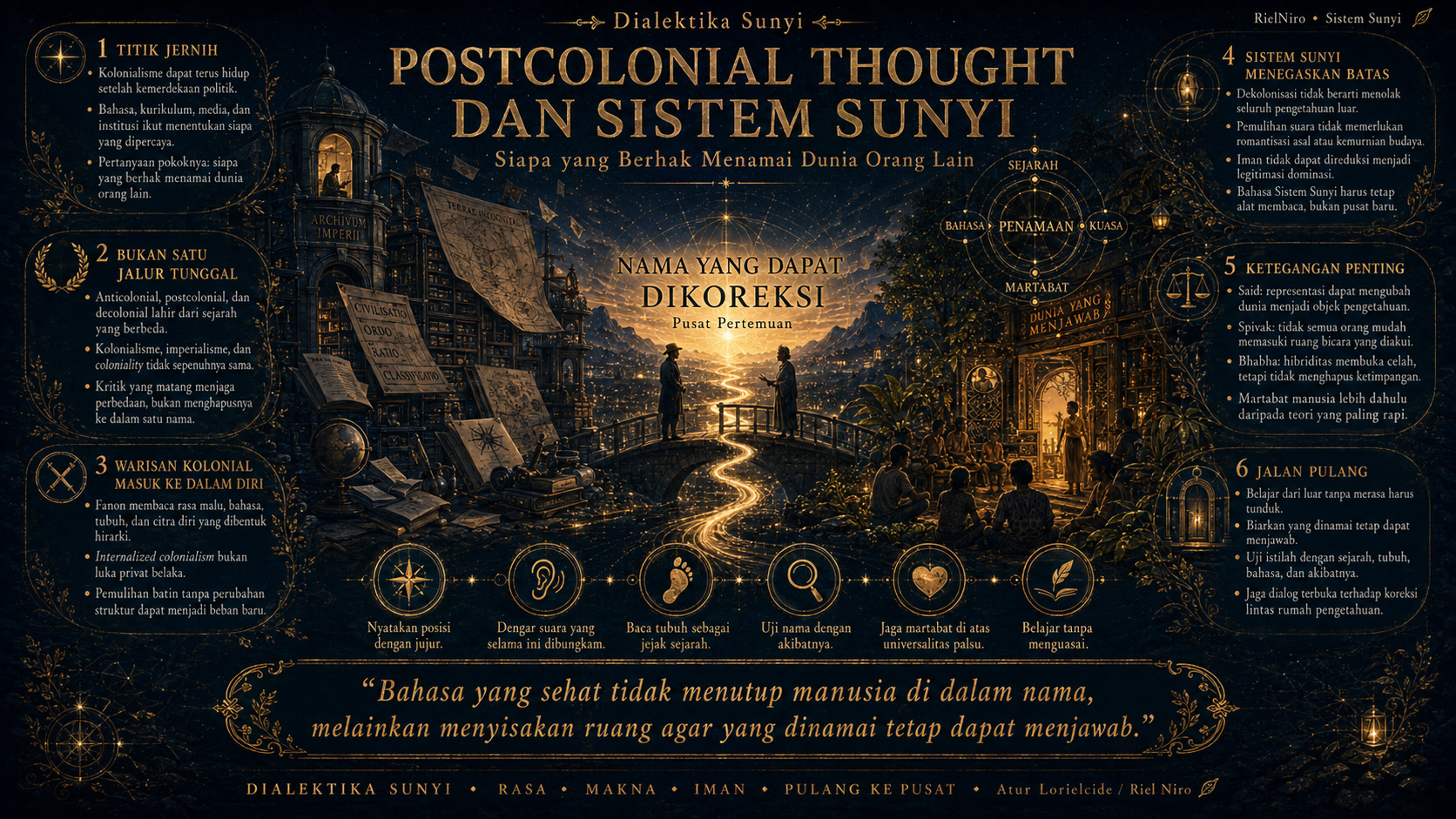
Postcolonial Thought begins its reading here. Its central concern is not only the history of colonization as a political event, but the inheritances that continue to work long after formal colonial rule has ended. Language, education, media, curricula, institutions, and even the ways people regard themselves can continue to carry older hierarchies without ever naming themselves colonial.
The question raised by Postcolonial Thought is therefore not simply who once colonized whom. Its question goes deeper: who still has the authority to determine what counts as universal, which languages are granted authority, whose experience becomes the measure of the human, and who continues to be positioned as someone who can only be explained by others.
This question of unequal standing enters directly into the conceptual home of The System of Silence. The System of Silence has grown through encounters with many traditions of philosophy, psychology, theology, social thought, and spirituality. Postcolonial Thought reminds it that not every tradition enters conversation from the same position. Some forms of thought are accepted as theory from the beginning, while other experiences must first be translated before they are considered worthy of being heard.
That awareness does not require The System of Silence to stop entering dialogue. It protects encounter from turning into a subtle form of appropriation, in which a tradition is allowed to remain only insofar as it can speak in the language of the more powerful house.
Anticolonial, Postcolonial, and Decolonial Thought Are Not One Path
The terms anticolonial, postcolonial, and decolonial are often used as though they referred to the same tradition. Yet each arose from different histories, experiences, regions, and intellectual pressures. Treating them as one may simplify conversation, but it also removes distinctions that matter to the way each understands colonialism.
Anticolonial thought grew amid struggles against colonization that were still unfolding. It spoke from concrete political experience: resistance to domination, the struggle for independence, refusal of assimilation, and the effort to rebuild the dignity of colonized peoples. This path lived within struggles across Africa, Asia, the Caribbean, and many other regions that did not always use the same theoretical language.
Aimé Césaire helps reveal how the language of civilization can conceal dehumanization. Colonialism does not damage only those who are colonized. It also trains the colonizer to see other people as functions, labor, territory, or raw material. When violence is called education and domination is called progress, language begins to operate as a moral veil.
Postcolonial Thought developed through the examination of colonial inheritances after formal rule had ended. Much of its attention moved through literature, history, language, representation, education, identity, and institutions that continued to reproduce the division between center and margin.
Decolonial approaches have a different genealogy. They developed largely through Latin American experience and through readings of modernity and coloniality. Their focus is not only colonial inheritance in culture, but the patterns of power, knowledge, race, labor, economy, and life that were formed together with the emergence of the modern world.
Colonialism, imperialism, and coloniality are also not identical. Colonialism refers to direct rule over territories and peoples. Imperialism can operate through the extension of political, economic, or cultural power. Coloniality names patterns of classification and hierarchy that endure even after colonial government has ended.
Distinguishing these paths is not merely an academic exercise. The distinction protects critique from repeating what it seeks to oppose: erasing different histories into a single name that is assumed capable of explaining them all.
The System of Silence must preserve the same sensitivity. The closeness of themes does not automatically mean sameness of interpretation. Dialogue becomes richer when every tradition is allowed to carry its own history, wounds, language, and questions.
Frantz Fanon and Colonialism Entering the Body
For Frantz Fanon, colonialism is not only a political system that controls territory. It is also an experience that gradually enters the body, language, and image of the self. Domination becomes deeply rooted when people begin seeing themselves through standards created by those who rule them.
This experience does not always appear as visible violence. It can emerge as shame toward one’s mother tongue, the desire to distance oneself from one’s own culture, or the belief that one’s value rises by becoming more like standards arriving from elsewhere. What changes is not only social condition, but a person’s sense of what it is possible to become.
The body is then read through hierarchies already in place. Skin color, facial features, hair texture, accent, name, clothing, and manner of movement can become signs continually reminding a person of the position assigned to them. Fanon shows how social judgment can cling to the surface of the body until the body seems to speak before the person has had the chance to say anything.
Language carries a similar pressure. Mastering the language of those in power can open access to education, work, and recognition, yet it can also produce the desire to be accepted as a person closer to the center. The problem is not the ability to speak another language, but the moment one language becomes the measure of intelligence, maturity, and human worth.
This condition is often described as internalized colonialism. Yet the term must not make colonial injury appear to be a private psychological problem. Hierarchies do not move into the self by themselves. They enter through schools, law, economy, media, spatial arrangements, social life, and forms of recognition that repeatedly declare who is considered higher.
Decolonization for Fanon therefore never ends with a change of government. Political liberation does not automatically bring psychological liberation, and the independence of a state does not always mean the independence of imagination. A postcolonial elite can inherit old institutions, standards, and styles of power while governing beneath a new flag.
This correction reaches directly into the way The System of Silence reads inward experience. Shame toward one’s origins, language, body, or identity can indeed be lived as an inward experience. Yet The System of Silence refuses to separate that experience from the long history that continues to work through education, media, economy, and social recognition.
The Homeward Path therefore cannot consist only of changing the way a person speaks to themselves. Inner restoration that separates injury from structure can leave someone feeling like a failure for being unable to heal something the surrounding world continues to reproduce.
Returning Home is also not a return to a self untouched by history. Returning Home means recovering the ability to see oneself without surrendering the value of one’s life to eyes that regarded it as lesser from the beginning, while still having the courage to change the world that continues to reproduce that gaze.
Edward Said and Who Has the Right to Describe the World
If Fanon shows how colonialism enters the self, Edward Said asks us to see how colonialism works through the ways the world is described. The relationship between West and East was built not only through trade or political power, but through stories, scholarship, archives, education, and administration that determined how the East could be known.
Through the concept of Orientalism, Said shows how the East was repeatedly portrayed as exotic, emotional, mystical, irrational, passive, or in need of guidance. This repetition did more than create an image. It formed an imaginative geography in which one region became the center of reason and another became an object in need of explanation.
The question is not whether every Western writer intended harm. The issue is a pattern of representation supported by academia, literature, administration, media, museums, and policy. When many institutions repeat the same image, representation begins to feel like reality that no longer needs examination.
Knowledge then organizes distance. One side receives the right to observe, classify, preserve, and explain. The other becomes a field of research, a source of objects, material for archives, and a body that can be read without always receiving the right to correct that reading.
Representation has consequences far beyond academic life. When a society is repeatedly understood as incapable of governing itself, intervention, surveillance, and even domination become easier to regard as reasonable. Language no longer merely describes reality. It helps prepare the conditions for political action.
Said’s critique is therefore not a prohibition against outsiders writing about another tradition. Such a prohibition would deprive the world of possibilities for learning. What must be examined is the structure of authority: whether a writer discloses their position, leaves room for correction, recognizes the archives shaping their view, and allows those being represented to remain subjects of knowledge.
Said’s lesson matters to The System of Silence. The closeness of ideas does not grant the right to absorb the whole experience of a tradition into one’s own language. Two traditions can address one another without being forced to say the same thing. Respecting difference is often a more honest form of dialogue than searching for similarity at every opportunity.
Similarity must not make a tradition lose its own house. Discovering a similar echo does not mean erasing the history, context, or difference that gives that tradition its life.
Spivak and the Voice That Is Always Translated
The question does not end with who describes the world. Gayatri Chakravorty Spivak asks something more difficult: what if someone has already spoken, but the world has no way of hearing them?
Through her discussion of the subaltern, Spivak shows that some groups do not merely lack a stage. They stand outside structures of representation that determine who can be recognized as speaking. Their voices remain. What is missing is a channel through which those voices can be acknowledged as knowledge.
The claim that the subaltern cannot speak must therefore not be read as saying that they lack language, will, or testimony. The issue is that dominant structures can receive the sound of their voices without recognizing those voices as statements carrying authority.
Spivak also distinguishes the question of speaking for someone from the question of representing someone. Both can become necessary, yet both carry risk. Political representation can turn into appropriation, while conceptual representation can arrange another person’s life into categories more easily accepted by the center.
The matter is not merely one of giving someone an opportunity to speak. It also concerns who translates the experience, which language is used, and whether the experience still belongs to the person who lived it after being translated into academic, legal, media, or political categories.
Spivak names this risk epistemic violence. Such violence often occurs without physical coercion. It appears when a person’s experience can be accepted only after being rearranged according to the language of the more powerful party.
Even a phrase such as giving voice can conceal a new form of power, as though the voice came into existence only after someone else granted a stage. What matters more is examining why particular testimony has not been believed, which categories have made it unreadable, and what must change so that it no longer depends upon the same translator.
Listening does not mean ceasing to speak. The System of Silence carries Spivak’s lesson into a discipline of reading: speaking about another person’s experience always requires humility, openness to correction, and a willingness to acknowledge that not every experience can be translated in full by an outsider.
Bhabha and Identity That Is Always Moving
If Fanon speaks extensively about injury, Said about representation, and Spivak about voices that go unrecognized, Homi K. Bhabha invites us to examine spaces of encounter that are never entirely stable.
Colonialism did not produce only two completely separate sides. It also created spaces in which imitation, adaptation, resistance, and mixture continually unfolded. These spaces were not free from power, yet they could never be fully controlled by those who held power.
Through the concept of mimicry, Bhabha shows that colonized peoples were often encouraged to become almost the same as the colonizer, but were never truly regarded as equal. They were asked to master the center’s language, manners, education, or modes of thought while being continually reminded that resemblance would never be enough.
Such imitation carries ambivalence. It can reinforce colonial standards by compelling people to conform. Yet it can also unsettle power, because repetition never produces a perfectly obedient copy. Shifts, irony, and new possibilities emerge within the very act of imitation.
The concepts of hybridity and the third space help us see that identity almost always arises through encounter. Languages mix, traditions influence one another, religions meet cultures, and ways of life change through long histories of interaction.
Yet Bhabha also reminds us that mixture does not always arise from equal relations. Many forms of hybridity emerge through pressure, negotiation, forced displacement, and even violence. A hybrid identity therefore must not be celebrated as though it had, by itself, resolved material injustice.
The System of Silence does not make wholeness dependent upon purity. A person can still possess an integrated Center even when their identity has been shaped by many languages, traditions, and life experiences.
The Center does not command a person to discard every mixture in order to discover an original self. It protects the capacity to choose, establish boundaries, and remain responsible for the direction of one’s life within encounter.
By contrast, pursuing purity of identity often freezes history and refuses a reality that is always moving. Purity can become a False Center when it promises security by expelling everything considered mixed.
Coloniality and the Inheritance That Outlives Colonial Rule
When a country gains independence, not every form of domination ends with it. Governments may change, while standards of legitimate knowledge, scientific language, modern economy, or advanced culture continue to follow older arrangements.
This is where the concept of coloniality emerges. Unlike colonialism as a formal political system, coloniality names patterns of power that endure after administrative rule has ended. What remains is no longer an army or colonial governor, but a way of classifying the world.
Such classification works through race, labor, territory, language, knowledge, and economic value. Some regions are positioned as producers of theory and technology, while others remain sources of labor, raw materials, data, markets, or case studies.
The global division of labor carries this history. Goods can move freely while people are restricted. Wealth can leave a region more quickly than protection returns to communities bearing the consequences. The language of development can then make inequality appear like a natural stage that must simply be endured.
Education and data can reproduce the same arrangement. Curricula teach who counts as a discoverer. Statistics translate life into categories defined from a distance. Digital infrastructures collect local experience, while the ability to process, own, and profit from data remains concentrated in centers of power.
Decolonial approaches develop this reading through a path different from postcolonial studies. The two can illuminate one another, but they must not be merged until their distinct genealogies, concepts, and regions of experience disappear.
The System of Silence preserves a simple yet profound distinction: inner freedom does not automatically arise from political change, just as political freedom does not automatically transform how people see themselves. Structures shaping inferiority, success, and the authority of knowledge can continue working without ever calling themselves colonial.
Scientific Language, Epistemic Extraction, and Who May Produce Theory
One of the most enduring inheritances is the hierarchy governing who is considered entitled to produce theory. Knowledge arising from academic centers is often accepted as universal, while local experience is more readily called an example, a case, a tradition, or wisdom.
This difference can appear to be only a question of quality. Yet it is also connected to publication language, university networks, access to funding, colonial history, citation indexes, ownership of journals, and the institutions deciding what deserves to be called knowledge.
As a result, translation often moves in only one direction. Local experience is forced to find a place within concepts already available, while those concepts are rarely required to change after encountering local experience.
Epistemic extraction occurs when a community’s experience is collected, translated into data, organized into concepts, and returned to the world as theory that no longer remembers the life from which it came. The community becomes an object of research, yet rarely becomes an owner of the knowledge produced from its own experience.
Citation, credit, access to publication, ownership of data, and the right to determine the benefits of research are therefore not minor administrative matters. They determine whether a scholarly encounter becomes exchange or merely a more polite form of taking.
Local knowledge must also not be treated as always pure, harmonious, or correct. Critiquing hierarchies of knowledge does not abolish examination. It requires the standards being used to remain open to scrutiny and prevents theories from the center from receiving immunity merely because they arose from more powerful institutions.
The System of Silence was born in Indonesian. This is neither a weakness to conceal nor a virtue that automatically makes it more authentic. Precisely because it grew in a particular language, The System of Silence must hold two forms of humility at once: it must not assume that outside theories are always more legitimate, yet it must not reject outside knowledge merely because it comes from another center.
Dialogue becomes healthy when every tradition is willing both to learn and to be changed by encounter.
Museums, Archives, and Objects That Have Lost Their Home
The right to name does not work only through books and theories. It also works through objects. Many cultural objects, manuscripts, ancestral remains, works of art, and ritual objects were removed from their communities of origin, then given new names, numbers, categories, and explanations within distant museums or archives.
When an object is separated from the language, ritual, land, and relationships that gave it life, it can remain physically preserved while losing its home of meaning. Visitors see its form, while the history of its removal appears only as a small note or disappears altogether.
Colonial archives also carry arrangements of power. Colonized people often appear through official reports, missionary records, censuses, photographs, maps, and classifications created for the needs of administration. Their lives are preserved, but preserved through the eyes that governed them.
Restitution is therefore not only about moving an object from one building to another. It concerns a community’s right to determine the object’s name, context, care, access, use, and whether it should continue to be displayed at all.
Not every question has a simple answer. Communities can hold different views. Objects may have undergone long histories and acquired new meanings. Yet complexity must not be used to postpone acknowledgment that earlier ownership and interpretation often arose from unequal relations.
The way museums separate objects from their homes of meaning carries a direct warning for The System of Silence. A concept can be removed from its original house, preserved with great care, and still lose its life when its relationships, history, and limits of use are no longer remembered.
Religion, Mission, and Power That Is Never Simple
Colonial history shows that religion never appeared only as private spiritual experience. In many historical contexts, religion arrived together with education, administration, trade, translation, health care, and political power. These relationships were never simple, yet they cannot be ignored.
Translating scripture can open the language of faith to a new community, yet it can also replace local terms, diminish older symbols, and determine which forms of life are considered sacred. Mission schools can bring education while also teaching that worthy knowledge always comes from elsewhere.
Postcolonial Thought therefore asks us to examine not only the content of a teaching, but the way that teaching acquires authority. Who interprets? Whose language is considered most legitimate? Whose symbols are erased? Which social structures are preserved through interpretation?
These questions do not aim to reduce faith to an instrument of domination. Many communities have found courage to resist oppression through religious conviction. A language of faith once carried alongside power can be reclaimed, reinterpreted, and made into a source of liberation.
Syncretism and inculturation cannot always be judged from outside by a single measure. The meeting of religion and culture can become coercion, negotiation, vitality, or all of these at once. What must be examined is who has the power to determine which form of faith is considered legitimate.
The System of Silence does not evade this tension. The experience of faith must not be used to erase wounds carried by institutions. Conversely, criticism of institutions does not automatically invalidate a spiritual experience that genuinely gives life to a person.
A faith tradition remains a house, not merely a social layer that can be dismantled at will. Yet that house exists within history. Its interpretations, institutions, language, and structures of power can be examined without claiming that the whole reality of faith has been exhausted by that history.
Faith is therefore not read as a realm outside history, yet neither is it reduced to a mere product of history.
Standards of Beauty, Success, and the Image of the Self
Colonialism transformed more than government or economy. It also helped determine which bodies were praised, which languages sounded prestigious, which forms of education counted as success, and even which futures were considered worthy of desire.
Such hierarchies gradually become part of everyday life. A person may feel more valuable when their accent sounds closer to the center, when their skin meets a particular standard, when their hair is arranged to be considered professional, or when their success follows measures inherited from the same system.
Beauty industries, advertising, film, labor markets, education, and digital platforms extend these standards. Certain images continually receive light, while other bodies appear only as a before, a problem, or a deviation to be corrected.
Visual algorithms can make older hierarchies appear like personal preference. Systems learn from habits shaped by history and repeat them through recommendation, ranking, facial recognition, and measures of engagement. Older injustice returns as an apparently neutral result because it has been produced by a machine.
This is often described as internalized colonialism. Domination no longer requires open coercion because its standards have become the means by which a person judges themselves.
Restoration cannot end with an invitation to love one’s own culture. Romanticizing identity does not automatically dismantle industries, labor markets, education systems, or distributions of recognition that allow some identities to continue receiving greater advantage than others.
The System of Silence reads shame, alienation, and the search for dignity as real inward experiences. Postcolonial Thought reminds it that these experiences are often shaped by histories far longer than the life story of one person.
The Homeward Path must therefore bring inner change into encounter with changes in the ways society assigns value. It is not enough to ask the body to make peace with itself while the world continues profiting from the sense of inadequacy planted within it.
Digital Colonialism and a World Explained Again by Machines
Today the right to explain the world belongs not only to states, universities, media, or museums. It also belongs to companies that own digital infrastructures, language models, search engines, communication platforms, and systems of classification used by billions of people.
Data is often treated as a new form of raw material. Conversations, images, habits, languages, locations, and community knowledge are collected at enormous scale. Yet the people producing that data do not always have the right to determine how it is used, who profits, or how they will later be represented.
Dominant languages receive a double advantage. They possess more material, more researchers, more systems of evaluation, and more users able to correct errors. Smaller languages often appear as margins, variations, or technical problems waiting to be translated.
Global models then return to explain the societies from which their data came. They can sound confident while misnaming traditions, simplifying identities, or repeating old images because dominant categories are more available within their corpora.
Digital colonialism is not identical with historical colonialism, and equating them too quickly would erase important differences. Yet patterns of extraction, concentrated infrastructure, linguistic inequality, and unilateral rights to classify make the term worthy of careful examination.
The System of Silence has a direct stake in this question. When its language is translated, entered into a knowledge base, or used by AI, what must be protected is not only lexical accuracy. What must be protected is its conceptual house, the relations among terms, the limits of its reading, and the right of experience to correct the system.
The System of Silence’s Canonical Translation Dictionary is therefore more than a technical tool. It represents a form of responsibility for the way concepts travel from one language to another, ensuring that the expansion of their reach does not quietly become an erasure of meaning.
Decolonization Without Romanticizing Origins
After seeing how colonialism shaped language, knowledge, religion, bodies, economy, and self-image, it becomes tempting to imagine that the answer is a return to a pure original identity.
Postcolonial Thought reminds us that such an image often never truly existed. Almost every society has been shaped for centuries by trade, migration, war, religion, technology, marriage, and encounters across cultures.
Decolonization is therefore not an attempt to erase every outside influence. What it challenges is a relation of power in which one tradition continually occupies the position of explaining while another is repeatedly placed as the object of explanation.
Decolonization can work on many levels: politics, economy, language, education, archives, knowledge, bodies, imagination, institutions, and spirituality. Yet the term loses force when used for everything without identifying the mechanism being changed.
Romanticizing the past can even produce new problems. Precolonial traditions also contained hierarchies, injustice, violence, and wounds that must not be sanctified merely because they are considered more original.
Origin does not always mean truth, just as what comes from outside does not automatically mean domination. Judgment still requires facts, consequences, dignity, and a willingness to hear those who live the life being discussed.
This lesson clarifies the meaning of Returning Home within The System of Silence. Returning Home does not mean returning to a form never touched by history. Returning Home is not a search for purity, but a recovery of grounding that allows a person to enter dialogue without losing themselves or dominating another.
The Center is therefore not a frozen cultural identity. The Center is an orientation that allows people to carry their history without turning that history into a prison, a source of superiority, or a reason to reject every encounter.
Speaking Across Experience Without Taking Over
The farther a conversation travels across culture, religion, class, language, or history, the greater the temptation to believe another person’s life has been understood merely because a few similarities have been found. Understanding is never identical with possession.
Postcolonial Thought reminds us that many forms of domination arise through the intention to explain. Someone speaks for another until the voice they intended to defend gradually disappears behind the language of the translator. What remains is no longer the original experience, but an experience arranged so that the center can understand it easily.
Caution does not mean that conversation across experience must stop. The world would become narrower if everyone were permitted to speak only about themselves. What is needed is not silence imposed upon speech, but a way of speaking that remains aware of its own limits.
The central question is therefore not simply who speaks, but how a person speaks. Do they disclose their position honestly? Do they leave room for correction? Do they allow another person’s experience to retain the right not to be translated in full?
Speaking across experience requires distinguishing testimony, analysis, interpretation, and the claim to represent. A person can offer a reading without treating that reading as the final voice belonging to someone else.
The question of how to speak across experience becomes an inner discipline for The System of Silence. Before explaining another person, one must read the movement within oneself: whether one seeks to help understanding, to appear most knowledgeable, to become a savior, or quietly to turn another person’s experience into a stage for one’s own knowledge.
Dialogue across traditions can endure only when each party arrives not as the owner of a finished truth, but as a fellow traveler carrying a particular history, language, house, and set of limitations.
The System of Silence as a Local Language That Remains Open
The System of Silence was born from a place, a language, and an experience. This is not something to conceal in order to appear universal. Precisely because it has a house, it can meet other houses without having to rule them.
Indonesian is the ground in which The System of Silence grew. From this ground it enters dialogue with psychology, philosophy, theology, social thought, and contemplative traditions from many parts of the world. That dialogue is not an effort to gather everything into one system, but an effort to offer mutual illumination without mutual erasure.
Some concepts in The System of Silence do not move easily into another language. A single word can carry relations to other terms, a history of writing, rhythm, and atmosphere that disappear when translation seeks only a phrase that sounds natural.
English expands reach, yet that expansion can also shift the conceptual center of gravity. Translation must therefore be judged by more than fluency. It must preserve function, movement of meaning, relations among terms, and the editorial cadence of the source language.
The Canonical Translation Dictionary is one way The System of Silence carries that responsibility. It does not claim that a single translation will always be perfect, but serves as a safeguard against terms continually changing with each translator’s preference until their conceptual home disappears.
This awareness does not make the source language sacred. Indonesian itself continues to change, carries histories of power, and can contain limitations. Yet the source language remains important because it is where many concepts first acquired their relations and life.
The System of Silence does not regard itself as a new center. It does not speak on behalf of all Indonesia, still less on behalf of all human experience. It offers one way of reading that arose from a particular journey and therefore remains open to expansion, repair, and correction.
In this sense, being a local language is not a weakness. It becomes a condition for honest conversation across cultures. Only something that knows its own house can respect the house of another.
What Postcolonial Thought Requires of The System of Silence
Postcolonial Thought requires The System of Silence to acknowledge that its terms were not born outside history. The Center, Returning Home, the Inner Fence, Echo, and wholeness have particular functions within the house of The System of Silence, yet those functions do not automatically make them a universal language for all people.
Finding an echo in another tradition does not grant the right to absorb that tradition. Similarity must be read together with differences of history, purpose, language, practice, and the communities that keep a concept alive.
Postcolonial Thought also requires The System of Silence to be cautious when reading injury as inward experience. Colonial shame, linguistic alienation, and loss of dignity must not be privatized into personal distortion as though history were merely background.
Returning Home must not be used to ask people to make peace with conditions that still oppress them. The Homeward Path must contain room for changes in institutions, rights, economy, language, education, and representation.
KBDS and the entire architecture of The System of Silence also carry the power to name. The wider the map becomes, the more urgent it is to ask who remains unseen, whose terms have been borrowed, which houses have been diminished, and whose experiences are repeatedly asked to conform.
English must not become the measure of whether The System of Silence has reached maturity. Translation is an expansion of conversation, not an elevation from a local language into one considered more legitimate.
Finally, Postcolonial Thought requires experiences outside The System of Silence to possess the right to correct it, rather than being used only as examples proving that an existing map was right all along.
What The System of Silence Adds to Reading Colonial Inheritance
Colonial structures can remain as an Inner Echo. The System of Silence opens this layer of reading through the small feelings that arise when a person hears their own accent, says their family name, enters an academic space, or looks at their body in a mirror.
Reading that echo does not return the whole problem to individual psychology. It helps reveal how structure acquires life within bodies, choices, fears, and desires, so that social change and inner restoration do not become two forms of work that cancel one another.
The Center is not cultural purity. It does not command a person to return to an identity before history. The Center is an orientation that helps someone remain present within a layered identity without surrendering the whole self to demands for assimilation or purity.
The Inner Fence helps protect encounter. It shields a person from the pressure to translate themselves continually for the comfort of the center, while also preventing wound from becoming a fortress that refuses all knowledge from outside.
The Ethics of Feeling asks not only whether a term is correct, but what that term does to a human being. Does it open dignity, widen the capacity to speak, and preserve responsibility, or does it once again turn someone into an object who can only be explained?
Dignity does not wait for recognition from the center. Yet inner dignity does not replace rights, access, restitution, representation, or institutional change. A value not dependent upon recognition still requires a world that does not continually deny it.
The System of Silence also affirms that faith cannot be exhausted by its use as an instrument of domination. Institutions and interpretations can become colonial, yet lived faith can provide language for resisting domination and binding life to a reality no empire can possess.
The System of Silence therefore does not offer an inward solution to a colonial problem. It offers one layer of reading through which history, structure, body, feeling, faith, and responsibility can be seen without erasing one another.
When Decolonization Becomes a New Purity
Critique of colonialism can lose direction when all Western knowledge is treated as colonial merely because it came from the West. The origin of an idea matters, but origin alone does not determine its truth, function, or consequences.
Another distortion appears when every local tradition is treated as liberating. Societies before and after colonialism contain hierarchies, violence, exclusion, and elites who can use the language of decolonization to preserve older power in a new form.
Identity can then be frozen in the name of authenticity. Those living between languages, religions, cultures, or regions are treated as insufficiently pure. A decolonization that began as liberation creates a new test of who is authentic enough to belong.
Caution toward representation can also become a total prohibition against outsiders speaking. Such a prohibition does not automatically return voice to those long silenced. It can create closed spaces in which correction across experience becomes impossible.
The language of decolonization can become a style. Terms are used in conferences, brands, curricula, and campaigns without changing ownership, wages, access, decision-making, or the distribution of risk. Vocabulary changes while structure remains.
Hybridity can also be celebrated too quickly, as though cultural mixture had erased the violence through which it occurred. Conversely, local identity can be sanctified until it can no longer be examined.
Within The System of Silence, a similar distortion appears when its local origin is treated as automatically more authentic, when Returning Home is equated with a return to purity, or when foreign terms are rejected merely to preserve the image of a system born in Indonesia.
Mature decolonization does not seek a new center to replace the old one. It widens the capacity of many houses to speak, correct one another, exchange, and preserve boundaries without turning difference into a new reason for domination.
Who Has the Right to Name Another Person’s World
In the end, Postcolonial Thought returns us to a question that appears simple yet accompanies the whole of human history: who has the right to give a name?
To give a name is to determine what becomes visible, what is considered reasonable, which experiences receive language, and who is believed when explaining their own life. A name can open a world, but it can also close other possibilities before they have been heard.
Postcolonial Thought makes history, representation, language, archives, institutions, bodies, and economy visible as active parts of naming. It corrects the assumption that knowledge stands outside relations of power or that scientific language merely describes something already there.
At the level of language, Postcolonial Thought offers The System of Silence an important correction. Language is never completely neutral. Every term carries history, position, and a particular way of seeing reality. Dialogue with different traditions therefore cannot rely only on searching for similarities. It also requires a willingness to read the differences, inequalities, and relations of power shaping the conversation itself.
At the same time, The System of Silence stands at an equally important boundary. Decolonization does not require people to reject all knowledge arriving from outside. Nor does it require a return to an imagined pure identity. A more mature path is to learn without feeling compelled to submit, while remaining humble enough to accept that one’s own knowledge always has limits.
No party is entirely free from the risk of taking over. Outsiders can speak too far. Insiders can claim to represent an entire community. Local institutions can repeat older ways of erasing voices. Even the language of liberation can become a tool for deciding who is allowed to be called authentic.
The task is therefore not to discover the party who finally possesses an absolute right to name. What must be built are conditions in which naming remains open to correction, positions are disclosed honestly, those being named can answer, and the consequences of a term are not hidden behind good intentions.
Perhaps this is why the question of who has the right to name another person’s world never receives a completely finished answer. What can be continually protected is the space every name must leave for the person it names, so that language does not replace life, theory does not replace experience, and knowledge does not become a new form of domination.
Dialektika Sunyi (Format 2) adalah ruang dialog antara Sistem Sunyi dan dua puluh empat rumah pemikiran dari berbagai tradisi filsafat, psikologi, etika, teologi, dan pemikiran sosial. Dua puluh empat tulisan ini tidak disusun untuk menjadikan tradisi-tradisi tersebut sebagai bagian dari Sistem Sunyi, melainkan untuk mempertemukan cara pandang yang berbeda agar manusia dapat dibaca dari lebih dari satu pintu.
Sistem Sunyi tidak datang ke dalam dialog dengan rumah yang kosong. Ia sudah membawa cara membaca sendiri: Rasa perlu didengar tanpa segera dijadikan kebenaran, Makna tidak dipaksakan kepada luka, Iman memberi arah tanpa menjadi jawaban instan, dan manusia tidak dapat dihabiskan oleh satu istilah atau satu peta.
Karena itu, setiap rumah pemikiran hadir sebagai ruang dialog yang tetap memiliki bahasa, sejarah, pertanyaan, dan batasnya sendiri. Dialektika Sunyi bukan upaya membuktikan bahwa dua puluh empat tradisi tersebut pada akhirnya mengatakan hal yang sama dengan Sistem Sunyi.
Mengapa dua puluh empat rumah pemikiran?
Karena manusia terlalu luas untuk dibaca melalui satu lensa. Penderitaan dapat hadir sebagai pengalaman batin, pola tubuh, relasi, cerita diri, bahasa, kondisi sosial, struktur kuasa, sejarah, iman, maupun perubahan kehidupan. Satu lensa dapat membuka sesuatu yang penting, tetapi selalu ada wilayah yang berada di luar jangkauannya.
Dua puluh empat rumah pemikiran karena itu membuka percakapan dari berbagai arah. Membuka pintu tidak berarti meninggalkan rumah. Setiap tradisi tetap dibaca sebagai rumahnya sendiri, sementara Sistem Sunyi membiarkan perjumpaan itu memperluas cara melihat tanpa kehilangan batasnya.
Di dalam panel ini, dua puluh empat tulisan dibagi menjadi tiga bagian: Peta I, Peta II, dan Peta III. Ketiganya adalah pembagian navigasi untuk membantu menemukan delapan rumah pemikiran pada masing-masing bagian.
Sebelum masuk ke daftar, dua ruang berikut dapat digunakan untuk melihat keseluruhan Dialektika Sunyi dalam skala yang lebih luas:
Atlas Dialektika Sunyi
24 Percakapan, 24 Peta Pembacaan
Ruang orientasi publik untuk menjelajahi dua puluh empat tradisi yang berdialog dengan Sistem Sunyi tanpa kehilangan rumah pemikirannya masing-masing.
Peta Pengetahuan Dialektika Sunyi
Dua Puluh Empat Rumah. Tidak Ada yang Dilebur Menjadi Satu.
24 Rumah Pemikiran · 20 Kejernihan · 25 Pintu Kehidupan
Ruang untuk melihat bagaimana dua puluh empat tradisi dipertemukan dengan Sistem Sunyi tanpa penyerapan, kemenangan, atau sintesis yang lebih tinggi.
Peta ini hanya membantu menemukan jalan. Pembacaan sebenarnya terjadi di dalam masing-masing tulisan, ketika satu rumah pemikiran dibuka dan dialognya dengan Sistem Sunyi mulai berlangsung.
Paket I bergerak paling dekat dengan pengalaman personal, tetapi tidak membiarkan batin menjadi dunia yang tertutup. Kendali bertemu keadaan, perhatian bertemu makna, kedekatan membawa sejarah relasi, kebebasan berhadapan dengan keterbatasan, dan keheningan diuji oleh doa serta kehidupan yang kembali dijalani.
- Ketika keteguhan tidak berarti mematikan rasa
- Ketika hadir belum berarti memahami
- Ketika hidup tidak hanya meminta penjelasan, tetapi jawaban
- Ketika kebutuhan akan tempat aman ikut membentuk cara manusia mencintai
- Ketika hidup tidak menyediakan kepastian yang dapat memilih atas nama manusia
- Ketika bagian diri yang tidak disadari ikut membentuk cara manusia melihat kenyataan
- Ketika bahasa iman belajar mengakui Tuhan tanpa menjadikan misteri sebagai tempat bersembunyi
- Ketika keheningan di hadapan Tuhan kembali menjadi kasih, kerja, batas, dan tanggung jawab
Paket II memperdalam pertanyaan tentang bagaimana pengalaman sebenarnya terbentuk. Apa yang terasa tidak hadir tanpa tubuh. Apa yang dipahami tidak lahir tanpa bahasa. Agency mempunyai lingkungan. Care mempunyai distribusi beban. Makna dan keyakinan memperoleh ujian ketika mereka meninggalkan jejak dalam kebiasaan, tindakan, dan dunia bersama.
- Ketika kenyataan perlu diberi ruang sebelum kesimpulan mengambil alih
- Ketika tubuh, kebiasaan, alat, relasi, dan dunia ikut membentuk cara manusia memahami dan memilih
- Ketika rasa sakit tidak harus hilang sebelum manusia bergerak menuju yang bernilai
- Ketika motivasi dibaca melalui autonomy, competence, relatedness, dan mutu alasan untuk bergerak
- Ketika kisah hidup memberi arah, tetapi tidak berhak menjadi seluruh kenyataan
- Ketika bahasa, sejarah, tradisi, dan kuasa ikut menentukan apa yang dianggap sebagai kebenaran
- Ketika kebutuhan, dependency, kerja perawatan, kompetensi, dan pembagian beban menjadi persoalan moral
- Ketika gagasan diuji melalui kebiasaan, penyelidikan, konsekuensi, komunitas, dan revisi
Paket III membawa pembacaan ke kondisi yang membuat sebagian pengalaman dipercaya, sebagian dinormalkan, dan sebagian bahkan sulit memperoleh bahasa. Struktur dan sejarah masuk lebih jelas, tetapi manusia tidak dibiarkan menghilang di dalamnya. Karena itu Systems Thinking bertemu Virtue Ethics, Liberation Theology bertemu batas praxis, dan Process Philosophy menutup paket dengan kehidupan yang terus menjadi tanpa kehilangan tanggung jawab.
- Membaca penderitaan di antara batin, ideologi, institusi, ekonomi, dan distribusi kuasa
- Ketika pengetahuan dibentuk oleh posisi, tubuh, bahasa, kredibilitas, dan relasi kuasa
- Bahasa, institusi, dan relasi yang membuat kategori terasa alamiah
- Sejarah, bahasa, representasi, dan kuasa di balik hak untuk menjelaskan manusia lain
- Membaca pola, feedback, penundaan, batas sistem, dan perubahan yang tidak pernah berdiri sendiri
- Karakter, kebiasaan, emosi, teladan, dan kebijaksanaan praktis dalam kehidupan sehari-hari
- Ketika doa, kasih, keselamatan, dan kitab diuji oleh kemiskinan, penindasan, serta tindakan pembebasan
- Identitas, relasi, waktu, dan Pusat yang bertahan tanpa membeku menjadi bentuk final
Atur Lorielcide berjalan di antara kata dan keheningan.
Ia menulis untuk menjaga gerak batin tetap terhubung dengan pusatnya.
Melalui Sistem Sunyi, ia mencoba memetakan cara pulang tanpa tergesa.
Lorong Kata adalah tempat ia belajar mendengar yang tak terlihat.
Baca juga: Dua Ruang, Satu Sunyi: Jejak Atur Lorielcide alias Rielniro