
 Tulisan ini bagian dari sistem kesadaran reflektif
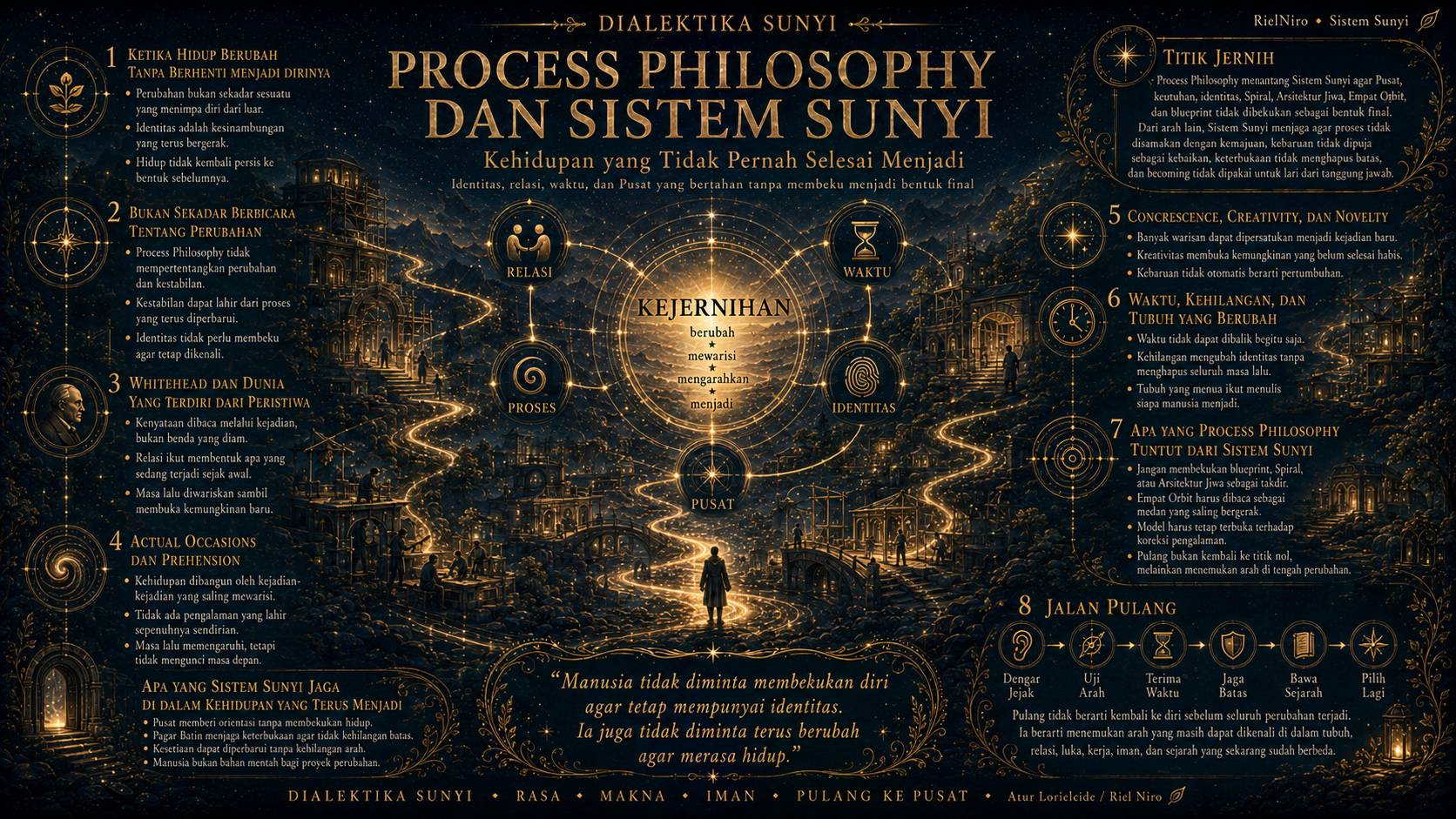
The self does not stand still behind change. The body grows older, relationships shift, loss leaves traces, time keeps moving, and every decision gradually changes who a person is becoming. Yet through all of this, a human being can still recognize the direction of life without freezing the self into something already complete.
A person loses a life partner. What disappears is not only the presence of the beloved, but also the way morning, home, the future, and even the self were once understood. Friends can still recognize the person. Memories remain. The values once held have not vanished entirely. Yet no part of life returns exactly to what it was before.
Experiences like this reveal something easily missed. Change is not merely an event that happens to the self from the outside. Change participates in forming the self itself. There is no clean line dividing the “old me” from the “new me.” What remains is a continuity that keeps moving.
Process Philosophy begins from this kind of question. It asks something more fundamental than how a thing changes. It asks whether change is itself part of the basic texture of reality. If so, identity is no longer understood as a thing that occasionally undergoes change, but as a pattern continually emerging through relationship, experience, body, memory, and time.
That final question is what makes Process Philosophy useful to The System of Silence. Center, Spiral, inner dynamics, Architecture of the Soul, blueprint, and living system all use the language of movement. Yet the language of movement can become a static map when terms begin to feel more certain than the life they are meant to read. Process Philosophy does not ask The System of Silence to abandon these terms. It asks that every term remain open to the fact that a human being is not finished becoming.
Why Process Philosophy Is Not Simply About Change
Process Philosophy is often introduced through the famous saying associated with Heraclitus that everything flows. The phrase opens a door, but it does not explain the whole tradition. If everything merely changed without pattern, the world would be nothing more than a sequence of chaos that could never be recognized.
What matters is that change always appears alongside continuity. A river remains a river even though its water is never the same. A family is still recognized as a family even when members are born, leave, age, or die. An institution appears stable not because nothing changes, but because countless small changes continually reproduce its larger form.
Process Philosophy does not oppose change and stability. Instead, it reads stability as something continually produced by processes that never stop. Something appears enduring not because it is motionless, but because a pattern keeps being renewed through time.
Another boundary matters here. Process Philosophy is not one single system that can simply be identified with Whitehead. Different strands emphasize time, relation, experience, organism, pragmatism, life, and change in different vocabularies. Whitehead offers one of the most systematic process metaphysics, but process thought is broader than any one philosophical architecture.
This helps The System of Silence enter the conversation without searching for one-to-one equivalents. What matters is not adopting a metaphysical package, but learning a shift in vision: stability itself can emerge from processes that continue to work, and identity can retain continuity without becoming a frozen thing.
Whitehead and a World Made of Events
The reading of reality as process received one of its most systematic forms in the work of Alfred North Whitehead. In Process and Reality, Whitehead develops a metaphysics that no longer begins from objects assumed to be fixed. He begins from events.
The shift sounds simple, but its consequences are large. If the world is understood as a collection of things, relation comes later, as though two already finished entities then encounter one another. If the world is understood through process, relation participates in shaping what is happening from the beginning.
Whitehead sees reality not as a set of objects that happen to touch, but as a network of events continually affecting one another. What happens now always carries an inheritance from the past while opening possibilities that did not exist in exactly the same form before.
This change of starting point puts new pressure on the language of dynamics in The System of Silence. Dynamics cannot mean only shifting moods. The Spiral cannot remain merely a metaphor of development. Living system cannot become profound simply because it sounds organic. Every term has to face harder questions: what process is taking place, what relationships are helping form it, what inheritance is being carried, and what possibilities are being opened or closed?
Actual Occasions: When Reality Is Built Through Events
Whitehead uses the term actual occasions to suggest that reality is fundamentally made of events in process rather than motionless things. The idea sounds strange because ordinary habits make it easier to see the world as a collection of objects that later undergo change. Whitehead reverses the order. Events are more basic, while what appears stable is a pattern continually arising from sequences of events.
This is more than a terminological exercise. It changes how identity is understood. If a self is built through events that inherit from one another, identity is not a hidden core standing behind experience. It is a continuity continually renewed through experience itself.
One major change does not immediately make a person entirely different. Neither do they remain the same merely because they still have the same name, job, or memories. Life moves through thousands of small events that gradually alter direction. Some changes are barely noticeable while they happen, yet years later they have helped form a different person.
Actual occasions, however, need protection from simplification. In Whitehead, the term is not simply another name for small events in everyday life. It operates at a more fundamental metaphysical level. When this essay brings the idea toward human experience, it is building a bridge of reading, not equating ordinary decisions with Whitehead’s metaphysical structure.
This boundary protects dialogue from collapsing into conceptual absorption. The System of Silence can learn from the way Process Philosophy reads identity as continually emerging continuity, but it does not need to turn Orbits, Inner Echoes, or inward experience into direct translations of actual occasions. The two houses remain more fruitful because their difference is preserved.
Prehension: No Experience Is Ever Born Entirely Alone
If reality is made of events, another question follows. From where does each new event receive its form? Whitehead answers through the concept of prehension. Every new event carries something from prior events. The past does not simply disappear. It remains as an inheritance participating in what is happening now.
Prehension is often mistaken for ordinary perception or conscious awareness. Whitehead means something more basic. The term points toward the way reality receives influence before everything is organized into conscious experience. The world is not made of isolated points later connected. Relation has been at work from the beginning.
Everyday life makes this easier to recognize. The way someone responds to criticism today is not determined only by the sentence just heard. The response also carries childhood experience, earlier relationships, success, failure, and perhaps wounds no longer remembered explicitly. The past keeps working without needing to appear as a clear memory.
Yet inheritance is not the same as absolute determination. What is received can still be interpreted differently, given a different weight, or redirected. Process Philosophy therefore does not fall into simple determinism. The past influences, but it does not seal the future.
That inheritance is also not received with equal weight. Whitehead’s language of positive and negative prehension helps show that process does not only receive. Some elements enter the formation of a new actuality, while others are not taken up in the same way.
In human experience, this distinction should not be translated too mechanically. But it opens a concrete question: from everything we inherit, what are we giving weight to? Which experiences do we keep placing at the center? Whose voices do we carry? Which patterns do we refuse to let govern the next moment?
The Inner Fence gains depth here. A boundary is not only a mechanism for rejecting external influence. It is also part of how a person decides what may continue to carry force in present life. Not everything inherited deserves the same right to shape what comes next.
Even refusal, however, needs examination. A person may call something a boundary when they are actually avoiding correction. They may believe they have released the past while the old pattern has merely changed form. Choosing what receives a place therefore requires clarity, not only the ability to say no.
Concrescence: When Many Inheritances Become One New Event
If every moment carries so many influences, how do they become one reality that actually happens? This question brings Process Philosophy to the idea of concrescence.
Concrescence names the process through which many inherited influences do not remain separate, but take shape in one new actuality. The past is present, possibilities remain open, relations exert pressure, and something finally becomes real.
Everyday experience offers a way toward the idea. Someone receives criticism. They bring childhood history, the degree of safety they feel that day, the relationship with the person speaking, beliefs about themselves, and the responses available. None of this remains merely a list. In one concrete response, many elements take shape as one new event.
Whitehead’s language of the many becoming one becomes powerful here. The many do not disappear, but neither do they remain scattered. They gather into one actual moment that then adds one more reality to the world.
A decision is therefore never entirely small. It may be only one event, but once it happens, it becomes part of the history inherited by later moments. One response can change a relationship. One lie can alter trust. One act of courage can open a possibility that did not previously have a place.
The System of Silence can read this movement without turning concrescence into an inward term. What matters is the weight of actualization. Life is not made only of possibilities. At some point, a person chooses, acts, speaks, refuses, receives, or remains silent. When that happens, some possibilities become reality and others are left behind.
Becoming does not mean keeping every possibility permanently open. Becoming also means allowing something to actually happen and accepting that the event has now become part of a world that cannot be treated as though it never occurred.
Creativity and Possibilities That Never Fully Run Out
If every moment carries the past, why can life still produce anything new? Whitehead approaches this through the idea of creativity. Reality does not simply repeat what already exists. It continually opens room for configurations that have not occurred in exactly the same way before.
Creativity here does not primarily mean artistic talent. It names the principle that becoming always includes room for novelty. The past provides material, but does not fully determine the outcome. Life is therefore never only a copy repeated without remainder.
Human experience offers many examples. Two people can pass through nearly similar wounds and move in different directions. A community can inherit a long history of violence and gradually build a healthier culture. Conversely, a society that appears stable can produce forms of oppression that did not previously exist. Novelty is not always progress.
That last correction matters. Process Philosophy opens space for novelty, but never says that everything new is automatically better. Change can carry liberation, but can also generate subtler forms of damage. Novelty still requires moral judgment.
Creativity in Whitehead must also not be reduced to the psychological ability of human beings to be creative. It works as a metaphysical principle more fundamental than talent, improvisation, or personal freedom.
This distinction keeps the dialogue clear. The System of Silence can speak of possibilities and new responses without claiming that human creativity is a direct equivalent of creativity in Whitehead’s metaphysics. What resonates is reality’s openness to novelty, not identity between the terms.
Novelty, Repetition, and the Direction of Change
In many modern cultures, change is treated as a value in itself. What is new is assumed to be better simply because it is new. Process Philosophy resists that optimism. Novelty means the arrival of possibilities that did not previously exist in the same way. It does not guarantee that those possibilities make life more humane.
The System of Silence brings the question of direction into the center of the conversation. The Spiral does not move upward merely because it keeps turning. New experience does not automatically produce maturity. A person can change jobs, communities, cities, or even convictions while still repeating the same wounded pattern. Conversely, a change that appears small from the outside can gradually alter an entire orientation of life.
What matters, then, is not simply whether life changes, but what kind of change is being formed. Creativity needs direction. Novelty needs wisdom. Becoming needs orientation if it is not to collapse into motion without purpose.
Life is not formed by novelty alone. Repetition matters just as much. A promise gains meaning because it is kept repeatedly. Love becomes trustworthy because it returns. Work gains quality through repeated practice. Faith takes bodily form because small choices keep returning toward the same orientation.
Repetition can also preserve wound. The same way of speaking, the same choices of relationship, the same work patterns, or the same unexamined responses to conflict can keep life moving without allowing it to truly change.
Novelty and repetition need not be treated as opposites. Something new often grows through repetition that changes little by little. One response that differs from the old pattern may not transform a whole life, but when repeated it can build a possibility that previously had no place.
Virtue Ethics helps illuminate this through the language of habit. Process Philosophy adds that repetition itself always occurs in a different time. No act is perfectly identical to the act before it because the person, context, relationships, and inherited history have already shifted.
Time, Irreversibility, and an Identity That Never Returns to Zero
One consequence now becomes clear. Time is not merely an empty container in which things move. Time participates in the emergence of identity itself. Who someone is today always arises from the relation among what has been inherited, what is being lived, and what is beginning to become possible.
Life never fully reaches completion. Identity is not discovered once and for all, but keeps receiving form through decisions that are lived. Even fidelity to the same value will look different as the body ages, relationships change, or the world presents new problems.
Process Philosophy does not ask human beings to lose all footing. It reminds us that footing itself lives within time. What endures does not endure by refusing change, but by finding new forms that remain faithful to a recognizable direction.
Time also carries something harder: irreversibility. What has happened cannot be made into something that never happened. An apology can open a new future, but it cannot erase the fact that injury occurred. Healing can alter the way someone lives with loss, but it cannot restore the world exactly as it was before the loss.
Irreversibility makes change different from a reset button. Human beings can grow, repent, and build new forms of life, but they do so with a history that has already become part of reality.
Continuity needs to be distinguished from sameness. Continuity does not mean that a person remains exactly identical. It means change retains a real relationship to the life that came before. The sentence “I have changed” does not erase relation to earlier actions, just as “I am still the same person” does not mean that no genuine change has occurred.
Through this distinction, The System of Silence reads Returning Home more clearly. Returning Home is not a return to the version of the self that existed before every wound. The Homeward Path moves through a history that cannot be undone and seeks a way for that history no longer to become a prison for the future.
Loss, Memory, and Relationships That Keep Working After Someone Is Gone
The loss that opened this essay needs to return to the center of the reading. When someone dies, the physical relationship ends in a way that cannot be reversed. Yet the relationship does not disappear from the lives of those who remain.
Names, habits, conversations, objects, rooms, and ways of seeing the world still carry traces of the person who is gone. Presence changes form. It is no longer a two-way conversation, but it continues to shape decisions, grief, gratitude, and even the way someone learns to love others.
Grief, therefore, is not simply an emotion that should gradually shrink until life returns to normal. Normal life itself has changed. Healing does not mean returning to the condition that existed before loss. It means learning to live within a world that now has a different shape.
Memory also does not behave like an archive opened without alteration. We remember the past from where we now stand. New experience can give an old memory a different meaning. Something once ordinary can become precious after loss. A wound once dismissed as small can become clearer when a person finally has language for it.
The past remains past, but the way it is present is never entirely static. We do not change the event that occurred. We change our relationship to it through the way it is carried into present life.
This reading leads The System of Silence to affirm an important boundary. Returning Home must not mean restoring a person to life before the wound. Sometimes there is no old home that can be restored. What can be built is a new form of life that still carries love, loss, and memory without allowing them to occupy the whole identity.
The Changing Body Also Writes Identity
A metaphysical reading of Process Philosophy can allow the body to slowly disappear. Human beings, however, do not change only through ideas and decisions. The body itself is a history continually unfolding.
Aging alters energy, speed, needs, and the way a person moves through the world. Illness can force life into a new rhythm. Disability changes relationships with space, technology, work, and other people. Fatigue can make a choice that is easy one day far more difficult on another.
The body also carries traces that do not always appear as conscious memory. Injury, tension, sleep patterns, hormonal change, felt safety, and physical experience all help form the way the world is received.
Identity cannot be read only as a story produced by the mind. Becoming always occurs within a body with capacities, limitations, needs, and a material history of its own.
This corrects The System of Silence whenever it moves too quickly from change toward Meaning or inward choice. Not every bodily change asks to be interpreted. Some require treatment, accessibility, rest, support, or environmental change.
The Center can still provide orientation, but that orientation must be livable within an actual body. Fidelity to direction does not mean forcing the body to preserve a form of life it can no longer sustain.
Relationships That Form Us but Are Never Free from Power
Many ways of thinking imagine that human beings first become themselves and only then enter relationships. Process Philosophy reverses the order. Relation does not arrive after identity has already been completed. Relation participates in forming identity from the beginning.
No one is born as a fully independent person. Language is learned through others. Ways of trusting, loving, fearing, hoping, and understanding the world grow through networks of relationship that continually shape life. Even the decision to distance oneself from others arises within a history of relationship already lived.
Every encounter carries the possibility of change. Long friendship does not merely accumulate shared memories. It changes the way both people understand themselves. Loss works in a similar way. Someone who has died is no longer physically present, yet the relationship continues shaping those who remain.
Process Philosophy broadens the way The System of Silence reads relationship. Relationship has long been recognized as one of the spaces in which human beings grow or are wounded. The conversation now moves further: relation is not merely an environment for growth, but participates in the emergence of identity itself.
Relationality, however, must be read together with asymmetry. Not every relationship has equal formative power. A child and a parent do not begin with equal power. An employee and a corporation do not always have equal freedom to leave. Victim and perpetrator cannot simply be described as mutually shaping one another as though influence moved both ways with the same weight.
The statement “everything is connected” too easily becomes an empty slogan. What must be read is which relationships are concrete, who holds greater power, what influence is operating, which dependencies can be refused, and who bears the cost when a relationship changes.
The Inner Fence gives this question a clearer shape. The System of Silence does not use boundaries to deny that relations form human beings. It uses boundaries to keep connectedness from becoming absorption and to prevent unequal relationships from being disguised as neutral mutual influence.
The Four Orbits Are Not Four Separate Parts
The language of relation also tests the way The System of Silence uses the Four Orbits. If the Orbits are read as four separate components, boxes, or subsystems, life is cut apart again into units with apparently fixed boundaries.
The Four Orbits are better understood as fields of reading. A single experience can move through several Orbits at once. Loss can change Feeling, habit, relationship, work, faith, and the body’s response to the world without asking permission from editorial categories.
Change in one field can also alter the way another field is experienced. A new work habit can change a relationship. A changed relationship can shift Meaning. A shift in Meaning can change the way the body carries pressure. No single Orbit contains the whole process.
Process Philosophy helps sharpen this openness without turning the Four Orbits into a systems diagram. An Orbit does not need to become a metaphysical component. It remains a useful reading tool so long as human experience retains the right to cross boundaries, resist categories, or reveal relationships not yet mapped.
The Epistemic Boundaries matter here. A map can guide attention, but it must never make the human being smaller than the categories used to read them.
The Center as an Orientation Continually Renewed
The next dialogue touches one of the most basic terms in The System of Silence: the Center. Many people imagine a center as a fixed core hidden deep within the self, waiting to be discovered. Process Philosophy raises a more demanding question. What if the Center is not a motionless thing, but a pattern of orientation continually renewed through life?
This does not make the Center relative or meaningless. Something can endure without freezing. A compass still indicates direction while the vessel moves. A river keeps an identifiable course while the water changes. In the same way, an orientation of life can remain recognizable even when experience, work, relationships, and self-understanding change radically.
After loss, for example, a person often says they are no longer the same. The statement is true and not entirely true. Something has changed deeply. Yet if value, love, faith, and direction continue to be carried, something still gives continuity to the change. What endures is not the outer shape of life, but an orientation that keeps finding new forms.
The question of renewal creates another difficulty. If the Center is continually renewed, what prevents it from becoming a name for whatever happens to feel important now? How can growth be distinguished from rationalization that merely gives new reasons to old desires?
The answer cannot lie in change itself. Orientation must be tested by the life it produces. Is dignity better protected? Does love take a more mature form? Does responsibility become more concrete? Does faith become more capable of facing reality without manipulating it?
In this way the Center remains dynamic without becoming arbitrary. It is neither a hidden metaphysical object nor a flexible label moved according to convenience. It is a direction continually chosen, tested, corrected, and embodied within concrete history.
Wholeness and an Architecture of the Soul That Remains Alive
The idea of wholeness often carries the image that one day every wound will be healed, every conflict disappear, and a person finally reach a complete form of self. Process Philosophy offers a quiet but deep correction. Life never fully stops becoming.
Wholeness cannot mean a state without fracture. It is closer to the capacity to carry different experiences within a direction of life that still holds together. A wound may not disappear, but no longer determines the whole identity. Loss is not forgotten, but gradually receives a place that can be borne. Change is not treated as an enemy, but as part of a life that keeps moving.
The System of Silence carries this understanding into the Architecture of the Soul. Architecture is not a building completed once and then left standing. It is closer to a home continually maintained, repaired, expanded, and sometimes partly dismantled so it can remain inhabitable for a changing life.
The metaphor of the Architecture of the Soul faces the same test. The word architecture easily suggests a structure designed in advance. Life, however, is more like living architecture: rooms change because they are used, new needs alter the arrangement, damage requires repair, and inhabitants themselves are shaped by the space they live in.
The Architecture of the Soul must not function like a final floor plan that already knows the entire human form. It works as a way of reading relationships and orientation that remains open to correction when experience reveals something for which the map had no room.
Wholeness then does not mean that every part has reached a final place. It means life has enough relation, direction, and flexibility to continue changing without losing the dignity of the human being living it.
The Spiral and the Blueprint Without Freezing into Destiny
The System of Silence has long used the language of the Spiral to describe the way human beings meet recurring themes at different depths of experience. Process Philosophy deepens this image. Repetition is not always proof of failure. Sometimes life needs to return to an old question before it can understand it with a depth that was not yet possible before.
Process Philosophy also offers a warning. The Spiral does not automatically move upward. A person can repeat the same wound in subtler forms. They can change jobs, partners, communities, or even convictions while carrying a pattern never truly examined. A change of form does not necessarily mean a change of direction.
The same correction applies to the blueprint. A blueprint is useful only if it is understood as an open pattern of orientation rather than a final design that determines the entire future. Otherwise new experience becomes merely evidence for something already decided beforehand.
Process Philosophy presses the question harder. A blueprint normally imagines a design existing before the building. If that metaphor is used without boundaries, new experience can easily be forced to confirm what has already been assumed true.
Within The System of Silence, blueprint language is useful only when read as a pattern of possibility or open orientation, not as final design, destiny, or hidden script waiting to be performed. Life has structure, but structure meets history, body, relationship, contingency, loss, and decisions that genuinely can redirect a life.
The Spiral has no automatic privilege either. It can help read the return of life themes, but it cannot guarantee that every turn is higher. Sometimes what returns is growth. Sometimes it is an injury never truly read. The Spiral becomes meaningful only when concrete experience shows what has actually changed.
This correction allows The System of Silence to retain orientation without turning orientation into fate. A map may provide direction, but life keeps the right to produce forms the map never predicted.
Becoming Is Not a Project of Throwing Away the Former Self
The language of becoming is easily absorbed into the culture of self-reinvention. People are invited to abandon an old version, begin again, construct a new identity, and live as though the past could be removed like clothing.
Process Philosophy gives reason to distrust that fantasy of reset. Becoming does not mean replacing the old self with a new self that has no relation to it. The past remains inherited. Relationships continue to leave traces. Earlier decisions can keep producing consequences after the person feels they have changed.
Process is not the same as progress. There is growth, but there is also regression, decay, fragmentation, loss, and destruction. Change has no moral direction simply because it happens. The life produced by the change still has to be judged.
Openness is also not the inability to decide. A person can keep saying they are still in process in order to postpone commitment, avoid consequences, or preserve every option so that no choice has to be made.
Concrescence reminds us that life actually actualizes something. Choosing one path means some possibilities are not taken. Commitment means accepting that freedom does not always consist in keeping every door open.
Commitment in a changing world is not a promise never to change. It is the willingness to renew a choice within change, test new forms without abandoning responsibility, and carry an earlier orientation even when its embodiment must develop.
Faith as gravity gains depth here. Fidelity is not static. It is a direction chosen again when body, time, relationships, and understanding are no longer the same as when the commitment was first made.
When Process Becomes Theological Language
The influence of Process Philosophy did not remain within philosophy. Out of this tradition grew what came to be called Process Theology, especially through Charles Hartshorne and other theologians who sought to read the relation among God, world, and change more dynamically.
This development matters, but it needs a clear boundary. Process Theology is not simply Whitehead with religious vocabulary added. It has its own debates, assumptions, and consequences. Not every Christian tradition accepts it, and not every reader of Process Philosophy must arrive at the same theological conclusions.
Process Theology then pushes the question further. If the world is genuinely relational and continually becoming, how should God’s relation to the world be understood? Does change in the world genuinely matter to God? How should divine power be imagined if relation is not merely something added after everything else is complete?
Some process theologians develop language for aspects of the divine that genuinely relate to the world and understand power through more than the image of coercive domination. This territory still carries broad metaphysical and theological debates. The essay does not need to turn any of them into answers for The System of Silence.
What matters is the boundary. The System of Silence can allow Process Theology to raise questions about power, suffering, relation, and fidelity without concluding that the whole theology of process must be adopted. The two houses remain distinct, and serious theological differences do not need to be forced into agreement.
Ecology, Materiality, and a World Continually Shaping Itself
Because it treats relation as constitutive of reality, Process Philosophy has influenced ecological ways of thinking. Living beings are no longer imagined as isolated units that happen to share space. They continually shape one another through exchanges of energy, environment, history, and networks of life larger than any one organism.
This makes ecological damage more than the loss of a tree, river, or species. What changes is the wider network of relations that allows life to continue. When one part is damaged, effects can spread through other parts, often before they are immediately visible.
The Ecology of Silence deepens its reading here. The environment is not a passive background in which human beings live. Body, space, technology, work rhythm, city, nature, and air quality all help form inward experience. Life does not happen only inside the self, but always takes place together with a world that continues shaping it.
Ecological connectedness becomes concrete through climate change, extraction, food systems, pollution, species loss, and urban design. These are not metaphors of relation. They are material processes determining the air people breathe, the food available, the illnesses that emerge, the work that disappears, and the communities forced to move.
Time also carries ecological responsibility beyond the present generation. Decisions made today can become conditions inherited by human beings not yet born. In this sense, process connects responsibility to the future without imagining that future as already fixed.
The Ecology of Silence sharpens the discipline of its reading: it is not enough to say that human beings are connected with nature. What must be read is the concrete form of the connection, who extracts resources, who profits, who carries pollution, and whose life becomes harder to sustain.
Dignity remains a boundary when the language of networks becomes too large. The whole does not gain the right to sacrifice particular lives simply because a system is said to need to function. Human beings and other forms of life must not disappear behind the efficiency of a process.
Technology That Is Not Only Used but Also Shapes the Human Being
Technology makes it especially clear that relation does not simply arrive after identity is complete. The tools human beings create then participate in changing how human beings attend, remember, work, move, and relate.
A phone does more than make communication easier. It changes the rhythm of availability. Social media does more than carry expression. It influences what seems worthy of attention. Recommendation systems do more than read preference. They help shape which possibilities appear most often before us.
Digital memory also changes the relation to the past. Photos, messages, archives, and online traces allow what once would have faded to reappear years later. The past takes on a new form because technology changes the way it can be present.
AI adds another layer. When systems help write, choose, filter, or recommend, questions of agency do not end with the statement that a human being still presses the button. Tools help shape the field of possibilities in which decisions are made.
Process Philosophy helps read technology not as a neutral object standing outside life. This connectedness still does not erase human responsibility. Precisely because technology helps shape us, design, rules, incentives, ownership, and use become part of moral responsibility.
The System of Silence tests technology through the question of attention. What technologies are helping human beings see more clearly, and what technologies gradually make life follow currents shaped by someone else? The Inner Fence applies in digital space as well: connectedness does not require limitless availability.
Process, Accountability, and Repair That Carries History into the Future
Every philosophy that emphasizes change carries a familiar risk. If identity is understood as process, someone can say they have changed and therefore no longer need to answer for the past. Wrongdoing is assigned to the “old self,” while the present self claims freedom to begin again without looking at consequences others still carry.
Process Philosophy itself does not lead there. The fact that human beings keep becoming does not make history meaningless. Because identity grows through continuity, every action helps form who a person later becomes. The past does not determine the whole future, but it remains part of the reality that must be faced.
In ordinary life this becomes simple. An apology gains meaning not because someone claims to have changed, but because change begins to appear in the way they accept consequences, repair harm, and build different habits. Becoming always requires accountability.
Self-change is still not enough to prove that responsibility is finished. Other people may still be living with the consequences of earlier actions. Repair belongs to becoming because a new future is not built merely through declarations that the person is now different.
Repair can mean acknowledging facts, accepting consequences, returning what was taken, changing habits, ending dangerous access, or helping repair structures that allowed harm to happen. The form differs by situation, but each connects personal change with a world that still carries consequences.
Repentance does not mean abandoning the former self as though it never existed. Repentance carries old history into a new form of life and allows responsibility to become one sign that change is real.
The same applies to institutions. Churches, companies, organizations, and states can replace leaders, logos, policies, or language and then claim they have changed. Institutional becoming cannot be demonstrated by rebranding alone.
Institutions still carry history through archives, assets, culture, victims, benefits, obligations, and inherited patterns. Change becomes real when structure, behavior, distribution of power, and the way damage is repaired also change.
Process Philosophy widens accountability. What changes remains related to what came before, and that relationship is exactly what makes repair both possible and necessary.
Between Openness and Losing Direction
Process Philosophy teaches that life is never finished. The claim itself can be misused. If everything changes, can we still speak of fidelity, commitment, or identity? If everything is always becoming, is there anything that can genuinely be held?
Questions like these show why Process Philosophy needs dialogue with other traditions. Process without orientation can dissolve into relativism. Orientation without process can freeze into dogma that has lost the ability to learn.
The question of direction leads The System of Silence to hold a different balance. The Center is not a rejection of change, but a direction that allows change to retain meaning. Faith is not a rejection of history, but fidelity that keeps seeking new form within history. Love is not an emotion that remains identical throughout life, but an orientation that keeps learning how to be present to another human being in circumstances that continually change.
Within this balance, The System of Silence does not appear as a static antidote to Process Philosophy. The Center does not come to stop change. Faith is not meant to freeze history. Love does not preserve one relational form forever.
What is protected is an orientation alive enough to change form without losing every measure. Change must still answer to dignity, love, responsibility, reality, and the consequences it leaves behind. Without that, openness becomes only a more elegant name for losing direction.
What Process Philosophy Requires of The System of Silence
After this entire conversation, Process Philosophy’s correction of The System of Silence begins from one recurring concern: language meant to read life must not make life appear already complete. Center, Four Orbits, Spiral, blueprint, and Architecture of the Soul remain useful only so long as they help attention keep moving. Once a term becomes more certain than experience, the map begins to take the place of the human being it was meant to read.
The Center becomes the first test because it is easy to imagine as a core waiting to be found. Process Philosophy unsettles that picture. Orientation can endure without standing outside time. It takes form through decisions that keep changing with body, relationship, loss, and history. From here, the Four Orbits also cannot be treated as fixed parts of the self. Experience crosses several fields at once, and life is not required to obey the editorial divisions created to read it.
The same pressure reaches the Spiral and the blueprint. The Spiral helps recognize themes that return, but repetition does not guarantee that someone has moved higher. A blueprint can illuminate patterns of possibility, yet becomes dangerous when new experience is read only as evidence for a design already assumed to be true. In both terms, Process Philosophy protects the possibility that life can genuinely bring something the map had never contained.
The Architecture of the Soul must likewise remain inhabited architecture rather than a final plan. Space changes because life takes place within it. Some rooms need expansion, some need dismantling, and some relationships become visible only after a person lives through what could never have been included in the original design. If architecture cannot receive such change, it stops being a way of reading and becomes a way of forcing.
Behind all these corrections lies one deeper distinction: continuity is not sameness. A human being can genuinely change without severing relation to history. A person can find a new form of life without causing earlier consequences to disappear. Openness to process therefore never provides a shortcut out of responsibility.
In the end, what is at stake is not whether The System of Silence has a model. Every reading needs some form so attention does not scatter. The question is whether the model remains humble enough to change when life reveals something it cannot contain. Process Philosophy pushes The System of Silence to keep that space open: not a space without orientation, but one in which experience still has the right to correct the map.
What The System of Silence Protects Within a Life That Keeps Becoming
The openness defended by Process Philosophy immediately raises a question that change itself cannot answer: change toward what? If life is always becoming, how do human beings distinguish growth from mere movement, openness from loss of direction, or novelty from a form of damage that simply did not exist before?
At this question, The System of Silence returns attention to orientation. The Center does not stop process and does not determine a final form of life. It works as a direction continually tested by reality: does change protect dignity more fully, make responsibility more concrete, and allow love to become more mature without losing boundaries? With measures like these, process is not forced to stop, but neither is it allowed to become a value in itself.
Relationship belongs to the same question. Process Philosophy is right that human beings are formed through relation, but connectedness is never neutral. Some relationships nourish, some dominate, and some make it difficult for a person to say no. The Inner Fence protects openness to influence from becoming an obligation to receive every influence.
Fidelity then shows that change and commitment do not have to be enemies. Faith as gravity does not stop history. It gives human beings reason to choose direction again when old forms can no longer be maintained. Fidelity remains alive because it must be translated again within bodies, times, relationships, and responsibilities that have changed.
Orientation itself reaches a limit when human dignity begins to be treated as material for a larger project. Systems, communities, technologies, institutions, and even visions of the future can speak the language of development while asking some people to pay costs they never chose. The System of Silence stands firmly at this boundary. A human being is never merely raw material for transformation.
A life that keeps becoming does not have to turn into a project of endless self-optimization. There are times when growth comes through practice and the courage to decide. There are other times when life asks a person to receive a changing body, an irreversible loss, or a limitation that discipline cannot solve. Process continues in both. What changes is the form fidelity takes toward the life that actually exists.
When the Language of Process Becomes an Excuse Never to Finish Taking Responsibility
The language of process sounds humble because it admits that human beings are unfinished. Precisely for that reason, it can become a hiding place. The sentence “I am still in process” can open room for genuine change, but it can also postpone an apology, decision, or responsibility that is already clear enough. Openness then becomes an excuse so that nothing ever has to be brought to completion.
From there the distortion can move further. Change begins to look good simply because it carries a new form. Novelty gains prestige, while repetition, fidelity, and commitment are treated as signs of stagnation. Human beings begin to feel they must constantly become the next version of themselves, as though a life that does not visibly change were a life that had failed to develop.
Relationality can lose its sharpness in the same way when everything is simply called connected. The phrase “everything is connected” sounds expansive, but it does not tell us who holds power, which relationship keeps producing injury, who is able to leave, or who must bear the consequence. Connectedness without concrete reading can hide inequality.
A heavier danger appears when change of identity is used to break relation with history. The wrongdoer feels different now, while someone else still lives with the consequences of what happened. Becoming then turns into a fantasy of reset. The past is assigned to a self supposedly left behind, even though the wound does not disappear merely because the wrongdoer has found new language for themselves.
The same pattern can live inside The System of Silence. Blueprint can harden into fate, the Spiral can be assumed always to rise, the Center can freeze into a core beyond challenge, and the Architecture of the Soul can become a plan that already knows the whole human form. Terms created to help life become clearer begin deciding in advance what may be discovered.
Institutions have another way of using process language. An organization changes leaders, logos, policies, or slogans and declares itself transformed even though distributions of power, patterns of harm, and treatment of victims remain the same. Rebranding receives the name of transformation because visible change is often easier than repair that actually alters relationships.
Technology makes this distortion subtler. Systems are said to keep learning, platforms to keep evolving, AI to keep becoming more intelligent, but process language can make human beings forget to ask who designs the goals, who owns the infrastructure, who benefits, and who loses room to choose. Technical change does not automatically produce moral development.
The language of process remains alive only when it can return to consequences. Is responsibility being carried? Are relationships becoming safer? Can power be corrected? Is the model still willing to change when experience resists it? When those questions disappear, process stops being language for unfinished life and becomes an excuse for human beings, institutions, and even The System of Silence never to finish taking responsibility.
A Life That Never Finishes Becoming
A person who loses a life partner does not return to being the same person they were before the loss. The house changes. Morning changes. The future changes. Even the way the person remembers themselves gradually takes on another form.
That change does not erase all the life that came before. Love continues leaving traces. Promises, conversations, habits, and memories still participate in shaping days now lived without the same presence.
Process Philosophy offers an important reading here: identity does not have to choose between remaining and changing. Human beings can have continuity precisely through the changes that keep happening.
The System of Silence answers this correction by keeping the Center alive within time, releasing the Spiral from any right to guarantee growth, allowing the blueprint to remain open to novelty, retaining the Four Orbits as fields of reading, and keeping the Architecture of the Soul open to renovation by life.
The journey also reveals boundaries. Not every change is growth. Not every relationship should be preserved. Not every possibility should be actualized. Not every part of the past can be left behind without repair.
The body ages, capacity changes, and technology shapes attention. Institutions carry history and relationships leave traces. Decisions actualize some possibilities and close others. Life does not merely move. It continually produces realities that must be carried.
Becoming does not mean living without footing. Precisely because no final form can be possessed once and for all, orientation has to be chosen again. Fidelity has to be renewed. Boundaries have to be rebuilt. Responsibility has to follow consequences as they continue moving through time.
Returning Home also does not mean going back to a point before all change occurred. There is no zero point to restore. The Homeward Path means finding a direction that can still be recognized within body, relationship, wound, work, faith, and a history that is now different.
Perhaps this is where a life that never finishes becoming finds its depth. Human beings are not asked to freeze themselves in order to keep an identity. Neither are they required to keep changing merely to feel alive. They learn to carry the past without becoming prisoners of the past, to receive novelty without worshiping it, and to choose direction without assuming that the present form of that choice will last forever.
Life keeps becoming because time does not stop. Within irreversible time, human beings can still learn how to carry what has happened toward what has not yet happened. That possibility is what keeps process from becoming mere change and allows responsibility, love, faith, and possibility to keep taking new form.
Tulisan ini merupakan bagian dari Dialektika Sunyi, kategori yang membaca ulang berbagai konsep umum melalui lensa orbit dan spiral kesadaran Sistem Sunyi. Tujuannya bukan menolak pemahaman luar, tetapi menunjukkan bagaimana sebuah konsep berubah arah ketika dilihat dari pusat batin Sistem Sunyi.
Sistem Sunyi lahir dari perjalanan batin manusia, bukan dari mesin atau algoritma. Ia tumbuh dari luka, jeda, doa, dan keberanian untuk diam. Orbit, spiral, dan gema bukan formula buatan, melainkan kosmologi yang muncul dari pengalaman hidup yang jujur.
Untuk memahami asal-usulnya lebih jauh, lihat juga Origin Story Sistem Sunyi: Ruang Orientasi · · .
Pengutipan sebagian atau keseluruhan isi diperkenankan dengan mencantumkan sumber: RielNiro – TokohIndonesia.com (Sistem Sunyi)
Lorong Kata adalah ruang refleksi di TokohIndonesia.com tempat gagasan dan kesadaran saling menyeberang. Dari isu publik hingga perjalanan batin, dari hiruk opini hingga keheningan Sistem Sunyi — di sini kata mencari keseimbangannya sendiri.
Berpijak pada semangat merdeka roh, merdeka pikir, dan merdeka ilmu, setiap tulisan di Lorong Kata mengajak pembaca menatap lebih dalam, berjalan lebih pelan, dan mendengar yang tak lagi terdengar.
Atur Lorielcide berjalan di antara kata dan keheningan.
Ia menulis untuk menjaga gerak batin tetap terhubung dengan pusatnya.
Melalui Sistem Sunyi, ia mencoba memetakan cara pulang tanpa tergesa.
Lorong Kata adalah tempat ia belajar mendengar yang tak terlihat.
Baca juga: Dua Ruang, Satu Sunyi: Jejak Atur Lorielcide alias Rielniro