
 Tulisan ini bagian dari sistem kesadaran reflektif
Faith loses its moral force when prayer only soothes the heart, love refuses to name injustice, and suffering is given meaning without ever asking why it continues to be produced. At that point, silence can become a shelter for conditions that should have been challenged.
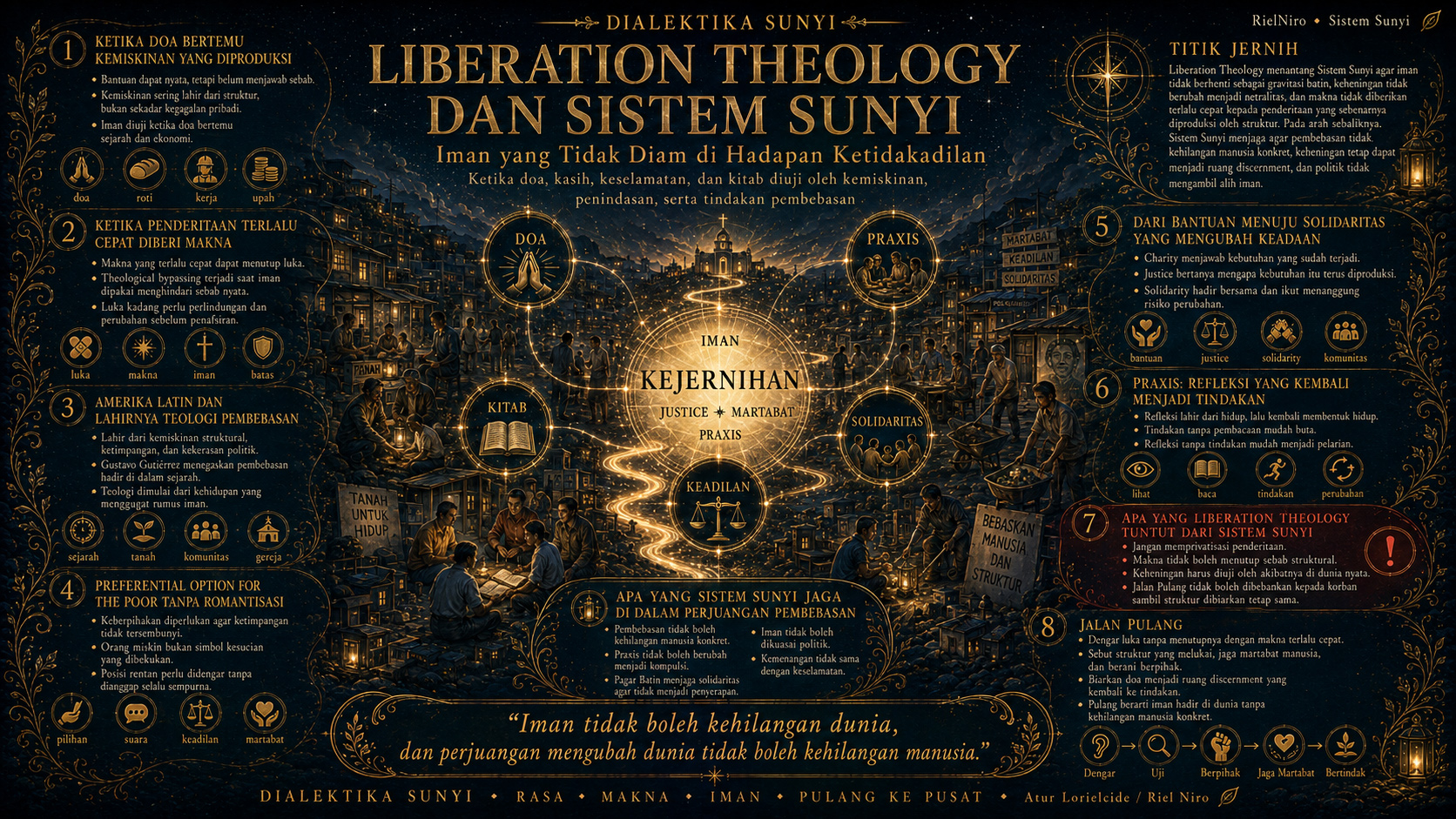
A mother prays that her family will make it to the end of the month. A community arrives with food supplies, offers comfort, and goes home believing that love has been practiced. The help is real and important. Yet afterward, few people ask why the same prayer must be spoken month after month. Why are wages never enough? Why do prices continue to rise? Why does debt become an inheritance? And who benefits from conditions that keep some people permanently at the edge of scarcity?
Liberation Theology begins its questioning from this condition. The central issue is not whether believers care about those who suffer, but whether faith is courageous enough to read the causes of suffering itself. It resists forms of faith that move the entire problem into the inner life while leaving the structures that produce injury unnamed. For Liberation Theology, sincere prayer does not only seek strength to endure. It also opens the eyes to a world that can be changed.
Poverty is not immediately read as the result of personal laziness, fate, or insufficient faith. It is first traced as a historical reality shaped by economic relations, distributions of power, policy, education, and a long history of inequality. Individuals still bear responsibility, but not all suffering arises from individual choices.
That last question makes the conversation with The System of Silence uncomfortable, and necessary. Faith, hope, love, work, Feeling, and silence can indeed help a person endure. Yet all of them must be examined when inward calm makes a harmful structure increasingly difficult to see. The language of Returning Home must not lead people back to themselves while allowing a world that continually strips others of dignity to pass without being named.
When Suffering Is Given Meaning Too Quickly
The language of faith has a profound capacity to help human beings endure suffering. It offers hope, restrains despair, and opens the possibility that injury will not have the final word. Yet the same capacity can turn in another direction when meaning is given too quickly.
People living in poverty are told to see deprivation as a test. Victims of violence are encouraged to discover the lesson. Those living under oppression are asked to be patient because suffering is said to carry a divine purpose. Such sentences may sound devout, but devotion becomes a problem when questions of cause are pushed aside.
There is a difference between discovering meaning after a wound and using meaning to close a wound before it has truly been read. The first can help a person grow. The second can become theological bypassing, when language about God is used to avoid history, power, economics, or relationships that are actually producing suffering.
Liberation Theology refuses that shortcut. Theological questions must not make material reality disappear. If someone is hungry because wages are insufficient, faith cannot end with an invitation to be grateful. If someone is silenced by an abuse of power, prayer cannot become the reason they are expected to remain quiet.
This question forces The System of Silence to reexamine the relationship among Feeling, Meaning, and Faith. Meaning does not always need to arrive immediately. Some wounds first require recognition, protection, distance, or structural change before they can be read as part of an inner journey.
Faith as gravity still gives direction, but direction gives no one the right to interpret another person’s suffering from a distance. Sometimes the most truthful form of faith begins when human beings stop explaining a wound and start asking what must change so that the same wound is not continually produced.
Latin America and the Birth of Liberation Theology
Liberation Theology did not arise from an academic space far removed from suffering. It grew in Latin America during the second half of the twentieth century, when structural poverty, concentrated land ownership, political violence, authoritarian governments, and economic inequality were part of everyday life for millions. In such a context, the question of God could never be separated from the question of human lives continually stripped of dignity.
From that experience came a deep theological struggle. Gustavo Gutiérrez became one of its most influential voices by arguing that salvation could not be understood only as a private matter or as life after death. Liberation also concerns concrete history, the places where people work, suffer, hope, and struggle. Faith therefore speaks not only of the world to come, but of the world being lived now.
Yet Liberation Theology itself is not a uniform tradition. It developed through different churches, communities, countries, and political experiences. There have been disagreements about pastoral strategy, the relationship to social theory, the reading of Scripture, and the forms of church involvement in public life. To reduce all of this development to one formula would erase the richness of the conversation that formed the tradition from the beginning.
The System of Silence does not need Liberation Theology as a ready-made answer. What matters more is the tradition’s courage to alter the starting point of theology. Human experience is not placed merely as an illustration after doctrine has already been completed. It can challenge the way faith itself is articulated. Here, the language of Silence must prove that it is open enough to be corrected by lives that do not fit its own inward maps.
The Preferential Option for the Poor Without Romanticization
One of the best-known ideas in Liberation Theology is the preferential option for the poor. The phrase is often misunderstood as though liberation theology assumes that poor people are always more correct, more holy, or more moral. Its claim is different. Those who are most vulnerable to injustice are also very often those least heard when important decisions are made. Faith therefore chooses to listen first to voices that are easiest to ignore.
This preference is not sentimentality. It grows from the recognition that neutrality is often available only to those who are not carrying the consequences. When everyone is treated as though they occupy the same position, actual inequality disappears from view. In such conditions, taking a side is not a denial of justice, but one of the conditions through which justice can begin to be restored.
Yet taking a side carries its own danger. Poverty can become a romantic moral symbol. Poor people are treated as images of holiness while their actual lives, with all their diversity, conflict, failure, and hope, disappear behind a picture constructed by others. They lose their voice again, this time not because they are despised, but because they are idealized.
This preference also has an epistemic dimension. Those who live close to injury often see consequences that remain invisible from centers of power. Workers know the cost of policies that appear efficient in reports. Women carrying an unequal share of care work know burdens that never enter the statistics. Communities living in extraction zones know forms of damage that never enter market prices.
Yet an oppressed position does not automatically produce perfect truth. Suffering can open forms of knowledge, but it can also carry fear, conflict, bias, or wounds that remain unresolved. Listening first to vulnerable voices does not mean treating them as incapable of error. It means that a conversation about justice cannot begin with those who have always been easiest to hear while everyone else is asked to wait.
Here The System of Silence must hold a sharper boundary. Solidarity does not require hatred of those on the other side, but love for every human being cannot be used to erase unequal positions. The oppressor retains human dignity, but that dignity does not grant a right to continue oppressing. Mature love can preserve the humanity of the wrongdoer while still removing access to those being harmed.
From Aid to Solidarity That Changes Conditions
When someone is hungry, food is still needed that day. No theory of justice can replace the need to eat. Charity therefore need not be belittled simply because it has not yet changed a structure.
The problem begins when immediate help is treated as sufficient. Charity responds to a need that has already occurred. Justice asks why the need keeps being produced and how rules distribute resources, risk, protection, and opportunity.
Solidarity moves further than helping from the outside. It asks people to stand with those who bear the consequences, listen to how they understand the problem, and allow the goals of change to be shaped together. The person receiving help is no longer merely an object of goodness, but a subject who helps determine direction.
Liberation then touches the capacity of people and communities to change the conditions that restrict their lives. Liberation does not mean every form of suffering will disappear. It means people gain greater room to act, speak, and participate in shaping the world they inhabit.
These four movements can meet without becoming identical. Aid can be a concrete form of love. Justice changes rules. Solidarity changes the position of the relationship. Liberation opens the possibility that those who have long received decisions made by others can begin to act as agents within their own history.
For The System of Silence, this distinction matters because works of love must not end with the feeling of having done something good. Work can meet today’s need while keeping a larger question alive: does this action merely reduce pain, or does it also help change the pattern that keeps bringing the pain back?
Praxis: Reflection That Returns as Action
For Liberation Theology, faith does not stop at correct knowledge. It moves through praxis, an ongoing relationship among action, reflection, and renewed action. Action without reflection easily becomes hasty reaction. Reflection without action easily becomes intellectual comfort that never touches anyone’s life.
A community that feeds people who are hungry is indeed doing something good. Yet praxis does not end there. It asks why hunger keeps appearing, who benefits from the system, and how an act of love can grow into more fundamental change without losing the face of the human being being served.
Liberation Theology distinguishes praxis from activism that merely pursues motion. Praxis is not a race to perform as many actions as possible. It needs the ability to stop, reread what has happened, admit error, and act again with deeper understanding. Movement that refuses examination can become as dangerous as silence that never moves.
Praxis also requires discernment about time. There are moments when action cannot wait because harm is already unfolding. There are other moments when the sense of urgency is driven by anxiety, group pressure, or the need to appear active immediately. Not every pause is cowardice, just as not every speed is courage.
Reflection after action matters as much as reflection before it. Who was actually helped? Who carried a new cost? Did those affected have space to say that the chosen strategy did not work? Praxis loses its liberating character when a movement evaluates itself only by goals established by its own leadership.
A practice of silence can have a place within this movement without replacing action. The System of Silence uses silence to create distance from the loudest impulse, so that calling can be distinguished from compulsion. Silence of this kind is not withdrawal from the world. It protects the possibility of returning to the world with clearer direction.
Structural Sin, Complicity, and Responsibility That Is Never Simple
In many Christian traditions, sin is often understood as a personal decision that distances a person from God and neighbor. Liberation Theology does not reject that understanding, but considers it incomplete. Some forms of evil arise not primarily from the intention of one person, but from rules, institutions, habits, and relations of power that allow injustice to continue even when the people occupying particular roles change.
The idea of structural sin emerges from this widening. It does not mean that a system sins without human beings. It means human beings can build arrangements that collectively produce suffering and then come to regard those arrangements as normal. Wages that cannot sustain a decent life, discrimination inherited through procedure, or an organizational culture that repeatedly sacrifices certain groups can survive far longer than the individuals who first created them.
This awareness changes how responsibility is read. Sin no longer ends with personal acts. It also reaches the ways people participate in structures that wound their neighbors. A person may consider themselves kind, generous, even religious, while continuing to benefit from a system that impoverishes others.
Structural sin becomes harder to read when a person does not feel they ever chose the structure that benefits them. They were simply born into it, work inside it, purchase through its supply chains, use its services, and receive the conveniences it provides.
Complicity differs from direct wrongdoing. A person may not have created a rule, yet still benefit from it. They may not intend harm, yet continue following a procedure that consistently makes a particular group bear the cost. Participation does not always mean equal moral guilt, but neither does it mean freedom from responsibility.
Guilt, responsibility, and participation need to be distinguished. Personal guilt is not always the most accurate language for every structural injustice. Responsibility, however, can arise from one’s position, benefit, power, knowledge, or capacity to help change a condition.
This reading prevents two escapes at once. A person cannot say, “I never intended harm,” and assume the question is closed. But neither must they carry all of history as a private guilt that can never be repaired. A more useful question is: what am I helping to preserve, and what change genuinely lies within the reach of my responsibility?
This correction widens the way The System of Silence reads responsibility. Structures must not erase agents, but personal guilt must not become the only moral language available. Sometimes Returning Home means becoming willing to see advantages once treated as neutral, then changing one’s way of living even when no single act can be named as the source of the problem.
Salvation Within History
If human suffering takes place within history, does salvation speak only about life after death? Liberation Theology answers that the question is too narrow. Salvation exceeds history, but is never detached from it. God is understood not only as humanity’s final end, but as present within the struggle for dignity in life now.
Gustavo Gutiérrez describes liberation through several interrelated dimensions. There is liberation from social injustice, liberation from forms of alienation that damage human relationships, and liberation from sin that restores relationship with God. These dimensions must not be separated, but neither should they be collapsed into one another. Political change does not automatically bring repentance, just as personal repentance does not automatically transform structures that continue producing oppression.
This distinction protects Liberation Theology from two reductions at once. On one side, salvation is not reduced to a political project. On the other, faith is not moved entirely into the inner life until history loses theological meaning. Eschatological hope gives strength to act within history without claiming that history can be perfected by human hands.
This tension can be read through the language of the already and the not yet. Signs of liberation can genuinely appear within history. People can gain land, rights, safety, education, political voice, or freedom from violence. These changes are real and must not be dismissed as merely worldly concerns.
Yet none of those victories completes history. New structures can produce new wounds. A movement that liberates can lose its direction. People once oppressed can gain power and repeat patterns they once resisted.
Eschatological hope keeps historical change from being worshiped as final salvation. At the same time, hope must not be used to postpone justice until another world. What remains unfinished is precisely what gives reason to keep working without claiming that human hands can complete all of history.
Before this tension, faith as gravity faces a concrete test. The System of Silence cannot use an inward horizon to retreat from the world. Yet neither must it hand all of faith over to political outcomes. Hope protects action from despair and from the arrogance of believing that one victory has brought history to its end.
When Liberation Begins to Believe History Is in Its Hands
Liberation movements arise because certain conditions truly must not be left untouched. Yet the conviction that change is necessary can turn into the conviction that one movement possesses a complete knowledge of history’s direction.
At that point, a noble goal begins to justify any means. Violence is called temporary. Criticism is said to slow liberation. Those who disagree are no longer political opponents, but obstacles to history who must be removed.
Political messianism appears when political victory takes on the language of salvation. A movement no longer sees itself as a limited actor, but as the bearer of a future that doubt must not disturb.
Liberation Theology must guard itself against this temptation because the language of liberation can easily acquire moral certainty. Real suffering demands action, but suffering does not make human strategy sacred.
The debate over violence and nonviolence shows how difficult this territory is. Structural violence can make calls for peace sound like demands that victims accept their condition. Yet resistance that begins to enjoy the destruction of an opponent can also give birth to a new domination.
There is no formula that settles every case. Self-defense, resistance, civil disobedience, and nonviolence arise in different circumstances. The ethical question is not only what may be justified, but who bears the risk of the chosen strategy and who has the luxury of insisting that someone else remain nonviolent.
The System of Silence does not enter this tension with a ready political answer. What it protects is the space in which hatred does not disguise itself as clarity. The Inner Fence can end a wrongdoer’s access without erasing their humanity, while faith as gravity keeps the goal of liberation from becoming permission to abandon every moral boundary.
Reading Scripture from Wounded Experience
One of Liberation Theology’s greatest contributions is its willingness to ask from where a person reads Scripture. No reader arrives without a history. Life experience, social position, language, and wounds shape what becomes visible when the same text is opened.
The story of Israel’s liberation from Egypt, the cries of the prophets, Jesus’ ministry among those pushed aside, and the cross all carry a different resonance when read by communities living under oppression. The content of Scripture has not changed. The reader’s point of departure has. Those who were long treated as objects of history begin to read themselves as participants in the same story.
Yet Liberation Theology does not give permission to turn every verse into a political manifesto. Scripture has its own histories of composition, varied literary forms, and theological tensions that must not be erased in service of a single agenda. Reading from the side of the oppressed can enrich hermeneutics, but it does not release the interpreter from academic or spiritual responsibility.
This conversation tests The System of Silence as well. Human experience can open dimensions of a text that had remained unseen, but experience cannot become the sole measure of truth. Conversely, the text must not become a wall that strips concrete suffering of its right to speak. Mature reading allows both to correct one another without forcing either to become the single final judge.
Base Communities, Authority, and Communities That Can Still Be Corrected
In the development of Liberation Theology, base communities became important spaces where Scripture was read alongside everyday life. These small communities were more than discussion groups. They became places where people shared experience, learned from one another, prayed, and searched together for ways faith might answer the problems they faced.
What changed was not only the content of conversation, but the direction of authority. The experience of ordinary people was no longer treated as an illustration for theology that had already been completed. It became part of the process of doing theology itself. Everyday life became a laboratory in which faith was tested.
Yet small communities do not automatically become healthy spaces. Closeness can generate new pressures, informal leadership can become domination, and solidarity can turn into a demand for sameness. A community formed in the name of liberation still needs ways to correct itself.
The question of community therefore leads to authority. Who leads when everyone is described as equal? Who decides that a voice has become too disruptive? Who is believed when conflict arises between an ordinary member and a respected figure?
Safeguarding becomes part of liberation precisely because intimate communities can hide abuse very effectively. Closeness allows trust to grow, but trust without mechanisms of correction can turn every report of harm into an accusation of betrayal.
A liberating community needs room for dissent, procedures for responding when power is abused, and the possibility that even the most beloved person may be wrong. Solidarity must not become moral surveillance that polices whether every member speaks with the same language and emotion.
The Inner Fence gives The System of Silence a concrete language for this need. Boundaries are not the enemy of community. They protect closeness from becoming absorption and prevent love from requiring a person to sacrifice safety in order to preserve an image of harmony.
Paulo Freire and a Consciousness Learning to Read the World
Although Paulo Freire was not a theologian in the same sense as Gutiérrez or Leonardo Boff, his thought deeply influenced Liberation Theology through the idea of conscientization. For Freire, education is not the process of filling an empty head with information. It helps human beings become conscious of the world they are already inhabiting.
Critical consciousness emerges when personal experience begins to be understood in relation to wider structures. People no longer see themselves merely as victims of fate, but begin to recognize how history, economics, culture, and power have helped shape their lives. From that consciousness, the possibility of acting together begins to appear.
Freire also warns that liberating education can become a new form of oppression when the teacher assumes that all the answers are already in hand. Dialogue loses its meaning when the conclusion has been determined in advance. Those being taught become passive recipients once again, only now of an ideology with a different name.
A pedagogy of dialogue cannot merely replace the content of education. The relation of power within learning must change as well. The educator does not arrive as the conscious one who awakens those presumed unconscious. They bring knowledge, but also the willingness to discover that their own way of reading the world may need correction.
The language of liberation can become colonial when it replaces conclusions without transforming relationships. Students are asked to repeat a new vocabulary, communities are asked to accept a new analysis, and all of this is called critical consciousness even though there is almost no room to disagree.
Freire’s question reveals a similar risk within inner education. The System of Silence can offer models, terms, and maps that help people find language. Yet those tools lose their purpose when readers are simply asked to see themselves through conclusions already fixed in advance. Living dialogue must preserve the possibility that the model itself will change after meeting experience.
Leonardo Boff, Jon Sobrino, and an Expanding Horizon of Liberation
As Liberation Theology developed, it did not remain one voice. The tradition continued to grow through thinkers who brought new concerns without abandoning its underlying question: how can faith remain faithful to God in a world that wounds human beings?
Leonardo Boff widened the conversation toward church, community, and later ecology. Liberation, for him, concerns not only oppressed human beings but also an earth treated merely as an object of exploitation. The logic by which human beings dominate nature often resembles the logic by which they dominate one another. Liberation therefore cannot be separated from the restoration of relationship with the whole of creation.
Jon Sobrino traveled another path. His Christology reads from the experience of those crucified by history. The question of who Christ is cannot be separated from the question of who today continues to be crucified through poverty, violence, humiliation, and oppression. The cross is not only a symbol of individual suffering, but a mirror held before a world that continues producing victims.
The ecological widening becomes even more urgent when climate crisis reveals that damage is not distributed equally. Those who have benefited least from economic growth are often among the first to lose land, water, health, and security through environmental change.
Indigenous communities encounter another layer. Land is not always understood merely as an economic asset. It can be a place of memory, ancestral relationship, language, cosmology, and identity. A model of development presented as progress can therefore become the erasure of a lived world that never entered the market calculation.
Eco-liberation brings social and ecological justice into conversation without making them identical. The exploitation of human beings and of the earth can emerge from the same logic of domination, but each wound still has its own shape.
From here, The System of Silence must widen what it means by the world that needs to be read. Ecology is not a background to the inner journey. Body, air, land, water, work, and place all help determine whether people have somewhere to Return Home, or whether they are continually forced to survive within environments that injure them.
Black Theology, Feminist Liberation Theology, and Wounds That Are Never Singular
As Liberation Theology developed, it quickly became clear that experiences of oppression are never singular. Poverty is not the only form of historical injury. Race, gender, coloniality, disability, and many forms of marginalization create experiences that cannot simply be dissolved into one general category.
Black Theology emerged especially from the experience of Black communities confronting systemic racism. Questions about God were carried into the history of racial discrimination, so that faith was tested not only by poverty, but by structures that from the outset treated some human beings as less valuable than others.
Feminist Liberation Theology raised another set of questions. It showed that even liberation movements can continue carrying patriarchal patterns when women’s voices are used merely as additions. Genuine liberation must be willing to reread language, symbols, leadership, and religious practices that have restricted some people in the name of tradition.
These developments also correct the tendency to use the phrase the poor as though it named one uniform experience. A poor woman does not necessarily experience poverty in the same way as a poor man. Racism can add risk even when class positions are similar. Disability, coloniality, social position, and geography can make structures work through overlapping layers.
Intersectionality helps show that wounds cannot always be separated into boxes. One person may simultaneously bear class, race, gender, disability, and colonial history. A liberation that reads only one axis may free someone in one area while leaving them oppressed in another.
Indigenous and decolonial readings widen the question further. Liberation is not only about economic redistribution. It also concerns land, language, memory, local knowledge, and the right not to be forced to live inside one imposed model of progress.
Religion itself must be willing to read its history of coloniality. The language of salvation has at times traveled alongside cultural erasure, imposed ways of life, and the delegitimization of local knowledge. Liberation theology therefore cannot only criticize state and market. It must also ask when religious mission itself became part of the structure in need of repentance.
This layered reading prevents The System of Silence from using the word victim as a category too quickly. Every wound has its own history, language, body, and distribution of power. To listen means allowing those differences to remain alive rather than forcing every experience into one story of suffering.
When the Church Speaks of Liberation While Still Holding Power
The church can become a place of resistance against injustice. It can protect the vulnerable, give language to those who have been silenced, and preserve dignity when state or market ignores it. Yet the church is also an institution, and every institution carries questions of power.
Who is allowed to speak? Who has authority to interpret? Who is believed when abuse takes place? Who has access to leadership? Who is asked to remain loyal in order to protect the community’s good name?
Liberation theology loses integrity when the church courageously criticizes the state while refusing criticism of itself. The language of standing with victims becomes empty when reports of abuse are first read as threats to reputation.
Religious institutions can also use the language of family, loyalty, forgiveness, or obedience to restrain correction. Liberation must enter its own house before it becomes too quick to point toward structures outside.
These questions are not meant to make all authority suspect. Communities need structure, responsibility, and leadership. But healthy authority provides paths for correction, limits to power, protection for dissent, and mechanisms for responding when leaders fail.
The System of Silence faces a similar test in any community that uses its language. Inner maps, closeness, or shared faith give no one the right to become the center of gravity for another person. Center belongs to the orientation of life, not to office, personality, or institution.
Love, Forgiveness, Reconciliation, and Boundaries That Must Not Be Erased
One of Liberation Theology’s sharpest criticisms is directed toward sentimental versions of love. Love is often translated as gentleness, forgiveness, and the ability to accept. All of these can matter. Yet they can become tools of silencing when victims are asked to remain quiet in order to preserve peace.
Love that loses justice slowly turns into language that protects the existing condition. Victims are asked to forgive before the injury is acknowledged. Those who have been harmed are asked to preserve unity while those with power are never asked to change. In such a situation, love no longer liberates. It covers injustice.
Liberation Theology does not separate love from the courage to name what is wrong. Forgiveness does not erase responsibility. Loving a wrongdoer does not mean allowing continued access to the victim. Reconciliation cannot be built on denial of reality.
Forgiveness must be distinguished from reconciliation. A person can choose not to cultivate hatred without returning to an unsafe relationship. Reconciliation requires more than inward forgiveness. It requires truth, changed behavior, responsibility, and conditions in which trust can become possible again.
Justice is not always identical with punishment. In some situations, justice requires ending access, repairing harm, changing rules, public acknowledgment, or protecting those who are vulnerable. Repair asks what must be changed so that injury is not only recognized but also made harder to reproduce.
Love of enemy is also frequently misused when victims are told that love requires continued access. To love does not mean to trust again. The dignity of the wrongdoer does not erase consequences. Distance, reporting, refusal, and boundaries can become forms of love when they stop a person from continuing to harm.
Here the Inner Fence gives The System of Silence a concrete language. Boundaries do not cancel love. They can protect love from becoming enabling. Respecting the humanity of a wrongdoer and stopping their actions can happen at the same time.
Prayer, Silence, and the Danger of Neutrality
Prayer gives human beings a place to return to God. Silence restores attention, quiets anxiety, and opens the capacity to listen. All of this can be part of a faithful life. Yet Liberation Theology warns that prayer can also become a hiding place when it is used to avoid a reality that demands action.
Silence is not always wisdom. There is a silence born of love, when someone chooses to listen before speaking. There is also a silence born of fear, comfort, or the desire to preserve one’s position. From the outside they may look the same, while their moral direction is entirely different.
Liberation Theology asks a simple but disturbing question: who pays the price for that peace? If church harmony is protected by asking victims to stay quiet, if organizational peace is preserved by covering abuses of power, then silence has become part of the structure that wounds.
Silence, contemplation, neutrality, and withdrawal must not be treated as the same thing. Contemplation can deepen attention. Withdrawal can sometimes be necessary for the body to recover or for safe distance to be created. Neutrality names a position within conflict. Silence only tells us that speech has stopped, not why.
The moral question always concerns direction. What is this silence protecting? Who is gaining room to breathe? Who is losing a voice? Is someone ceasing to speak in order to listen, or in order to avoid risk?
Liberation Theology opens a dimension that can disappear when The System of Silence evaluates silence only by its inward quality. Silence must be tested by the world a person leaves and the world they reenter. Mature silence does not make human beings more skilled at avoidance. It makes them more capable of presence without being ruled by fear or the impulse to react.
When Activism Loses the Concrete Human Being
Another danger comes from the opposite direction. If faith can lose the world by becoming preoccupied with the inner life, liberation movements can lose human beings by becoming preoccupied with struggle. People become symbols, statistics, a mass base, or evidence that an agenda is correct. The individual slowly disappears behind a project supposedly carried out on their behalf.
Activism that never stops can also create a new form of exhaustion. Rest produces guilt. Relationships are treated as distractions. Gentleness is suspected of weakness. Even the body is treated as a tool that must continually produce change. Ironically, a movement born to defend human dignity begins to ignore the dignity of its own participants.
Praxis needs rhythm. Action must keep returning to reflection, and reflection must keep returning to action. That cycle protects struggle from becoming a machine that loses its direction.
Movement exhaustion is not only physical. There is grief from living too long beside loss. There is moral injury when every available strategy carries a cost. There is survivor guilt when someone can rest while others remain in danger. There is compassion fatigue when care is forced to function without pause.
Martyrdom can bear witness to courage, but the heroization of sacrifice carries danger. Activists begin to feel that their bodies do not matter. Exhaustion is praised as faithfulness. Personal relationships are treated as luxuries. Those who stop are suspected of losing commitment.
A liberation movement can then form a culture disturbingly similar to the system it resists: people are measured by productivity, endurance, and willingness to sacrifice without limit.
The Psychology of Distance, the Inner Fence, and practices of silence help protect struggle from consuming a person’s entire identity. Distance is not indifference. It gives room for body, relationship, grief, joy, and a life that is not entirely turned into an instrument of an agenda.
A liberation that leaves no room for its participants to remain human eventually carries a contradiction within itself. It defends dignity outside while slowly eroding the dignity of those doing the work.
Faith That Is Not Ruled by Politics
When Liberation Theology speaks of structures, power, and injustice, a question almost always follows: does faith finally become merely another form of politics? The concern is not without reason. Throughout history religion has been used to justify power, but politics has also repeatedly borrowed religious language in order to claim moral legitimacy.
Liberation Theology walks a boundary that is never simple. It rejects a faith that closes its eyes to history, but it also resists reducing all faith to political strategy. Politics is one field in which love, justice, and responsibility take form. It is not the center that absorbs the whole spiritual life.
The greatest danger emerges when theological conviction becomes ideological certainty. Political opponents are no longer seen as fellow human beings who may be wrong, but as moral enemies who have forfeited dignity. Criticism becomes betrayal, while victory begins to serve as the measure of truth. At that point liberation slowly becomes a new form of domination.
This warning asks The System of Silence to keep a discipline more difficult than simply staying away from politics. Hope has social consequences, but hope must not turn political victory into proof that God belongs entirely to one side. Faith can give strength to take a position without turning that position into certainty that one’s own reading must be wholly correct.
What Liberation Theology Requires of The System of Silence
Liberation Theology requires The System of Silence not to privatize suffering. Inner wounds can have economic, political, colonial, gendered, racial, ecological, and institutional histories that cannot be resolved merely by changing the way someone reads themselves.
Meaning becomes the next field of correction. Liberation Theology rejects meaning that is given too quickly. Experience can come to carry meaning, but meaning must not become a blanket covering structural causes before those causes are actually named.
Liberation Theology also requires faith as gravity not to stop at inward direction. Faith must have consequences for the way people treat wages, land, power, bodies, policy, community, and those who have the least room to determine the course of their own lives.
Silence faces the same test. Liberation Theology does not equate it with clarity. Silence must be tested by what it does after a person returns to the world. If it only makes injustice easier to tolerate, silence has lost its moral direction.
The Homeward Path must not be assigned to victims as an inward task while structures remain unchanged. There are times when Returning Home also means gaining safety, leaving a destructive relationship, recovering one’s voice, or helping change rules that have constrained life.
Love, too, must stand with justice. Compassion without change can become help that must be offered over and over because the source of injury is never touched.
The experience of oppressed people must have the power to correct The System of Silence Model (MSS). A map must not merely search for evidence that it is already broad enough. When life reveals something the model has failed to read, the model must be humble enough to change.
What The System of Silence Protects Within the Struggle for Liberation
The System of Silence brings one question back to Liberation Theology: how can liberation protect the concrete human being from dissolving into a symbol of struggle?
That question keeps the human being from dissolving into a mass. Each person has a body, fear, relationships, boundaries, a private history, and a need for rest. None of these can be treated as an obstacle simply because a political goal feels urgent.
The needs of the concrete human being lead The System of Silence to reject praxis that becomes compulsion. Praxis needs rhythm, while silence can become a space of discernment when it is used to read one’s impulses rather than to avoid the world.
For the same reason, the Inner Fence protects solidarity from becoming absorption. A movement does not have the right to own the whole identity of its members. A community can ask for responsibility, but it cannot demand that people erase their private lives in order to prove loyalty.
Faith as gravity protects direction without becoming a machine for political legitimacy. It can move people toward solidarity while restraining the belief that one victory, one party, or one strategy has acquired the right to represent truth in full.
The System of Silence stands firmly by the conviction that the wrongdoer remains human. Stopping violence does not require dehumanization. Boundaries can be firm, consequences can be real, and justice can be pursued without turning hatred into the primary fuel.
Finally, liberation does not end with the transfer of power. New structures still require correction. Victims can become holders of power. Movements can become institutions. Clarity therefore must remain alive even after the victory once struggled for finally arrives.
When the Language of Liberation Begins to Lose the Human Being
The language of liberation loses its direction when poor people become symbols of holiness. They are spoken about constantly, but are not given room to determine what they actually need.
Praxis loses its liberating character when it becomes compulsive activism. Movement is treated as more moral than pause, and the body becomes an instrument expected to keep producing change.
When ideology replaces discernment, the direction of liberation narrows again. The conclusion has already been decided, and experience is then gathered only to confirm it.
The dehumanization of opponents brings another form of damage. Dignity is granted only to those standing on the correct side, while others are treated as though political or moral error has stripped them of humanity.
A movement also abandons liberation when it closes itself to internal criticism. Leaders are protected from correction because they are considered too important to the struggle. New victims are asked to remain silent for the sake of a supposedly larger goal.
Burnout reveals the next distortion when it is praised as noble sacrifice. Body, friendship, family, and the need for rest are treated as evidence of insufficient commitment.
Political victory can take the place of salvation. A transfer of power is then read as though history has been completed, and new structures no longer believe they need to be watched.
A hierarchy of oppression makes the language of liberation lose its breadth by treating one wound as more legitimate than another. Race, class, gender, disability, coloniality, and ecology are forced into competition instead of being read through their interactions.
The same direction is lost when structures are discussed until agents disappear, or when personal responsibility is discussed until structures disappear.
Love without justice protects the status quo, while justice that loses every trace of love risks building a new world through the same logic of dehumanization. The language of liberation must refuse both distortions.
The System of Silence itself loses its direction when it uses silence, Center, the Inner Fence, or Returning Home as language for helping people tolerate structures that should be changed. No inward term is exempt from the test of life.
Faith That Does Not Remain Silent in the Face of Injustice
In the end, Liberation Theology does not primarily change faith by adding a list of social issues. What changes is the place from which faith stands when it looks at the world. Prayer meets history again. Love meets justice again. Salvation meets bodies, land, work, power, and human beings who are being wounded.
This encounter means The System of Silence can no longer speak of faith only as an inward direction. Faith does have an inner gravity, but that gravity must become visible in the way people inhabit the world. True silence does not estrange a person from suffering. It clarifies attention so that wounds can be named without immediately being covered by a comforting meaning.
From the other direction, the struggle for liberation also needs boundaries. Solidarity is not hatred. Praxis is not endless motion. Structural sin does not erase personal responsibility. Solidarity does not give a community the right to own the whole life of its members. Political victory is not salvation.
At that boundary, the two houses remain standing. Liberation Theology keeps pushing faith out of inward comfort and toward concrete history. The System of Silence keeps asking whether a just struggle still leaves room for the body, relationships, correction, repentance, and love for human beings who differ from us.
The encounter does not produce a synthesis that closes the difference. The tension between them protects something easily lost: faith must not lose the world, and the struggle to change the world must not lose the human being.
Faith that does not remain silent in the face of injustice is not faith that always speaks the loudest. It has the courage to look for causes when many people see only symptoms. It has the courage to take a side when neutrality merely protects comfort. It has the courage to keep boundaries when love is misused to demand that victims remain available.
Yet the same faith also has the courage to correct itself. It does not assume that suffering grants a right to hate, that victory proves the whole truth, or that every movement using the language of liberation is automatically liberating.
Liberation finally moves through two forms of work that cannot replace one another. The world must change so that human beings have more just room to live. Human beings must also continue to be formed so that a transfer of power does not merely create another form of domination.
Between them, prayer finds a place that is heavier and more truthful. It is neither an escape from history nor a stamp of divine approval for an agenda. It becomes the space where human beings carry a wounded world before God, then return to that world with more open eyes, braver love, and enough humility to keep learning what liberation should become.
Tulisan ini merupakan bagian dari Dialektika Sunyi, kategori yang membaca ulang berbagai konsep umum melalui lensa orbit dan spiral kesadaran Sistem Sunyi. Tujuannya bukan menolak pemahaman luar, tetapi menunjukkan bagaimana sebuah konsep berubah arah ketika dilihat dari pusat batin Sistem Sunyi.
Sistem Sunyi lahir dari perjalanan batin manusia, bukan dari mesin atau algoritma. Ia tumbuh dari luka, jeda, doa, dan keberanian untuk diam. Orbit, spiral, dan gema bukan formula buatan, melainkan kosmologi yang muncul dari pengalaman hidup yang jujur.
Untuk memahami asal-usulnya lebih jauh, lihat juga Origin Story Sistem Sunyi: Ruang Orientasi · · .
Pengutipan sebagian atau keseluruhan isi diperkenankan dengan mencantumkan sumber: RielNiro – TokohIndonesia.com (Sistem Sunyi)
Lorong Kata adalah ruang refleksi di TokohIndonesia.com tempat gagasan dan kesadaran saling menyeberang. Dari isu publik hingga perjalanan batin, dari hiruk opini hingga keheningan Sistem Sunyi — di sini kata mencari keseimbangannya sendiri.
Berpijak pada semangat merdeka roh, merdeka pikir, dan merdeka ilmu, setiap tulisan di Lorong Kata mengajak pembaca menatap lebih dalam, berjalan lebih pelan, dan mendengar yang tak lagi terdengar.
Atur Lorielcide berjalan di antara kata dan keheningan.
Ia menulis untuk menjaga gerak batin tetap terhubung dengan pusatnya.
Melalui Sistem Sunyi, ia mencoba memetakan cara pulang tanpa tergesa.
Lorong Kata adalah tempat ia belajar mendengar yang tak terlihat.
Baca juga: Dua Ruang, Satu Sunyi: Jejak Atur Lorielcide alias Rielniro